Mirabile Does Middlebrow: Ada Leverson’s The Little Ottleys

Photo on 2013-04-15 at 20.07

We read The Little Ottleys.

Sometimes a comedy is stripped to the bone.  The plumage is colorful but the skeleton pokes through.

Ada Leverson’s novels are a bit like this. Her style is minimalist.  The plots are contrived.  The characters are sticks.  They walk around the stage and chat.

Yet Leverson is charming.

If you like an epigrammatic style, witty dialogue, chic characters, and drama that unfurls in drawing rooms, you will probably enjoy Leverson’s novels.

Leverson is like a second Oscar Wilde, albeit female and heterosexual.  And she was indeed a close friend of Wilde, and even published parodies of his poems in Punch.
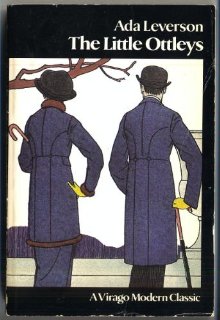
The Little Ottleys by Ada LeversonI am not a fan of Wilde, but Leverson’s trilogy, The Little Ottleys, is important not only for its Wildean entertainment:  Leverson obviously  influenced the comic voices of Angela Thirkell and Violet Trefusis.

In Love’s Shadow, the first novel in Leverson’s witty trilogy, the beautiful but practical heroine, Edith, works constantly to manage her profligate husband Bruce, a hypochondriac who skips work,  fritters away hours at amateur theatricals, and cannot be bothered to sit down and look at their finances.

We love Edith, but are frustrated and puzzled by her choice of husband.  How did this happen?

Much of Love’s Shadow revolves around another bad match, that between Edith’s beautiful, rich friend, Hyacinth Verney, and Cecil, a charming man in his thirties who is madly, miserably in unrequited love with an older woman who urges him to marry Hyacinth.

The story of Hyacinth and Cecil, though outwardly romantic, is chilling.  So this is what love comes to.  One can’t get the one one wants, and so….   Hyacinth loves Cecil, but he simply obeys Eugenia in attempting to love and then marrying Hyathinth.  Maybe Eugenia fixes everything by rejecting Cecil, but we doubt it.  Love has shadows and doubles wherever we look.

Equally chilling is Leverson’s portrayal of Edith, the amused, strangely unruffled wife and mother who expects very little and who mothers her husband almost as much as she does their hilarious son, Archie.  (And by the way, Mrs. Moreland’s loquacious son Tony in Angela Thirkell’s High Rising MUST be modeled on Archie.) Bruce doesn’t bother to hide his extreme admiration for Hyacinth from Edith, and even admits he can’t go see his mother because he has asked a woman from the amateur theatricals to lunch (but she turns him down).  None of this bothers Edith.  She is serene and gently humorous.

The novel ends with an odd little scene:  the Ottleys are cruising in a taxi looking for the house of the Mitchells who have invited them to dinner.  Bruce has forgotten the address.
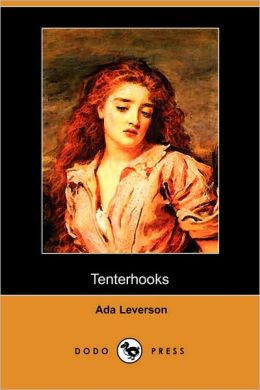
Tenterhooks by ada leversonAnd so that odd scene is their marriage.

In the second novel, Tenterhooks, Edith prefers the company of Aylmer Ross, a widower she meets at a dinner party.  We still don’t know why she married Bruce, though they’re still together.

In the case of Aylmer, a successful, hard-working barrister with a large income and extravagant tastes, we know  exactly how he got married, and how unimportant it was.

People had said how extraordinarily Aylmer must have been in love to have married that uninteresting girl, no-one in particular, not pretty and a little second-rate.  As a matter of fact the marriage had happened entirely by accident.  It had occurred through a misunderstanding during a game of consequences in a country house.”

This is perhaps a bit too-too, but it’s charming.  Marriage proposals are not always about champagne and rings in cupcakes.

Aylmer’s chivalry is unrealistic, but that’s Leverson’s deadpan comedy.  Such romantic gestures are taken in stride.

What will happen?  Edith and Aylmer see each other every day.  She buys a new dress to get his attention.  Or rather, her good friend buys it:  Edith doesn’t like to shop, and her friend doesn’t mind doing it for her.

Finally Aylmer and Edith kiss, but don’t have sex.  Then Aylmer takes off and rambles around Europe because he is so unhappy.  Edith misses him very much.

And even Bruce has a moment of jealousy.  When Edith won’t show him a letter, he physically takes it away from her.  It is not one of Aylmer’s, though:  it turns out to be an advertisement.

Will Edith and Aylmer get together?  I’m guessing not in this book.

But I still have the last book to read.

These books are a feather-light, charming entertainment for a rainy afternoon.

Mirabile Does Middlebrow: Ann Hood’s The Obituary Writer & Colette’s The Blue Lantern

Last year I read innumerable middlebrow novels, and especially enjoyed Nancy Hale’s Dear Beast, Laura Moriarty’s The Chaperone, and Mary McCarthy’s The Group.

Nancy Hale

Nancy Hale

This year it may seem that I’ve read mainly classics, or perhaps just Balzac, Balzac, and Balzac.  (Does my repetition of his name make it sound like a law firm?)

Yes, this has been the year of the classics.

But I continue to enjoy new middlebrow literary novels that may or may not last, and older books, sometimes out-of-print, other times reissued as rediscovered classics by optimistic publishers.  Often such books are written by women for women, because women after all, according to studies in the U.S. and Canada, make up 80% of the fiction readers.

Don’t we want to know what women are writing?  I mean, we’re reading it.  Aren’t we?

I have a recurring dream in which I own a writers’ retreat.  Actually it is an apartment house that resembles a motel, and it happens to be located behind my house. I am very anxious.   It is a lot of work.   Whom will I allow to stay?   It’s always a shock to walk in and find the apartment to the right of the biggest bathroom inhabited by a man I don’t know and don’t approve of.  (Is he even a writer?)   Yet if Jonathan Lethem or Ann Hood shows up in my dream, they’re serious writers so they get nice rooms; but if Tom Wolfe or Tina Brown come, they have to be sent elsewhere, because they’re  off doing journalism and socializing and won’t be around the rooms much anyway, see?   In my dream I’m the all-knowing landlady with rules like, “Lights out at 1 a.m.”  How’s that for sternness? That’s like saying, “Lights out, never.”  But the worst thing is trying to gather all the animals in every night.  You wouldn’t believe how many dogs, cats, and hamsters come to live at a writers’ retreat.

Ann Hood

Ann Hood

“Ballbody!”  “Muffy!”  Don Juan!”  “Cheri!”  If you can convince them you have food, they’ll come in.

It’s good to get out of the dream and talk about books again.

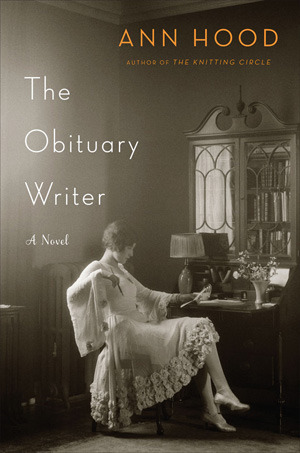
I have long been a fan of Ann Hood, and am two-thirds of the way through her new novel, The Obituary Writer.

the obituary writer by ann hoodIn alternating chapters Hood relates the stories of two women of different generations: Claire, a ’60s housewife, who dislikes her husband deeply and is pregnant with her lover’s child, regards John F. Kennedy’s inauguration as a symbol of hope; Evelyn, a teacher whose lover disappears in the San Francisco earthquake of 1906, becomes a traumatized, almost psychic writer of literary obituaries.  This thoughtful, nuanced book focuses on women’s emotions and sensibilities, and I can tell you right now, our husbands are never going to read this delicate novel about loss.  But Hood’s  crystal-clear prose has depth, and though this is unlikely to make the New York Times Notable Books list, it is perhaps her best book, and it is worth reading.

cha_colette

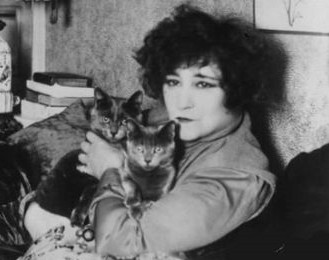
Colette

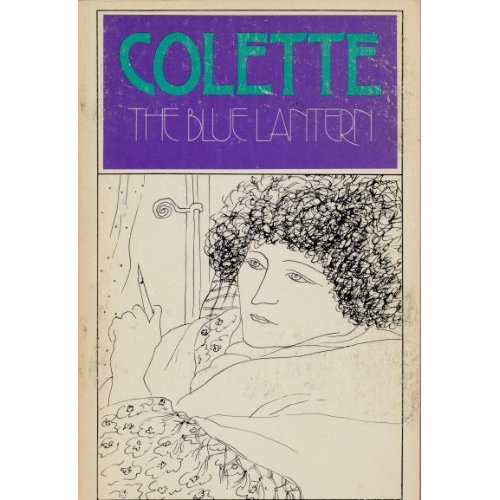
How I love Colette!  Her lush prose reads like poetry, and her laudations of nature are both subtle and sensual. But I admit I had put off reading The Blue Lantern, her journal and memoir about old age, because the subject naturally is one to be avoided.

Colette’s meditations in her seventies are just as sharp and astonishing as ever, even when she humorously admits to some faltering of her vision and hearing.  If she has to travel by car instead of on foot in her seventies, she makes the best of a different vantage point.

She writes of the frailty of aging:

More than once of late, turning my eyes from my book or my blue-tinted writing paper towards the superb quadrangle that I am privileged to view from my window, I have thought ‘The children in the Garden are not nearly so noisy this year,’ and a moment later found myself finding fault with the doorbell, the telephone, and the whole orchestral gamut of the radio for becoming progressively fainter.”

The Blue Lantern Colette She still visits vineyards and markets, still eats good food and drinks wine. She tells funny anecdotes about her famous friends, Jean Cocteau and Gide.  One day she is determined to copy a lovely rug in Cocteau’s country house at Milly.  She must have it!  But her friend Cocteau is abroad, Jean Marais is on a film location, and Paul of the Bookshop says he’ll go to Milly and charter an airplane.  Colette tells him to forget it.  The next thing she know,

…out of the blue Jean Marais sprang to life before my very eyes, tall enough to brush the ceiling with his orange–no, moonlight blue hair–no, auburn mop of hair!  And what in the world was he trailing behind him, slung from his shoulder?

The rug!  Colette’s friends will do anything for her.  They’re all so brilliant and funny.  Don’t you feel sad that you weren’t a brilliant actor/filmmaker/bookshop owner/writer who hung out with Colette?

She also quotes letters from fans, which amuse her, even when they ask outrageously that she write a preface to their “life work.”

Oh, Colette, we love your voice!

The Plague, Love’s Shadow, & Love Has No Pride

The 1971 version of Cousin Bette is great when you're sick.

The 1971 miniseries of Cousin Bette with Margaret Tyzack.

I’ve been shivering under blankets and comforters, wonder if I’ll be able to wash my hair tomorrow, can’t even drink tea, which I usually live on, and didn’t make weekend oatmeal muffins.

We  have one of those viruses that go around offices and then go around the family and then go away and then come back.   First stomach flu, then a cold, headaches, you name it.  We call it the plague.

I had intended to do some work today, even if it meant shivering in the living room, but I just didn’t feel well enough.

Nap.  Diet 7-Up.  Nap.  Diet 7-Up.

I watched the last episode of Cousin Bette, the brilliant 1971 miniseries with Margaret Tyzack and Helen Mirren.  It is slower, more detailed, and better-cast than the ’90s movie with beautiful Jessica Lange tarted-down slightly, but still breathtaking as unattractive Bette.  (It was a little like casting Winona Ryder as Jo in Little Women:  the audience laughs when Jo sells her hair and one of her sisters (Amy?)  says Jo’s hair was her one beauty.)

Diet 7-Up.  Suddenly I felt like reading a romantic novel.

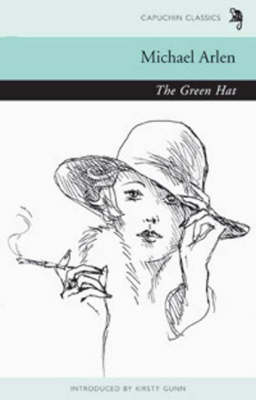
Green Hat by Michael ArlenIt’s not that I was in the mood for romance.  I just wanted to reread Michael Arlen’s romantic middlebrow novel, The Green Hat, a kind of 1920s mood piece where flappers and free love abound and a stylish woman can’t get it right.  The narrator, a writer, relates the tragic  story of Iris Storm, a beautiful, languorous woman who wears a green hat and drives “a long, low, yellow car which shone like a battle-chariot,” who lives unconventionally and takes love lightly, and with whom, of course, everyone is in love.

Then love turns heart-rending.

It’s a sad novel, but I was already crying because I couldn’t drink my tea, so what’s a little more sadness?

But I couldn’t find it.

What to read when you're sick.

What to read when you’re sick.

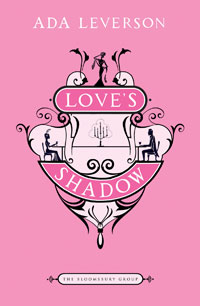
Finally I settled for Love’s Shadow, the first book in Ada Leverson’s The Little Ottleys, a trilogy so witty Leverson seems like a female Oscar Wilde.

And, in fact, Leverson was Wilde’s friend, and during his trial, he lived at her house in her son’s nursery.  She was also the first one to visit Wilde when he got out of prison.

I haven’t read much of this yet, but it is utterly charming.  The three novels in the trilogy are Love’s Shadow, Tenterhooks, and Love at Second Sight, all of which are available free at manybooks.net.  The paperback version of Love’s Shadow is available from Bloomsbury.

And then…

“It sounds like Delilah in here,” my husband said later.  (N.B.  Delilah is the host of a syndicated call-in and pop music radio show.)

Linda Ronstadt

Linda Ronstadt

I was listening to Bonnie Raitt and Linda Ronstadt and watching their videos on YouTube, and, indeed, they  probably are favorites of Delilah.

Do you know how many versions of “Love Has No Pride” there are on YouTube?  Linda Ronstadt’s and Bonnie Raitt’s are the best.

And the lyrics, by the way, have more depth than I realized.  When I was young, I used to spend hours listening to such music, but I don’t think I caught the fact that the narrator’s friends have walked out on her, too.  For me it was all about love.

But look at this first verse:

“I’ve had bad dreams too many times
To think that they don’t mean much anymore
Fine times have gone and left my sad home
Friends who once cared just walk out my door.”

Really startlingly sad, and the fourth line is a shock.  Because it’s not what we’re expecting:  her lover scorns her, but so do her friends.  And that loss also hurts, when friends give you up because you’ve made a bad choice, or they think you have.  (Has anyone ever refused to go to your wedding?  Probably.)  And”…just walk out my door” is brilliant.  You need the “just.”  It makes it sound pop and colloquial.  (That would be edited out in a writing class.)

Then there’s the repeated:

“And I’d give anything to see you again.”

Like many of us, I have regrets and would “give anything” to go back in time “and see you again,” and take that Aeschylus class…

There have been many emotional scenes in my life, as I’m sure there have been in yours, and this song captured my intense feelings in a way that The Green Hat and Love’s Shadow could not.

So below are two brilliant versions of “Love Has No Pride,” the first by Bonnie Raitt, the second by Linda Ronstadt.

http://www.youtube.com/watch?v=-I_X6BwvAEE

And here’s the Ronstadt:

Comments & Nuns: Where Did I Go Wrong?

It is easier to comment at The Guardian than at blogs hosted by Blogger.

I tried to comment on a blog about this book, but the commend didn't go through...

I tried to comment on a blog about this book, but the commend didn’t go through…

It takes about a minute to sign up at The Guardian and call yourself Ishmaella or something–and then you can write any foolish thing that comes into your mind.  Fortunately I only did that twice, and I can’t remember what I said.

Many of The Guardian’s articles are based on comments these days, so it’s a good thing they’ve made it easy.

Good though these comments may be, I prefer comments at blogs.

Comments on blogs seem friendlier and more supportive than comments at newspapers. Blogging is more homey, more like publishing a small-press book than like publishing a newspaper.  A small-press editor once told me that if a writer had a lot of friends, the book sold, and if he or she did not, the books just sat in a box.

If I apply this to bloggers, it makes sense.  There are some wonderful popular blogs with dozens of commenters, and then there are other wonderful unknown  blogs with few comments.  Bloggers tend to have more comments if they are active in Yahoo book groups or network with fellow bloggers  and “do” challenges. (But aren’t those challenges for very young readers?)

These days I limit my online social activities  to commenting occasionally at blogs.  Although one family member reads my blog, he doesn’t comment online.   He just likes to see what I’m reading, because I’m not supposed to be buying books.

Sometimes I want to comment at blogs, but find it impossible to type in the indecipherable code of letters and numbers that proves I’m not a bot.

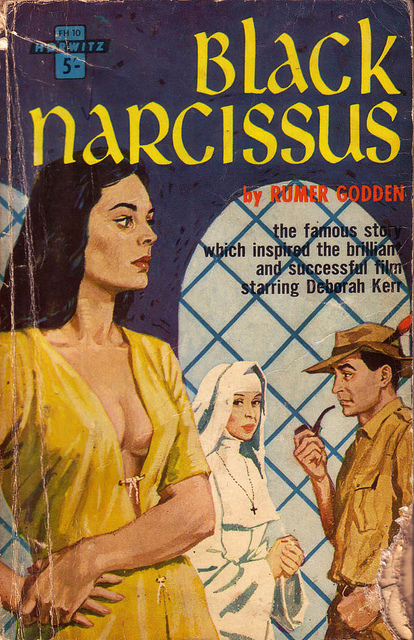
I recently tried twice to comment at Vintage Reads, because I loved a post on Rumer Godden’s Black Narcissus.  I’ve never read Black Narcissus, but when I first read Godden’s other nun book, In This House of Brede, as a teenager, I thought about becoming a nun.

You might actually have to go to church to do this, however.

I wandered around a beautiful Episcopalian church.  There was a courtyard.

I didn’t get around to going to any of the services.

I have known some very nice nuns and some very mean ones.  Overall, I wouldn’t like that line of work.

Back to commenting at blogs, whether they are about nuns or not:  If you want a spam-free environment, you often screen your comments.

Most of the commenters here are bloggers, and they are civil.  After I approve the first comment by a visitor,  he or she can comment regularly.

It is a little more difficult at Blogger, which I think is the most popular blog platform.  First you must sign in under a

Google Account
OpenID
Name/URL
Anonymous

And this is sometimes more difficult than it looks.

hieroglyphicsThen you need to type in a bunch of indecipherable hieroglyphics that I have to take off my glasses and squint at to see.

Do I get the letters and numbers right?    Sometimes it takes two or three tries.

But, if you haven’t seen me commenting lately, know that I REALLY LOVE YOUR BLOG.  Your blog  won’t let me comment.

Peter Stothard’s Spartacus Road

One of the best nonfiction books I read last year was Robert Dessaix’s Twilight of Love:  Travels with Turgenev, part biography of Turgenev, part memoir/travel book, and part literary criticisms.

Spartacus Road Peter StothardPeter Stothard’s Spartacus Road:  A Personal Journey through Ancient Italy is another unclassifiable volume of what I’ll call belles-lettres: part Roman history, part memoir/travel, part  analysis of literature pertaining to the history of the escaped slave Spartacus, part translations of Roman poetry and letters.

When Stothard, a classicist, the editor of the TLS, and former editor of The London Times, suffered from pain from an undiagnosed cancer, he often experienced what he called “pain pictures,” vivid memories of his own past and also of scenes he knew from his classical education.   He hallucinated, or saw pain pictures, of Spartacus’s battles with the Romans, when “Nero,” as he referred to his cancer, tortured him.

Scenes from a classical education came unwilled.  During some of Nero’s visits I had vivid views of this first fight in the Spartacus war, not those of a general watching high up on a nearby hill but those of a soldier seeing what was close before his eyes.  It was as though I had been at the centre of this and other slaughters, hour after hour after hour.”

After he recovered from his illness, Stothard remained psychologically traumatized.  He had survived a rare cancer but could not put the experience behind him.  And so he decided to travel the Spartacus Road, the route Spartacus and his slave army traveled when they escaped from the gladiator school near Capua.  This strange but brilliant book fuses his journalism with his knowledge of the classics.

The book is a history of Spartacus, but it is also an often humorous 21st-century travel diary in which he discusses the tourist industry and the people he meets.  He pores over maps with a Korean teacher and her doctor husband, meets a priest who insists that he talk about his father, and encounters a peripatetic gladiator-actor who cannot play his part due to odd union rules, and who thus has become the  manager of  a woman who poses as a statue-like Virgin Mary.

Stothard is equally fascinated by the lives and views of Roman poets and historians. He begins by writing about Symmachus, a little-known politician of the late Roman Empire who wrote letters, edited texts of Livy, and understood the disasters of slave wars.  Stothard also delves into the famous poetry of Statius, Horace, and Lucretius, the histories of Sallust and Plutarch, the letters of Pliny, Cicero’s scorn of  Spartacus, and the Epicurean philosophy recorded mainly in Lucretius’s beautiful hexameters..

Peter Stothard

Peter Stothard

As Stothard speculates about Spartacus, about whom little is known, he wonders what kind of man this leader of the gladiators was.  He might have been calm, he might have been vicious.

Stothard writes:

He may have found the thinking hard.  He may be one of those who had survived his fights with fellow men and animals in the Arena but not the feelings that followed afterwards.  Psychological trauma is not a discovery of modern analysis alone.  The Romans knew about it too.  Anyone selling a slave who had fought a lion or bear had to declare that contest in a contract.  Attempted suicides had to be declared, even escapes.”

And I cannot help but think that  journalists may  also be gladiators, with widely different codes, some being resisters and heroes, others merely ambitious or vengeful.

Stothard interweaves personal memories with his travels, some of them serious, some of them funny.  He remembers seeing the Stanley Kubrick movie, Spartacus, on the walls of the chemistry lab at school in the ’60s, and is pleased when he manages to buy it from a Polish DVD seller on the street.   (He especially likes Jean Simmons as Varina.)  And I found this very comical because, during one of my rare intervals of teaching Latin in the ’80s, I showed Spartacus  on the VCR before Christmas break.  Some things never change.

I was drawn to Spartacus Road because I, too, have a classical background, and it seems natural to turn to the classics in a crisis.  I am not a historian, but I am fascinated by the poets, by Cicero and Pliny, and during one horrifying illness, infected by a deadly bug bite which the doctors could  treat only by trial and error of different medications administered through IVs, I recited all the lines of Roman poetry I could remember, thinking they would control the pain.  Since I had memorized only lines I made my students memorize, there were fewer than I needed.

Stothard’s voice is brilliant, creative, and very strong–there is no hint of uncertainty or weakness in his voice.  But  as the book goes on, it becomes a better, more original, less journalistic, book, and he occasionally shows his vulnerability, though never for longer than a paragraph.

This stunning book deftly balances the historical significance of Spartacus’s rebellion with Stothard’s very private war against cancer and struggle to be well.

What a great book.  A great pleasure to read, and astonishing that I found it.

Mirabile Does Genre Fiction: Historical Novels, Science Fiction, &Jonathan Lethem’s Brilliant Amnesia Moon

Are you ready?

A quick blog.

7:45 p.m.

I love genre fiction.

librarian sexyIt all started when my friend, Maya, a former librarian who went back to school in classics, recommended Ursula K. Le Guin’s The Left Hand of Darkness. As a librarian, she had had a lot of free time, and science fiction was her favorite genre.

Classics departments teem with genre-loving ex-librarians, and library schools with genre-loving classicists who can’t find jobs.

And though the ex-librarians didn’t quite look like the woman in the picture, they certainly knew how to party:  on Diet Coke and popcorn, that is.

Classicists are a surprisingly unclassical lot when it comes to English literature.  You would expect them to read nothing but Sophocles and Anne Carson out of the classroom.  Instead, they recommended historical novels like Susan Howatch’s The Rich Are Different, the story of a banking family, and all the characters based on Caesar and the First Triumvirate, if I remember correctly?  which complemented our studies.

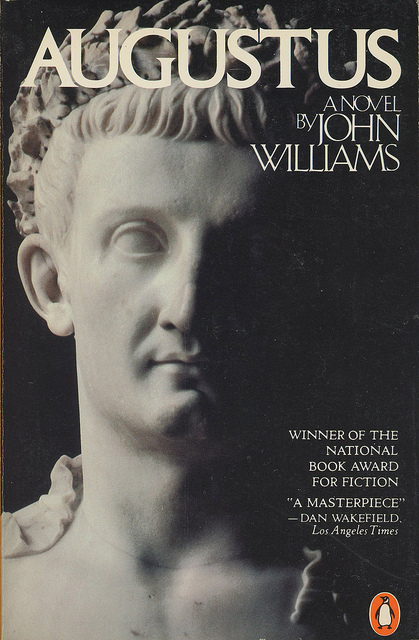
Augustus John WilliamsA better bet was John Williams’ Augustus, the National Book Award–winning historical novel by the writer now best known for Stoner, reissued by NYRB a few years ago.  But Augustus is just as brilliant, the story of Augustus’ bid for power after Julius Caesar’s murder and his dealings with the likes of Cicero and Mark Antony, some of our favorite historical characters.

Shambleau c. l. mooreThe most notable of all my classicial friends were the professors who were SF fans.  After I earned my degree, I became fair “prey” to the profs, who only had about seven women students a year, so I looked good, surprisingly good.  They were a decent lot, if clueless, with their offers of vacations in, of all places, New Jersey (they would have had a better chance with Rome, but I declined all invitations:  they were my friends and father figures).  One of them, by far the most brilliant, introduced me to the science fiction of C. L. Moore, Joanna Russ, and some other great American writers. And, by the way, the Library of America should have hired him to edit one of their science fiction books, because he could have recommended a few books by women, and we know that’s not LOA’s strong point.  (By the way, I am a big supporter of LOA, but they need to publish more interesting women’s books.)

***********************************************************************

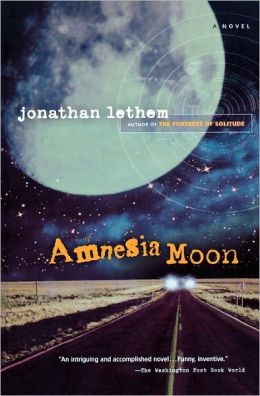
Amnesia Moon Jonathan LethemAnd now just a little bit about Jonathan Lethem, one of my favorite American literary writers, the author of Chronic City (my favorite), The Fortress of Solitude (my second favorite), and the National Critics Circle Award-winning Motherless Brooklyn (my third favorite).  I am now exploring his  1990s work, which was science fiction.

Amnesia Moon, his second novel, is surreal, funny, and sad.  Is the hero, Chaos, a survivor of a postapocalyptic world, dreaming his world, or his world real?

Chaos lives in a former cineplex in Hatfork, Wyoming.  He tries not to sleep, because he and the other residents all dream the dreams of the local despot Kellogg.  Kellogg is in charge of everything:  dreams, history, and the funky canned food he sometimes distributes.  Nobody can remember what was there before the apocalypse.

When Chaos decides to take a trip to get away from Kellogg, Melinda, a furry mutant teenage girl,  happens to be in the car.  They take off for Colorado, where they find a world of green fog, dreamed by another dreamer.  And in Vacaville, California, where their car breaks down, they find a city based on luck tests and moving twice a week to houses assigned by the government.

In Vacaville he tells Edie, with whom he falls in love, that there was a war. “Everyone remembers some kind of disaster.  But it’s different in different places.”

Then a hippie friend says Chaos needs to go back to San Francisco to see his best friend and girlfriend.  Chaos remembers little about them, but wants to know his past.  And when he starts dreaming everybody’s dreams–well, you can imagine.  San Francisco is by far the scariest place in the book.

When I read Lethem, I always wonder how he comes up with such strange plots.  His style is astonishing.  You really read him for his style.

A great book, not just great SF.

How to Plant a Tree

Our maple tree.

The stump of our maple tree.

We have an enormous back yard.

That’s one thing we like about the neighborhood:  the big yards.

The branches of a huge maple tree used to stretch the width of the back yard and make an umbrella of shade.

We sat on lawn chairs under the tree.  We ate hamburgers from the grill and Hy-Vee potato salad under the tree.  I read Angela Thirkell and Anna Karenina in our Adirondack chair (which splintered next winter when we left it outside) under the tree.

Last spring our tree was wounded.

A thunderstorm boomed and cracked.  A limb was torn off by the wind and fell across the neighbor’s driveway, extending from the garage to the street.

We called the tree service and they removed the branch the next day.

They looked at our tree.  “It will have to come down.”

I wondered, “Couldn’t we just prop it up or something?”

You see, we have had storm problems before.  A few days after we moved in, a storm tore the neighbor’s tree in half and brought it down on our roof and across our driveway.

We had to be calm.

But where was our luck?

Trees were down all over the city.  There was no power.

The power was out, the roof and garage roof were damaged, and I couldn’t cope.  The stove was electric:  I needed coffee. I rushed down the street to Friedrich’s, because their generator was working.  We live in urban neighborhoods so we can rush to urban coffeehouses in emergencies.

On the way home, carrying a Super-Grande coffee (or something), I chatted to neighbors.  Ours is a quiet neighborhood, and nobody sits on his or her front porch much.

But that day we were all outside, though some of these neighbors haven’t been seen in their yards since.  “Hi, I’m Kat.  A tree  fell on our house.”

“Oh, you live in the cottage,” one man from a Big House said.

Cottage?

“Trees fall down,” one serious man said.

“Yeah, but…like this?”

Huge branches and trees were down all over the neighborhood.

We waited till January to have our maple cut down.

St. Patrick's, 2006

St. Patrick’s after the tornado, 2006

This is the way we live now.  Storms and power outages. FEMA is here every time we turn around.   A tornado destroyed St. Pat’s church in my hometown, the church my mother attended her whole life.  When it was rebuilt, it was too far out of town for my mother to drive.  She had to make do with taking taxis to St. Wence and St. Mary’s.

And so you cope.  It’s a tree. I can plant a tree.

And now it’s spring.  There is no shade in our back yard.

It is upsetting.

So we’re going to plant a tree.

But just try the internet for information. Here’s what I’ve found out from the agricultural extension service.

There is a lot of information about rootballs and site preparation.  There is also a long list of trees, without illustrations, and a chart telling us life span, growth rate, etc.

Do you know these trees?

nannyberry tree

nannyberry tree

Hophornbeam
Black Maple
Bur Oak
Chinkapin Oak
Northern Pin Oak
Red Oak
Shingle Oak
Swamp White Oak
White Oak
Basswood/Linden
Cockspur Hawthorn
Downy Serviceberry
Hackberry
Kentucky Coffeetree
Nannyberry
Pagoda Dogwood
Shagbark Hickory
Witchhazel

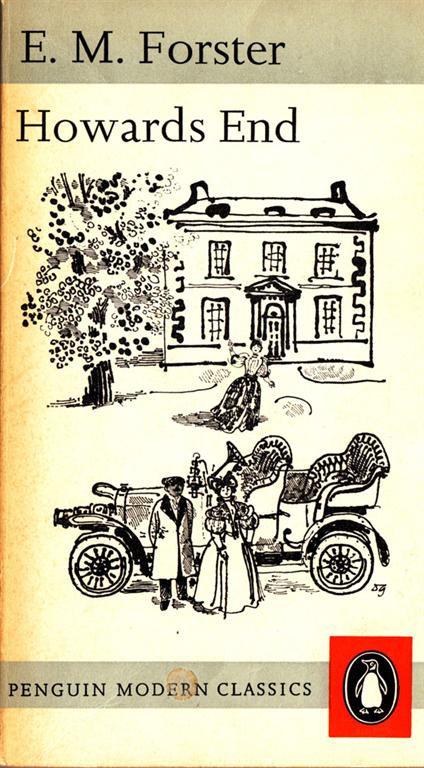
Howards EndYou know the tree I would really like?  The wych-elm tree in Howards End.

You would think a tree would last forever.

What do you bet our air conditioning bill is going to go up?

Did you ever use the book Treefinder on a hike?  That was pretty useless.

Have you got any hints about trees?

Here are some lines about trees from  J. B. Greenough’s 1900 translation of Virgil’s Georgics.

Apples, moreover, soon as first they feel
Their stems wax lusty, and have found their strength,
To heaven climb swiftly, self-impelled, nor crave
Our succour. All the grove meanwhile no less
With fruit is swelling, and the wild haunts of birds
Blush with their blood-red berries. Cytisus
Is good to browse on, the tall forest yields
Pine-torches, and the nightly fires are fed
And shoot forth radiance. And shall men be loath
To plant, nor lavish of their pains? Why trace
Things mightier? Willows even and lowly brooms
To cattle their green leaves, to shepherds shade,
Fences for crops, and food for honey yield.
And blithe it is Cytorus to behold
Waving with box, Narycian groves of pitch;
Oh! blithe the sight of fields beholden not
To rake or man’s endeavour! the barren woods
That crown the scalp of Caucasus, even these,
Which furious blasts for ever rive and rend,
Yield various wealth, pine-logs that serve for ships,
Cedar and cypress for the homes of men;
Hence, too, the farmers shave their wheel-spokes, hence
Drums for their wains, and curved boat-keels fit;
Willows bear twigs enow, the elm-tree leaves,
Myrtle stout spear-shafts, war-tried cornel too;
Yews into Ituraean bows are bent:
Nor do smooth lindens or lathe-polished box
Shrink from man’s shaping and keen-furrowing steel;
Light alder floats upon the boiling flood
Sped down the Padus, and bees house their swarms
In rotten holm-oak’s hollow bark and bole.
What of like praise can Bacchus’ gifts afford?
Nay, Bacchus even to crime hath prompted, he
The wine-infuriate Centaurs quelled with death,
Rhoetus and Pholus, and with mighty bowl
Hylaeus threatening high the Lapithae.

Winner of Benediction Giveaway

The winner of Kent Haruf’s Benediction is Arun!

Send me your address at mirabiledictu.org@gmail.com

I’ll put the book in the mail and I hope you enjoy it.

Giveaway: Kent Haruf’s Benediction

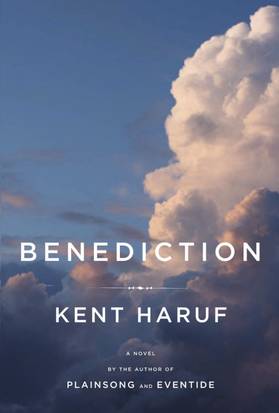
Benediction by Kent HarufI am giving away my copy of Kent Haruf’s Benediction (see review here). Set in a small town in Colorado, this deceptively simple novel, which reminds me of the novels of Willa Cather, is the story of Dad Lewis, who is dying of cancer, his devoted wife and daughter, and friends and neighbors who help out and make the last summer bearable.

I very much enjoyed this, and would be happy to pass it on to someone.

Leave a comment if you’d like it.

And if no one wants it, I’ll give it to the charity sale!

In Which I Read Contemporary Fiction & Finish Kent Haruf’s Benediction

Mirable Attempts Contemporary Fiction.

Mirable Attempts Contemporary Fiction.

I’ve been reading the classics lately.

Balzac and Bronte.  Lost Illusions and Villette.

I’ve written long, long posts.

Although there are a few, very few, outstanding contemporary American writers, I’ve struck out with almost everything lately.  I can’t even tell you how many cats died in the first hundred pages of Antonya Nelson’s Some Fun, a collection of short stories and a novella.

Back to Blood by Tom WolfeI started reading Tom Wolfe’s Back to Blood.  His verbal pyrotechnics dazzle, and it’s a very entertaining novel.  Set in Miami, it interweaves the stories of several colorful characters, including Edward T. Topping IV, a new editor of The Miami Herald who is reeling from Cuban-American hate mail; Nestor, a Cuban-American marine patrol officer who alienates the Cuban community after he rescues an illegal immigrant and hands him over to the Coast Guard; and Magdalena, a beautiful Cuban-American psychiatric nurse.

Some love Wolfe.  I always find him a little draining.  This 704-page novel  reads like an exceptionally vivid, long piece of new journalism. Lots of ellipses…lots of noises like Smack,  Beep, and  Click!

By the way, in the first chapter, the editor and his wife are going to Balzac’s, “the coolest of hot spots.”  Since I’ve been reading a lot of Balzac, do you think I’m meant to read this book?

If you like it, you like it.  It’s good bedtime reading.  I’m reading it in 60-page increments.  I’ll post on it when I’m finished.

Benediction by Kent HarufI finished Kent Haruf’s Benediction.  It is a simple novel, very well-written, set in a small town in Colorado, mainly the story of a hardware store owner who is dying of cancer and his family.

Dad Lewis has only a few months to live.  His  devoted wife Mary is caring for him alone, but it becomes too much for her:  she ends up in the hospital with exhaustion.

She explains on the phone to Dad,

I don’t have any pep.  That’s all.

When she comes home three days later, she calls her daughter, Lorraine, for help.

The dialogue is brilliant.  Simple one-liners mostly.  When Lorraine arrives:

Oh, Daddy.

Yeah.  Ain’t it the goddamn hell.

She took his hand and held it.  Are you in a lot of pain?

No, not now.

You don’t have any pain?

I’m taking things for it.  Otherwise I would.  I was before.  Well, you look good, he said.

Although when it comes down to it, I don’t know anyone in small towns who talks like this, the dialogue is convincing and pitch-perfect in a novel.  It could be adapted for a play.

Other characters include Berta May, their next-door neighbor, and her granddaughter, Alice, who has come to live with her because her mother has died of cancer; the new pastor, Lyle, who alienates his parish by speaking against the war in Iraq; and Willa Johnson and her daughter, Alene, two church members who visit and become like members of the family.  Alene, an unmarried, retired third-grade teacher, and Lorraine, whose daughter died, both befriend the child, Alice, because childlessness is the most heartbreaking lack in their lives.

This novel reads very, very fast.

Dad’s illness is sad and very realistically described.  Eventually he has to wear diapers and his wife and daughter clean him up.  He starts hallucinating: he believes he is having a conversation with his gay son, who ran away years ago.

My online book group on AOL read Haruf’s novel Plainsong, which, as I recall, was a big hit in the ’90s.  The characters from Plainsong are mentioned in Benediction.

I imagine Haruf’s other books are set in this part of the country, too, but I haven’t read them.

I don’t have much to say about Benediction, but it is very good.  One of those award-worthy books, but perhaps too straightforward to be remembered.