Mr. Rochester, Knightley, or Graham Bretton?

Knightley 2009

Johnny Lee Miller as Knightly in the 2009 version of Emma.

Do you read and reread Diana Gabaldon’s Outlander series because you’re in love with  Jamie?  Do you try to persuade booksellers to sell the latest Gabaldon before the publication date, as a friend of mine did?

Forget it.  You are never going to meet Jamie, because you would have to time-travel in Scotland.  And you are never going to persuade the booksellers to sell the book early.

I have read only one and a half of the Outlander books, but found them considerably more erotic (and healthier) than 50 Shades of Grey.

If you’re still in love with Jamie, you can fall in love with a romantic hero in a classic. Jane Austen and Charlotte Bronte created some of the most attractive romantic heroes in 19th-century fiction.
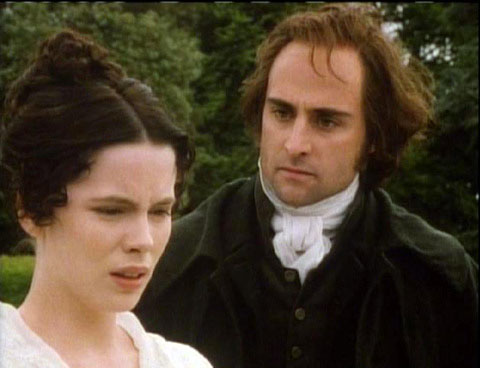
Kate Beckinsale as Emma and Mark Strong as Knightley (BBC 1996)

Kate Beckinsale as Emma and Mark Strong as Knightley (BBC 1996)

It is not that they wrote romantic fiction:  far from it. We all know Austen’s comedies about marriage and class, and Bronte’s Gothic novels.

In Austen’s Emma,  Knightley, a handsome, rich, bossy man, bullies Emma about her match-making and impetuous friendships, but on the other hand is kind, sensible, and sociable.  When Emma’s friend Harriet considers marrying Knightley, Emma is appalled. If you try to marry “up,” you’re done for.

In Jane Eyre, Charlotte Bronte  created Mr. Rochester, one of the sexiest men in literary history.  He falls in love with Jane, a  passionate governess, but  secretly has a mad wife in the attic.  Oho!  The old routine, “I have a wife in the mental hospital:  don’t you feel sorry for me?”  Only Mr. Rochester doesn’t tell Jane about Bertha.  He waits till someone objects to their marriage at the altar.

Let's marry Mr. Rochester (William Hurt) and get it over with!

Let’s marry Mr. Rochester (William Hurt) and get it over with!

In Villette, Lucy Snowe falls in love with John Graham Bretton, a witty, attractive, above average, though, alas, red-haired doctor who, alas, loves the pretty more than the brainy, but at least he is normal:  unlikely to spring a mad wife on you!  There are no mad wives, but there are nun-ghosts.
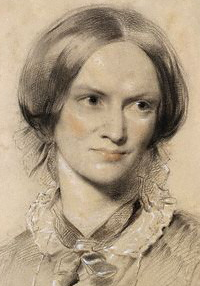
Charlotte Bronte

Charlotte Bronte

In a way, it’s a pity that the normal John Graham Bretton seems more fitting at my age, because Villette hasn’t even inspired a movie. Yet  Graham (or Dr. John, as he is sometimes called)  is reliable, smart, and likable.

But which hero is most suitable for you?  I have devised a four-question quiz to show you with whom you are most compatible.

And now for the Quiz:

1.  Which  remark would make you breathless?

A)  “I never met your likeness… you please me, and you master me–you seem to submit, and I like the sense of pliancy you impart.”

B)   “Invite him to dinner…and help him to the best of the chicken and fish, but leave him to chuse his own wife.”

C)  “Here are some flowers.”

2.  Do you prefer men who see through society women’s charms, or men who cannot?  (It probably depends on the kind of woman you are.)

A) “You should have seen her whenever I have laid on her lap some trifle; so cool, so unmoved, no eagerness to take, not even pleasure in contemplating.  Just from amiable reluctance to grieve me, she would permit the bouquet…”

B)  “My dear ___, do you think you perfectly understand the degree of acquaintance between the gentleman and lady we have been speaking of?”

C) “She’s a rare one, is she not?…A strapper, a real strapper:  big, brown, and buxom; with hair such as the ladies of Carthage must have had.”

3.  You find it romantic when:

A) You receive a long, chatty letter.

B) A man has been unable to find his ideal of women among English ladies, French countesses–but now there’s you.

C)  A hyper-critical man says you will always be his dearest.

4.  You want:

A)  to be needed.

B) to win the love of a worthy man.

C) to marry the most handsome, smartest, kindest, and most influential man in the neighborhood.

5.  You think of yourself as:

A) beautiful, brilliant, and well-loved.

B) plain and brilliant, with good friends.

C)  plain, brilliant, and friendless.

All right!  are you ready for the results?  You are simply going to have to figure out which character gets the highest percentage of your answers–or write in Jamie!

Answers:

1.  A, Mr. Rochester.  B, Knightley.  C, Graham

2.  A, Graham.  B, Knightley.  C, Mr. Rochester.

3.  A, Graham.  B, Mr. Rochester.  C, Knightley

4.  A, Jane Eyre-Rochester.  B, Lucy-Graham.  C, Emma-Knightley.

5.  A, Emma, B, Lucy, C, Jane

Okay,  two for Emma and Knightley, one for Jane and Rochester, and two for Lucy and Graham, so it looks like either Knightley or Graham Bretton will do for me!

I am Emma-Lucy!
Triangular Relationships in Charlotte Bronte’s Villette

Villette in the Mirror

Villette in the Mirror

I have read Charlotte Bronte’s Villette many times.

I am rereading it now.

To a woman of a certain age, Bronte’s Villette, an unflinching report of solitude and isolation, is more interesting than Jane Eyre.  By the time one is thirty, Mr. Rochester no longer appears romantic, and we frankly think Jane would have been better off with St. John.

We’re sorry that the heroine of Villette, Lucy Snowe, ends up with whom she does, but nonetheless we adore the book.

Here is my Villette chart.  I read it at:

Age 14:  Thought it odd.  Perhaps I would end up like Lucy Snowe.  My aunt seemed to think so…  She stressed education over romance.

Age 24:  Despite the fact that I had been married and was engaged once more, I  felt like Lucy Snowe.  I was teaching and perhaps in love with Dr. John Graham Bretton.

Age 37:  I was teaching again and rereading Villette.

Age 44: No longer thought I was Lucy Snowe, but loved the book.

Age __:  This bold novel is much tougher and yet more nuanced than Jane Eyre, and feminist readers and Bronte fans should give it another chance.

villette-charlotte-bronte-paperback-cover-artThroughout Villette, Lucy Snowe, the solitary narrator, is the invisible woman in triangular relationships.  Attachments become triangulated without her realizing it, and the men certainly do not realize it, but whenever she has a friendship with a man, there is another woman in the foreground.

When we first meet Lucy, she seems cold.   There is something almost voyeuristic about Lucy’s cold scrutiny of her godmother Mrs. Bretton’s household, though she loves her godmother.  As a teenage girl, Lucy has no interest in Graham Bretton, the handsome, lively teenage son.   But in minute detail Lucy describes Graham’s friendship with Polly, a small child who becomes passionately fond of Graham when she stays with the Brettons’ during her father’s illness. Graham teases her and behaves like an older brother, while Polly is like a tiny woman.  Lucy cannot understand the magnitude of the child’s attachment.

Lucy is shadowy.  She tells us very little about her family, and there is a Gothic mystery about her intense solitude and taciturnity.

We wonder who this woman is, who in later chapters is thrown on the world without money, and who eventually ends up a teacher at Madame Beck’s school in Villette (an imaginary city like Brussels, where Bronte taught) and meets Graham Bretton (now called Dr. John) again.

villette-charlotte-bronte-hardcover-cover-art Two people have an enormous influence on Lucy’s position  in Villette.  Ginevra, a beautiful, giddy, merciless, heartless student, whom Lucy first meets on the boat from England, tells her about the school.  She mentions that Madame Beck, the headmistress, needs a nurse for her children. Lucy ends up teaching there coincidentally, and she also coincidentally meets John, whom she does not recognize, and who helps her with the language when she needs to inquire about her luggage.

We learn that he is in love with Ginevra.

Lucy and Ginevra have a borderline-lesbian relationship.  Lucy has nothing good to say about Ginevra, and yet when both are in a school play,  Lucy, who plays a man, does her best to flirt and out-woo the other man for Ginevra.  It is partly because John is in the audience (she does not yet know he loves Ginevra) and she wants to shine, but Lucy also favors Ginevra at breakfast by trading bread for coffee, and likes her company, despite her dislike of the girl.

Lucy falls in love with John, though he does not realize it. The triangle does not affect him, because he does not know Lucy cares.   She realizes she is likely to be single all her life.  She is intelligent but not pretty or charming.

Reason tells her not to hope after she returns from a visit to the Brettons and John promises to write to her.

Lucy thinks he won’t and tells us:

This hag, this Reason, would not let me look up, or smile, or hope:  she could not rest unless I were altogether crushed, cowed, broken-in, and broken-down.  According to her, I was born only to work for a piece of bread, to await the pangs of death, and steadily through all life to respond.  Reason might be right; yet no wonder we are glad at times to defy her, to rush from under her rod and give a truant hour to Imagination–her soft, bright foe, our sweet Help, our divine Hope.  We shall and must break bounds at intervals, despite the terrible revenge that awaits our return.”

Lucy’s hopelessness is harsh, because aren’t we all madly in love in our twenties and secretly believe ourselves irresistible?  But this is Charlotte Bronte talking, and we never doubt her, because Lucy’s style is both meticulously restrained and passionate.  Lucy is a fiery woman stuck in the drudgery of teaching unintelligent girls English.

There are other triangular relationships, including Madame Beck’s rivalry for John with Ginevra, but she soon realizes it won’t work.  She is middle-aged; John is in his mid-twenties. There is another triangular relationship when  John falls for Polly, who is now a woman:  Lucy is unnoticed.  Later, Lucy and Madame Beck are earnest rivals for M. Paul.  And Lucy is visible when the man is ordinary, plain, and intelligent.

A very complicated book!