
In “Parks and Recreation,” a man chains himself to a pipe in Leslie’s office. After he lends “Twilight” to Tom, they (with Donna) form an impromptu book group.
BOOK GROUPS. My cousin the librarian and I sit in the back yard.
We had Creamsicles for lunch.
She would prefer one of my tomatoes-on-pasta dishes.
I wasn’t up for it.
She is supposed to be in an office (with the cataloguers) reading Michael Chabon’s Telegraph Avenue. She is reading it on her iPad here.
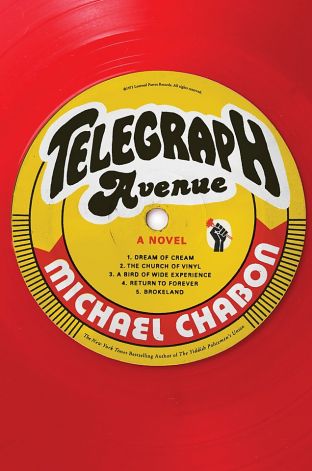 She found out at 9 a.m. that she must substitute for the woman who leads the book group tonight.
She doesn’t have time to read the book.
It was my favorite book last year, but it is long.
“You could lead it,” she says.
I read it last December and don’t have time to prepare.
“But you could come to the group with me!”
I know that they would love it. It would be very cute. The librarian and her cousin! She could be charming and chat (she is charming and loquacious) and I could do all the work.
I am actually feeling sick today.
So, instead, I am researching Chabon for her and taking notes on reviews of Telegraph Avenue.
“What page are you on?” I ask.
“50. Can I have another Creamsicle?”
So here’s my plan for the book group (and God help me, I might have to go along, though I’m unwell):
- Offer everyone Darjeeling tea (which I will provide for her in a big thermos, because I have much Darjeeling).
- Briefly introduce the book and summarize a couple of reviews. (I will write the introduction.)
- Show pictures of Michael Chabon on the iPad. Pass it around. According to Wikipedia, he turned down an opportunity to be named one of People’s 50 Most Beautiful People after The Mysteries of Pittsburgh was published. He is indeed good-looking.
- Mention his wife, who is also a writer, Ayelet Waldman.
That will take 10 minutes, what with the chat of the group members.
Then:
- Explain that your style of leading a book group is to remain neutral. You will ask questions and they will answer.
- Read questions from the back of paperback.
Tada! What could be easier?
100 Best Novels. In 2003, Robert McCrum of The Observer made a list of The Greatest Novels of All Time. It is still popular, he says. Now he is making another list, only with novels in English, in collaboration with The Guardian. One book will be introduced at a time over 100 weeks.
He is starting with Pilgrim’s Progress, which Meg, Jo, Amy, and Beth in Little Women liked. (I couldn’t care less about it, though.)
But I very much like his selection of Jane Austen: Emma, my favorite book.
He writes:
Inevitably, this list reflects educational, national and social influences. Some Scottish readers may say that we have not given enough space to the great northern tradition.Irish readers will argue about Flann O’Brien (aka Myles na gCopaleen). In or out? Wait and see. Further afield, in the English-speaking world,some Australian readers may feel short-changed. All we can say in response is that this list was compiled for a British newspaper, based in London, in 2013.
There will be debate.
Goodreads’ New Standards for Posts. I have joined a group at Goodreads, which is good for discussions (though I haven’t had time). One problem: first-time authors leave posts promoting their books rather than chatting about the assigned book.
As far as I know, Goodreads does not delete these posts.
Kara Erickson, Director of Customer Care, announced that they will delete reviews about author behavior at readings or elsewhere.
We have had a policy of removing reviews that were created primarily to talk about author behavior from the community book page. Once removed, these reviews would remain on the member’s profile. Starting today, we will now delete these entirely from the site. We will also delete shelves and lists of books on Goodreads that are focused on author behavior.
Is this censorship?
I once helped run a book group at Book Central (now defunct) on AOL. It was a wonderful place to post about books, but we deleted attacks on fellow members (usually from strangers), racial slurs, gender slurs, and general hate talk.
I don’t remember deleting posts about authors, though some were negative.
Should such posts be deleted?
What do you think?
Yahoo Groups changes. At Under the Sign of Sylvia 2, Ellen Moody has posted a fascinating piece, “The Debasement of Yahoo Groups.”
 mirabile dictu
I have been in several book groups, some live and some on line. Even the best groups seem to decay over time, and I’m not sure why. Sometimes the original members develop other interests, or perhaps we become too familiar with each other’s opinions.
Although I want free speech (especially for myself), if you comment at my blog you are in my space and I “trash” comments that go over the line . Sometimes they are promoting something unrelated like auto parts. Others seem to be asking for attention. A recent commentator described a book on which I had posted as “literary diarrhea.” No examples, no supporting statements — just name calling. I flushed that comment to the appropriate place.
LikeLike
I know what you mean about book groups. The leader can make a big difference, but people do move on. (I’m hoping everything works out for my cousin. I taught for years, so I do know how to put something together on short notice, but when you haven’t read the book…)
Many of the good Yahoo groups I’ve belonged to have become moribund, so I sense something new is happening on the internet.
I, too, delete negative comments here: I do stay “under the radar,” and though I am sometimes very critical here, I write only positive comments at blogs.
Goodreads is a big organization, and I can see why they wouldn’t want to keep unnecessary bitching at their site.
They can always start a blog!:)
LikeLike
Interesting! My only book groups are virtual ones on LibraryThing, but your strategy sounds good. If you went, I hope you survived.
As for Goodreads – what do they mean by author behaviour? I would have thought that if you, say, go to an author’s reading and think they’re either a good or bad reader, couldn’t you say so? However, we mustn’t forget that GoodReads are now part of the Big A, so maybe they don’t want to offend any authors!
The Yahoo post is interesting too. I only just realised recently that there were commercials on my WordPress blog which is vaguely alarming especially as I don’t see them – hopefully people will ignore them. I guess unless we can afford to buy our own webspace this is going to be something we have to bear… :s
LikeLike
After reading all these novels over the years, I find it sad that I haven’t read the novel McCrum considers the greatest of all time, ‘Pilgrim’s Progress’. I suppose the typical American reaction is that ‘Pilgrim’s Progress’ is just some dull Puritan thing. I may have to give it a read. to see if it is any good. My candidate for best novel in English would be either Ulyses or At Swim-Two-Birds.
LikeLike
Karen, I know: this is the problem. You can critique readings! But I don’t know quite what they’re talking about because I haven’t spent enough time there.
Yes, you can pay not to have ads at WordPress ($30 a year). But since my old blog is moribund, I’m not paying there. That means that whoever goes there will have to look at ads for stuff.
That’s just how it is at WordPress, and we all understand it. We’ll ignore those ads, Karen!
LikeLike
Tony, he’s going in chronological order, so thank goodness Pilgrim’s Progress isn’t necessarily Number 1. Yes, it probably is worth reading, but when am I going to get around to a book where Christian puts pebbles in his shoes? (I know about this book from Little Women. At least I THINK he puts pebbles in his shoes: it’s been a while.)
All right, I don’t know At-Swim-Two-Birds, either. My top book would be Daniel Deronda or Villette.
LikeLike
Three novels in English tie for first place: Middlemarch, Bleak House, Huckleberry Finn.
I did read Pilgrim’s Progress years ago as a conscientious student. It didn’t do much for me.
LikeLike
Oh, I love those three books, Nancy! Obviously any of my favorite books will do. I love so many!
Yes, Pilgrim’s Progress is not on my list.
LikeLike