What to Read on a Plane, or Which Pocket?

IMG_2772

Which pocket?

I don’t travel much, but when I do I travel light.

So after I packed a couple of turtlenecks and a cozy sweatshirt/pajamas ensemble that I WOULD wear down to the hotel lobby when I couldn’t get the WiFi to work, I decided what to read on the plane.

The Nook was probably all I needed.

But what if the Nook broke?

“Maybe I should take this book?  Or that book?”  I asked my husband.

He didn’t know what I would like to read on the plane.

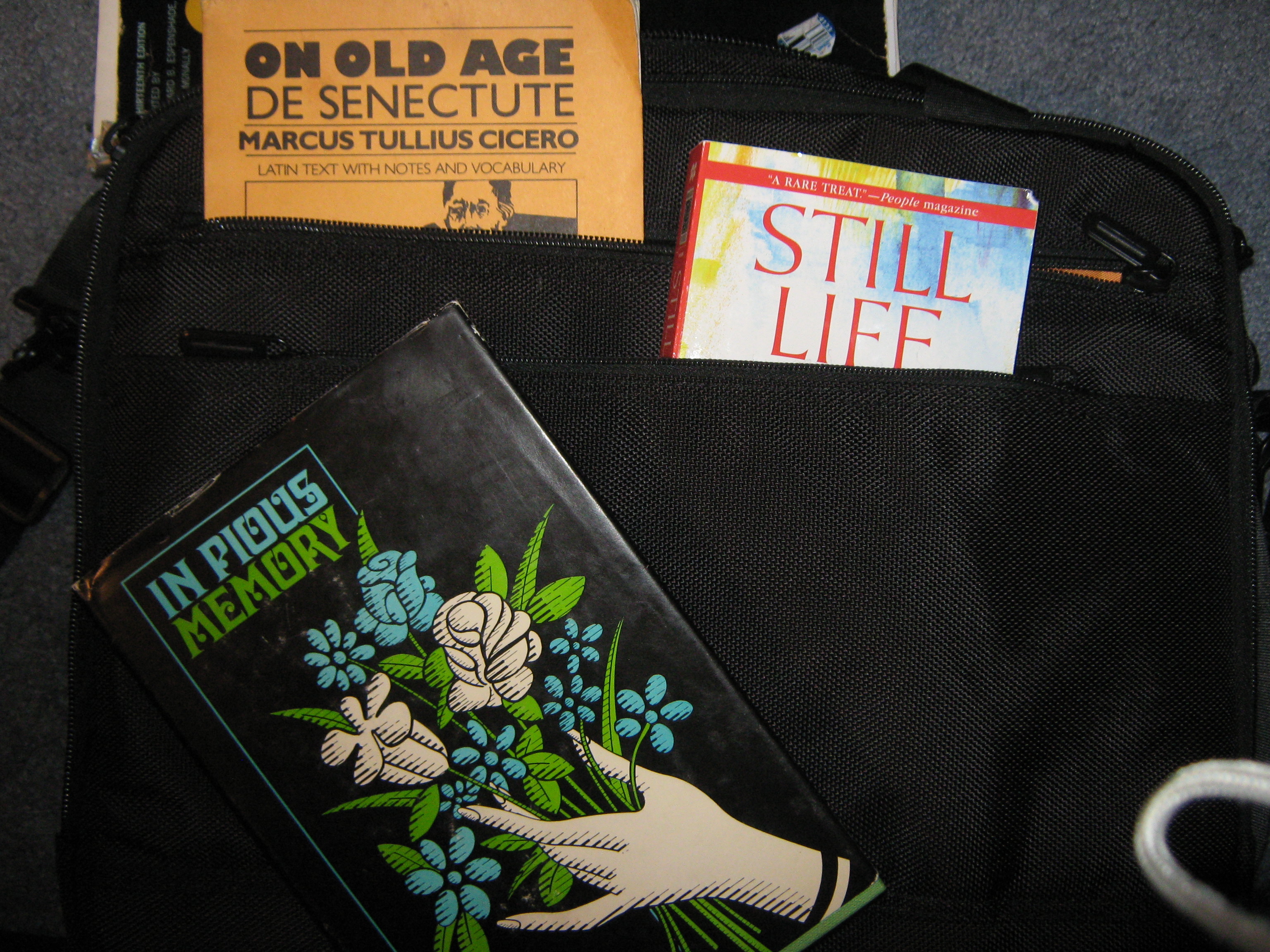
I have a big bag with many pockets.  I finally packed a mystery by Canadian writer Louise Penny, Still Life.

And I packed a Dorothy Sayers.

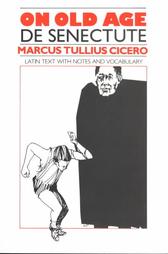
And I brought Cicero’s De Senectute (About Old Age), a Latin text with vocabulary and notes, because I know from experience that if pills (my first choice) fail Cicero WILL put me to sleep.

What I didn’t count on was reading Cicero on the plane.

Here’s what happened.

I was very bookish for four hours when a plane was delayed.

Then I got on two planes and read through the short flights.

four-gated-city-doris-lessing-paperback-cover-art

What I read on my Nook.

In Washington, D.C.,  I was busy with my friend Ellen going to the Kennedy Center, the Folger Theater, and the National Gallery.  At night I blogged and read Doris Lessing’s The Four-Gated City on my Nook.

But on the way home I suddenly needed a mystery.

I needed it because I didn’t want to talk to my seatmate.

Do you have “grandkids?” This woman did.  If you do, please SHUT UP about it on the plane.  We’re bored, we’re Zero Population Growth, and we can tell from the sound of your voice that you’re bored, too.

Looking at the woman, who was probably my age, I thought, Oh no, TELL me you didn’t spend your vacation babysitting.

You’re in the prime of life.

For God’s sake, just go to Washington, D.C., New York,  or even Anchorage, Alaska.

No, she had flown to a faraway city so she could babysit for her children so they could go somewhere.

She sounded desperate. And so sad.

She might have been my friend under other circumstances.

But I was really tired.

And so I refrained from chat.

I reached for my mystery.

I knew what pocket it was in.

I could only find Cicero.

The mystery had sunk down to a pocket within a pocket.

And so I read Cicero.

Yup.  Flipping back to the notes and the glossary.

Cicero de senectuteCicero wrote this philosophical work in 44 or 45 B.C., and dedicated it  to his famous friend Atticus.  In the “dialogue,” Cato the Elder tells Scipio and Laelius that old age isn’t so bad.  He’s Stoic about it.

He tells them, “For to those who have no resources to live well and happily, every age is heavy.  But nothing that the law of nature brings can seem bad to those who seek all good things in themselves.” (Quibus enim nihil est in ipsis opis ad bene beateque vivendum, eis omnis aetas gravis est; qui autem omnia bona a se ipsi petunt, eis nihil potest malum videri, quod naturae necessitas afferat.)

It did make me feel better.

It was calming.

I’m not quite old yet, but soon.

And so I have time to do everything I still want to do.

Not that I have a list.

But I do seek the good in myself.

By the way, it’s LIVE LIKE A STOIC WEEK.  Go to the website for directions and read the Stoic Handbook.  I intend to read something by a Stoic later this week and post about it.

Maybe on Thanksgiving!

In Pious Memory margery sharpTHE BOOK I SHOULD HAVE BROUGHT ON THE PLANE:  In Margery Sharp’s light comedy, In Pious Memory, Mrs. Prelude, the wife of a famous financier, survives a plane crash, but her husband does not.  Later, she is unsure if she has correctly identified his body; and she and her youngest daughter, Lydia, fantasize that he is still alive.  Lydia and her cousin set off on a bicycle trip to look for her father in France.  It is funny, though a bit Disneyish.  Perfect plane reading. Not very good, but entertaining.

And, by the way, LOOK FOR BOOKISH POSTS AGAIN SOON.

Washington, D.C.: Music, Art, & Money

National Gallery of Art

National Gallery of Art

I spent three days in Washington, D.C.

I visited my kind friend Ellen.

I love the feeling of city streets.

Long ago, when I lived in D.C., my haunts were Kramerbooks & Afterwords Cafe at Dupont Circle, The National Gallery, The Freer Museum, Safeway (my daily destination after work, naturally), and 10K races. In those days I thought Washington a very dowdy city, but now it seems glam beyond my wildest dreams.

Ellen and I did enough to last me a year (and it will have to, as I live in a city where there is nothing to do–though that has its own virtues). We enjoyed a Classical Master Session at the American Voices festival at the Kennedy Center, where Eric Owens, an opera singer, coached young singers and almost brought them up to professional level when he told them not to sing like opera singers.

It made me think not of opera, but of rock (yes, that is more my medium):  R.E.M.’s “All the Way to Reno (You’re Gonna Be a Star)”

Your Achilles heel
Is a tendency
To dream
But you’ve know that from the beginning
You didn’t have to go so far
You didn’t have to go.

Then, at the Millennium Stage at Kennedy Center, it was moving to see the enthusiastic Washingtonians lined up in their warm coats to attend a free concert of opera and blues on a first-come, first-serve seating basis.  I very much liked Afro Blue, Howard University’s jazz ensemble, who  sang “On the Sunny Side of the Street,” “This Can’t Be Love,” and “We’ve Only Just Begun.”

Grab your coat and get your hat
Leave your worries on the doorstep
Life can be so sweet
On the sunny side of the street

Now let me critique the one event that was in my line of expertise.

It is an exhibit is at the National Gallery: From the Library:  The Transformation of Ovid’s Metamorphoses.

Alas, as soon as you walk into the tiny almost-corridor space, you realize that the curator doesn’t know Ovid.  The books on display are, inexplicably, translations in Italian, French, and German–none in English, oddly, if that’s the route he/she is taking–and only one in the original Latin.  Clearly he/she did not understand that the Latin text of Ovid was widely read from the Middle Ages through the beginning of the 20th century, not only by scholars and schoolboys, but by brilliant writers like Chaucer, Petrarch, Thomas More, Marlowe, Marvell, Erasmus, Milton, and Pope.  In fact, Marlowe, Dryden, Pope, and Joseph Addison all translated Ovid.  Many European writers wrote not only in their own language but in Latin, or exclusively in Latin:  Erasmus’ In Praise of Folly, Boethius’ Consolation of Philosophy, some of Milton’s poems, and Thomas More’s Utopia were written in Latin).

I left a nose print on the glass case as I squinted at the one Latin edition of Ovid I saw, with a commentary by Thomas Farnaby, published in 1637.

Thank you, Guard, for not warning me to step away from the case.  (When I got too closed to the scroll of Kerouac’s On the Road at the University of Iowa Art Museum, I had to step away from the case–slowly–no, I’m kidding about the “slowly.”)

There are a couple of nice engravings and a lithograph by Braque of Phaethon, but it’s really just a very few books in a very few glass cases.

And scholars’ heads will spin if they read the brochure.  The “Selected Reading” was apparently chosen at random by a person with moxie whose boss fortunately knew nothing about Ovid. Recommended is a 1955 Penguin edition of a prose translation of Ovid’s Metamorphoses by Mary M. Innes (why the 1955 edition? when there are so many brilliant poetic translations); and a random article that does not apply to the exhibit;  and a book that barely applies.

Have I trashed this enough?

I think so!

I love the National Gallery, but skip this exhibit.

I very much enjoyed the Impressionist paintings, and we admired the 19th-century photographs of Paris by Charles Marville.

I’d love to live in D.C., but every time you leave the building you spend $10—and then $10 more–and then $20 or $30 more–and then maybe $50 more–and then your Metro card gets mysteriously demagnetized and the guard has to let you through the gates because frankly you’re out of money.

For those of you who read about my harrowing flight to Washington (here), let me say that flying home was great.  I was pre-approved.  Yes, I got to WALTZ through security with only an ID card.

It’s the way to go.

Fresh Ingredients, Mouse News, & Mollie Katzen’s The Heart of the Plate

It was late at night.

A friend had left something in a restaurant. I banged at the door, and an employee kindly let me in to retrieve the item.  It was a pleasant place, the food was good, and I enjoyed the calm after-hours ambiance.

Then I saw something.

The mouse wasn't quite this cute.

The mouse wasn’t quite this cute.

About fifteen feet away a mouse scuttled across the floor.

I’m not afraid of mice.  I was startled to see a mouse.

It paused under a table.

It wasn’t afraid of me.

I pretended I didn’t see it.

I said nothing about it.

The restaurant is clean.  It is in an old building, and I would not be surprised if there are mice in many of these old buildings.  Your favorite restaurant has probably seen a mouse or two.

I was from out of town.

I am not the health department.

Yes, vermin can be a serious problem.

But I’m quite sure they swab the place down–it looked very clean that night–and they don’t leave food out on the counter for the mouse.

I have a lot of empathy for restaurateurs. The restaurant business is tough enough without some out-of-towner’s reporting a mouse problem (and if you’re going to report it, report it to the restaurateur first.  Give him/her a chance.).  It is estimated that 60-80% of new restaurants go out of business in five years.

In my freelance-writing days,  I was not concerned with mouse-reporting or reviewing.  It was the food industry per se.

What is/was happening at McDonald’s?  Are/were sales flat?

Yes, they are/were.

What is the secret of every top chef in the country?

“Always use fresh ingredients.”

What are people eating on Thanksgiving?

Nineteen percent of Americans plan to purchase prepared items from a grocery store or retailer this year, 6% said they would use a restaurant or caterer, and 4% plan to use both, according to Food Business News.

I was not critiquing food, but oddly many people didn’t notice that.  I had a very hard time explaining that I was writing the “Who? What? Where? Why?”, and not the “How good?”  Somehow, God knows how, the word got out among restaurateurs that I was writing about “food.”  Once a chef presented me with a rich chocolate dessert gratis, and I was unhappy about it. Take free gifts and you’re not much of a journalist.  But you can hardly be rude when somebody makes you a present in front of other diners, and I suppose I must have written something about him somewhere, if not actually about the dessert.

Anyway, I was freelance.

A freelancer recently approached a friend and me.

As usual, his/her story was a tortuous one that made no sense–talk of The Washington Post, followed by the admission that she/he wrote for a website–that is always the tale of a freelancer.

And  his/her business card was a little scatty.

My freelancer friends and I always hilariously had strange homemade-looking business cards.

If we had cards at all.

When I said I was writing for so-and-so, they always wondered why I didn’t have a card.

Because I was freelance, I explained.

Well, I’m not Lesley Stahl!

I no longer write about the food industry.

I rarely eat out these days.  One reaches an age when one wants good healthy food at home.  I do not particularly like to cook, but I spend a lot of time chopping fresh vegetables and cooking so we can avoid the high sodium and chemicals in prepared foods.  Fresh ingredients are the secret of good cooking.  Go to Whole Foods, get organic vegetables, some fresh pasta, and you have a meal.

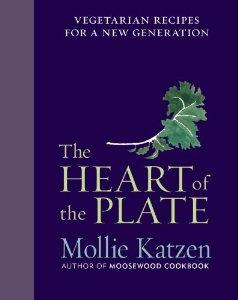
HeartofthePlate by Mollie KatzenMollie Katzen’s new cookbook, The Heart of the Plate: Vegetarian Recipes for a New Generation, is remarkably good.  We have been eating many roasted vegetables lately:  a favorite of ours is her roasted cauliflower with cheese.

Here is the recipe

Cheese-Crusted Roasted Cauliflower
Makes 4 servings

Cauliflower offers the broadest textural range of just about any vegetable. When spanking fresh, it’s delightful raw: Its crunchy white puffballs make satisfying crudités. And at the other extreme, cauliflower is also brilliant when boiled to oblivion and mashed. In this recipe, the high-temperature roasting process allows the cauliflower to become simultaneously fork-tender and chewy, with delicately crisp surface points (helped along greatly by the cheese) surprising you at random.

The roasted cauliflower will keep for up to 5 days in a tightly covered container in the refrigerator and will reheat beautifully.

1 tablespoon olive oil
1 medium head cauliflower (about 2 pounds), trimmed and broken or cut into 3/4-inch pieces
2 cups minced onion (1 large)
¼ cup grated Italian fontina or sharp cheddar or shredded Parmesan, or more to taste
¼ teaspoon salt
Black pepper

Preheat the oven to 400, with a rack in the center position. Line a baking sheet with parchment paper or foil and slick it with the olive oil. (You can use a chunk of cauliflower to spread it around.)
Arrange the cauliflower pieces on the sheet and sprinkle them with the minced onion. Roast for 15 minutes, then shake the baking sheet and/or use tongs to loosen and redistribute the pieces—gently, so they won’t pop off the baking sheet.

Roast for another 5 to 10 minutes, until the cauliflower is becoming uniformly golden, then push everything together in the center of the baking sheet, keeping it a single layer. Sprinkle evenly with the cheese.

Roast for 10 or so minutes longer, or until the cheese is thoroughly melted, forming an irresistible golden crust. Remove the baking sheet from the oven and season with the salt and pepper. Serve hot, warm, or at room temperature.

Optional Enhancements:

Roast a sliced carrot along with the cauliflower. Try this same process using broccoli instead of, or in addition to, the cauliflower. Sprinkle some toasted bread crumbs over the cauliflower after it comes out of the oven.

JFK

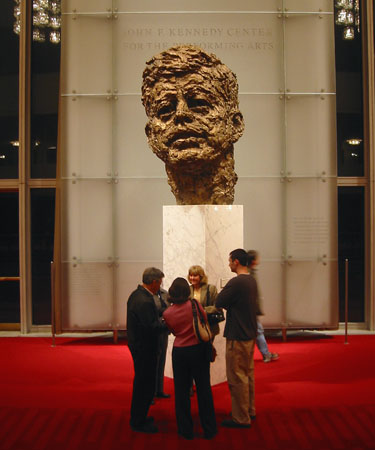
kennedy_center_jfk_bust_frontPeople were snapping pictures of Robert Berks’  bust of John F. Kennedy at the Kennedy Center.

I stood in the lobby.  I was there for a concert.  I was not thinking about JFK. I was thinking in a desultory way about opera.  I do not admire this bust.  I would not have photographed it if I’d had my camera.

But today is the 50th anniversary of the assassination of  John F. Kennedy.

A very sad day for our country.

There is a bit of the conspiracy theory paranoia in me, as in many Americans.  The assassination often seemed the beginning of the slow, deliberate destruction of the liberal Kennedy dynasty.  Robert assassinated five years later.  Ted’s reputation wrecked, though he survived to be a champion of social programs. And then John F. Kennedy Jr.’s death in the small plane.  (Count the Democrats killed in small planes and…remember Paul Wellstone?)

Okay, that’s quite enough of that!

Now, understand, I am not Kennedy-obsessed.

But my family was proud of the first Catholic president.  We were sent home from school early on Nov. 22, and we simply could not believe he had been killed.  It was a confusing time of watching black-and-white TV in what seemed to me to be a darkened room.  And then going around the block to my friends’ house to play on the porch with Sugar and Spike paper dolls:  we cut the pictures of Sugar and Spike from our comic books and glued them on cardboard.

And I actually had Jackie and Caroline paper dolls.  (Expensive ones that my mother bought me.)

As children we were fascinated by Jackie and her children.

I never thought John F. Kennedy was handsome.  Sorry.

And honestly?  I don’t remember my memories very well.  I do not feel anything sharp when I think about that day.  I was too young.

I am reading Minae Mizumura’s gorgeous novel, A True Novel, and this paragraph sums up what I feel about these very old memories.

These are my memories, but they just don’t seem like mine.  The sensations remain vivid, as if engraved on me, but…how shall I put it?  I feel my mind has changed so much that they’re no longer part of who I am now.  I can see no link between the world of my childhood and my adult life.

The Zipless

Have you flown recently?

Flying!

Yeah!

I don’t mind flying.

I don’t fear flying.

I love flying.

Get in a plane and FLY.

It’s quicker than driving.

But when I flew recently, it was not at all fast.

zippersLike Isadora Wing in Erica Jong’s Fear of Flying, you are always looking for the zipless…but not her kind of zipless.  You are looking for the zipless flight.

You get to the airport a couple of hours early.

You take off your shoes, put your laptop in a bin, probably a few other things you’ve forgotten, and four ziplock bags of samples of shampoo, toothpaste, etc.   You see someone else throwing ziplocks into the bin so YOU throw your ziplocks in.

Only one of them belongs there, the guard says.  The one with the mouthwash.

Why mouthwash?

So you quickly throw the other ziplocks back in your bag.

You don’t have any gels or hairspray.  You thought that was the problem.

Naturally, they don’t want people doing their hair on the plane.

After you are cleared by security, you wander off to some nonexistent zone because you misread your gate number and huh…it’s just not there.

Finally you find the right gate number.

Then they change the gate number.

Then you all move, and then you sit down, and you can’t find your e-reader  because your new bag is far from zipless…Zip, unzip, zip.  Too many pockets.

Everybody else is pulling phones and laptops out of zipper bags and presumably going online.

Your tablet won’t go online.

The plane is late.

Then the plane is so late that you have to reschedule your connection.

At the next airport everything is well-marked, and you happily get to your gate, but there are no passengers.

You ask the woman behind the counter if you are in the right place.

Yes, barely in time…

You drag your bag onto the plane.

And there is no place to put it.

So finally a place is found far, far from your seat.

And then when you arrive, your phone doesn’t work.

And then you lose your phone.

Yes, it’s in one of the pockets.

You’ll find it days later.

It’s zipless!

Quo Vadis?

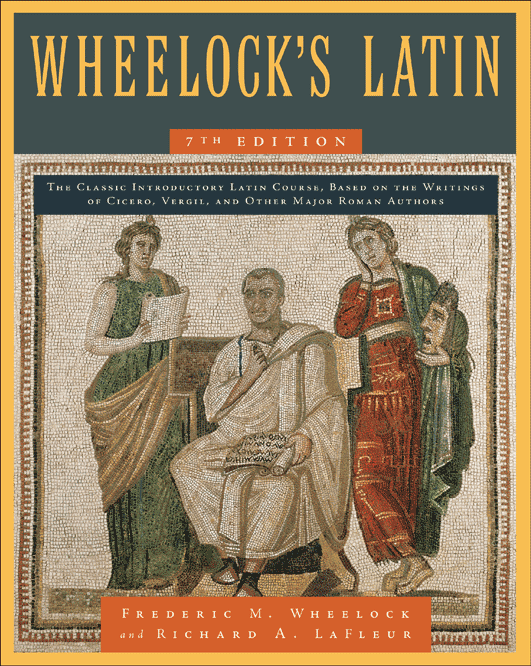
wheelock7_frontcoverA few years ago, I taught an adult education Latin class.  The group was eclectic.

Some had taken Latin in high school. Some wanted to take it “before they died.”   Others  were there to meet people.  One week a young woman popped in who clearly was the lonely new Latin teacher from the suburban public school.  Her tattered Wheelock (the textbook) had obviously seen much use, but she declined to participate:  “I’ve never been much good at sight-reading,” she said.  Perhaps she was self-conscious; at any rate, she never came back.  Essentially we were too ancient for her.  It must have shocked her to come into the classroom and see not her peers, but a group of people with gray hair.  (And she quit her job at the end of the year.  I was not surprised.)

Adult ed classes have a dynamic all their own. It is not college.  It is after-work school.  It is, We’re out of the house; let’s make the most of it!  This group was very friendly.  They liked to chat.  They liked digressions.  Some of them had no idea of English grammar at all. My plan to cover two chapters a week of Wheelock proved untenable.

I soon realized what was going through my students’ heads was rarely going through mine.

Some were very religious and remembered the Latin Mass.  When a student asked what “Quo vadis?” meant, I gamely translated it, “Where are you going?” and knew it was a title of a historical novel and a movie.  I did not, however, realize there was a scene where the disciple Peter asks Jesus the”Quo vadis?” question.   Fortunately the ensuing critique of Peter Ustinov’s and Deborah Kerr’s acting did not take a theological turn.

Then there were the amateur military historians.   “Ah, yes, good old Vercingetorix,” I would say absent-mindedly as they chatted about the Helvetii.  Though bored by maps of battles, I was perfectly happy to translate Caesar for them after class.

I’m a nice woman who likes Latin poetry.  If you’re going to read Latin in translation, I assure you that Virgil, Catullus, and Ovid are more fun to read than Caesar.

One can’t read much poetry when a Latin class meets for only two hours once a week, though. One has to teach the language.   “I can’t get my head around the ablative,” they would say.  “Oh, yes, you can,” I would say right back at them.  We covered some basic grammar and vocabulary, and  translated  passages from Virgil with the help of reams of worksheets I spent hours making.

Some of us went on together for a couple of years.  The sad thing about teaching older people is that you lose them.  Two got very sick.  One had a heart attack in the classroom.  (The EMS squad was great and rescued him.)  Another died.

Sometimes I think I should offer the class again, because Latin programs have folded like dominoes in the U.S.  State universities still offer classics, and a good thing, too, because without us hoi polloi state university classics graduates, who would teach the students at eastern private schools that blessedly still offer Latin (and Greek)?  The oligarchy would not thrive.

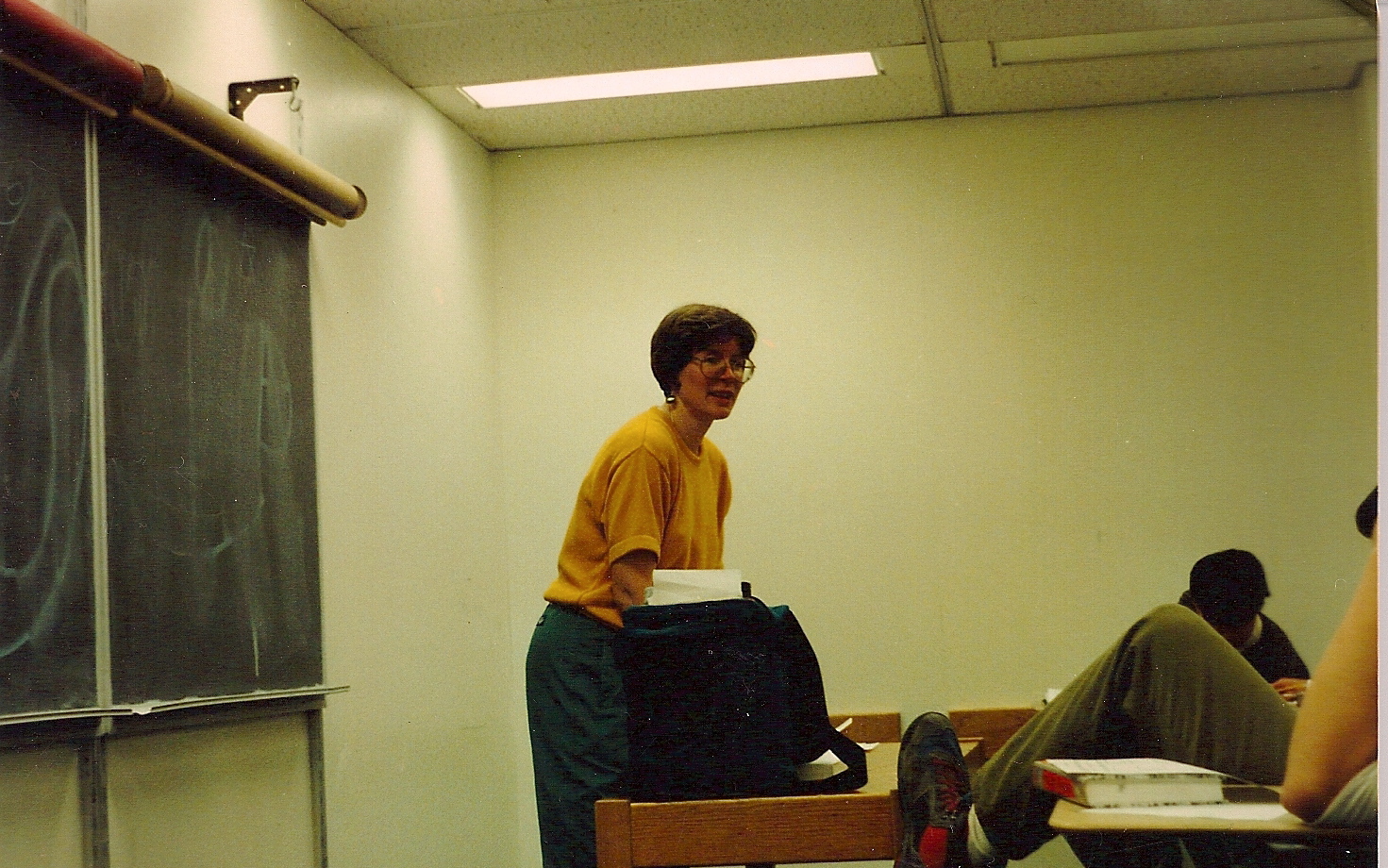
Teaching Ovid in the Big Glasses era. (Yes, I allowed them to put their feet up...but only if they did their homework!)

At an Ovid gig in the Big Glasses era.

Many years ago my friends and I got our M.A.’s in classics and almost died of boredom teaching conjugations, declensions, and, yes, even Caesar, Cicero, and Virgil in private schools.  It wasn’t the students:  it was a question of over-work and endless repetition.

I know lot of silly mnemonics from teaching:

bo bi bi, bi bi bu, future sign in 1 and 2

I was big on chanting conjugation endings.

-o, -s, -t,
-mus, -tis, -nt

Chant, repeat, learn.

Most of us lasted a couple of years.  I taught for five, not counting various part-time and substitution gigs.  The money was terrible at private schools, we had four preparations, and taught five 50-minute classes five days a week.  At the public schools, one was required to know very little Latin–only three college Latin classes were required in one state–but many education classes were required. No one who actually knew Latin seemed qualified to teach in public schools.  You could have a Ph.D. in classics, but you could not get the good-paying public school job.  (No wonder the Latin programs in public schools have folded.)

According to the The National Commission on Teaching and America’s Future, approximately one-third of all new teachers leave after three years, and 46 percent are gone within five years.  Of course these statistics apply to the public schools, but the turnover is also very high at independent schools.  Certainly these stats sound right as far as the small group I know.  Only one old friend is still teaching Latin.

So many talented teachers simply can’t hack it.

Occasionally one reads about a Latin renaissance in the U.S., but it usually amounts to very little.  A school here or there adds a program.  Yet Latin is essential. It is the template for our literature.   One studies Latin to read the poets.  Or to learn about oneself, because that kind of discipline takes you into a zen state that almost makes you feel as though you’re in ancient Rome.  (Oh, and, by the way, more than 60% of English words come from Latin.)

If one is to judge from the TLS, there is a classics renaissance in England.  Mary Beard, classicist, Cambridge professor, and author of a new book, Confronting the Classics:  Traditions, Adventures and Innovations, writes a blog for the TLS, A Don’s Life.  She frequently mentions various Latin programs in the UK:  recently she and Peter Stothard, author of Alexandria:  The Last Nights of Cleopatra (whom I interviewed here), gave a presentation on “How to Read a Latin Poem” at the Cheltenham Literary Festival.

Can you imagine such a presentation being given at, say, the Iowa City Book Festival?  Or The New Yorker Book Festival, for that matter?

I cannot.

And that is probably why the very nice and doubtless psychic classics professor said all those years ago, “The future is going to need the Ms. Mirabiles.”

The Little Free Library

IMG_2760My husband spotted the Little Free Library as we were driving home.

It’s on our street.

‘Oh my God!”

I made him stop the car.

I raced out to look at the books.

The Little Free Library looks like a birdhouse on a stick.  Some are fancier than others:  I’ve seen a two-story LFL that looks like a tiny house.  Open the glass door of the shelf and you can browse, borrow, or take a book, and then return it or donate more.  I have given books to another Little Free Library in my neighborhood.  I can’t say my books go like a house a-fire:  the copy of D. H. Lawrence’s The Rainbow is still there, but Octavia Butler’s Parable of the Sower has been checked out twice.

In 2009 Todd Bol in Hudson, Wisconsin, built the first Little Free Library:  a bookshelf that was designed to look like a one-room schoolhouse, with a sign that said “Free Book Exchange.”

It caught on.

People told him they wanted to build their own and wanted to share their books.

Today there are 12,000 Little Free Libraries not just in the U.S. but in Ukraine, Italy, Japan, Pakistan, Brazil.  And the three I’ve seen in town don’t appear on the map, so apparently aren’t registered. At Bol’s website, Little Free Library, you can buy kits.  Or you can build your own.

Is our neighborhood hip?  Is that why we have one?  Not necessarily.  But this is a nice aspect of community.

People long to be connected, according to the Slow Movement.  And not necessarily by internet.   Well, I can’t say I’ve met anyone at a Little Free Library.  I’m always the only one there!  But it is a lovely  idea. It would make a very nice feature story to bang on the door and interview the owners about why they’ve started this.

There are readers in our neighborhood:  I know because every book from Amazon is automatically delivered to me.  Twice I’ve ripped them open, not noticing the address label is wrong.  Then I saunter off with an apology to the person who ordered the book. (Once Bill Bryson’s The Life and Times of the Thunderbolt Kid and another time a self-help book.)

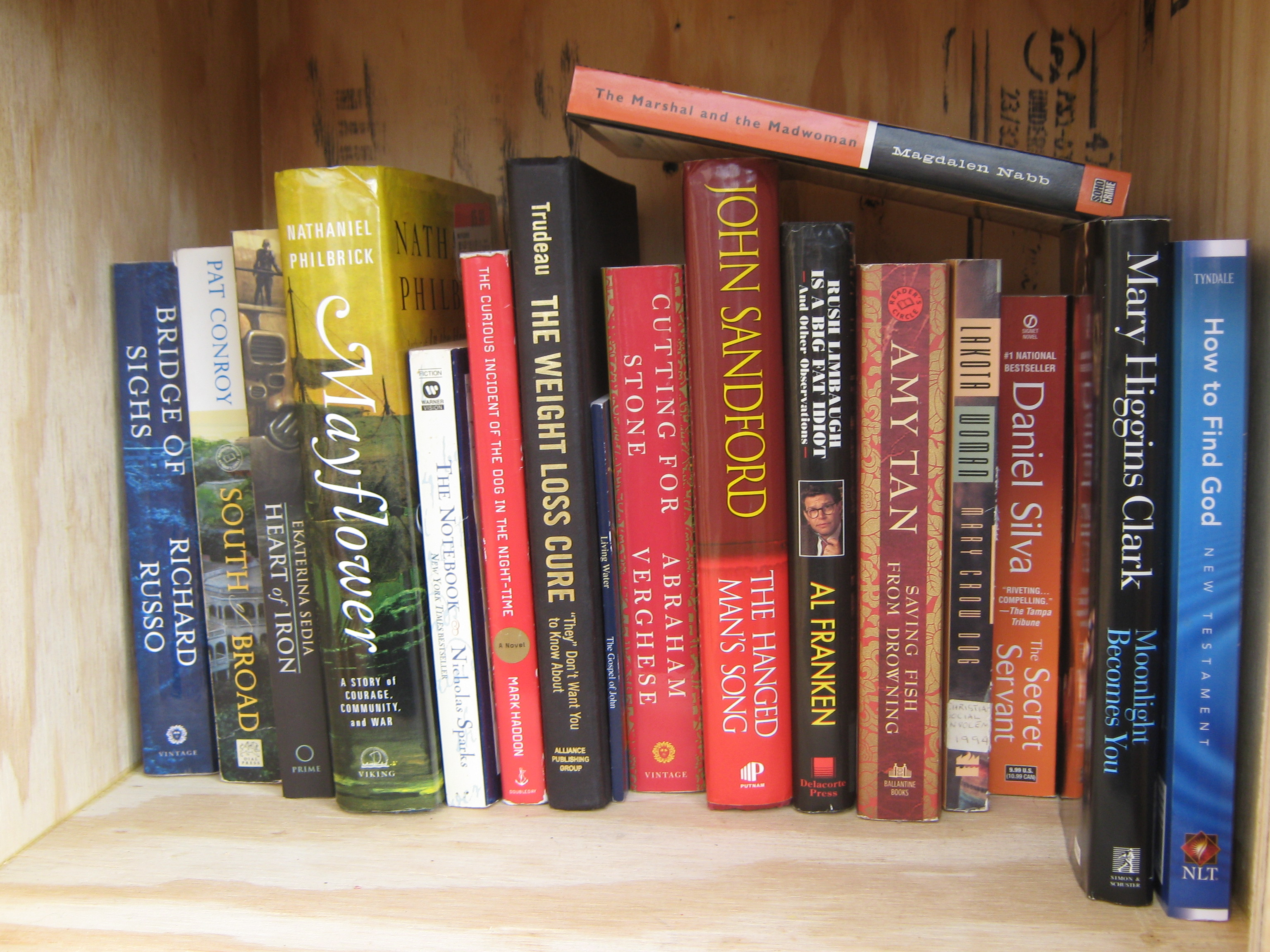
IMG_2763The selection at the new LFL is not bad: Richard Russo’s Bridge of Sighs, Amy Tan’s Saving Fish from Drowning, Nathaniel Philbrick’s Mayflower, Abraham Verghese’s Cutting for Stone, and then the usual Mary Higgins Clark.

I borrowed Ruth Prawer Jhabvala’s Travelers.  Actually, I have a copy , but I wanted to borrow something.  She is one of my favorite writers, and, alas, she died earlier this year.

“That looks like someone dropped it in the toilet,” my husband said.

“It’s just a couple of crinkled pages,” I said indignantly.  “The rest are fine.”

But it did put me off a bit.  I think I’ll just find my old copy of Travelers and read that instead…

Doris Lessing

Doris Lessing

Doris Lessing

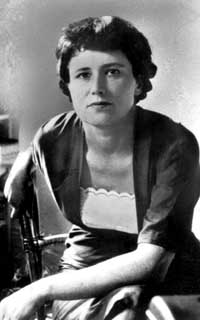
Doris Lessing died yesterday, age 94.

In her honor, I am re-posting this piece I wrote about her Children of Violence series.  (It appeared at my old blog in May  2012.)

Martha Quest, the heroine of Doris Lessing’s Children of Violence series, is my hero.  There are Martha Quest people, and there are non-Martha Quest people.  Even though millions of women were obviously reading Doris Lessing when I discovered her, I didn’t know any until a librarian walked into the bar where I worked and caught me surreptitiously reading A Proper Marriage.  “I LOVE  Martha Quest,” she said.

Instant bonding.  That often happens with reading.

Last August, I started rereading Lessing’s Children of Violence series, and hope some of you have enjoyed it, too. I began with the last novel, The Four-Gated City, a strange, labyrinthine masterpiece which has a distinct science fiction tone near the end, and then I backtracked to the other realistic novels in order, Martha Quest, A Proper Marriage, A Ripple from the Storm, and Landlocked.

I wrote about The Four-Gated City here and here.  I said:

Her analysis of 20th-century politics, history, class, and the socialization of women is so lucid that we apply it to ourselves and feel that we are reading about ourselves.

“The Four-Gated City is…a stunning portrait of a woman in her thirties, Martha Quest, who, leaves family, friends, and the Communist party to immigrate to England from Africa.  It is not just a personal portrait, though.  It also examines post-war London torn by the Cold War, persecutions of Communist Party members, fear of the McCarthy era, terror of war, women breaking down from pressures, and more.”

The five novels cover a lifetime–Martha from age 15 till old age.

I have just finished Landlocked, and I am sad because I will miss Martha Quest.  Landlocked is my favorite of these four and I will write a more detailed “review” at the end of this post, but first I will summarize the plots of the first three.

MARTHA QUEST, A PROPER MARRIAGE, AND A RIPPLE FROM THE STORM.  Set in Southern Africa on the verge of World War II, Lessing in  Martha Quest introduces the heroine as a furious teenager living on a farm on the veld.  Martha has dropped out of school to educate herself, and is desultorily reading Communist tracts, Freud, and other intellectual books lent by her friends, the Cohen brothers.  She longs to get off the farm, and knows from books there are other worlds.  She  hates her fastidious mother, who is neurotically jealous of Martha and fights with her about every detail of her life.  She gets along with her father,  but he is delicate and uninvolved with the family, shell-shocked during World War I and never recovered.  Meanwhile, stuck at home, Martha experiments with femininity:  making dresses her mother doesn’t approve of, going to dances, necking with boys she doesn’t like much, and trying to fit in with the people of different nationalities who have settled here. Eventually she finds a job in the city as a typist, where she attends sundowner parties and gets drunk every night, and  gets involved with all the wrong men.

In A Proper Marriage, Martha is married to Douglas Knowell, a successful, dull, hard-drinking young man with no political views, and she doesn’t quite know how she became married to him, except that everyone was getting married.  She has violated her principles and is doing all the conventional things young women do, as if she can’t help herself.  She gets pregnant, though she doesn’t want to and goes to a condescending doctor to get a Dutch cap (or was it a diaphragm?), and we hear his thoughts on how she will soon be pregnant if she is not already.  Martha simply cannot believe she is going to be a mother.  She has a child, Caroline, whom she doesn’t much love.  And she agonizes over how she sold out her socialist principles for a marriage she didn’t want, and her old friends the Cohens quietly sneer.  Martha longs to get involved with the commune one of them has formed.

In A Ripple from the Storm, set in the early 1940s, Martha has finally matured, is divorced from Douglas, and is very active in a Communist group.  This is a much more focused, energetic novel, because Martha is finally doing something she intended to do.  The novel describes her political activities during World War II–her social life revolves around lectures, study groups, and attempting to help the Africans. I found this utterly absorbing, and somehow understand when Martha makes her next mistake:  she marries a German “comrade,” Anton Hesse, a refugee who works as a clerk but puts all his energy into the Communist group.  She knows that there is something sexually wrong between them, and says she will not marry him.  But then she feels sorry for him, and suddenly they are married.

(Don’t you all know how this goes?  Marriages that everybody knows are doomed, but what can you do except go to the party and drink champagne?)

LANDLOCKED is my favorite after A Four-Gated City.  Set near the end of World War II and just after it, Landlocked centers on the disintegration of their Communist group, and describes Martha’s own feeling of being ripped apart and landlocked as she tries to compartmentalize her life:  she balances secretarial work (she becomes a freelance typist and makes more money), her work for the Communist group, her cold marriage to Anton, visiting her ill father, and having an affair with Thomas, while what she really wants to do is go to England.  She dreams again and again of the sea, dreams where she can’t get there.

Politics change rapidly at the end of the war as people try to cope with the realization that 40 million people have died.  The townspeople long for normalcy and need a scapegoat:  the  Communist group, which had been tolerated when everyone was pulling together during the war,  is execrated.  Even Mrs. Van, a popular, liberal activist who has served on the town council and in Parliament (not a communist), and Jack, a trade union leader and member of Parliament, are ostracized.  Jasmine, a sort of secretary of the group, goes to Johannesburg, and Martha is stuck in her place.  Athen, the earnest Greek member, prepares to go home, though Greece is in a civil war. Anton starts to lose control and becomes involved with a wealthy businessman’s family.  And the Africans believe the communist group is condescending.  Then the group begins to learn of the Russian persecutions and imprisonments.

Martha is still married to Anton, but they have decided they will get divorced at the end of the war, when he will be “naturalized.” They decide they can have affairs, but Anton is still in love with Martha, and she is incredulous.  It was the same with Douglas.  It’s as though neither knew there was anything sexually wrong.

Then she has an affair with Thomas, a member of the group, a Polish farmer, a Jew who escaped with his wife to Africa.  Thomas has had affairs with many women, always painfully thin women.  He falls “in love” with Martha when she is ill (later she has a fat phase and he tells her she looked better when he was with her).  It is the most sexual love affair of both their lives.  But love is far too inexact a word for these two Communists, who view personal lives with distance and don’t use that word.

Doris Lessing always steps away and lets us know what Martha, apart from her actions, is thinking and feeling.  And it is these original thoughts that make the reader look at a situation differently.  Lessing writes beautifully and intelligently, and Landlocked is a stunning novel in the tradition of the big, detailed, exhilarating bildungsromans of Thomas Mann and Henry Handel Richardson.

In the beginning of the novel, Martha is in a thin, blonde phase because she is so busy, and people respond to her looks.  The “real” Martha is cynical.

And besides, what was real in her, underneath these metamorphoses of style or shape or–even, apparently–personality, remained and intensified.  The continuity of Martha now was in a determination to survive–like everyone else in the world, these days, as she told herself; it was in a watchfulness, a tension of the will that was like a small flickering of light, like the perpetual tiny dance of lightning on the horizon from a storm so far over the earht’s curve it could only show reflected on the sky.  Martha was holding herself together–like everybody else.  She was a lighthouse of watchfulness; she was a being totally on the defensive.  This was her reality, not the ‘pretty’ or ‘attractive’ Martha Hesse, a blondish, dark-eyed young woman who smiled back at her from the mirror where she was becomingly set off in pink cotton that showed a dark shadow in the angle of her hips.”

Martha doesn’t get to England till the last book, and that is her “real” life.  But I understand the life she leads in Africa, wanting to leave, but stuck because of her relationships.

E-readers, Never Shop with a Man, & NANOWRIMO

The-eBook-e-Reader-Painting--95667Sometimes my e-reader is my friend, sometimes it isn’t.

Last week I had a solitary weekend.

Everyone I knew was out of town.

My husband was on a business trip and gave me several phone numbers I would never call.

Doesn’t everyone love a solitary weekend?

It was pretty much my e-reader and I.  We are  great friends since I deleted my email account and Twitter from the machine.  No more email alerts:  no more reading 10 pages, then checking 10 emails.  I feel about my e-reader the way the women in Sex and the City feel about their vibrators.

And so I spent the weekend reading Meg Wolitzer’s brilliant new novel, The Interestings, a long realistic masterpiece that pleased critics who underestimated her last book, The Uncoupling, a short, clever riff on Aristophanes’ Lysistrata.

As I said at my old blog, Wolitzer has a brilliant, distinctly American voice, slightly Nora Ephronish, with a twist of Dorothy Parker.

In The Interestings, she writes about a group of New Yorkers who meet in the ’70s at an arts camp.  Their friendship extends into middle age in the 21st century.

Read, read, read.  And then…

Oh, no.  A car in the driveway!

I hoped the person with hennaed hair and black clothes in the driveway was not the old friend with hennaed hair and black clothes I had last seen in a mental hospital after her bad trip at Woodstock II.  Normally I am happy to see anybody, but this was my weekend!

The person went away.  Wrong address apparently.

Meg Wolitzer’s The Interestings seemed to apply to the situation, though, as so often happens when you’re reading and living life.  She writes about mental health politics as well as other changes of the 20th and 21st centuries.  The pills do not necessarily work well.

The main character, Jules, a (female) social worker, is married to Dennis, who has depression.

Ever since he’d been taken off the MAOI five years earlier, Dennis had rarely returned to buoyancy.  Instead, he still struggled with what his pharmacologist variously referred to as “low-level depression,” “atypical depression,” and “dysthymia.” There were some people who were just very hard to treat, Dr. Brazil said.  They were able to live their lives, sometimes to a fairly full extent, but they never felt good.  Dennis’s atypical depression wasn’t making him break down, as it had in college, but it also wouldn’t go away.  He felt its presence like a speck in the eye or like a chronic, rattling cough.  Different drugs were tried, but nothing worked for very long, or if a drug did work, the side effects made it untenable.

By the way, I am so glad Obama’s health care plan will treat mental illness like a physical illness, with the same deductibles, etc.  Don’t let the insurance companies and the Republicans destroy our new national health care.

Hey!  Why didn't we look like that?

Hey! Why didn’t we look like that?

NEVER SHOP WITH A MAN.   I  went to the mall with a man.  What was I thinking?

I had to buy a few things that were too big to fit in the bike pannier.

He moodily paced behind me.  No smile, and he wondered why no clerk would help us.

Finally I caught the attention of  a clerk who showed me several bags I could use for a laptop that weren’t strictly laptop bags.

Later, the man was so tired and mall-phobic that he argued over whether we could spend 99 cents at Target.

The other men at the mall were behaving well, but their wives were clearly in charge.

I bought the 99-cent item.

You know the reggae:  Get up, stand up.

But it’s really easier to shop with your cousin.

THE SHORTEST NANOWRIMO EVER.   Every November people all over the world sign up for NANOWRIMO (National  Novel Writing Month) to write a 50,000-word novel in 30 days.

I’m not a fiction writer.

Nor do I want to write fiction.

Nor do I want to write 1,660 words a day.

But I love the idea of writing a novel in 30 days, so I planned to write a new version of Ovid’s tale of Daphne and Apollo.

Then I realized I’d rather read Ovid.

I wrote 32 words.

I lasted one minute this year!   I will not even PRETEND to write a novel.

That’s it!  I  promise never to sign up for NANOWRIMO again.

An Interview with D. J. Taylor

D. J. Taylor

D. J. Taylor

D. J. Taylor, the novelist, critic and biographer, kindly agreed to be interviewed by email.

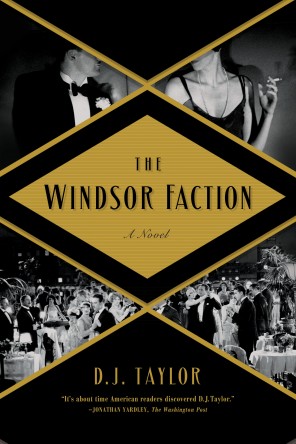
First, a few words about his book:  his brilliant new novel, The Windsor Faction, is one of our favorites of the year.  It poses the questions, What would happen if Edward VIII had not abdicated the throne because Wallis Simpson died  in 1936?  And what if he were a fascist sympathizer?

Billed as an “alternate history,” The Windsor Faction is also a fascinating literary novel, set in the late 1930s when England is on the verge of war and told in multiple forms:  the diary of Beverley Nichols, a journalist, who collaborates with the King on a speech on pacifism; a traditional third-person narrative about Cynthia Kirkpatrick, a bored young woman who works at a spy-ridden literary magazine in London; and newspaper articles and editorials about the death of Mrs. Simpson and the war.

MIRABILE DICTU:  Your novel has been called an “alternate history.”  What do you think of that term?

Windsor Faction d. j. taylorD. J. TAYLOR:  I’d describe it as ‘counter-factual history’. The analogy I usually use is that of chess board in which one of the pieces has been removed, meaning that the remaining 31, though unchanged, have to re-calibrate themselves in interesting ways. Keeping the reader on your side means that you can’t alter a great deal. In The Windsor Faction, for example, I was careful to employ the same politicians and the same public figures. Without this, I think the whole thing becomes less believable.

MIRABILE DICTU:   Did any writers influence you in the writing of The Windsor Faction?

D. J. TAYLOR: I wouldn’t say there were direct influences. But I have read fairly widely in the literature of World War II – Evelyn Waugh’s Sword of Honour trilogy, say, and the three war-time novels of Anthony Powell’s A Dance to the Music of Time, and I’m sure these raise their heads every now and again, particularly as one of my aims was to make it read and sound like an artefact written in the period in which it was set.

MIRABILE DICTU:    When and why did you begin to write?

D. J. TAYLOR: I started writing at a very early age. Even in my teens I was sending things – mostly chronically bad impersonations of J.R.R. Tolkien – off to publishers. I began to get things published in my early ’20s, but I think this was due merely to having served an apprenticeship at an age before most people get properly going

MIRABILE DICTU:   Do you prefer writing fiction or nonfiction?

D. J. TAYLOR: I like both, and find – encouragingly – that the one cross-fertilises the other. For example, the idea for my novel Ask Alice (2009), which is about an American-born British society hostess, grew out of non-fiction book called Bright Young People (2007) about the social circles that inspired Evelyn Waugh’s novels.

MIRABILE DICTU:  Who are your favorite writers and what are you reading now?

D. J. TAYLOR: My favourite writers are English classics  like Thackeray, George Gissing, Orwell, Powell, but I have a weakness for those sprawling early 20th American novels by people like Dreiser, Upton Sinclair, James T. Farrell, Steinbeck and Dos Passos. Among modern US writers, I very much enjoyed the memoir that Richard Russo published a couple of years ago, and my absolute favourite is Mary Gaitskill.

Thank you for the interview, David!

You can read more about D. J. Taylor at his website:  http://www.djtaylorwriter.co.uk/