
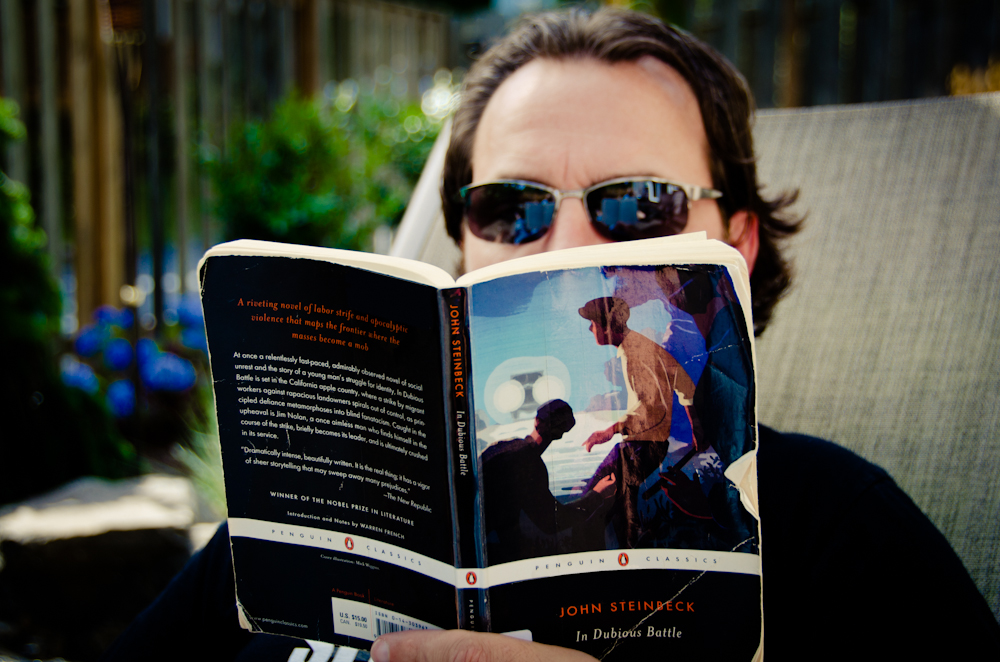
No idea who this is, but he’s reading Steinbeck.
Men don’t read. That is according to a recent study of 2,000 readers by OnePoll for the Reading Agency in the UK. Sixty-three percent of British men said they don’t read as “much as they should,” and 75% that they preferred the film or TV versions of novels to novels.
Similar studies have been done in the U.S. Men not only don’t read much, but they don’t read novels. Women make up 80 percent of the fiction market, according to surveys here.
Is this true?
I don’t know.
My husband reads a lot of fiction.
In my family, many people read. As far as I know, everyone on my father’s spottily-educated side of the family (only we women went to college) reads fiction.
My husband reads, and his father reads, but they read mainly award-winning novels. (My husband claims he has read only one mystery in his life, and that he has never read a science fiction book.)
I am addicted to fiction and have always been addicted to fiction. I read it all: classics, literary fiction, science fiction, and the occasional mystery.
I asked my husband if his friends read fiction. He says he doesn’t know. They never talk about it.
My guess would be that liberal arts graduates read more fiction than those who pursue more commercial degrees. But is that in the data? I might be dead wrong.
On the other hand, I know a surprising number of English teachers who never read fiction. They majored in English because they thought it was easy. I’ve never been able to understand this.
Is there a reading gene?
Meg Wolitzer, author of The Interestings, one of my favorite books last year, told The Nervous Breakdown that men don’t read women’s fiction.
What matters in a big way is subject matter and men with very few exceptions, won’t read books about women. Something nebulous and thought-based – a book of ideas – people seem much more willing to have that from a man than a woman.”
And D. J. Taylor, author of the Man Booker Prize-nominated Derby Day and Ask Alice, wrote in The Independent that women are the preservers of culture. He said that a FiveThirtyEight survey on film (from which he concludes that women are better filmmakers)
merely confirms a truth that historians of literature, drama and music have suspected for ages. This is that, broadly speaking and allowing for certain kinds of genre differentiation, the flame of “culture” is pretty much kept stoked by women. The history of the British novel since the early 19th century, for example, is a perpetual triumph for Scheherazade and her handmaidens – written, increasingly, by women and, especially as the board school reforms of the late-Victorian age began to speed up the drive towards mass literacy, read by women as well. The early surveys of national reading habits that began to appear in the 1930s reveal a clear gender divide: women were found to read all kinds of different books; men tended to settle either for the classics or detective novels.
Obviously D. J. Taylor reads fiction.
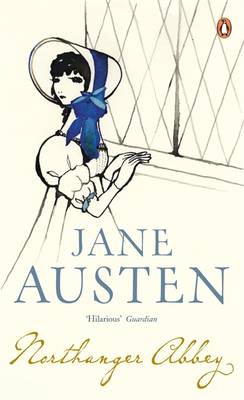 And the men in Jane Austen’s Northanger Abbey (or at least Henry Tilney) also read fiction.
Catherine, the heroine, reads a lot of novels. She assumes Henry will think she’s silly. “But you never read novels, I daresay?”
Henry replies,
“The person, be it gentleman or lady, who has not pleasure in a good novel, must be intolerably stupid. I have read all Mrs. Radliffe’s works, and most of them with great pleasure. The Mysteries of Udolpho, when I had once begun it, I could not lay down again,–I remember finishing it in two days–my hair standing on end the whole time.”
Even the silly John Thorpe, Fanny’s other suitor, likes Tom Jones.
AND NOW HERE IS A LIST OF SOME OF MY FAVORITE TWO-DAY NOVELS:
Back Street by Fannie Hurst
Resurrection by Tolstoy
Emma by Jane Austen
Futility by William Gerhardie
A Lost Lady by Willa Cather
Ask Alice by D. J. Taylor
The French Lieutenant’s Woman by John Fowles
The Realms of Gold by Margaret Drabble
We Are All Completely Beside Ourselves by Karen Joy Fowler
Flight Behavior by Barbara Kingsolver
 mirabile dictu