
What are your favorite garden novels?
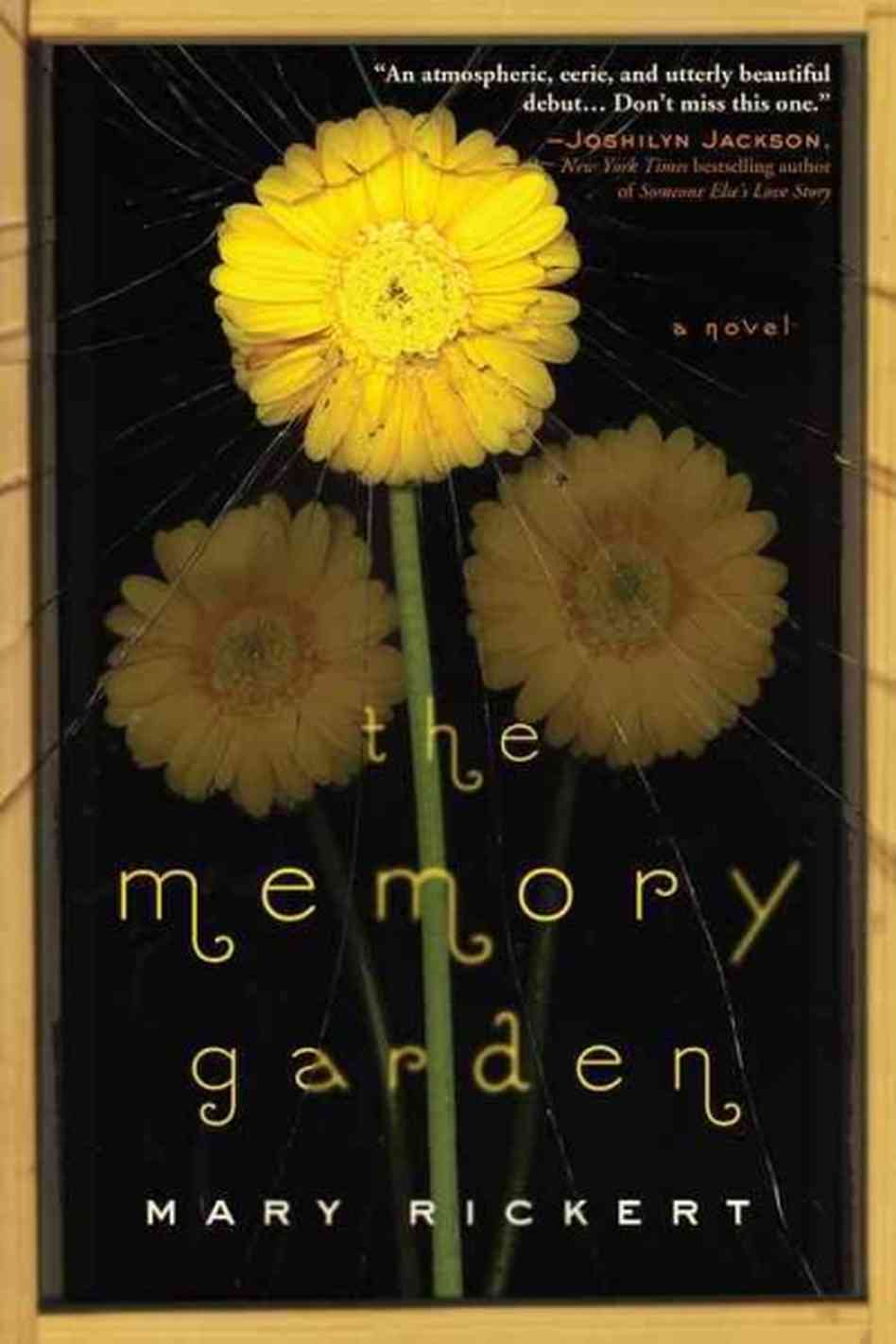 I am in the middle of Mary Rickert’s The Memory Garden, a stylishly-written literary fantasy about a garden, an old woman, a foundling daughter, friendship, witches, misfits, and ghosts.
One of the main characters, Nan, an old woman, is not only raising a teenage girl, Bay, who was left on her porch as a baby, but has planted a flourishing enchanted garden. Rumored to be a witch, she is disliked by the locals, who sometimes throw shoes into the yard. She plants flowers in the shoes.
Rickert is a lyrical, imaginative writer:
It was because of the shoe garden that the house became locally famous, though there had always been rumors about disturbing fertile elements in the soil. The large elm tree, for instance, was not only unaffected by the disease that killed so many in the sixties, but also thrived, branching dark shadows across the entire left side of the porch, which did not impede the vigor of blue heaven morning glory or moonflowers trained to crawl up the railings.
Charming, isn’t it?
This is a good summer novel. Most garden novels seem to be light, don’t they?
Here is a short list of my favorite garden novels. Please tell me yours!
 2. Frances Hodgson Burnett’s The Secret Garden. In this children’s classic, the cross-tempered Mary Lenox and her cousin, a spoiled invalid, Colin, develop their creativity when they plant a secret walled garden on their uncle’s estate. (It was my favorite book when I was seven.)
 3. Kate Morton’s The Forgotten Garden. A fascinating, if rambling, pastiche of mystery and fairy tale, The Forgotten Garden is a pop-fiction sibling of A. S. Byatt’s beautifully-written The Children’s Book. (There really are resemblances, but I won’t get into that.) In 1913 a nameless child shows up alone on a dock in Australia. She has a fairy tale book in a suitcase, but no other personal belongings. When she grows up, she learns she is adopted and investigates her identity. Interspersed are tales of another orphan, an abused girl who grows up to be a fairy-tale authoress and lives in a cottage in a secret garden. Nell’s granddaughter mysteriously inherits the cottage and finds out more secrets.
 4. Margot Berwin’s Hot House Flower and the Nine Plants of Desire. In this entertaining, light first novel, which I enjoyed a few years ago, one of the characters says, “The tropics can happen anywhere, you know. They’re a state of mind.”
The narrator, Lila Nova, is a divorced, confused, clever advertising executive who stumbles into a magical world of gorgeous tropical plants. In New York, she buys a Bird of Paradise plant at a market, and finds a laundromat decorated with tropical plants and moss. When she embarks on a quest to Mexico for the legendary Nine Plants of Desire, this slightly comic-book-ish adventure is equally dominated by good and evil gardeners.
 5. Rumer Godden’s An Episode of Sparrows. I’ve borrowed the description from NYRB, which reissued this a few years ago. (The cover is from Virago.): “Someone has dug up the private garden in the square and taken buckets of dirt, and Miss Angela Chesney of the Garden Committee is sure that a gang of boys from run-down Catford Street must be to blame. But Angela’s sister Olivia isn’t so sure. Olivia wonders why the neighborhood children—the sparrows—she sometimes watches from the window of her house —have to be locked out of the garden. Don’t they have a right to enjoy the place, too? But neither Angela nor Olivia has any idea what sent the neighborhood waif Lovejoy Mason and her few friends in search of —good, garden earth.— Still less do they imagine where their investigation of the incident will lead them—to a struggling restaurant, a bombed-out church, and at the heart of it all, a hidden garden.”
And now tell me your favorites!


 mirabile dictu