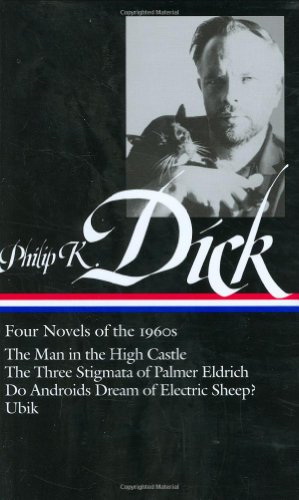
Alternate History: Philip K. Dick’s The Man in the High Castle

Philip K Dick_OMNIBUS_LIBRARY OF AMERICAThose of you who know my fondness for science fiction will not be surprised I have read a few alternate histories this summer.  The genre runs the gamut from science fiction to literary fiction, from Harry Turtledove’s Southern Victory series to Philip Roth’s The Plot Against America, from Doris Lessing’s Alfred and Emily to D. J. Taylor’s The Windsor Faction, from Jo Walton’s Farthing to Susanna Clarke’s Jonathan Strange and Mr. Norrell.

Perhaps the most famous alternate history is Philip K. Dick’s science fiction novel, The Man in the High Castle, which won the Hugo Award in 1963.  Even if you think you don’t know Dick’s work, you probably do:  Blade Runner is based on his superb novel Do Androids Dream of Electric Sheep?, and Minority Report on his story, “The Minority Report.”

Ursula K. Le Guin has called Dick the “American Borges,” and the brilliant writer  Jonathan Lethem, who won the National Critics Book Circle Award in 1999 for Motherless Brooklyn, has heavily promoted Dick’s work in recent years.  He has edited three volumes of Dick’s  novels for The Library of America; edited The Selected Stories of Philip K. Dick; and written, with Pamela Jackson, The Exegesis of Philip K. Dick.

In The Man in the High Castle, the Nazis and Japanese won World War II. They squabble for power in the U.S., keep Americans down, hunt down Jews, and inflict most people with an inferiority complex about their culture. The Jews must change their names and hide their Jewishness, so as not to be deported to Nazi Germany.  Other Americans, too, are high-strung about the fascist government.  And the Asian influence is so strong that all the characters consult the I Ching.

There are multiple story lines, and I will not attempt to write about all of them.  The novel opens with the owner of an antique Americana shop, Mr. R. Childan,  terrified because a Civil War recruiting poster has not arrived promptly for a high-ranking Japanese trade commissioner, Mr. Tagomi.

In another part of San Francisco, Frank Frink,  a Jew born with the name Frank Fink, has quit his job at a factory that makes fake antique weapons. Unless he can persuade the boss to rehire him, he will be blacklisted.  And so, like all the other characters  he pulls down the I Ching and the yarrow sticks.

Aloud he said, ‘How should I approach Wyndam-Matson in order to come to decent terms with him?’  He wrote the question down on a tablet, then began whipping the yarrow stalks from hand to hand until he had the first line, the beginning.  An eight.  Half the sixty-four hexagrams eliminated already.  He divided the stalks and obtained the second line.  Soon, being so expert, he had all six lines; the hexagram lay before him, and he did not need to identify it by the chart.  He could recognize it as Hexagram Fifteen.  Chi’en.  Modesty.  Ah.  The low will be raised up, the high brought down, powerful families humbled; he did not have to refer to the text–he knew it by heart.  A good omen.  The oracle was giving him favorable counsel.

Frank’s friend, Ed McCarthy, persuades him to go into business with him, designing and making original jewelry.  Although it is gorgeous, R. Childan, the shop owner, cannot sell it to rich Japanese customers, who prefer Mickey Mouse watches and old American artefacts.  It is not in their interest to encourage Americans to develop their culture.

Frank’s wife, Juliana, has moved to Colorado, where she works as a Judo instructor. After an Italian trucker picks her up and more or less moves in with her, she learns he is obsessed with a banned novel, The Grasshopper Lies Heavy, an alternate history in which the U.S. and the Allies won World War II.  Hawthorne Abendsen, the author of this banned book, is said to live in a high castle in Wyoming.

This novel within a novel has a huge influence on the characters.  Even the Japanese are reading and commenting on it.

The Man in the High Castle is a masterpiece, and I urge you to try it even if you are not a science fiction reader.  The best science fiction ranks up there with classics.

Digressions: Teaching, Tech, and Why We Shop at Amazon

Kindle NookWhen you teach an adult education class, you learn a lot about people.

They are not necessarily there to learn.

They are lonely.

They are retired.

They want to make friends.

The young, single students drop out at once, horrified by the others’ wrinkles and gray hair.

I found my students’ age disconcerting at first.  When my husband recently pointed out that we are closer to 70 than 40, I shrieked.  (Remind me:  dye my hair, lose 50 pounds, have plastic surgery, then regain 50 pounds plus ten more…  No, I’m not gonna bother.)

The young, lonely high-school Latin teacher, whose first job was at a huge public school, was clearly dismayed by the age of her fellow students.  Intimidated by the sight reading–what was I thinking of to ask her?–and the lack of a peer group, she didn’t come back.  And at the end of the year, the poor girl quit her job and moved away.

The older students learned, chatted and digressed.

Anyonw can sign up for a non-credit adult ed class.   It was my first experience of what I call “teaching in a public school.”

I’m not snobbish about public schools.  I went to public schools.  The best students learn; the worst (or low-track students) learn little.  And it’s not always the teacher’s fault, though teachers are blamed for everything.   If you think you can teach a third-generation Welfare student whose parents’ minds are burned out on cocaine, or a young man in a gang whose older brother was shot on the streets, good luck to you!

Homework was a foreign language to half of my adult ed students.

But here’s what I learned:  they are all fantastic at tech.

One of my students downloaded books we recommended right there in the classroom.   (Now that I have an e-reader, I don’t find this amazing.)

After buying the book, he said, “Amazon has the best website in the world.”

But, “Traitor!” said a student who worked at Borders.

Borders was going down.  A few years later, when I ran into this student-bookseller at Barnes and Noble, he explained the failure of Borders.  The corporate culture had changed,  it adopted a retail business model, neglected the book culture,  hired people who didn’t know books, and also missed out on the e-reader trend.

Borders was an excellent store.  I miss it very much.

But, traitor or not, I agree with my other student:  Amazon has the best website in the world.

Amazon has a bad rep these days–in the Amazon vs. Hachette struggle,  we all act as though Hachette were a cozy little company instead of a corporation.

But perhaps it’s not as simple as we think. Hugh Howey, a science fiction writer who started out self-publishing and then was picked up by a major publisher, recently wrote an essay for the Guardian attacking Hachette.  The fight, it turns out, is over e-book pricing.  And he believes that Amazon is in the right.

He says,

High ebook prices harm not only individual readers but readership in general. And Hachette’s authors suffer from lost sales due to uncompetitive prices. With reasonable prices, Hachette could continue to move units, and Amazon would be able to earn the margin a retailer is owed by not having to discount for its customers at great sacrifice to itself.

I don’t have a Kindle, so this battle does not concern me.  I am, however, very sorry for the Hachette writers.

On the one hand, my husband and I think Jeff Bezos goes too far; on the other hand,  we give each other Amazon gift cards on our anniversary.

One half of our mind knows things are out of control; the other half ignores it.

But Amazon has certainly done some very good things for us.  I have ordered countless used books I would never have found elsewhere.  My shelves are filled with out-of-print books by Martha Gellhorn, Balzac, George Meredith, and Anna Kavan, and were often bought for a penny (with the $3.99 delivery charge).

I very much enjoy Nancy Pearl’s Book Lust Rediscovery Series, published by Amazon. Pearl, a librarian, has chosen several neglected out-of-print books for this series.

The Kindle singles are also interesting.  (You can read those on a Kindle app if you don’t have a Kindle.)

Twenty years from now, everything will be different.  Eventually someone will come along and put Amazon out of business.

Perhaps Jeff Bezos will move into outer space. Doesn’t he have a rocket?  And the rest of us will be dodging drones.

Yes, we’ll still be shopping at Amazon.

Elizabeth von Arnim’s Vera

Elizabeth von Armin’s charming comic novel, The Enchanted April, was adapted in 1991 for a first-rate movie starring Josie Lawrence, Miranda Richardson, Polly Walker, Joan Plowright, and Jim Broadbent.

Vera by Elizabeth von arminSince then, I have hunted down many of von Arnim’s books, and earlier this summer read and enjoyed The Pastor’s Wife.  Her stunning dark comedy, Vera, is perhaps even more compelling (and von Armin considered it her best book):  I simply couldn’t put it down over the 4th of July weekend.  Her writing is plain, but the sum of the book is better than its parts:  by the end, you understand how very artistic the design is.

The novel tells the story of the unfolding of a dark relationship between 22-year-old, pretty, clever Lucy, whose brilliant, affectionate father has just died, and 45-year-old Everard Wemyss, a handsome, despotic widower and stockbroker with no imagination.

At the center of the book is the spectre of Vera, Wemyss’s dead wife, a predecessor of Daphne Du Maurier’s Rebecca, though Vera was sensitive and artistic rather than a socialite.  Vera died of “falling out the window”at their weekend home, according to Wemyss.  The inquest’s verdict was open:  she might have committed suicide, might have fallen. Wemyss is indignant:  of course Vera slipped on the oak floors.

Both Lucy and Wemyss are distressed by death, and that is their initial connection. No, they don’t go to a grief group:  the novel opens with a description of the heroine Lucy’s shock over the  loss of her father.  Standing at the gate of the rented cottage in Cornwall, she simply can’t believe she is alone; she has never been alone.  Then Wemyss, who has come to Cornwall to escape the publicity of Vera’s death and because he is expected to mourn (he has no intention of mourning the disobedient, incautious Vera), walks by the gate, notices Lucy, and begins to chat with her. By the time Aunt Dot comes to help Lucy with the funeral arrangements, Wemyss has taken over.

Lucy goes to live with her Aunt Dot in London, and this is a disaster for Aunt Dot, who must leave her small house every day to get away from the obnoxious Wemyss.  She disapproves of Wemyss’ coarseness, his right-wing politics, his lack of education, and authoritarianism.  She dislikes his flouting of mourning conventions.  She is sure his affair with her niece’is doomed, but does not interfere.  And she becomes so tired  of Wemyss that eventually she wants them to get married quickly so she can have the house to herself.

After marriage, Wemyss’ strategy is to isolate Lucy from her friends and dominate her.  He will not give her any reading time or time to herself. And he insists on taking her to the weekend home, of which she is very afraid, and even installs her in the sitting room where Vera committed suicide.

Wemyss even controls his books.  They are locked up, and only he has the key.  The books are unread, and do not look as though they’re meant to be read..

[Lucy] was of those who don’t like the feel of prize books in their hands, and all Wemyss’s books might have been presented as prizes to deserving schoolboys.  They were handsome; their edges–she couldn’t see them, but she was sure–were marbled.  They wouldn’t open easily, and one’s thumbs would hae to do a lot of tiring holding while one’s eyes tried to peep at the words tucked away towards the central crease.

What happened to Vera?  That is one of the questions.  But the other question is:  what will happen to Lucy?  Aunt Dot has some of the answers.

I have the Washington Square Press book, which has an excellent Afterword by Xandra Hardie.  This book is also available in a Virago edition, which I assume has an interesting intro or Afterword.

I loved this book.  No, it’s not quite a classic, but that’s not the point.  This is a fascinating, suspenseful novel about an abusive relationship, marriage, and a spinster’s musings on love.  Yes, in some ways Aunt Dot is the heroine.

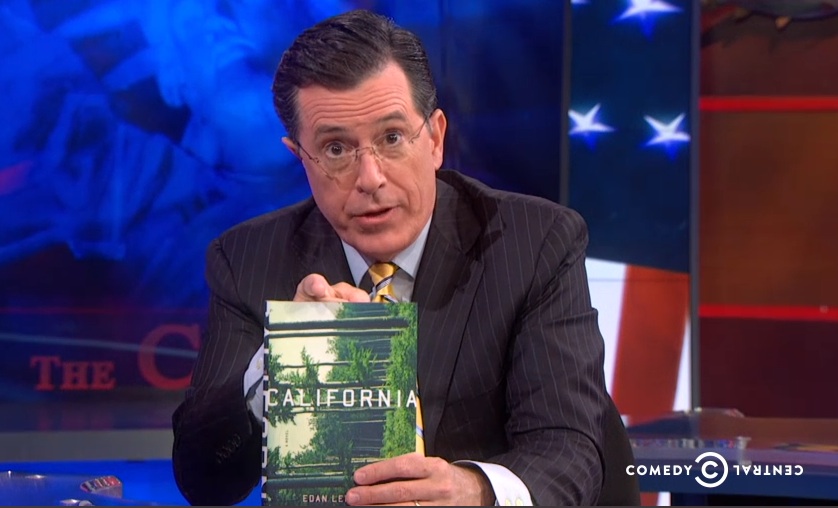
Who Is Stephen Colbert & Why Should He Tell Us What to Read?

Stephen Colbert

Stephen Colbert

Who is Stephen Colbert, I wondered.  And why should he tell me what to read?

I don’t have cable TV, but Colbert, the host of a satirical fake news program on Comedy Central, recently asked viewers to pre-order Edan Lepucki’s debut literary dystopian novel, California, from independent bookstores and attempt to make it a New York Times best-seller.  This gesture is to protest Amazon’s recent blocking of customers from ordering books published by Hachette, the publisher of both Lepucki and Colbert.

Amazon and Hachette are having a  financial dispute.   Amazon now claims at its website that Hachette’s books are not available for 3-4 weeks. (Hachette says they’re in stock.)  Really a shocking fight, and I’m surprised it’s legal.

I love following social trends, and for that reason I DID pre-order California, not from an indie (what indie would that be here?), but from Barnes and Noble.  This first novel, to be published on July 8, is a Barnes and Noble Discover book for the fall.

Confusingly, Amazon has named it one of the best books of the month, but the website says it is “currently unavailable.”  And Amazon says that Colbert’s latest book, America Again, will take 3-4 weeks to deliver.

California is said to be one of the most pre-ordered books ever from Hachette.  Publishers Weekly says that it has,

according to publicist Carrie Neill, gone back to press three times already, for a total of 60,000 copies. As of mid-June, Powell’s had pre-orders for 6,400 copies and the title has ranked, consistently, at #1 on the mini-chain’s bestsellers chart. This week the novel’s Amazon ranking dropped below 1.5 million, but Amazon is not accepting preorders for it, as the book is published by a Hachette imprint.

And so I’ve been suckered in.  Oprah, The Today Book Club, and now Stephen Colbert.

It must be very depressing to be a Hachette writer these days.

Now here’s the thing:  I don’t really buy much from indie bookstores.  It’s not that I don’t like them, but I have to go out of town to support them. So I shop at Amazon and Barnes and Noble.  What else can I do?

I’ve now supported Hachette, but obviously I’m not just a Hachette shopper.  Many literary books deserve to be best-sellers.  What books, new or old, would you promote as best-sellers if you had a chance?

Anything on my “Best of” sidebar deserves to be read.  And I would love to revive Elizabeth von Arnim’s The Pastor’s Wife, Pamela Hansford Johnson’s Helena trilogy,  Elizabeth Spencer’s The Voice at the Back Door, D. J. Taylor’s Ask Alice, Doris Lessing’s Memoirs of a Survivor (the best ever literary dystopian novel), and Jonathan Lethem’s Girl in Landscape and Amnesia Moon (two other great literary dystopian novels).

Now tell me your faves!

Bookstores in Omaha & a Ride on the T-Bone Trail

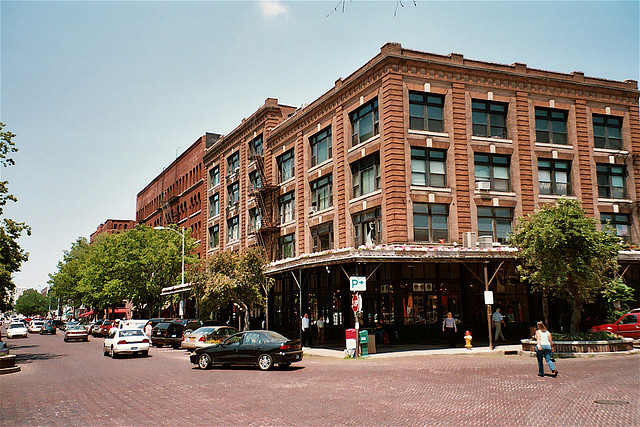
Old Market, Omaha

Old Market, Omaha

Omaha is our favorite city in the Midwest.

It’s not Chicago or Minneapolis.  It doesn’t try to be.

It is a good place to visit on the fifth of July.  After being kept awake by fireworks in our small city in Iowa on the Fourth–could there have been any more firecrackers?–we woke up bleary-eyed and decided to travel to Omaha for relaxation.

Sometimes you have to go to a big city to find quiet.

We  love the Old Market area, a lovely, hip downtown Omaha neighborhood with a world-class used bookstore,  an artists’ co-op, antique shops, many restaurants with attractive verandas, and a lawn ornament shop that sells iron sculptures of pigs.

We do have a sense we’re in a real city here.  We always feel rather unhip:  It’s a little more bustly than we’re used to.  When we first went to Omaha, I informed my husband I wanted to live there.  It might have been a bit of a commute, though.

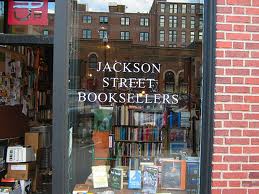
Jackson Street Booksellers, Omaha

Jackson Street Booksellers, Omaha

Naturally we spent a lot of time at Jackson Street Booksellers, the used bookstore.  I recently promised myself I would buy no more books this summer, but darn it!  What you do when you intend to break your Bibliophiles Anonymous pledge  is park your husband in an easy chair and then spend 40 minutes in the literature section.  AND THEN YOU BUY FOUR BOOKS AND PAY FOR THEM YOURSELF.   In retrospect, I wish I’d bought five books.  There was a novel by the Southern poet Alan Tate. Where will I ever see that again?

Then we went to the Bookworm, an independent bookstore in a strip mall way out on Pacific St.   I love this store.  Every summer they have attractive displays. A couple of years ago, intrigued by a flapper dress next to  piles of an appealing book with a cool blue cover, I discovered Laura Moriarty’s  engaging novel, The Chaperone, the story of a demure 36-year-old Wichita housewife who is coerced into chaperoning 15-year-old Louise Brooks (soon to be a film star) one summer in New York.  Last summer they displayed Dante’s Inferno with Dan Brown’s Inferno. (I went for the Dante.) Now they’re revving up for Erika Johansen’s The Queen of the Tearling (to be published July 8), the Number One pick on the IndieNext list this month (an organization of independent bookstores).  I quite like fantasy, and might very well like this novel, but it is a bit odd to have a display without any books.

And then we rode our bikes.  Not in Omaha, however.  We drove to Atlantic in Western Iowa (it’s on our way home, anyway) and rode the T-Bone Trail.

The T-bone Trail, Atlantic to Audubon, Iowa

The T-Bone Trail, Atlantic to Audubon, Iowa

The last time I rode the T-Bone, Nov. 13, 2011, I had a ghastly time.  As I wrote at my old blog:

The temp dropped five degrees in 15 minutes, according to the bank clock, and then we rode into the wind. It was very difficult to make any progress at all. I put my bike in low gear and leaned over the handlebars, but it was very, very cold. After an hour’s riding like that into the wind, I sat down on the trail and rubbed my legs.

But today it was warm and we only rode for two hours. It is absolutely flat, an extremely easy ride unless it is too hot or windy.  Cornfields, woods, prairie, small towns, and finally we rested in a gazebo in Ira, Iowa.   To be honest, I was glad to turn around, because one of my sandals was rubbing against my foot.  Sandals are not good biking shoes.  What was I thinking?

So I’m home, surrounded by lovely books, and I’ll chime in with what I’ve been reading soon.

Happy Long Weekend!

Mom’s Grave

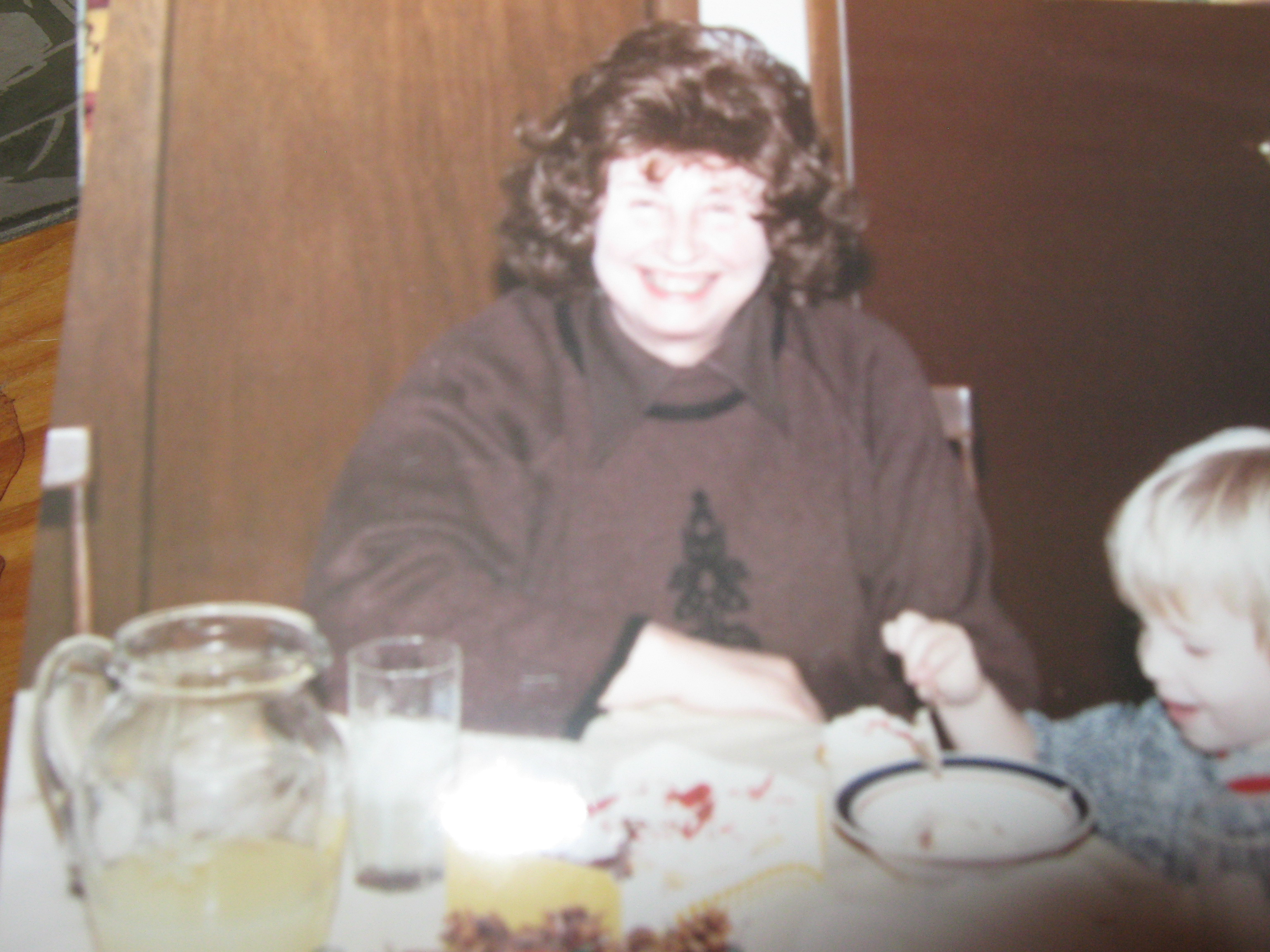
Mom, in her fifties or sixties?  (I'm not a good judge of age.)

Mom, possibly in her fifties.

I am very much against war, and resist holidays that celebrate the Military.  The Fourth of July isn’t quite about the military, thank God, though it borders on it and could be turned into one at a moment’s notice.

They would co-opt all the holidays for the military if they could.

For instance, we have always celebrated Memorial Day by decorating family graves.  Neither my husband nor I realized until recently that it is intended to honor dead vets.

We didn’t make it to Iowa City this year till after Memorial Day.  The day we  finally saw Mom’s new gravestone, which was installed a few months ago, I thought furiously,  Mom, where are you?

I have cried, I have mourned, I have suddenly cried out, “Oh, Mommy” (though she hasn’t been Mommy since I was nine ), and most recently I am irritated by her absence.

There is utter, utter silence from beyond the grave.

My heart was wrenched by the gravestone.  It is flat, and mown brown grass was scattered on top of it. Behind the stone was a big dirt clump with long unmown grass.

All around her are neat graves with flowers.

“Oh my God, oh my God.  Why isn’t that mown?  Is there some maintenance fee the family’s not paying?”  I swept the grass off the stone, picked up the candy bar wrapper, and looked at all the memorials on sticks in the cemetery.

At  the Hy-Vee garden center, we bought a stick with plastic flowers on it.  (This is called a “memorial.”)  The flowers were blue, not her favorite, orange.  Well, they would have to do.

I planted it on the north side of the grave.  Why north?  I don’t know.  Although I longed to use the f— word, because the memorial was so paltry, I couldn’t say it there.  I should have bought several memorials and stuck them around the grave.

Then I felt her there, wanting me to cut the grass around the stone with scissors.  Yes, she once had me do that in her yard.  Scissors!

None of us lives in Iowa City anymore.

Her friends are here.  Her best friend is dying of cancer.

One dies, they all die.

“The next time you see me, I’ll be in my grave,” her friend said at the funeral.

Her husband rudely said to me, “Glad you could make it to the funeral, Kat.”

That was mean.  We couldn’t find the church, even with Google map  (a tornado destroyed the old church and the new one was on the edge of town), but we still got there five minutes early.   I didn’t react to or care about his words.  I had other things on my mind.

My mother had strong feelings about church, family, and cemeteries.  She made a point of visiting her parents’ grave often until she became too old to do so.  It was always decorated with flowers.

I was frantic.  I needed to buy a memorial for my grandparents’ graves, too.  They are next to hers.

Next time, next time.

Nobody visits these graves.

If only I never left Iowa City.  I could have been a spinster, you know.  Then I could have taken care of the graves.

Well, work, love, and the late 20th century took us away.

Karl Ove Knausgaard’s My Struggle, Book 2

My Struggle Book 2 Knausgaard, Karl OveThe Norwegian writer Karl Ove Knaussgard’s My Struggle is my great pleasure this summer.

It is a six-volume so-called “Proustian” autobiographical novel, which Knausgaard refers to as “a nonfiction novel.”  (Only three of the books have been published so far in the U.S.) Reading My Struggle is to find yourself absorbed in a litearary soap opera about the daily life of Karl Ove, a lover/husband/writer/dad/friend.  He describes his relationship with the beautiful, complicated writer, Linda, an actress’s daughter who is deeply sensitive and who has bipolar disorder; his intense affection for their three children but also the mind-numbing boredom of child care; the difficulty of finding time for his work;  moments of depression; his visits to bookstores and coffeehouses; and long drinking sessions.

In other words, he is like us, only he says intellectual things about philosophy and poetry that we don’t say.

Does that tell you he’s not like us?  It does. But Karl Ove is also Everyman.   For instance, he admits he often has difficulty reading poetry.  He says, “I could read it, but poems never opened themselves to me, and that was because I had no ‘right’ to them: they were not for me…. You had to earn the right to read them.”

We become Karl Ove as we read My Stuggle.  Knausgaard doesn’t go for the big moments:  there’s cleaning the apartment, dealing with a psychotic neighbor, making love with Linda, taking the children to a kind of low-rent carnival they happen to pass in the car, giving readings, which he hates, and his fierce need to protect time for writing.

I started with Book Two, partly because the bookstore had it, but also because I didn’t want to be put off by a long introductory volume of a Proustian narrative. I needn’t have worried. Yes, there are layers and layers of stream-of-consciousness, but it is more compelling than Proust’s. And the book isn’t in chronological order–he doesn’t get to childhood till Book Three–so I’m not sure it matters where you start.  Book Two is subtitled A Man in Love and delineates his fierce passion for Linda after he leaves his first wife and moves from Norway to Stockholm.  Their relationship is essentially stable, though they have their disagreements and moments of boredom.   But actually this volume isn’t a chronological narrative either: it opens with a scene in which Karl Ove and Linda irritably attempt to control their children at a couple’s vacation house.  Only later do we learn the genesis of their relationship.

You can read long critical reviews of the book elsewhere, but I want to write about a few episodes that delighted me.

He goes to a cafe for an hour every day to read and smoke.

I never went to the same cafe more than four or five times at a stretch because then they started to treat me like a “stammis,” that is, they greeted me when I arrived and wanted to impress me with their knowledge of my predilections, often with a friendly comment about some topic on everyone’s lips.  But the whole point for me of living in a big city was that I could be completely alone in int while still surrounded by people on all sides.

I love this, because I have had a similar experience with coffeehouses.  When you walk in the door and they already have your drink ready for you, it’s both comical and perturbing, especially if you’ve decided you want something else.

Karl Ove is a bit cranky and socially awkward, as well as brilliant and passionate: he reminds me of Levin in Anna Karenina, particularly in a scene of his first daughter’s christening.  The priest was reluctant to christen Vanja because Karl Ove and Linda are not married. Suddenly at the christening, Karl Ove, not a Christian, ups and takes Communion.  His meditation on Christianity reminds me of Levin’s when he is required to confess to a priest before he marries Kitty.

Karl Ove also goes to bookstores and buys many books, knowing that he won’t read most of them.  Heavens, nobody has ever bought as many books as Karl Ove, and possibly I, and possibly you.

How can anyone be so fascinating on boring details of living?  But he wants to get past daily living so he can write.

Everyday life, with its duties and routines, was something I endured, not a thing I enjoyed, not something that was meaningful or that made me happy.  This had nothing to do with a lack of desire to wash floors or change diapers but rather with something more fundamental; the life around me was not meaningful.  I always longed to be awa from it.  So the life I led was not my own.  I tried to make it mine, this was my struggle, because of course I wanted it, but I failed, the longing for something else undermined all my efforts.

I love, love, love reading this.  I’m continuing with it (going on to Book One) this weekend.  The great thing about reading Book Two is that I will now appreciate the artistic design of Book One.

Knausgaard said in a recent Amazon interview:

I just tried to write a novel. This was the only way I could do it at the time. So no, no active down-tearing of anything. But for me, these books definitely are novels. I didn´t try to represent my life, but wanted to use my life as a kind of raw material for a novelistic search for meaning or for meaningful patterns. I use all the novels tools, I can describe one day over three hundred pages, or a year in a sentence. It isn´t fiction, though, it´s non-fiction, but it isn’t a documentary or a memoir either: it’s a non fiction novel.

Really a fascinating writer.