More on Proust Translations: A Letter to the TLS, The Boston Review on Moncrieff’s Translation, & Is It Shorter?

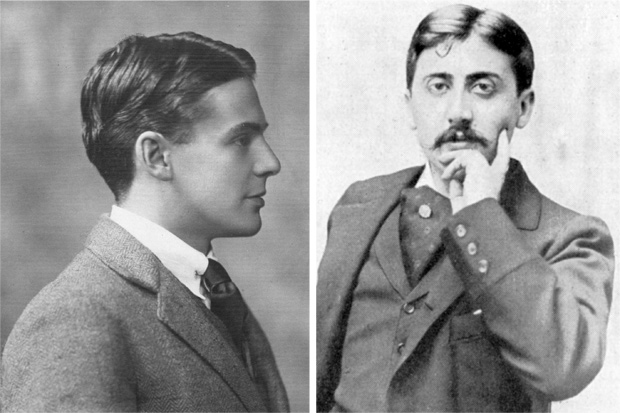
C. K. Scott Moncrieff and Proust

C. K. Scott Moncrieff and Proust

On Oct. 31 in the TLS, A.N. Wilson reviewed a new biography, Jean Findlay’s Chasing Lost Time: The Life of C. K. Scott Moncrieff.  Wilson says that Moncrieff’s English translation of Proust is a masterpiece and raises the question of whether it is better than Proust.

I was fascinated by Wilson’s review since I am reading Proust’s In Search of Lost Time in the marvelous Moncrieff translation corrected by Terence Kilmartin and later by D. J. Enright.  I do have two volumes of the Moncrieff original in old Modern Library hardback editions.  Should I read this musty hardback of The Guermantes Way in the original translation?  (The smaller print makes it less attractive.)  My other  flippant thought was, “Is Moncrieff’s translation shorter?” It is not.

In the Nov. 7 issue of the TLS, Christopher Prendergast, the general editor of the Penguin translations of Proust, wrote an outraged Letter to the Editor about Wilson’s “eccentric” claim that Moncrieff is better than Proust.  He says he called Moncrieff’s efforts “heroic” and the translation “majestic” in the introductions to the Penguin translations.  That does not, however, mean that the new translations are not superb.

Literary tastes naturally vary, and there are many ways of tasting Proust.  Lydia Davis’s translation of the volume re-baptized by her, largely for reasons to do with Proust’s own tetchy reservations over Scott Moncrieff’s version, as The Way by Swann’s is characterized by Wilson as “technically more ‘accurate,’  but no one, reading it, could consider it an atmospheric piece of writing.”  I leave it on one side what possibilities there are for us with The Way by Swann other than by “reading it.”  By “no one,” I take it that…this is code for Wilson.

He then quotes two passages, the first by Moncrieff and the other by Lydia Davis, and asks us which we like better.  The passage he chose?  Davis’s is by far more vivid.

Translations fascinate me, and I am certainly not adverse to the Penguins. For one thing, these are gorgeous books.  I respect the idea that we need new translations for a new century, and certainly there are different philosophies of translation.  Do you go with Moncrieff’s title Swann’s Way, or Davis’s more literal The Way by Swann’s?  (By the way, Davis’s is still called Swann’s Way in the U.S.)  We do have a copy of Davis’s translation (the book sale), and though I admired the first 125 pages, I went back to my Moncrieff-Kilmarten-Enright.  I prefer it.

What do others think of Moncrieff?  In The Boston Review, on June 16, 2014, Leland de la Durantaye reviewed a new Yale University Press edition of the C. K. Scott Moncrieff translation of Swann’s Way, edited and annotated by William C. Carter.  Carter believes the Moncrieff is the best, but de la Durantayef finds it very odd that Carter undid the revisions by Kilmarten and Enright.

There is always a tension in translation between the spirit and the letter, between conveying things we might call tone, mood, feel, or music, and being as literally faithful to the original as possible. Moncrieff excelled at both. He created a rich and recognizable style that became, for English readers, Proust. Because the translation was the only one in existence for so very long, it naturally became closely intertwined with the fate of the work in the English-speaking world. But translations age differently—and more quickly—than originals, and Moncrieff’s monumental achievement, with its many Edwardian intonations, came to feel increasingly dated. With this in mind Moncrieff’s translation was reviewed and revised in 1981 by Terence Kilmartin, and then re-reviewed and re-revised in 1992 by D.J. Enright, who changed its title to the more literal In Search of Lost Time. Ten years later, with the book at last out of copyright, a new translation was produced with a different translator for each volume, beginning with Lydia Davis’s 2002 translation of Swann’s Way—which she lobbied energetically, but in vain, to have retitled more literally as The Way Past Swann’s Place.

Translators have difficulty capturing the very real differences of the experience of reading a book in a foreign languages.  For instance, the best translations of Catullus I have read are in David Ferry’s 2012 National Book Award winner, Bewilderment: New Poems and Translations.  They are far from literal, but they capture the spirit. Are they Catullus?  Sort of.

And so as a common reader,  I am going with the Moncrieff-Kilmarten-Enright.  I love it, so why switch?

That said, I am sure the Penguins are worth reading.  Lydia Davis’s translation of Madame Bovary is a masterpiece.
The Barbara Pym Society of North America & Why Men Are Laundry Addicts

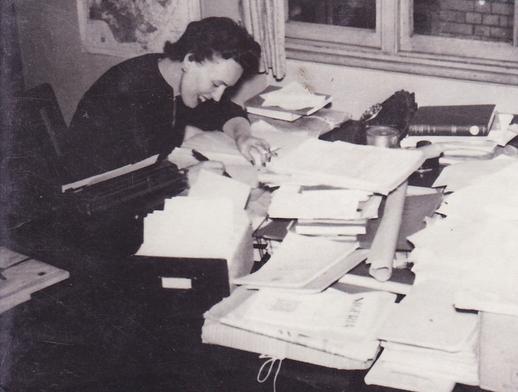
Barbara Pym at the International African Institute

Barbara Pym at the International African Institute

I recently joined the Barbara Pym Society, thinking I might attend the conference in Boston in the spring.  Though it does involve singing hymns, which I am not keen on, not being musical, as all know who have heard my stirring rendition of “All the Way to Reno,” I would enjoy meeting other Pymites and hearing papers on A Quartet in Autumn.

The real reason to join literary societies, however, is to collect the newsletters.  The house used to be awash in publications from the Trollope Society (a bit of a snooze), the Willa Cather Foundation (fascinating), and The Angela Thirkell Society (quirky).  Today I received two editions of Green Leaves, The Journal of the Barbara Pym Society.  It is a perfect blend of scholarship and entertainment, including well-written articles with such titles as “The Spinster’s Natural Clothing:  Postwar Styles in Excellent Women,” “Barbara Pym Society Knitting Competition:  Keith’s Sweater,” “Homosexuality in A Glass of Blessings,” and “Austen, Love, and Pain in the Novels of Barbara Pym.”

Pym is one of the best writers of the twentieth century, but not everyone understands her. (I am not talking about you.)  I have met a few men who scorn her.  On the other hand, one male friend of mine reads almost nothing but Pym.  When I tried to introduce him to Penelope Lively’s books, he said, “There is no comparison.”

And yet Pym seems to be stuck in the middlebrow women writers category, along with wonderful writers like Elizabeth Bowen and Elizabeth Taylor.  Pym is the best of these three:  she never wrote a bad sentence.  Bowen is superb but can be a bit stagey, and though Taylor’s books are enjoyable, I honestly never remember anything about them once read (with the exception of a few of her short stories).

But Pym can be read and reread.  Her wit, elegance, and liveliness never fail me.

WHEN MEN DO LAUNDRY…

One night I found five shrunken cotton sweaters in my laundry basket.  My husband had thrown them into the washer with regular detergent, and then into the dryer.

What an incentive to lose weight, right?

What do you do when a man gets ahold of your laundry?

My husband loves to do laundry.  It gives him a feeling of accomplishment.  Sometimes he does not use enough detergent, so I  sneak it back downstairs and do it again.

“You can wash those sweaters with Woolite, but you know how you always see sweaters drying on towels around here?  That’s because you can’t put sweaters in the dryer.”

I have had to replace a few of the sweaters.  I have many pilled sweaters to wear around the house, but I need a winter wardrobe reserved for out of the house, preferably something the cats haven’t clawed.

The mall has nothing warm in my size.  I’ve complained before about how difficult it is to find large clothing.

Catalogues have more choices, but there is much sending back and forth to find the perfect fit.

The same sweater in the exact same style as those lost costs $10 more than it did in 2010.  And so I decided to go for something a little nicer and slightly more expensive.

Diet, you say.  It is the perfect solution.  I do, I do.  Lose 15 pounds or 50 pounds, it all comes back.  That is the dieter’s secret.  And so I gain and lose the same weight every year.  I have clothing in five sizes and a size 8 coat I wore for three months in 2001.

Oh, well, it is time to go on a diet again.  Fifteen pounds off before the holidays.  But will I be able to fit into the shrunken sweaters?  Let’s go for 25…

Checking-in on Proust & Barbara Pym’s Less Than Angels

The last couple of years I’ve read fewer books than usual.  Too many long books (War and Peace three and a half times).

And I am still reading long books.

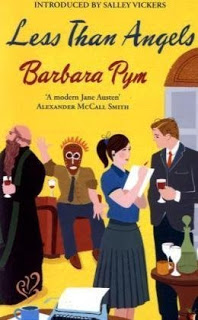
Less Than Angels Barbara Pym Cartoon Pym 4I am also a fan of short books, and I was very happy to read (and finish) Barbara Pym’s Less Than Angels.  This charming novel, published in 1955, is  wilder than her tales of curate-obsessed spinsters.   It centers on a group of anthropologists, some of whom appear in her other novels, because Pym obviously thinks they’re very funny. The novel is narrated from multiple points of view: my favorite character is Catherine Oliphant,  a romance writer and women’s magazine journalist, who provides a humorous outsider’s look at the group.  There is also Tom, her boyfriend, who returns from Africa after two years.  She kicks him out when she learns he is cheating on her with Deirdre, a 19-year-old anthropology student. Mark and Digby, two bachelors who are competing for grants for field work, are amusingly on the make at the new anthropological library and research institute.  And Deirdra, who lives in the suburbs with her mother, aunt, and older brother and is still very adolescent, is thrilled to have a sophisticated boyfriend, though she forgets him when he goes back to Africa.  Catherine proves the truer lover.

Pym’s mirthful attitude towards academics is typified by sketches of Professor Mainwaring, who persuades an American woman to fund grants for the center, and Miss Clovis, who became caretaker of the center after leaving Learned Society over the grand subject of tea.

The subject of Miss Clovis’s quarrel with the President was known only to a privileged few and even those knew no more than that it had something to do with the making of tea.  Not that the making of tea can ever really be treated as a petty or trivial matter and Miss Clovis did seem to have been seriously at fault.  Hot water from the tap had been used, the kettle had not been quite boiling, the teapot had not been warmed…whatever the details, there had been words, during the course of which other things had come out, things of a darker nature.  Voices had been raised and in the end Miss Clovis had felt bound to hand in her resignation.

So funny!  Of course I might have quit too…

I am also loving Proust’s In Search of Lost Time, though it’s futile to try to articulate it.  The series is one long novel, no? My husband, who has read the entire series in French, crossly says that Swann’s Way is the only volume worth reading.  Well, I’m simply loving it, but I see the structure is tighter in Swann’s Way than in the second volume, In a Budding Grove. Of course it’s all modernist brilliance. And there are seven fucking volumes so get used to it! One basks in Marcel’s symphonic descriptions of places, walks, meals, dinner conversations, the hotel in Balbec, neurotic worries about girls, friendships with the pretentious Bloch and the generous Robert, and lovesickness for the lively Gilberte Swann,.  The pattern of hopeless, anxious love is set by  his relationship with his mother, but his love for Gilberte is also echoes the pattern of Swann’s courtship of the fickle Odette, who makes him miserable.   In the second volume, we are amazed to find that Swann has become a bourgeois husband bustling to convince government officials to dine with Odette, since his aristocratic connections won’t entertain her.  There are many comic episodes: when Gilberte tells Marcel that Swann and Odette don’t like him, Marcel is indignant and writes him a very long letter about his love and respect for the Swanns. Ah, youth!  So funny!  I do recall writing a letter like that to a boyfriend’s parents, but thank God I didn’t send it.

I’ll try later to synthesize some comments by critics and biographers on Proust.  How I love homework!

Doris Lessing’s If the Old Could…

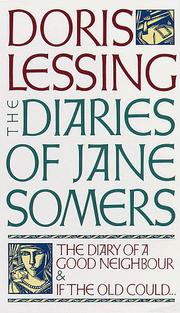
Diaries of Jane Somers Doris LessingIn the early 1980s, Doris Lessing published two remarkable novels under the name Jane Somers, The Diary of a Good Neighbor and If the Old Could...

“I have been thinking about writing a pseudonymous novel for years.  Like, I am sure, most writers.  How many do?  It is in the nature of things that we don’t know.  But I intended to come clean from the start, only wanted to make a little experiment,” Lessing wrote  in the preface of the paperback edition,  The Diaries of Jane Somers, which was published after she admitted to the authorship,

She said she wanted to be reviewed on merit, and hoped it would be a freeing experience to write pseudonymously.

And it did turn out that as Jane Somers I wrote in ways that Doris Lessing cannot.  It was more a question of using the odd turn of phrase of an adjective to suggest a woman journalist who is also a successful romantic novelist:  Jane Somers knew nothing about a kind of dryness, like a conscience, that monitors Doris Lessing whatever she writes and whatever style.

Indeed, few recognized Jane Somers as Doris Lessing.  Her British publishers, Cape and Granta, rejected Jane Somers’ novels, though Robert Gottleib of Knopf in New York immediately knew it was Lessing and asked, “Who are you kidding?”  According to the dust jacket bio, Jane Somers was a well-known woman journalist.  Reviewers didn’t look beyond that.

Last year I wrote briefly about The Diary of a Good Neighbour, which I consider the better novel of the two.  The middle-aged narrator, Janna, a women’s magazine editor and romantic novelist, befriends Maudie, a woman in her nineties, and their difficult friendship changes her ideas about obligations to the elderly.  She does more for Maudie than she did for her own mother.

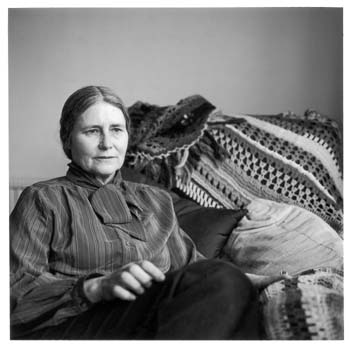
Doris Lessing, the 1980s

Doris Lessing, the 1980s

In If the Old Could…, Janna, now in her fifties, still at the magazine, has no time for romance.  Masturbation has been sufficient for her sexual needs since her husband Freddy’s death years ago.  But as the novel opens, she falls into a romance. When she steps off a train and catches her foot in the gap, an attractive man catches her and she finds herself lying in his arms, laughing. And then Janna notices a scowling girl behind him (his adult daughter).  The man walks away with her, and Janna expects never to see him again.

In his fifties, I should say.  Like me….  I went slowly up and out, more shaken than I had thought, and by more than my fall.  I was thinking, That was an unusual man, one that would stand out anywhere, in any crowd.  You forget how mediocre most people are.  Then, suddenly, one of the other kind.  What did he think of me?  Well, I knew, there was no mistaking that.

The next day she retraces her footsteps to Soho Square, and as she looks at spring flowers, she sees Richard.  The two fall in love, and it is true love, that dizzying flow of sexual and psychic connection.  But there are obstacles to their having a sexual affair. His daughter Kathleen stalks them, and soon Janna’s disturbed niece and new flatmate, Kate, is also stalking Janna. (And, yes, the girls are doubles.) In this multi-layered narrative, love is the province of the young, while the “old” must deal with doubles, dreams, shadows, and messes.

Family life is so intricate that Janna and Richard cannot jump into bed with each other.  Janna is ready for love, but Richard has some issues.  Richard’s wife is a superstar doctor, while he is ostensibly content to be a family doctor.  They have three children: Matthew is his young, insensitive lookalike-double, and Kathleen is unhealthily attached to the child with Down’s Syndrome who is the center of the household (and also to Richard).   The childless Janna should be free, but she is now very involved with her nieces. A few years ago Jill, a cool, bright young woman who is now working in the editorial department of the magazine, showed up at her flat in London and persuaded Janna to let her move in.  Now that Jill is living with her boyfriend, her younger sister Kate has moved into Janna’s flat.  But Kate is different.  She is one of those people who have been born without skills, who cannot take care of herself, and destroys everything she touches.  Where does Kate belong?  In the squat nearby where she has made friends?  In addition to the burden of Kate, Janna feels responsible for Annie, an old woman who was a neighbor of the late Maudie.

It is Richard himself who is the biggest obstacle to their love affair, though.  After he requests a picture, and Janna gives him a snap of herself as a beautiful young woman, he is unsettled.  Perhaps she is out of his league?  And when she arranges for them to have a weekend alone at her flat, he says her bedroom doesn’t look like her and they do not go to bed together. Yet Janna blindly continues to love him, to spend all her free time with him, and makes him the center of her life.  Their long walks and nights at cafes are idyllic.  But their obligations are such that they cannot love as they could have when they were young.

I kept thinking, Poor Jane. Like so many of the men in Lessing’s novels, Richard fears strong women.

And yet…that’s what it’s like, isn’t it?

Except in the movies.

Poor Janna.

Poor Doris.

Proust Translations: Moncrieff, Moncrieff Revised, or Penguin?

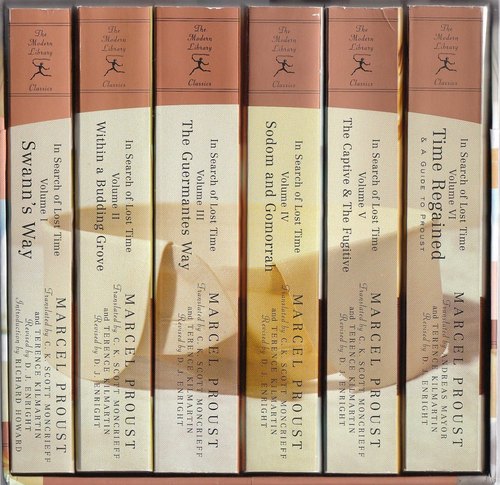
The Modern Library edition of Proust translated by C. K. Scott Moncrieff and Terence Kilmarten and revised by D. J. Enright.

The Modern Library set, translated by C. K. Scott Moncrieff and Terence Kilmartin and revised by D. J. Enright.

I have been reading Proust for three weeks.

In Search of Lost Time is a page-turner.

That is a comment on middle age, is it not?  When I first read Swann’s Way, it seemed a collection of beautiful, haunting, digressive essays.

Now I see form and story, as well as elegaic essays, and will write soon about the second volume, Within a Budding Grove.

But I wonder, Which translation should I be reading?

I am reading the Modern Library paperback editions, translated by C. K. Scott Moncrieff and Terence Kilmartin and revised by  D. J. Enright.  I used to have a fragile, falling-apart seven-volume Modern Library set in the original Moncrieff translation.  My husband read  Proust in the  Moncrieff and Kilmartin translation.

But is the original Moncrieff even better?

In an article in the Oct. 31 issue of the TLS,  “Faun’s Way,” a review of Jean Findlays’ Chasing Lost Time:  The Life of C. K. Scott Moncrieff, A. N. Wilson says that Findlay’s excellent biography reminds readers of Moncrieff’s literary genius and raises the question of whether his translation is better than Proust’s original.   Moncrieff’s is not a literal translation, but Proust himself very much admired it. Joseph Conrad preferred Moncrieff’s rendering to Proust.

Wilson writes,

Many of us with A level French are not quite able to read A la Recherche without frequently repairing to our frayed Harrap’s Dictionaries, and feel, if we are honest, that we have got more out of Proust by reading him in Scott Moncrieff’s pocket-sized, beautifully bound blue volumes, with their perfect dust wrappers designed by Enid Marx.  Many of us, indeed, would surely want to go further, and to say that we have derived more pleasure from these twelve volumes than from any other reading experience, and that, as well as basking in Scott Moncrieff’s prose, and luxuriating in the comedy of Proust’s characters, we have also learnt what little we know about life from reading and rereading them.

He goes on to say, “Scott Moncrieff’s twelve sky-blue volumes, therefore, belong to that special category of translations which are themselves literary masterpieces.”

And now I’m saying to myself, F–, f—, f—, I have the wrong translation then.

Coincidentally, I found a reference to the sky-blue Proust in Barbara Pym’s Less Than Angels.  When  Tom, an anthropologist, writes from Africa   about a memory that was “a moment out of Proust,” his girlfriend Deirdre is dismayed.

Must I then read Proust?  she asked herself despairingly, seeing the twelve blue volumes with red labels in Catherine’s bookshelves, for she was not much of a reader at the best of times.

The 12-volume sky-blue set of  Scott Moncrieff's Proust.

The 12-volume sky-blue set of Scott Moncrieff’s Proust.

All right, I don’t have the sky-blue Chatto & Windus, but I’m not panicking.  I love my paperback editions, whoever is responsible for the translation. The French editions of A la recherche were revised, first in 1954 and then in the ’80s:  hence the revisions by Kilmartin and then Enright.

I did find one of my old Modern Library editions (more than slightly foxed), The Captive.  Looking at the first page, I see very few differences in the translation.

Here is a sentence from Moncrieff:

The first sounds from the street had told me, according to whether they came to my ears dulled and distorted by the moisture of the atmosphere or quivering like arrows in the resonant and empty area of a spacious, crisply frozen morning; as soon as I heard the rumble of the first tramcar, I could tell whether it was sodden with rain or setting forth into the blue.

Here is the Enright revised:

The first sounds from the street had told me, according to whether they came to my ears deadened and distorted by the moisture of the atmosphere or quivering like arrows in the resonant, empty expanses of a spacious, frosty, pure morning; as soon as I heard the rumble of the first tramcar, I could tell whether it was sodden with rain or setting forth into the blue.

Does anyone have a preference?

Presumably there are whole paragraphs that don’t appear in the original Moncrieff.  But if you read the original Moncrieff, it is still Proust.  Yes?

And  there are the recent Penguin translations, each by a different translator.  Lydia Davis translated Swann’s Way.

Which Proust are you reading, or have you read?

Back to my Modern Library much-revised paperback editions!

Why Did I Bother to Vote?

i-voted-stickerThere is a Braley sign as big as a sail on Polk Ave.

Braley, Appel, Hatch…  All Democrats.  They’re my guys.

Vote.  It’s what we do.  V-O-T-E.  I’ve voted in every major election since I was old enough to vote.

The negative ads were so ghastly this year that I almost didn’t vote.

You must, I told myself crossly.

There was a big turn-out.  I stood in line.  Men and women of all ages were hurrying in and standing in line.  No one hassled me this year.  During the 2012 presidential election, a woman told me my name wasn’t on the list.  I made her look  again…and again…and again…and there it was. We should wear tags to protest the punitive new ID laws in some states: DO NOT HASSLE VOTERS.  We shuffled in line and smiled; I assumed many of us were Democrats.  This precinct is said to be the second most liberal in the state.

No one I voted got elected.  The state went Republican.

It’s a bit of a shock, so I’m playing this R.E.M. song, “Houston,” for all of us who are in despair.  R.E.M. wrote it after the Hurricane Katrina disaster, so it doesn’t quite apply, but we must “play the game” and hope the Democrats come up with some star power next time.

Here is the opening stanza:

If the storm doesn’t kill me the government will
I’ve got to get that out of my head
It’s a new day today and the coffee is strong
I’ve finally got some rest


Art & Books in Omaha: “In Living Color” at the Joslyn Art Museum & The Bookworm

Andy Warhol's "Camouflage"

Andy Warhol’s “Camouflage” at the Joslyn Art Museum in Omaha.

A friend’s abstract painting of a lake, the water and sky tousled by blues,  yellows,  greens, and purple, has changed the way I look at art. It calms me in the winter.  It helps me focus on the colors that will return in spring.  I don’t pay much attention to the prints I bought at museum shops.  All you need is one painting.

I have always enjoyed museums, but in recent years I have developed a more intense need to look at art. Sometimes I skim the art criticism in The New Yorker, though I don’t read it too closely, or it will make me unhappy, because I won’t have an opportunity to see the exhibits.

“Wouldn’t you like to go to New York to see the Matisse Cut-Outs show at MOMA?” I idly asked my husband.

Nothing will compel him to go to New York, but he will go on jaunts to museums in nearby cities.  Over the weekend we went to the Joslyn Art Museum in Omaha to see the superb exhibition, “In Living Color:  Andy Warhol and Contemporary Printmaking.”

If you’re not a Warhol fan, you will be after you see this stunning exhibition. The show consists of more than 110 works by Warhol and other twentieth-century artists, among them Louise Bourgeois, John Baldessari, Helen Frankenthaler, Keith Haring, and Richard Diebenkorn.  Karin Campbell, the curator of contemporary art at the Joslyn Art Museum, selected these works from the Collections of Jordan D. Schnitzer and his Family Foundation for a show centered on the theme of how Warhol’s “use of color impacts both subject and viewer, creating a dialogue between Warhol and nineteen contemporary artists who all use color to shape how we understand images.”

Seeing the screen prints “live,” so to speak,  gave me the thrill of the experience of Warhol’s powerful art.  I shivered looking at “Camouflage,” a series of prints based on cloth Warhol bought at a military supply store.  In the sixties, anti-war protesters had, and this is from the placard, “appropriated camouflage, turning it into a symbol of the unbridled power of the military industrial complex and the hubris of the American government.”  Warhol applied inorganic colors to the camouflage designs “to nullify its power of deception.”  The Joslyn displays seven of the camouflage prints, whose colors range from psychodelic to muted.  The camouflage becomes something altogether different when the colors are changed.

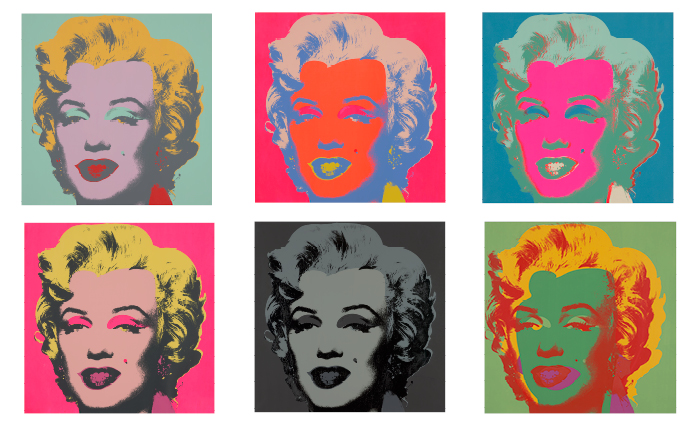
Warhol reacts to contemporary culture in his art, and nowhere is it more apparent than in his flamboyant portraits of pop icons.  The show displays nine of the Marilyn Monroe portrait screen prints, identical except for the color scheme.  I got a sense of the diminution  of character caused by celebrity.  The colors can make her look sad, vapid, depressed, worried, cruel, or ugly.   I have never been a Marilyn fan, but thesmudging out of her personality is painful, particularly in the green screen print at the bottom right.

Andy Warhol's portraits of Marilyn Monroe

Andy Warhol’s portraits of Marilyn Monroe

We also saw  the Mao portraits, a portrait of Edward Kennedy commissioned for a campaign fundraiser, a lovely portrait of Liza Minelli, and the chilling Electric Chair series.

Yes, the flowers were there, too, and I want a bedspread with that beautiful print.

We were fascinated by three in the Cowboy and Indian series, Annie Oakley, Geronimo, and John Wayne.

You will see that I have written only about Warhol, but he has star power that few other artists do, and who knows when I’ll get a chance to see his work again?

THE BOOKWORM.   When we arrived at the site of The Bookworm in Omaha and found an empty store, we panicked. We love The Bookworm, one of our favorite indepdendent bookstores. Had it gone out of business?  Fortunately, no.  It has moved about a mile away to Loveland Centre, a new shopping center at 90th Street and West Center Road.

I love the new space, the light wood and the high ceilings.  It reminds me a bit of the old Borders stores.  I limited myself to one book this time,  Nicola Griffith’s Hild, finally in paperback.   I’ll be back.

An Interview with Michelle Huneven, Author of Off Course

Michelle Huneven

Michelle Huneven

Michelle Huneven is the author of Off Course, one of my favorite novels of the year.  In this short, graceful novel, set in the ’80s, the heroine, Cressida, cannot write her dissertation. Cressida moves to her parents’ A-frame in the mountains to write, but after falling in love with Quinn, a married, semi-literate carpenter, she works as a waitress and procrastinates writing for four years.  If you have ever hesitated about your future after school (or some other pivotal time in your life), you will identify with Cressida.  (You can read more about  Off Course in my post here.)

Michelle has an MFA from the Iowa Writers’ Workshop and teaches creative writing at UCLA.  She is the author of four novels, three of which, Round Rock, Jamesland, and Blame, have been finalists for the L.A. Book Award.  Blame was also a finalist for the National Book Critics Circle Award.  Her awards include a GE Younger Writers Award, a Whiting Award for Fiction, and a James Beard Award for food journalism.  For many years she supported herself as a food critic for The Los Angeles Times, the LA Weekly, and other publications.

The Interview

Mirabile Dictu:  I love everything about your perfect novel:  the characters, the style, the detailed descriptions of the mountain setting.  When the heroine, Cressida, moves into her parents’ cabin on the mountains to finish her dissertation, she not only abandons her dissertation but gets involved with the wrong man. So many of us identify with Cressida’s experience (especially reviewers at the Los Angeles Review of Books and Pop Matters, who loved your novel), or at least have had  friends who procrastinated writing their dissertations and went wildly off course.  What inspired you to write Cressida’s story?

Michelle Huneven:  Thank you, Kat, for saying such kind things about Off Course, and for conducting this interview.

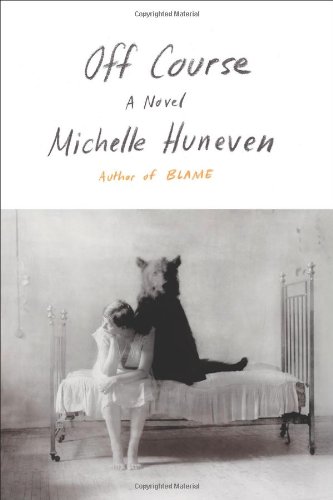
Off Course by Michelle HunevenIn my own life, I had a hard time in my late twenties. That age can be so perilous.  It’s the time when we’re done with school and we’re released into the world at large and must make our way. If there is unfinished business, or you haven’t been given certain tools, or there are destructive family patterns, this is when they can start to surface and wreak havoc in a young life.  It’s also the time when certain decisions start to crop up concerning marriage, children and career The late twenties are also the years when you start building your resume, line by line: So–do you take the ill-paid internship consistent with your professional path, or do you wait tables and make enough so you can live on your own without a roommate and afford to buy the occasional book?

In Off Course,  I wanted to write a novel about a woman who took a misstep and ended up in a place where family dysfunction and her own immaturity came home to roost.  I wanted it to be the book that I should have read back in my own twenties, when I got myself into a situation I couldn’t see my way out of, when my psychological problems were acted out rather than addressed.  I don’t think reading Off Course or a book like it could have changed me overnight, but it might have made me less lonely, and given me additional ways to understand my predicament.

Mirabile Dictu:.  I am always so grateful to read a short literary novel, because often even the best long novels sometimes ramble.   But do short novels get the same respect as long novels?  (Obviously they do from me.)

Michelle Huneven:  Many short novels are beloved and respected:  The Great Gatsby, My Antonia, Pnin, Housekeeping, etc.  That said, I think I know what you mean.  I have lost patience for what I call “mid-novel sag”–a lull in the tension during which the writer slowly sets her ducks in a row for the ending.  (I’ve been guilty of this myself, which perhaps is why I’m so sensitive to it.)  Nobody wants to get deep into a novel only to find themselves  in the doldrums… I love being immersed in a novel, but my attention span isn’t what it used to be.  (Whose is?)  The challenge, clearly, is to keep a novel taut and lively throughout without sacrificing depth and meaning and characterization.

Mirabile Dictu:  In Off Course, Cressida encounters a half-tame bear who leaves paw marks on the cabin windows.  In your earlier novel, Jamesland, the heroine encounters a deer in her dining room. Obviously you’re fascinated by wild animals.  Do you use them as symbols?

Michelle Huneven:  Rather than symbols I prefer to think of the animals in my books as resonances—there’s something ancient there that twangs between fear and attraction, but we can’t quite pin it down.

In Jamesland, the deer serves as a kind of spiritual “figurehead,” for lack of a better word.  As you say, a young woman wakes up to find a deer in her house.  She chases it outside and in the morning, she can’t quite tell if the whole episode was a dream or not; at any rate, she is sufficiently disturbed by the deer to discuss it with a minister. The minister suggests that the young woman explore “what deer mean to you.”  Over the course of the novel, the young woman looks at deer from many different perspectives, and by the end, although she still can’t articulate “ what deer mean to her,”  her entire life has changed.

In Off Course, the bear appears in various forms, too: as bearish men, as a rug, as food. The reader can make of him what he or she wants.  I suppose I saw the bear variously as a shadow or other, a creature of deep appetites, indifferent to civilized customs.  I’ve always loved that Delmore Schwartz poem, “The Heavy Bear That Goes With Me” and thought of it often when writing Off Course.

Mirabile Dictu:  Did any writer(s) influence you in your writing of Off Course?

Michelle Huneven:  Yes.  I was constantly checking with various writers to see how they obtained certain effects, among them Charlotte Bronte, Mona Simpson, John Muir, Alice Munro, Tolstoy.

Mirabile Dictu: What are you reading now and who are your favorite writers?

Michelle Huneven: Lately, I’ve been doing a lot of rereading, which is the deepest pleasure, because once you know the story, you can relish all the smaller touches in a book, and the cleverness of its construction.  Charlotte Bronte, Jane Austen, Barbara Pym, Willa Cather, Alice Munro, Mona Simpson are some of my longstanding favorites.  Also: Evelyn Waugh, Vladimir Nabokov, Henry James, Herman Melville, Giuseppe diLampedusa, Proust—I could go on and on…

Presently, I am listening to Jane Eyre—which means that as I drive or walk or garden or do dishes or fold laundry, I have my earbuds in place.  It’s heaven!  I just finished listening to Juliet Stevenson read Mansfield Park, and before that, Persuasion.  (I have listened to Persuasion 3 or 4 times now. And this is a second time through hearing Jane Eyre read by Amanda Root.)  As for reading—i.e. holding a book—I’m presently doing a second pass through A Glass of Blessings by Barbara Pym. Recently, I read and admired Molly Antopol’s collection of short stories, The Un-Americans. And, like thousands of others, I loved all three books in Elena Ferrante’s (presumably) autobiographical project: My Brilliant Friend, The Story of a New Name, and Those Who Leave and Those Who Stay.

Mirabile Dictu:  Thank you so much for the splendid interview, Michelle!

You can read more about Michelle at www.michellehuneven.com/‎