Reading in Bed: Paperbacks vs. Hardcovers, & Quasi-Collectibles

reading in bed tumblr_nfm2s10ofA1qhavevo1_500Reading in bed has always been my thing.

“Honey, I’m home.”

I walk around in my stockingfeet while I make a cup of tea.  I retire to my bed with three or four books.  I keep meaning to replace the platform bed with a new frame and a spring mattress.  I am too old to sleep on a platform bed. Was I ever young enough to sleep on a platform bed?  I need a nice big fourposter bed with a tall headboard.  And several very comfy pillows.

When you read in the supine position, as Laurie Colwin called it, paperbacks are the perfect weight.  They are light and flexible. The spine of your Oxford paperback of War and Peace will not crack as you rest it lightly on your raised knees. On the other hand, a hardcover of War and Peace is unwieldly.

wuthering-heights-2I fell in love with paperbacks as a girl in the ’60s.  Who could resist the Ballantine paperback editions of Lord of the Rings? Or the Gothic love scenes depicted on the mass market covers of Wuthering Heights?
I do have my share of hardcovers. I own first editions of Ann Beattie, Raymond Carver,  Margaret Drabble, and others whose books I bought when  new.  But I am not a collector: I can take or leave limited editions.   I am still gobsmacked by the idiocy of my spending $330 on the complete edition of  Trollope’s The Duke’s Children (my shocking introduction to The Folio Society). I am oblivious to the allurement of leather covers et al  but I wanted the complete text.

Anyway, I was sorting a few quasi-collectible yet affordable hardcover volumes and decided to take some snapshots.

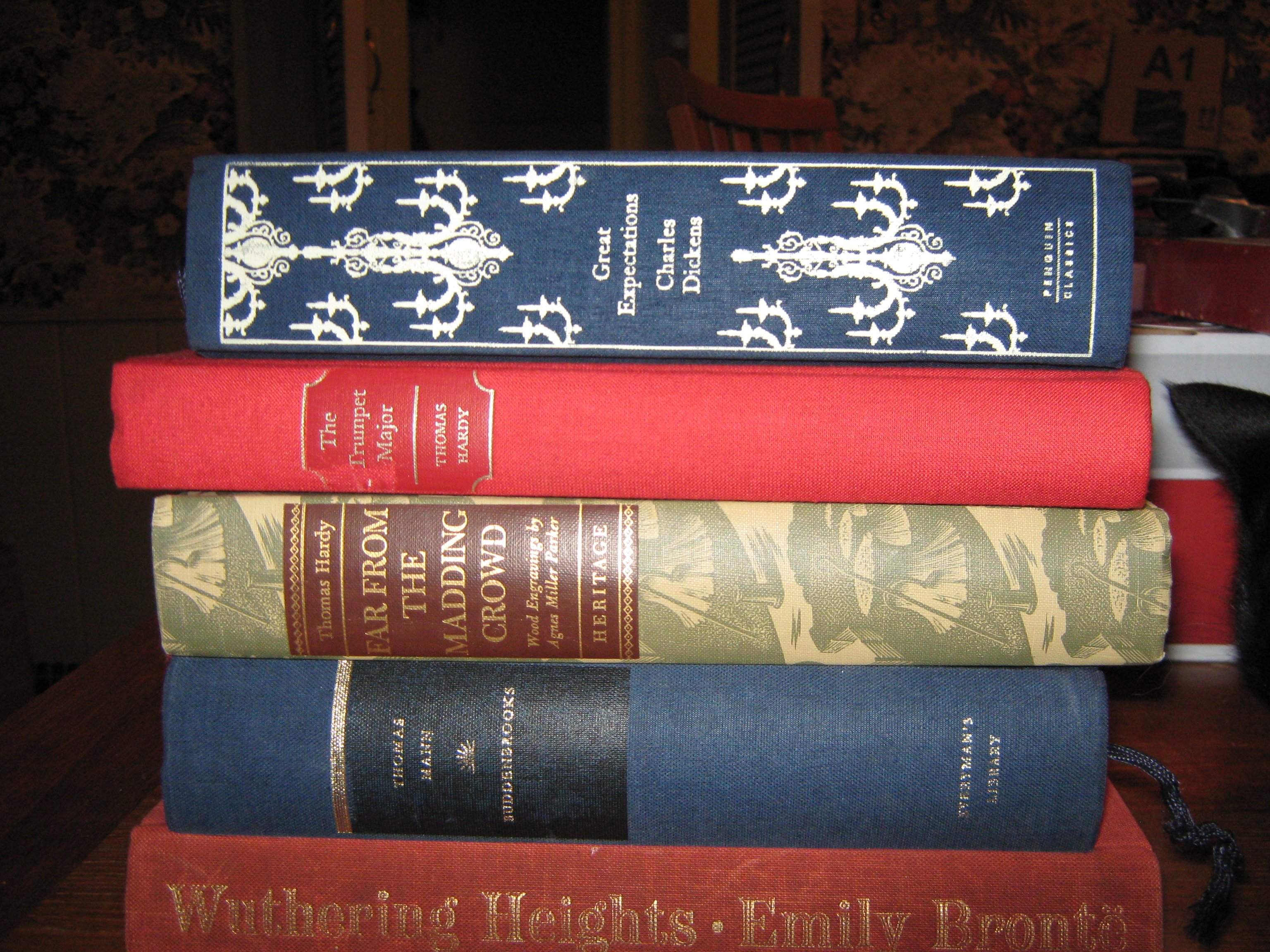
IMG_3078The five  tomes in the photograph are:  Dickens’s Great Expectations (Penguin Hardback Classics), with cover art and design by Coralie Bickford-Smith; Thomas Hardy’s The Trumpet Major (Folio Society); Thomas Hardy’s Far from the Madding Crowd (Heritage Press), Thomas Mann’s Buddenbrooks (Everyman) , and Emily Bronte’s Wuthering Heights (Heritage Press).

I was startled when I pulled my copy of Hardy’s The Trumpet Major off the shelf and realized it was a Folio Society book.  I bought it at a used bookstore years ago, because I loved the  beautiful engravings by Peter Reddick.   I characterized it a “book-in-a-box club” book.

Below is a photo of an illustrated page from The Trumpet Major.  It’s a lovely, slightly tall red book with beautiful creamy paper and crisp print. .

IMG_3079

The photo is a little dark, isn’t it?

Hardy’s Wessex novels are also available from the Heritage Press, which  was founded in 1935 as an offshoot of George Macy’s Limited Editions club.  The Heritage Club published cheaper unlimited editions of the illustrated classics originally published by the Limited Editions club.)

My Heritage Press copy of Far from the Madding Crowd has an introduction by Robert Cantwell and engravings by Agnes Miller Parker.

Below is an illustration of Bathsheba Everdene carrying a pail.

IMG_3081We all have to reread Far from the Madding Crowd to get ready for the new movie with Carey Mulligan.

I loved the Julie Christie movie, did you?

I  also have a much-read Heritage Press edition of a novel that never makes a good movie, Wuthering Heights.

IMG_3082The color lithographs by Barnett Freedman have a curiously modern Y.A. air. There are Catherine and Heathcliff  in all their rock-and-roll splendor as they stride across the moor. All they need are tattoos and piercings.

IMG_3083

Penguin hardback classics and Everyman hardbacks are an inexpensive, sturdy, and attractive alternative to paperbacks or collectible hardbacks..

I love my Penguin hardback of Great Expectations and my Everyman of Buddenbrooks.  No illustrations, though.

IMG_3087Are you a hardback or a paperback person?  And do you collect any books?
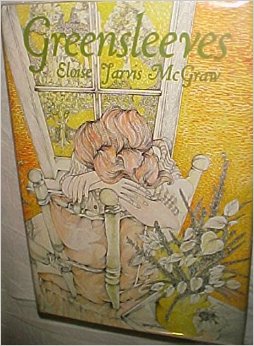
Eloise Jarvis McGraw’s Greensleeves

Greensleeves by Eloise Jarvis McGraw 23586165The narrator of Eloise Jarvis McGraw’s superb novel, Greensleeves,  reissued recently in Nancy Pearl’s Book Crush series, is one of my favorite waitresses in literature.

The daughter of a famous actress and journalist, eighteen-year-old Shannon Kathleen Lightley has an identity crisis after high school.   She  has lived all over Europe, speaks several languages,  yet always longed for stability. She was thrilled when her divorced parents agreed to let her spend her senior year living with her aunt in the  small town of Mary Creek,  Oregon.  But the year was such a disaster that she now doesn’t want to go to college.

Greensleeves mcgraw original cover 51--ik7N9pL._SY344_BO1,204,203,200_Greensleeves, first published in 1968, was one of my favorite books in childhood.  In Nancy Pearl’s fascinating introduction, she points out that realistic fiction for teens dominated the shelves during the late twentieth century, while today fantasy and SF books have ascendency.  McGraw, the author of three Newbery honor books, was perhaps best known for historical fiction.

Pearl writes,

But the novel of McGraw’s that I’ve always been fondest of is Greensleeves, which explores issues that teenagers–especially teen girls–can and do identify with.  Actually, given my own experience of reading Greensleeves, maybe you don’t have to be a teenage girl to enjoy it.  I first became acquainted with Shannon Kathleen Lightley, the main character and narrator, when I was in my twenties.  I loved the novel then, and, having just reread it for the third time in two years, I love it still.

Shannon’s captivating voice and wit make this a Y.A. classic.  And Shannon reminds me of Vicky Austin, the awkward heroine of several realistic novels by Madeleine L’Engle, among them Meet the Austins and The Moon by Night.

Shannon, who had given up on life in Oregon, was sitting in the Portland airport with the intention of returning to Europe when  her Uncle Frosty, a lawyer, tracks her down and persuades her to stay in Portland for the summer.  He hires her to do light detective work: he is investigating the validity of the will of an eccentric old woman who left all her money to neighbors for whimsical activities such as sky-diving lessons, a weed garden, studying “useless things,” and a trip to ancient Greece.

Shannon finds a job as a waitress at the Rainbow Cafe and moves into a boarding house:  she actually rents the late Mrs. Dunningham’s room.  And she experiments with her identity, wearing her long red hair in an upswept bouffant hairdo, snapping gum, and pretending she is from Idaho.

Because of her bright green uniform, she is nicknamed Greensleeves.

Her descriptions of waitressing are hilarious.  Another waitress, a college girl, Helen, hands over most of the work to Shannon, who breaks character to make a few sarcastic remarks.  Unfortunately, a bookworm, Sherry, looks up and stares at her and later tells her he enjoyed “the performance.”

But she is too busy to worry about Sherry.

For several minutes I was extremely active, while Helen shifted her weight to the other hip and turned a hamburger. Two new customers sat down near the three boys as I was starting that way with a handful of silverware, and she added that I might just take those ladies’ orders while I was there.  I succumbed once more to temptation and asked her nervously if she didn’t think it would be too tricky for me.  She gave me a fairly sharp glance, but said only, “You have to learn sometime, dear, and I do have my hands full right now.”

Life in the boarding house reminded me of my own university days living in rented rooms.  Shannon befriends her neighbors.  As she gets to know them–many are the beneficiaries of the will–she understands that Mrs. Dunningham was one of those whimsical 1960s people who tried to foster freedom.

Two men are interested in her, Sherry, a brilliant college student who wants to study “useless things,” and Dave,  a talented artist who draws weeds and wild flowers.  She loves Sherry, but being with Dave is like being with a sexual volcano.

What I love about Shannon is that she doesn’t give in to pressure and insists on knowing more about herself before she commits to a relationship.  So smart.  (Were we that smart?)

A very witty book, the kind of thing readers of all ages love.

Do you think I dare risk rereading McGraw’s Mara: Daughter of the Nile, set in ancient Egypt?

Well, maybe not!

What I’m Reading Now: Wendy Pollard’s Pamela Hansford Johnson & Andrew D. Kaufman’s Give War and Peace a Chance

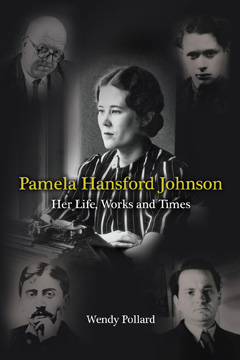
wendy pollard Pamela-hansford-Johnson-webWhen I read nonfiction, I tend to peruse  such esoteric  tomes as Philip Hardie’s The Last Trojan Hero:  A Cultural History of Virgil’s Aeneid.

But this weekend I am reading two very entertaining new books, Wendy Pollard’s biography, Pamela Hansford Johnson:  Her Life, Works and Times, and Andrew D. Kaufman’s Give War and Peace a Chance: Tolstoyan Wisdom for Troubled Times.

Wendy Pollard’s brilliant biography of Pamela Hansford Johnson (1912-1981) is carefully-researched and engrossing.  The fast-paced narrative is interwoven with excerpts from Johnson’s diaries, letters, detailed précis of her novels, and a history of their reception. It is the first biography of Johnson.

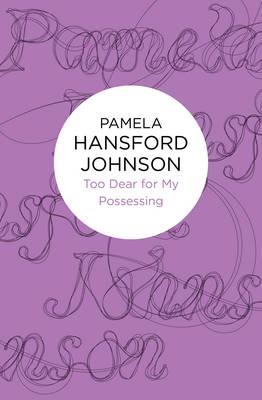
Johnson, a critically-acclaimed novelist and the author of literary studies of Ivy Compton-Burnett and Proust, is one of my favorite writers.  Her Helena trilogy, Too Dear for My Possessing, An Avenue of Stone, and A Summer to Decide, is slightly reminiscent of Anthony Powell’s A Dance to the Music of Time.

too-dear-for-my-possessing pamela hansford johnsonMany of Johnson’s novels, including the Helena trilogy, are now available from Bello as e-books or print-on-demand books.

I am utterly intrigued by this biography.  Pamela was the daughter of Amy Clotilda Howson, an actress and singer.  After Pamela’s father died when she was 11, Amy’s close relationship with Pamela became almost obsessional.  Pamela left school at 16, worked as a secretary, wrote poetry, and had a  rocky relationship with Dylan Thomas. Amy disapproved of some of Pamela’s boyfriends, though she liked Dylan Thomas, and, indeed, she and Pamela visited Dylan’s family in Wales.  Pamela eventually married an Australian journalist with whom she had two children, and later married the novelist and scientist C. P. Snow, with whom she had one child.

Pollard, who has a Ph.D. from the University of Cambridge, is especially strong on criticism and reception of Pamela’s work. She critiques all of Pamela’s  books, including a play and pseudonymous mysteries co-written with her first husband, and carefully summarizes and quotes the reviews

.There is also lots of literary gossip. When  Pamela was writing a study of  Ivy Compton-Burnett, Ivy invited her  to dinner, but Ivy and her cronies addressed few remarks to Pamela, preferring to converse about people Pamela didn’t know.   Later, when they met again, so Ivy could give her reviews to read for the study, she talked over Pamela’s head

Pamela recalled: “As I leafed roughly through [the reviews], I heard her talking busily above my head, but not to me.  It was an uncanny experience.’

She did not, however, permit Ivy’s eccentricities to interfere with her criticism.

Pamels’s husband C. P. Snow  upset many friends who were featured in his  novels obviously based on real-life incidents. (Not to the extent of Karl Ove Knausgård, of course.)   Ironically, Pamela was upset when  William Cooper (the pseudonym of Harry Summerfield Hoff) featured Snow and a former girlfriend as characters in a charming series of autobiographical novels about a physics-teacher-turned-civil-servant (Scenes from Provincial Life, etc.) .  Pamela was so disturbed by the portrait of the relationship that Cooper did not publish  Scenes from Metropolitan Life until 1982, after the deaths of both Pamela and Snow.

Reading Pollard’s book has introduced me to many books I’d never heard of.  It took her biography for me to find out that the Helena trilogy is actually a quartet.  Pamela’s out-of-print novel Winter Quarters  features characters from the Helena trilogy as minor characters.

I will write more about this biography after I’ve finished.

Give War and Peace a Chance Kaufman 51DPHjQm15L._SY344_BO1,204,203,200_Andrew D. Kaufman’s Give War and Peace a Chance: Tolstoyan Wisdom for Troubled Time is a short, accessible book on the significance of Tolstoy’s masterpiece, War and Peace.  (Yes, I am also rereading War and Peace, for the tenth time).

Kaufman  provides valuable background, and there are many brilliant insights.  I have a much better understanding of Tolstoy’s intentions (or lack of them) in writing W&P.. He did not want to write a book in the European tradition.   For instance, did you know that Tolstoy disliked Turgenev’s short elegant Fathers and Sons?  That when readers didn’t appreciate his long novel, he wrote a rebuttal?  That he didn’t consider War and Peace a novel?

Tolstoy wrote,

What is War and Peace?  It is not a novel, still less an epic poem, still less a historical chronicle.    War and Peace is what the author wanted and was able to express, in the form in which it is expressed.  Such a declaration of the author’s disregard of the conventional forms of artistic prose works might seem presumptuous, if it were premeditated and if it had no previous examples.  The history of Russian literature since Pushkin’s time not only provides many examples of such departure from European forms, but does not offer even one example to the contrary.

Kaufman explains that Tolstoy’s unliterary language astonished readers.  Kaufman writes, “War and Peace thrust readers raised on more polished literary fare out of their familiar paradigms and into a brave new fictional world,which, for all its strangeness, somehow starts to feel more “real” than reality itself.”

Tolstoy is unlike anyone else.  The characters in W&P always seem fresh to me, and I wonder every time if Natasha or Andre will behave differently druing their terrible romance.

Kaufman’s tone is sometimes too pop–rather blog-like–but the book is excellent.

I hope your weekend reading has been as fascinating as mine.

Mavis Gallant’s From the Fifteenth District

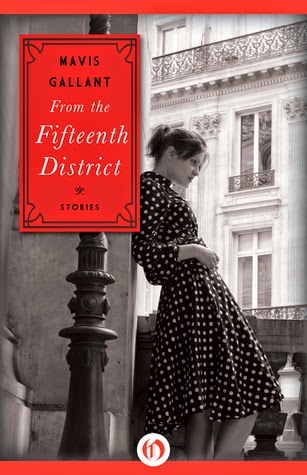
Mavis Gallant from-the-fifteenth-districtMavis Gallant was one of the best Canadian writers of short stories.

Gallant, a journalist in Montreal who gave up her career in 1952 to move to Europe and write fiction, published 116 short stories in the New Yorker.  She won The Governor General’s Award, the Rea Award for the Short Story, and the 2004 PEN/Nabokov Award for Lifetime Achievement.  She died in 2014.

I recently read Gallant’s 1979 collection of short stories, From the Fifteenth District. (It is in print as an Open Road Media e-book.).   Like the Canadian writer Alice Munro, Gallant has the ability to compress the power of a novel into a short form.  These stunning stories, shaped by Gallant’s percipience of the tragic destruction of Europe during World War II, cover long periods of time and depict the characters’ endurance of violence and later reshaping of lives.

“The Moslem Wife” is  the best story in the collection.  It delineates the the uneventful happiness of a hotel-keeping couple, Netta and Jack, in the South of France.  All changes with the war. The hotel business for Netta’s family has been secure for two generations, though in her childhood they moved nomadically from room to room in the busy season.  The story begins with Netta’s father Mr. Asher renewing a lease on the family hotel for 100 years.  (Netta is 11.)  He is confident after World War I  “that there would never be a man-made catastrophe in Europe again.  The dead of the recent war, the doomed nonsense of the Russian Bolsheviks had finally knocked sense into European heads.”

Some years later, when Netta marries her dilettante cousin, Jack (also the son of hoteliers), they run the hotel and live an idyllic life .  (There are tennis courts, a lily pond, a winter garden, and a rose garden.)  They have sex constantly. The guests at the hotel refer to her as “the Moslem wife.  Netta loves the hotel and does not like to travel.

She would have been glad to see the same sun rising out of the same sea from the window every day until she died.  She loved Jack, and what she liked best after him was the hotel.  It was a place where, once, people had come to die of tuberculosis, yet it held no trace of feeling of danger. … here the dead had never been allowed to corrupt the living; the dead had been dressed for an outing and removed as soon as their first muscular stiffness relaxed.

Death and famine move in during World War II.  Jack has gone to America with a woman, but  Netta sees brutality and experiences hunger. The Italians are billeted in the hotel, then the Germans.  The hotel is in ruins after the war, but Netta stays on.  She writes to Jack and asks for books.  He sends her Fireman Flower, The Horse’s Mouth, Four Quartets, The Stuff to Glue the Troops, Better Than a Kick in the Pants, and Put Out More Flags.

This long, powerful story captures the grief of the war more than anything else I have read.

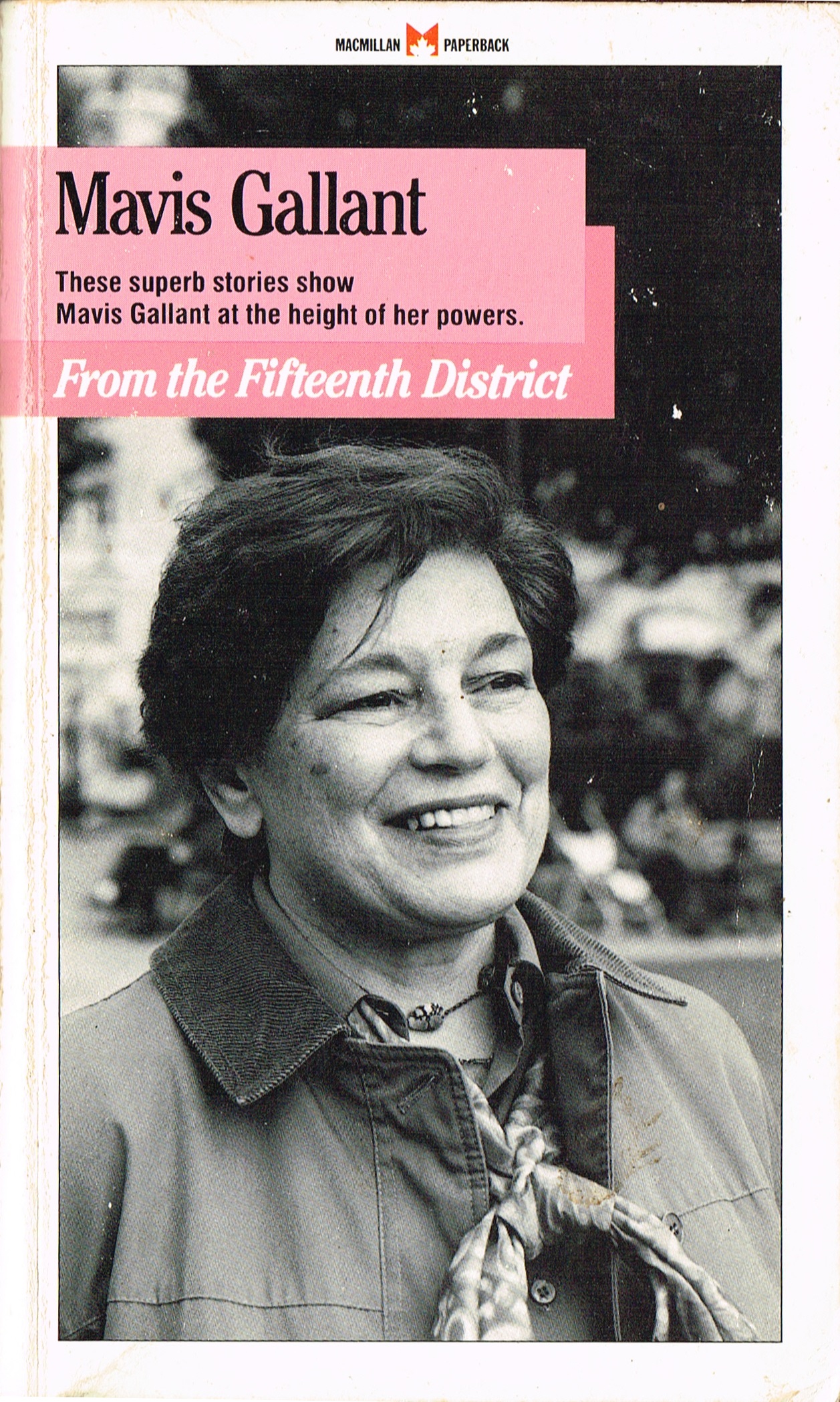
paperback mavis gallant From-the-Fifteenth-District-front-cover In “The Remission, ” Gallant recounts the decay of an English family who move to a house on the Riviera called La Mas.  Alec Webb, a war veteran who is dying of cancer, refuses to be treated by the National Health Service.  Living cheaply in France seems feasible, though the money is acquired through the grace of Barbara’s brothers and by bankrupting his sister.   Barbara, his wife, a profligate spender, goes through the money and neglects her children.  The children become French, and Barbara becomes poor.  It is  Gallant’s style and her talent for expressing the slowness of time that make this so memorable.

“Baum, Gabriel, 1935-( )” is the story of a later generation.  It is 1961, and Gabriel has recently been discharged from the French Army after two years in Algeria.  In Paris he is an actor.  As the years go by, he moves from the theater into bit parts on TV.  The films are mostly about World War II:  by the ’80s the films become less accurate and the new generation of actors know less history.

“Potter” is the story of a Polish intellectual who has spent time in prison for his radical beliefs. Sometimes he can get a passport to travel to France and sometimes not.  He falls in love with a young Canadian woman in Paris whose idea of history begins with the War in Vietnam.  Their differences enchant them.

The only story in the collection that did not grab me was the very odd title story in which three dead people who are haunted by people from the present.  The other stories, however, are superb. I am so thankful I have discovered Gallant.

Robin Morgan’s “Monster”

Robin Morgan

Robin Morgan

At Mirabile Dictu, we are celebrating  National Poetry Month.

In 1972, I heard Robin Morgan read from her first book of poems, Monster, at the Women’s Center in Iowa City.  I was a teenager, and it was the first poetry reading I attended.

Morgan is an award-winning writer, poet, feminist leader, political analyst, journalist, editor, and co-founder of the Women’s Media Center.  “Monster” is a feminist poem that reflects the radicalism of the Second Wave Women’s Movement.

It was a very different time.

Although I no longer am the radical young  girl who attended that reading,  I still get chills when I read the title poem, “Monster.”  (Note:  Morgan’s Monster has been reissued as an e-book by Open Road Media.)

“Monster”
by Robin Morgan

Listen. I’m really slowly dying
inside myself tonight.
And I’m not about to run down the list
of rapes and burnings and beatings and smiles
and sulks and rages and all the other crap
you’ve laid on women throughout your history
(we had no part in it — although god knows we tried)
together with your thick, demanding bodies laid on ours,
while your proud sweat, like liquid arrogance,
suffocated our very pores.
Not tonight.

I’m tired of listing your triumph, our oppression,
especially tonight, while two men whom I like –
one of whom I live with, father of my child, and
claim to be in life-giving, death-serious struggle with –
while you two sit at the kitchen table dancing
an ornate ritual of what you think passes for struggle
which fools nobody. Your shared oppression, grief,
and love as effeminists in a burning patriarchal world
still cannot cut through power plays of maleness.

The baby is asleep a room away. White. Male. American.
Potentially the most powerful, deadly creature
of the species.
His hair, oh pain, curls into fragrant tendrils damp
with the sweat of his summery sleep. Not yet, and on my life
if I can help it never will be “quite a man.”
But just two days ago on seeing me naked for what must be
the three-thousandth time in his not-yet two years,
he suddenly thought of
the furry creature who yawns through his favorite television program;
connected that image with my genitals; laughed,
and said, “Monster.”

I want a woman’s revolution like a lover.
I lust for it, I want so much this freedom,
this end to struggle and fear and lies
we all exhale, that I could die just
with the passionate uttering of that desire.
Just once in this my only lifetime to dance
all alone and bare on a high cliff under cypress trees
with no fear of where I place my feet.
To even glimpse what I might have been and never never
will become, had I not had to “waste my life” fighting
for what my lack of freedom keeps me from glimpsing.
Those who abhor violence refuse to admit they are already
experiencing it, committing it.
Those who lie in the arms of the “individual solution,”
the “private odyssey,” the “personal growth,”
are the most conformist of all,
because to admit suffering is to begin
the creation of freedom.
Those who fear dying refuse to admit that they are already dead.
Well, I am dying, suffocating from this hopelessness tonight,
from this dead weight of struggling with
even those few men I love and care about
each day they kill me.

Do you understand? Dying. Going crazy.
Really. No poetic metaphor.
Hallucinating thin rainbow-colored nets
like cobwebs all over my skin
and dreaming more and more when I can sleep
of being killed or killing.
Sweet revolution, how I wish the female tears
rolling silently down my face this second were each a bullet,
each word I write, each character on my typewriter bullets
to kill whatever it is in men that builds this empire,
colonized my very body,
then named the colony Monster.

I am one of the “man-haters,” some have said.
I don’t have the time or patience here to say again why or how
I hate not men but what it is men do in this culture, or
how the system of sexism, power dominance, and competition
is the enemy, not people — but how men, still, created that system
and preserve it and reap concrete benefits from it.
Words and rhetoric that merely
gush from my arteries when grazed
by the razoredge of humanistic love. Enough.
I will say, however, that you, men, will have to be freed,
as well, though we women may have to kick and kill you
into freedom
since most of you will embrace death quite gladly
rather than give up your power to hold power.

Compassion for the suicidal impulse in our killers? Well,
on a plane ride once, the man across the aisle –
who was a World War Two paraplegic,
dead totally from the waist down,
wheeled in and out of the cabin — spent the whole trip avidly
devouring first newspaper sports pages
and then sports magazines,
loudly pointing out to anyone who would listen
(mostly the stewardesses) which athlete was a “real man.”

Two men in the seats directly behind me talked the whole time
about which Caribbean islands were the best for whoring, and
which color of ass was hotter and more pliant.
The stewardess smiled and served them coffee.
I gripped the arms of my seat more than once
to stop my getting up and screaming to the entire planeload
of human beings what was torturing us all — stopped because I knew
they’d take me for a crazy, an incipient
hijacker perhaps, and wrestle me down until Bellevue Hospital
could receive me at our landing in New York.
(No hijacker, I understood then, ever really wants to take
the plane. She/he wants to take passengers’ minds, to turn
them inside out, to create the revolution
35,000 feet above sea level
and land with a magical flying cadre
and, oh, yes, to win.)
Stopping myself is becoming a tactical luxury,
going fast.

My hives rise more frequently, stigmata of my passion.
Someday you’ll take away my baby, one way or the other.
And the man I’ve loved, one way or the other.
Why should that nauseate me with terror?
You’ve already taken me away from myself
with my only road back to go forward
into more madness, monsters, cobwebs, nausea,
in order to free you — men — from killing us, killing us.

No colonized people so isolated one from the other
for so long as women.
None cramped with compassion for the oppressor
who breathes on the next pillow each night.
No people so old who, having, we now discover, invented
agriculture, weaving, pottery, language, cooking
with fire, and healing medicine, must now invent a revolution
so total as to destroy maleness, femaleness, death.

Oh mother, I am tired and sick.
One sister, new to this pain called feminist consciousness
for want of a scream to name it, asked me last week
“But how do you stop from going crazy?”
No way, my sister.
No way.
This is a pore war, I thought once, on acid.

And you, men. Lovers, brothers, fathers, sons.
I have loved you and love you still, if for no other reason
than that you came wailing from the monster
while the monster hunched in pain to give you the power
to break her spell.
Well, we must break it ourselves, at last.
And I will speak less and less and less to you
and more and more in crazy gibberish you cannot understand:
witches’ incantations, poetry, old women’s mutterings,
schizophrenic code, accents, keening, firebombs,
poison, knives, bullets, and whatever else will invent
this freedom.

May my hives bloom bravely until my flesh is aflame
and burns through the cobwebs.
May we go mad together, my sisters.
May our labor agony in bringing forth this revolution
be the death of all pain.
May we comprehend that we cannot be stopped.

May I learn how to survive until my part is finished.
May I realize that I

am a
monster. I am

a
monster.
I am a monster.

And I am proud.