The Art of Letter-Writing

The Letter (1906), by Pierre Bonnard

The Letter (1906), by Pierre Bonnard

E-mail is a whole new way of being friends with people: intimate but not, chatty but not, communicative but not; in short, friends but not. What a breakthrough. How did we ever live without it? I have more to say on this subject, but I have to answer an Instant Message from someone I almost know.–Nora Ephron, “The Six Stages of E-Mail”

According to a U.S. Postal Service Survey in 2011, the writing of personal letters is at an all-time low.  Americans say they receive one every eight weeks.

Twenty years ago, I received two letters a week.  Now I receive two a year.

Letters used to be my favorite form of writing. But even if we no longer write letters, we still enjoy poring over the letters of the Mitfords, Virginia Woolf, and Barbara Pym.

Letter-writing was much loved by my aunts. In my family women write the letters; men do not. Before the internet, letters were a Round Robin affair:  if you wrote a letter home, you could bet one of the aunts would make copies and include it in the next pack of letters sent out to all the women in the family!

Letters have been a part of my life since childhood.  It started as a school project:  the teacher found us penpals, and we were required to exchange information about our cultures.   I loved writing to Pam in Australia:  inscribing the date at the top, the polite little formulaic opening, providing the American culture data required for the letter exchange, and then writing a few creative paragraphs:  I’d enjoyed the book Berries Goodman! I’d come in third in a Chinese jumprope contest!   I had a new white faux fur coat!  I loved the Monkees! I bought stationery at Woolworth’s!   (Pink? Blue? Did it have a floral design?)  I loved addressing envelopes.  I loved the whole thing.

It wasn’t till after graduate school that I began to write long letters. Couldn’t we go back to school and study a new subject, we wondered?   We wrote about trying to find meaning through badly-paid teaching or proofreading jobs. We wrote about our feelings:  our boyfriends, our marriages, and the pressure to have children in our thirties (about half gave in).  Nowadays we have been through so much that we rarely mention feelings.  We write about them at our blogs before we do in letters.

Today, I certainly wish I’d received a letter.  I’ve been reading Barbara Pym’s letters in A Very Private Eye:  An Autobiography in Diaries & Letters).  Here is the opening of a letter she wrote to Bob Smith:

Such an ironical thing happened–I had started a letter to you last weekend on my typewriter, telling you that on Friday last, 1st Feb., we had a burglary and leaving the letter in the typewriter to finish later. But on Monday, 4th Feb., the thief or thieves broke in again, this time taking the typewriter with the letter in it! So I suppose you will never get that letter.

What a witty description of what must have been  traumatic.

You will not be surprised to learn that today in the mail I only received  catalogues. The Folio Society, Eddie Bauer, Talbots, the Vermont Store, and a bedding company called Cuddledown.

But Christmas is coming, and though we won’t get a letter from Barbara Pym, at least we’ll get a few cards signed with real handwriting.

On Urban Chickens & Chicken Literature

Egg and I Betty Macdonald RO60065818Raising chickens is legal in our city.

There is even a Backyard Chicken group.

Urban chickens used to be prohibited, a chore undertaken only by down-and-out hillbillies or extreme practitioners of sustainable living.  Ten years ago, we were astonished when we bicycled past a run-down house with a dozen chickens in the front yard.  They also had a disheveled pony.

It has always been a dream of mine:  living in the country, with my flock of chickens and a pony named Midnight, like the one my grandparents used to have.  But I’m a a city girl, and I am not quite sure I could get up early enough to care for demanding animals.

But urban chickens are fashionable, and you see them all over these days.   They run free and you get organic eggs! Anybody can raise an urban chicken!

So here is a list of  chicken lit, or do I mean Chicken Little?

Egg and I MacDonald in print 51lBQkMoFqL._SY344_BO1,204,203,200_1. Betty MacDonald’s The Egg and I (1945), the best-selling humorous memoir of MacDonald’s experiences as a young wife on a chicken farm in the Pacific Northwest.  Raising chickens is hard work, and also hilarious.  She wrote,

Gathering eggs would be like one continual Ester morning if the hens would just be obliging and get off the nests. Ccooperation, however, is not a chickenly characteristic and so at egg-gathering time every nest was overflowing with hen, feet planted, and a shout-if-you-must-this-old-grayhead look in her eye.  I made all manner of futile attempts to dislodge her–sharp sticks, flapping apron, loud scary noises, lure of mash and grain–but she would merely set her mouth, clutch her eggs under her and dare me.  In a way, I can’t blame the hen–after all, soft-shelled or not, they’re her kids.

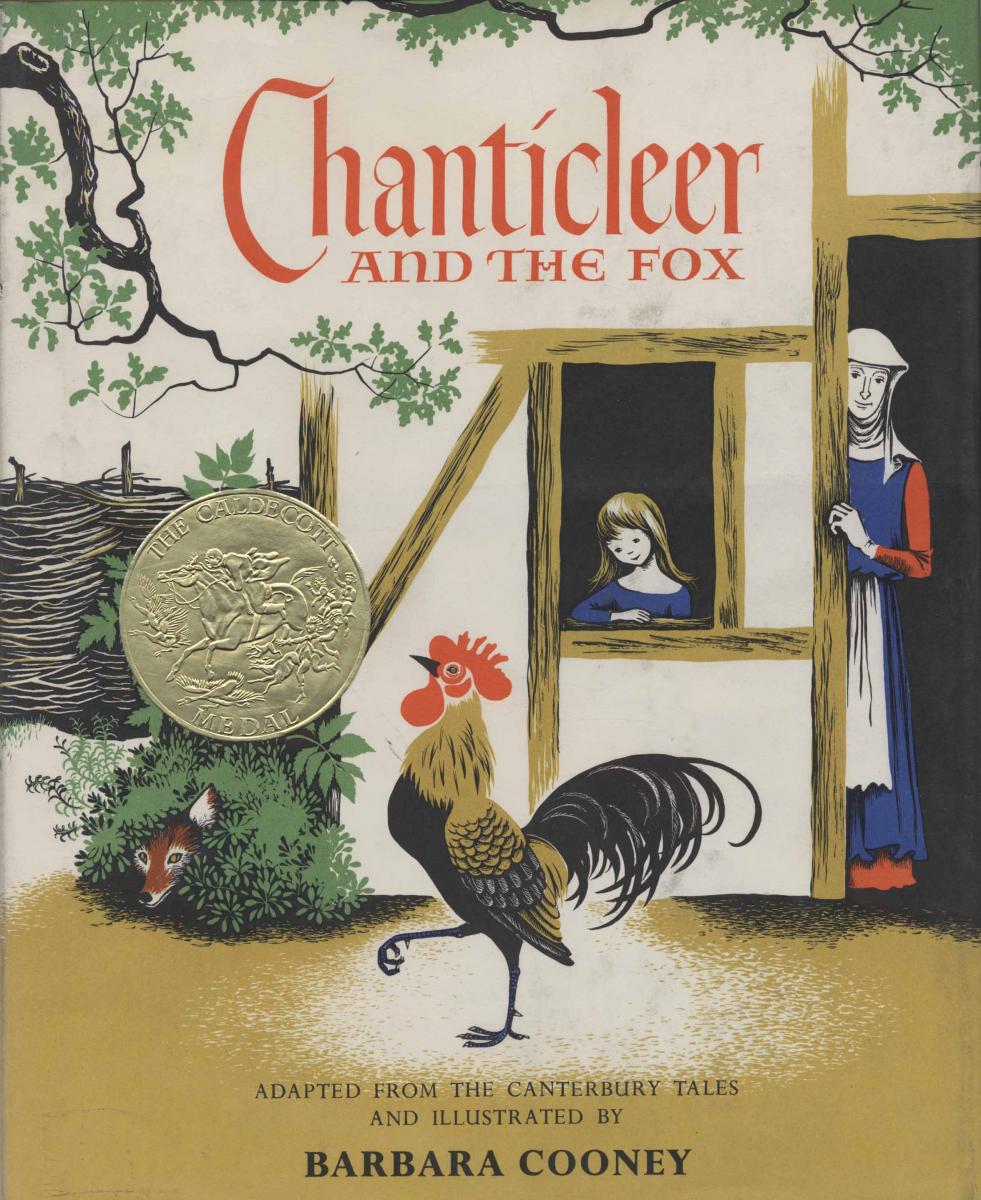
2. Chanticleer and the Fox, adapted from the Canterbury Tales and illustrated by Barbara Cooney, who won the Caldecott Medal. My aunt gave me this book when I was perhaps a little old for it, but I loved the illustrations.

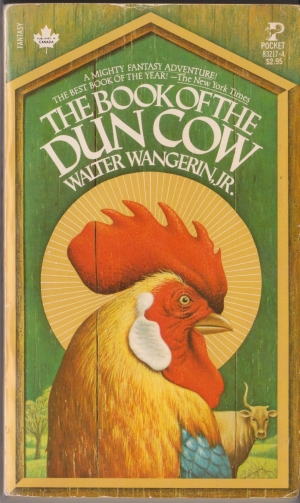
Barbara Cooney 1959_Chanticleer_and_the_Fox3.The Book of the Dun Cow by Walter Wangerin, Jr., won the American Book Award in 1978.  This adult fantasy novel is another retelling of the Chaunticleer and the Fox from Chaucer’s “the Nun’s Priest’s Tale.”  Wangerin is an outstanding writer, and one of these days I’ll post more about this novel.  I am very fond of the character, Chaunticleer, who has a big flock of chickens to take care of and does a lot of crowing in all moods.  It’s his job.

Chaunticleer the Rooster crowed when he was angry to be sure.  Upset, or out of humor, he could crow the fear of God into a wood tick or into nearly anything else, for that matter.  But no one must get the idea that this was the only time when he crowed, and the only kind of crow he knew.  Crowing was his profession.

book of the dun cow 1cow3004. Chicken Little.  Everybody knows this story about a chicken who thinks the sky is falling.  I adored this as a child!

chicken_little_book_cover5. You can read Sherwood Anderson’s short story, “The Egg,” in The Egg and Other Stories (Dover) or at http://www.online-literature.com/sherwood-anderson/1468/

The Egg Sherwood Anderson 51hJo6GYDOL._SY344_BO1,204,203,200_6. Jack Prelutsky’s “Last Night I Dreamed of Chickens”( 1940)  is a famous  poem:  https://www.poets.org/poetsorg/poem/last-night-i-dreamed-chickens

7.  Mother Carey’s Chickens is a 1911 novel by Kate Douglas Wiggin, the author of Rebecca of Sunnybrook Farm.  It is the story of  a widow struggling to raise her two daughters and son.

/Mother Carey's Chickens 516aiAB7Y6L._SX319_BO1,204,203,200_In the introduction Laura Ingalls Wilder’s annotated autobiography, Pioneer Girl,  it is revealed that she  used to raise chickens and was a poultry columnist before she wrote the Little House books.  Find out more at this website:  http://pioneergirlproject.org/2015/05/21/wilders-chickens/

Wilder Pioneer Girl the annotated authobiograhpy910DQmHfPELDo share your chicken literature!  I’m sure I’ve missed some titles!