
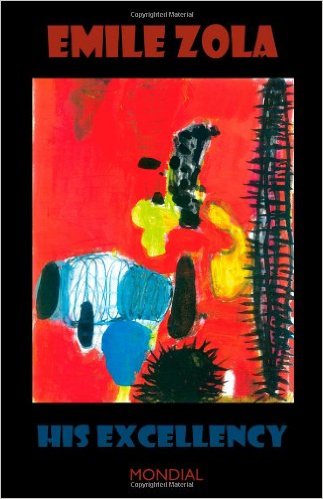
This translation is dreadful.
I recently tracked down Zola’s His Excellency Eugene Rougon, the sixth novel in his Rougon-Macquart series, and a copy of John Braine’s 1957 novel, Room at the Top.
Both books are minor classics, but, alas, I didn’t much care for either. Perhaps they’re the right books for you, though.
1. Readers of this blog will know that I recently enjoyed the new Oxford translations of Zola’s Rougon-Moucquart series, a racy inter-generational chronicle of five generations of a family prone to alcoholism, addiction, madness, and promiscuity in Napoleon III’s Second Empire. The 2012 editions are superb: I wrote about Helen Constantine’s translation of The Conquest of Plassans here, and Brian Nelson’s translation of The Fortune of the Rougons here.
His Excellency Eugene Rougon may well be a great political novel about the Second French Empire, but who can tell in Ernest Alfred Vizetelly’s archaic 1897 revision of an earlier nineteenth-century translation? Could we have a new translation, please?
In the preface, Vizetelly praises this realistic political novel. He writes, “In my opinion, with all due allowance for its somewhat limited range of subject, [it] is the one existing French novel which gives the reader a fair general idea of what occurred in political spheres at an important period of the Empire.”
This brilliantly-structured but turgid translation of Zola’s complicated novel about a corrupt politician is compelling once underway. The hero, Eugene Rougon, is a savvy lawyer who supported Napoleon III’s coup d’etat and clawed his way up to a high position in the government. In the opening chapter, he resigns after a disagreement with the Emperor, expecting soon to be recalled to office. His allies and friends turn on him when he is out of power: there are no enemies greater than friends. The most dangerous is Clorinde, the beautiful, intelligent daughter of an Italian countess who obtains information through flirtations but seldom gives anything away.
After a few years out of the government, Eugene is desperate for power. He suppresses information he gleans from a criminal friend about a terrorist plot. Deaths and woundings of innocent men result, but his rival is discredited, and that’s all that matters to Eugene. Ten days later Eugene is the Minister of the Interior.
This is the kind of reading that makes you NOT want to participate in the caucuses or vote in the primaries.
Okay, it’s a bold book. But try reading prose like this:
For a moment the President remained standing amidst the slight commotion which his entrance had caused. Then he took his seat, saying carelessly and in an undertone: “The sitting has commenced.”
A little of that goes a long way.
And that’s why we need a new translation.
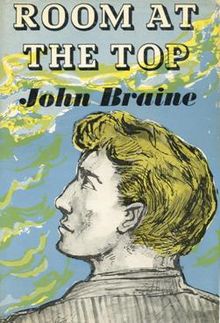 2. I was curious about John Braine’s Room at the Top, published in 1957 and recently reissued by Valancourt. It is one of the “Angry Young Men” novels, and I love the writers in this movement: Kingsley Amis, Alan Silitoe, and William Cooper.
But I cannot bear Braine, though he is witty, acerbic, and articulate. The other Angry Young Men are misogynists, but this is perhaps THE most misogynistic of their novels.
The novel begins with the narrator Joe Lampton’s looking back regretfully on his eruthless rise to “the top” in his twenties. Joe, a World War II vet and former prisoner of war, left the ugly working-class town where he was raised when he found a job in Warley as an accountant for the City Council. He was brash and on the make: he joined a community theater group to get to know women. Soon he hits on pretty Susan, the daughter of a wealthy man, because he sees her as a means to money and power.
He has an affair with Alice, a bright, witty married woman in her thirties who is the best actress in the company. He has double standards and double dealings but is in love with her. Joe’s friend tells him he cannot possibly marry an older woman without losing his reputation.
We women cannot help but hate Joe, and Joe hates himself, too. I don’t want to give too much away, but at one point, he derealizes and reports his dialogue in the third person. then he comments in the first person on this other Joe (the real Joe?).
“I expected it,” Joe said soberly… I didn’t like Joe Lampton. He was a sensible young accountant with a neatly-pressed suit and a stiff white collar. He always said and did the correct thing and never embarrassed anyone with an unseemly display of emotion. Why, he even made a roll in the hay with a pretty teenager pay dividends. I hated Joe Lampton, but he looked and sounded very sure of himself sitting at my desk in my skin; he’d come to stay, this was no flying visit.
This uneven, well-written novel has its points, and, thank God, is short!
 mirabile dictu