Pink Pajamas

Jane Eyre Doesn't Wear Pink Pajamas!

Mia Wasikowska as Jane Eyre in a very governessy dress.

We went to the cafeteria.  Ah, a lovely evening of not cooking!

Then a small creature a couple of booths behind us shrieked, “I don’t want to share my chicken with you!”

I collapsed into giggles.

“Where IS that coming from?” my husband asked.

“Look!  The mom’s in pink pajamas!”

“Those aren’t pajamas.”

“Yes, they are.  If I were a mom I’d wear pink pajamas, too.  I’d be wearing slippers.”

I hoped she was wearing slippers, but they were only Ugghs.

If you’re childless, you prefer families with small children to hang out at McDonald’s, though the parents are dying to get out of McDonald’s.

It’s not that I’m unsympathetic–I am sympathetic–but is it permissible to admit that children are boring? After a period as a teenage nanny long ago I decided I would never have children.  I  couldn’t get anything done, and by the time the child–and he was a very nice child–was asleep, I was asleep, too.

Anne Bronte dealt with the problem by tying the children to table legs so she could write.  Yes, she lost her job.

I spent my nanny time making papier-mache puppets and reenacting Wuthering Heights, my favorite book, much to the delight of the child, who wanted to be Heathcliff, since I claimed he never washed.  We also had picnics on the windowsill with his family of toy hedgehogs. I  didn’t quite realize that you didn’t have to go all out like this every minute, and I never had enough time to read.  After a year and a half I quit to go to the university.

Perhaps as an adult parent I would have had more energy, if less creativity.

Very few of my friends had children until their late thirties or early forties, and our friendships sometimes languished for years because they were so distracted… unless they had nannies or babysitters.

Our siblings looked daggers at us when we said we read books.  They didn’t read books:  they had children.  So why could we read books?  (Does that even make sense?)

One of my friends solved her need-to-read problem by begging her husband to look after the child on vacations.  “You really need it, don’t you?”  he said incredulously.  She spent 14 days reading in the hotel instead of sightseeing or doing recreational things.

I know how she felt.  It was a wonderful solution.

As my sympathetic mother once said, and she regarded me as a born teacher (was not!), “Kat, you get so tired.”

I do get tired.

I was a very tired teacher.   Like most of my friends, I sought an alternative profession after a few years teaching.  There was a mass exodus of those of us qualified to teach Latin.

I would have been a very tired mother.

And that’s why it made me laugh to see a mother in pink pajamas.

I wasn’t exactly laughing at her.   Well, I was…
Book Samples on My Nook: Will I Buy Any of Them?

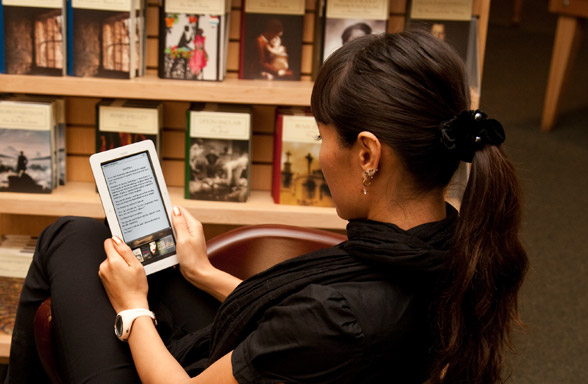
A nice picture of someone reading an  Original Nook.

This is not I, but it is a nice picture of someone reading a book on an Original Nook.

Since I acquired a Nook Tablet last year, I have downloaded approximately 250 books and samples.

So many, many, many samples.

It’s so easy to download.  John Wyndham’s The Kraken?  I loved The Day of the Triffids.  And why not try Hugh Walpole’s The Duchess of Wrexe?  I enjoyed Walpole’s The Green Mirror.

The Nook and I have a complicated relationship.

I adored my Nook tablet when I wrote fondly here on Dec. 11, 2012:

Like many of us in the electronic age, I spend as much time with “e”-things as I do with human beings. My e-reader is my friend.  It is basically a small computer that supplies me with infinite choices of books; allows me to open my email and surf the web; plays music; and provides me with crossword puzzles. It is tactile.  I have my hands all over the screen every day.  I tap, click and drag, swipe, and read.

And on Nov. 16, 2013, I wrote: “I feel about my e-reader the way the women in Sex and the City feel about their vibrators.”

I didn’t know what a tablet was when I bought it, and I still refer to it as an e-reader. We loved our original Nook, but it stopped turning the pages after a couple of years.  (It has recovered.  It was just going through a bad spell.)  At our house we used to compete for e-time on it, since I was absorbed in reading free books with titles like A Spinster of the Parish (what is it about books with spinster in the title?), while my husband wanted to peruse H. G. Wells’ The Wheels of Chance, a novel with a lot of bicycling.   (Both are free on the internet.)

We wanted another original Nook, but they stopped making it.

And so “Let’s buy the  Nook Simple Touch for $99!” (or whatever it cost.  It is now $59.)

“Piece of crap,” my husband said.

We bought a Nook tablet.

It works too well.

And so twenty-one percent of the books I read last year were e-books, perhaps double the number of e-books  read in 2011.  That’s a very fast change, don’t you think?

According to Pew Internet,  in late 2012 25% of Americans 16 and over owned tablet computers (iPads, Nook tablets, Kindle fires), while 19%  owned Kindles, Nooks, and other e-readers.

It is amazing how quickly I begin to fit in with cultural trends.

And then about the time I got hooked on my Nook, some bloggers began writing about the advantages of having both an e-book and a book.

Now what the f–, I thought.  I can’t possibly afford both books and e-books.

I prefer books.

I love my Nook, too, but when I look at all these samples I wonder what I’m thinking of.

Among the more fascinating samples of books are:

Scott Lynch’s The Republic of Thieves (SF/fantasy):  From Publishers’ Weekly:  “Lynch’s long-awaited third Gentleman Bastards high-fantasy caper novel (after 2007’s The Lies of Locke Lamora and 2008’s Red Seas Under Red Skies) abundantly delivers on the promise of the earlier volumes. Quick-witted protagonist Locke is slowly succumbing to poison as his loyal companion, Jean, tries to find someone who can save him. ”  The problem?  I don’t feel like reading the first two volumes.

In Times of Fading Light by Eugen Ruge.  A German novel, highly praised everywhere. I downloaded this e-book sample when I read the review at TLS, but so far have resisted buying it.   At Amazon:  “An enthrallingly expansive family saga set against the backdrop of the collapse of East German communism, from a major new international voice.”

Where’d You Go, Bernadette?  By Maria Semple.  Everybody loves it, it has been nominated for awards, but it looks a bit stupid.  Has anyone read it?  Perhaps I need to read more of the sample.

Kate Atkinson’s Life After Life.  Nominated for awards, everybody loves it, and you know more about it than I do.

The Birds by Frank Baker.  Michael Dirda in The Washington Post said:  “This isn’t Daphne du Maurier’s 1952 story “The Birds,” the partial basis of the celebrated Alfred Hitchcock film of 1963. But Frank Baker’s premise is much the same, and his eerie yet satirical and rather metaphysical novel first appeared in 1936.”

Patricia Brent, Spinster by George Herbert Jenkins.  A light romance, published in 1918: Jenkins also published P. G. Wodehouse’s books.  The blogger Redeeming Qualities praised this, and it is free at Project Gutenberg.

Quite a variety, and I don’t know what I’ll read next.  I’m sure I’ll buy one of these eventually…

The Blogging Article & L. M. Montgomery’s Emily of New Moon

Would Emily have blogged?

Would Emily have blogged?

I enjoyed interviewing writers in 2013, and intended in 2014 to add a series of interviews with bloggers, until I discovered this has been done with diligence by others, among them A Work in Progress, Stuck-in-a-Book, and Savidge Reads.

So instead I plan to write a short feature about blogging:  the blog as writing platform, the pros and cons, the acceptance or rejection by family, friends, and critics, and the courtship of marketers.  I will interview bloggers, writers, adherents, and critics, so listen up! you may receive a questionnaire in your mailbox.

And if any of you would like to be interviewed, please leave a comment or write to me at mirabiledictu.org@gmail.com

I love reading blogs, and would appreciate recommendations of new blogs.  Sometimes my favorite bloggers leave the net:  over the years a Texas housewife, a Cambridge photographer, and a PR writer/musician have ceased to blog, and two of the three deleted their blogs.

Certainly there are days when I wonder why I write online.  I could write this in a journal.

I look forward to exploring such issues, and hope you will help.

And now on to a review of L. M. Montgomery’s Emily of New Moon.

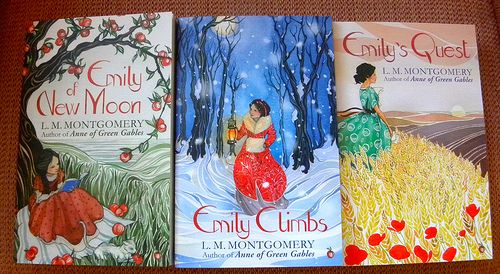
emily of New Moon trilogy montgomeryI have  long been a fan of L. M. Montgomery’s Anne of Green Gables books, and first learned about her Emily of New Moon series in Perri Klass’s article in The New York Times (May 17, 1992) “Stories for Girls about Girls Who Write Stories.”

So I penciled it in as a book I would like to read, since I love stories about girls who write.  I read part of it some years ago, but didn’t enjoy it.

Now Virago has reissued the Emily books, so I gave Emily of New Moon a second look.  What an exuberant, comical novel!  Afterwards, I looked for Klass’s article.

She wrote:

 I had, of course, read and loved the Anne books, but the Emily books were something else again. I read them over and over, convinced that they were speaking directly to me, that they held some special message for a girl who wanted to be a writer. I had identified with Anne as she got into scrapes, dyed her hair green or baked liniment into a cake, but this was different, this identification I felt with Emily as she looked at the world around her and collected material, noted it all down in her notebooks and composed her stories and poems.

In 2008, the centenary of Anne of Green Gables, I reread the Anne books, astonished by how well they have held up.  They are not just children’s books: the series follows Anne through her marriage and early years of family life.  L. M. Montgomery is the Canadian Louisa May Alcott, and if she is not quite as good as Alcott, she is perhaps a little better than Maud Hart Lovelace, whose Betsy-Tacy series is very dear to my heart.

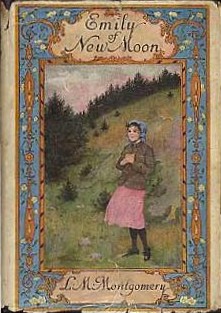
emily_of_new_moonEmily of New Moon is an engaging, wickedly humorous, moving novel.  Like Anne, Emily is an orphan.  When Emily’s father dies, she must go to New Moon to live with Aunt Elizabeth Murray, Aunt Laura, and Uncle Jimmie.  This middle-aged-to-elderly family doesn’t know quite what to do with her.

Emily is both dignified and hilarious.  She loves to write, and spends hours writing “letters” to her dead father on the backs of old letter-bills, because Aunt Elizabeth doesn’t see the point of buying paper.  Emily frequently experiences “the flash”–something she feels when she appreciates nature, beauty, or an idea.  When a teacher asks her why she is crying on the first day of school, she says with “the Murray dignity,” “It is a matter that concerns only myself.”  When Lofty John, a neighbor, pretends an apple she ate was poisoned for rats, she runs home and writes a letter to her best friend, believing she is dying.

I am going to die.  I have been poisoned by an apple Lofty John had put out for the rats.    I will never see you again, but I am writing this to tell you I love you and you are not to feel bad because you called me a skunk and bloodthirsty mink yesterday.

“Bloodthirsty mink!”  I love it.

Though Emily of New Moon is not quite as appealing as the Anne books, I enjoyed it very much and look forward to reading the others.

So, thank you, Virago!

Book Stats, Books I Didn’t Finish, & Bloggers Interviewing Bloggers

Happy New Year!  The most romantic New Year’s scene ever:  When Harry Met Sally

I don’t attend New Year’s Eve parties.  The last time I attended one, it was the ’80s, everyone except me had big hair, and there was much drunken flirting.  There was a snowstorm, and someone was very insistent that we spend the night.

“No, thank you!”

What do I like to do on New Year’s Eve?  Figure my book statistics for the year and make up my final Best  Books of the Year list.

BOOK STATS 2013

I.  I found out about the books I read this year from:

Book reviews:  10%

Blogs & websites:  2%

Award winners & finalists:  1%

Bookstores, online bookstores, & The Planned Parenthood Book Sale:  53%

Had at home:  34%

I love blogs and book reviews, but often read for the reviewer’s voice rather than his or her judgment, and to keep up with what’s new.  I have a long TBR list.

II.  BOOKS VS. E-BOOKS

Books 79%

E-books 21%

III. GENDER

Women authors 58%

Men authors 42%

Are you ready for my Best Books of 2013 listI’ve already posted two, one on my sidebar and one on a post, but now I’m going to choose

MY TOP 12 (in no particular order, because it’s ridiculous to compare them)

1. Doris Lessing’s The Four-Gated City

2.  Elizabeth Spencer’s The Voice at the Back Door

3.  Peter Stothard’s Alexandria:  The Last Nights of Cleopatra

4.  Graham Joyce’s The Silent Land

5.  D. H. Lawrence’s The Rainbow

6.  Steve Yarbrough’s The Realm of Last Chances

7.  Barbara Pym’s Some Tame Gazelle

8.  Tolstoy’s Anna Karenina

9.  D. J. Taylor’s The Windsor Faction

10.  Virgil’s Aeneid Book XII, ed. by Richard Tarrant

11.  Stand on Zanzibar by John Brunner

12.  Dickens’ Our Mutual Friend

And now for a new feature, “Books I Haven’t Finished and Why.”

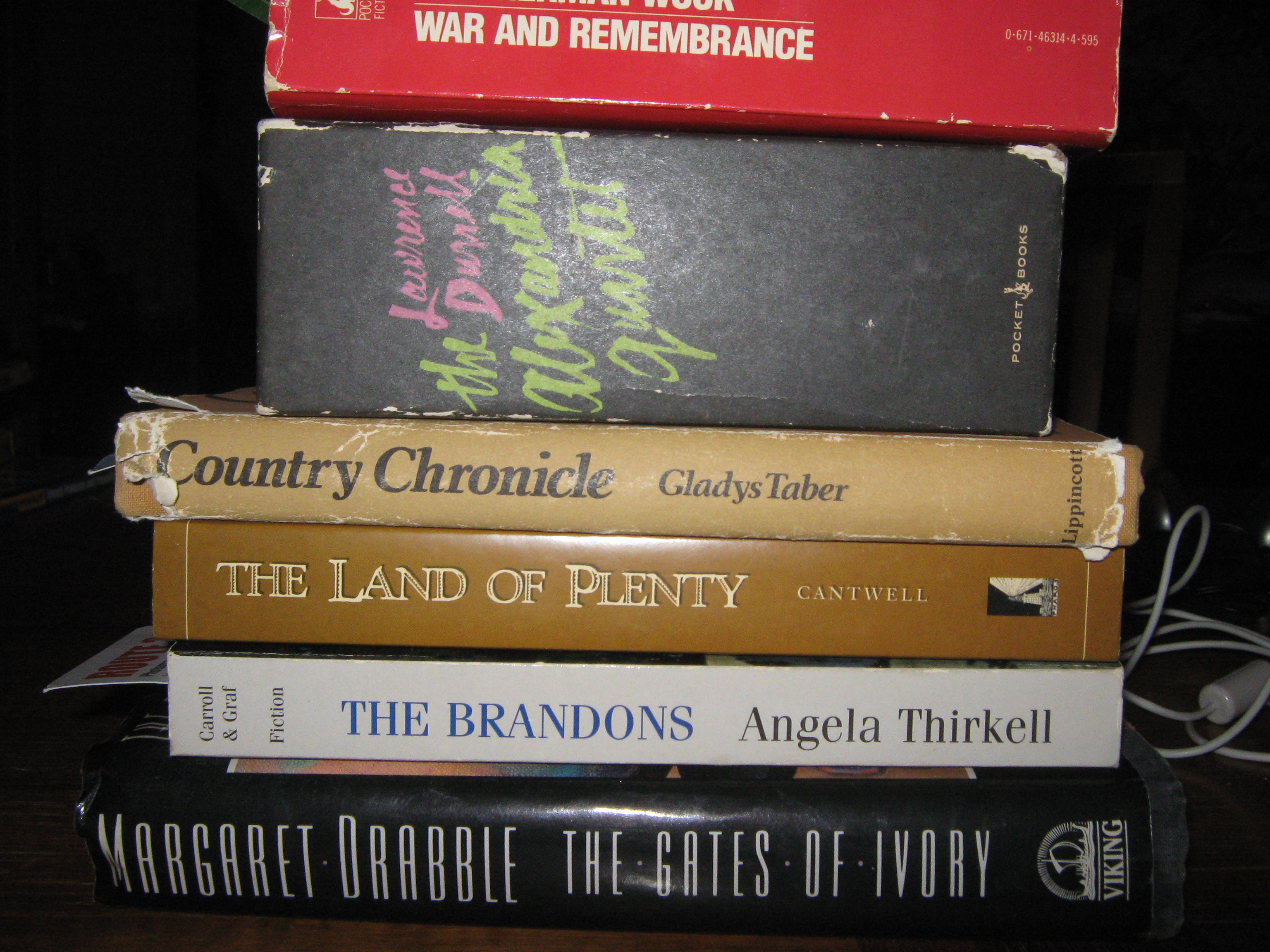
Books I haven't finished this year.

Books I haven’t finished this year.

1.  Herman Wouk’s War and Remembrance. I am very, very picky about what I read, and I don’t have time to read a 1,300-page book unless it’s War and Peace.  Wouk’s book was recommended by a Wall Street Journal writer.

2.  The Alexandria Quartet by Laurence Durrell.  Justine, the first of the quartet, is a brilliant, lyrical novel about a beautiful, half-mad, sexy woman with a terrible secret.  The narrator, a novelist, loves her, her husband loves her, and various other men in Alexandria love her:  she’s a great fantasy figure, and those of us who are average women are simply astonished.  I am halfway through the second book, Balthazar.

Loved these lyrical books in the ’80s.  If anybody wants the boxed set, let me know.  I’m reading it on my Nook.

3.  Gladys Taber’s Country Chronicle.  I adore her writing about her farm in Connecticut.  This is divided by seasons.  I have Summer and Fall  to go.

4.  Robert Cantwell’s The Land of Plenty.  A 1935 factory novel, very good, but not my kind of thing.  I may go back to it.

5.  Angela Thirkell’s The Brandons.  Angela Thirkell, a humorous novelist, is very, very witty,  but her verbosity can be like a tick.  She is very entertaining if You’re in the Mood for Copious Capitalization.

6.  Margaret Drabble’s The Gates of Ivory.  I have reread the first two books of her Radiant Way trilogy many times, but once again abandoned the third halfway through.  Maybe next year…

BLOGGERS INTERVIEWING BLOGGERS. I planned to interview bloggers about their blogging in 2014,  but  just noticed in surfing the net that a few other bloggers have done this kind of thing.    If I’m not talking about their reading per se, but rather how and why they blog, is it worth doing?  And something very, very short! Or is it like vanity writing?  Bloggers reading bloggers writing about bloggers writing about bloggers…

Well, Happy New Year while I figure this out!

American Veg! or Do I Mean the Turkey & I?

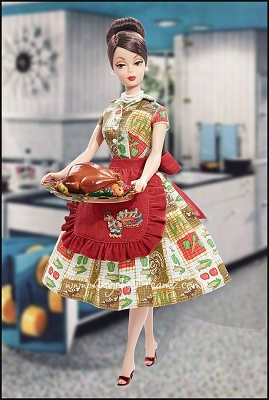
Barbie with turkey better picture

Barbie with turkey!

When I did not roast a turkey on Thanksgiving, there was massive discontent in my family.  They ordered pizza for supper.

I roasted a turkey on Christmas.

Turkey is a tradition.  Without turkey, there is no holiday.  I can deprive them of gifts (no gift-giving this year) and a tree, but there must be a turkey.

I became a vegetarian in September.

But being a carnivore is the American way of life.

Americans eat 270.7 pounds of meat per person a year, according to NPR–more than anyone in the world except Luxembourgers.  (And why Luxembourg I can’t tell you.)

Hormone-and-antibiotic-fed-and-shot-up meat and poultry.  Mm, mmm.  Delectable!

Being an American meat-eater can be hard on the planet.  Raising livestock has an adverse impact on the environment. Not only does it require more land, water, and energy than plants, but animal waste pollutes the air and water.

I ate some turkey on Christmas.

It was vaguely nauseating.

It was the chemical taste that turned me against meat and poultry.  (You don’t want to know what they’re feeding them.)  Suddenly I couldn’t eat confined-animal-facility-raised meat.

It has been a good health decision.  My blood pressure (always very low) has dropped 10 points, my cholesterol is finally normal, and I am in excellent physical condition.  (Fat is not necessarily unfit:  it depends on diet and exercise.)

The holiday is over.

And I will not deal with the leftovers.  I don’t like to handle meat.

I refused to make the turkey sandwiches.

I refused to make the turkey noodle casserole.

And when I gave instructions for the turkey noodle casserole, “Someone” didn’t speak to me all night.

The issue isn’t exactly turkey on the holidays.  It is vegetarianism.   Although most know vegetarianism is better for the planet, meat-eaters consider it a personal attack on themselves.

Dining out isn’t a problem.  Most restaurants have vegetarian selections, though not always good ones.  (Fast food, for instance:  McDonald’s has better options than Wendy’s.)

Dining at friends’ homes can be difficult.

You are invited to someone’s house for dinner.  Either your vegetarianism hasn’t registered, or they don’ think it’s worth bothering about, so they serve you pot roast.

You (a) explain that you are a vegetarian and create a huge scene because your hostess then becomes super-dramatic, or (b) eat the potatoes and carrots and any salad you can find on the table.

“Would you like more beef?” your hostess says.

My cousin has a theory about this.  “They hate you because you’re a bohemian bicyclist.”

“Perhaps if I were a thin bohemian bicyclist?”

“They wouldn’t like that, either.”

And on that happy note, here is a vegetarian meal for New Year’s Eve that everyone likes, Mac, Chili, and Cheese from Mollie Katzen’s The Heart of the Plate:  Vegetarian Recipes for a New Generation.

George Eliot’s Felix Holt: The Radical

I’m a Radical myself, and mean to work all my life against privilege, monopoly, and oppression.”  –George Eliot’s Felix Holt:  The Radical

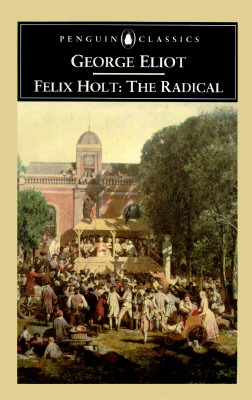
Felix Holt eliotGeorge Eliot’s  Felix Holt:  The Radical is the richest and most compelling  of several rather strained Victorian political novels I’ve read in recent years.  The others are Elizabeth Gaskell’s Mary Barton, Charlotte Bronte’s Shirley, Mrs. Humphry Ward’s Marcella, and George Meredith’s Beauchamp’s Career.

All of the aforementioned are also love stories:  the Victorians knew we long to read about the complex emotions that flourish or die under the machinations of politics.

And, yes, I read them for the love interest.

To an American reader whose 19th-century English history has been learned from novels, the politics are complicated but not incomprehensible.  The issues are usually  (a) something called the First Reform Act in June 1832,  (b) the Second or Third or possibly Fourth Reform Act, (d)  unrepealed corn laws,  (f) union politics, and (g) electioneering.

If forced to take a quiz, you could scribble a few words after skimming the footnotes.

But of course you get it:  there’s corruption, there are votes bought and sold, and there’s rioting.

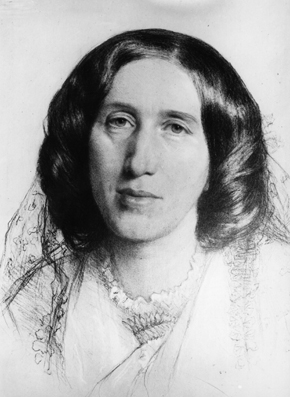
George Eliot

George Eliot

In Felix Holt, Eliot’s uneven, if compelling, novel, two men have parallel yet widely separate radical beliefs.  Felix Holt, the radical son of a quack doctor, returns to Treby after five years apprenticed to an apothecary and forbids his widowed mother to continue to sell a quack patent medicine.  Philosophically, in a hipster mode I sympathize with completely, he goes into business as a watchmaker, insisting it is preferable to a career as an apothecary or clerk.  When the minister wonders why he is wasting his education and offers to find him a clerical job, Felix insists that a  job that requires a cravat is “really lower than many handicrafts; it only happens to be paid out of proportion….  I mean to stick to the class I belong to–people who don’t follow the fashions.”

The wealthy Harold Transome at the same time returns from the East to Treby and stands for election to Parliament as a Radical, though his family are Tories.  His politics do not, however, interfere with his rank:  he is not an idealist like Felix.  Like Felix, he takes over the family business from his mother, i.e., running the estate.  Their mothers smoulder with anger in the background.

The two men’s lives intertwine when Felix reports to Harold that one of his election agents has bribed men in a pub with liquor.  Harold is annoyed:  he is a good man, he wants to win the election straight, but Jermyn, the lawyer who is running his campaign, considers dirty politics acceptable.

The radicalism of the two men also interests the beautiful, intelligent heroine, Esther Lyon, the minister’s daughter.  Both men are captivated by her beauty.  And the point of the novel comes down to, Whom should she love?

Esther is in her own right well-educated.  She has worked as a governess and tutors the upper-middle-class children in the neighborhood.  But she also dreams of love and likes to read novels, and the earnest Felix doesn’t approve of romantic dreams or novels.

His brilliance and outspokenness influence her.

The favorite Byronic heroes were beginning to look something like last night’s decorations seen in the sober dawn.  So fast does a  little leaven spread within us–so incalculable is the effect of one personality on another.  Behind all Esther’s thoughts like an unacknowledged yet constraining reverence, there was the sense, that if Felix Holt were to love her, her life would be exalted into something quite new–into a sort of difficult blessedness, such as one many imagine in beings who are conscious of painfully growing into the possession of higher powers.”

Harold, on the other hand, becomes interested in Esther when he learns that she is, through some very convoluted circumstances, the true heir of his estate. Harold acknowledges her position, and begins to court her.  If they marry, everyone will be happy.

Esther gradually becomes a realistic, three-dimensional character whose understanding of the political riot that sends Felix to jail is far beyond what we expect of the  beautiful “novel-reading” minister’s daughter.

I cannot pretend this is a George Eliot “must-read”:  it is, in fact, the least brilliant of her major novels. Felix is not a very well-rounded, believable character; Harold is also a bit of a stick.  Eliot was ill when she wrote this novel, and it shows.

It is negligible compared to Middlemarch, Daniel Deronda, or The Mill in the Floss, her masterpieces.

Nonetheless, I very much enjoyed it.  A beautifully-written book over the holidays.  What could be better?

N.B.  I recently wrote about Mrs. Humphry Ward’s Marcella here.  I jotted a few notes about Bronte’s Shirley, Gaskell’s Mary Barton, and Meredith’s Beauchamp’s Career at my old blogs, but so briefly that I won’t bother you with links.  All five are worth reading in their way, but they are not brilliant.

Is This What the Internet’s For? & a Satire of the Perfect Blog

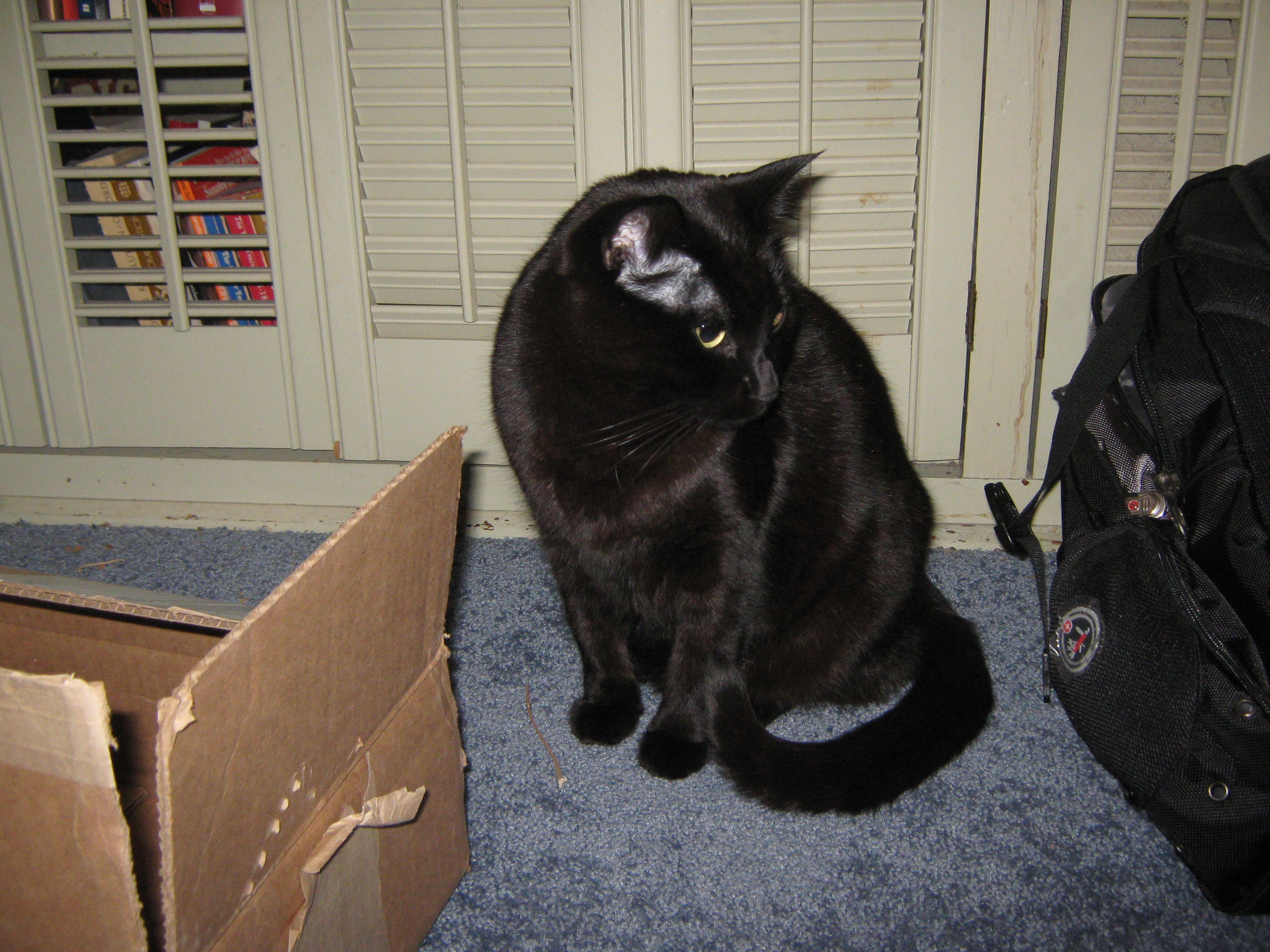
Black cat with holiday toys (a box and a knapsack).

My favorite black cat with her holiday toys (a box and a knapsack).

There are certain popular blogs I no longer read.  Year-round they may be a bit too happy for me, but over the holidays I can hardly bear the tales of their perfect lives. 

Last night I stared incredulously at happy shiny pictures of perfect Christmases in stately homes.

I got offline and told my husband in a quavering voice, “You should see the pictures of the perfect Christmas trees.  Heavily photoshopped, trees with glimmering makeup, but still…”

“Is that what the internet is for?  So people can brag at Facebook?”

“I think it used to be about community.  There used to be a lot of groups.”

“The less screen time, the better,” he said.

And perhaps blogs are changing. There used to be quite a few radical bloggers who were writing about subjects that were not attempted by mainstream press.  Nowadays, many bloggers I admired have burned out or quit, and there is a new happy, happy tone, a pressure to conform, that is not authentic.  Apparently nobody’s child is unemployed, nobody is in the hospital, all the siblings are on speaking terms, and nobody’s poverty-stricken uncle is washing his wife’s disposable diapers because he cannot afford to buy new ones. 

No, bloggers are magic. They have no problems. 

Or, you can say, they choose not to write about them.  You feel indignant.

But where are the people who write the truth?  An alternative to newspapers?

Book blogs, never entirely reliable, have grown less so.   Thank you, thank you, publicists! for using me to promote your books, they scream. If they have integrity,they needn’t thank the publicists publicly.   (It’s their job!)   If they don’t have integrity, announcing that they are accepting gifts will not improve the reliability of their reviews.

Bloggers have also become Teflon on every subject.  Christmas is more stressful for women than men, according to a survey by the American Psychological Association, because women feel responsible for making the holidays.  And the British Heart Foundation says that one in three people drink at least five days a week before Christmas,

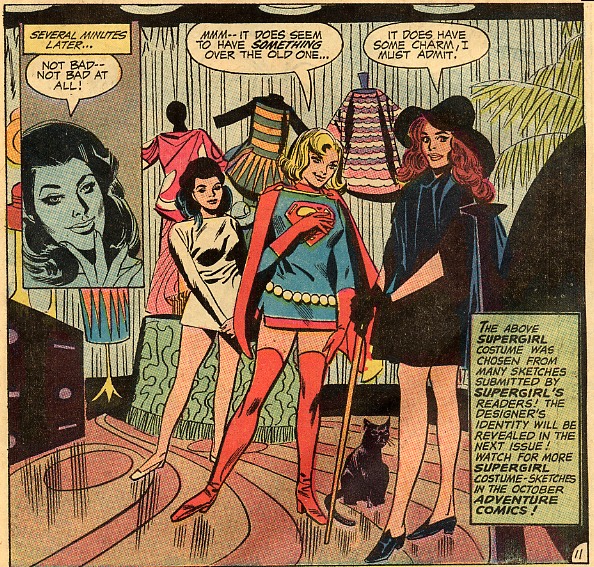
supergirlCostumeAre my favorite bloggers drinking or stressed?  They certainly don’t talk about it.  For instance, I have long been a groupie of a very popular blogger whom I shall call Superwomanonamphetamines.  She is perfect, if smug, and I suppose  you ARE smug, if you’re perfect (and on amphetamines).   I  can’t QUITE like her, can you? because she reads, writes, weaves, decorates cakes, makes her own wine, built her own house, hikes, runs, skis, skates, climbs rocks, dances, wrestles alligators, travels, gardens, has a personal meth lab, and is a witch in a coven…   Still, when I’m in the mood, I desperately want to be like her, except I don’t want to weave, wrestle alligators, be a witch, or take amphetamines etc. 

I, on the other hand, am at the opposite extreme from Superwomanonamphetamines.  I ride my bicycle, and complain about it endlessly.  I have a lovely family, and complain about them endlessly. I tell everyone they should read John Brunner’s 1968 dystopian novel, Stand on Zanzibar, because it’s about the world today.  And, yup, I write about the Christmas my cousin was in the mental hospital instead of about my perfect life.  Which is p-e-r-f-f-f…

(Yes, I can satirize myself with the best of them.)

So I don’t know quite what I’m saying here, but I wish the blogs WERE better, and were an alternative to newspapers, but they are NOT and will never be until we write about things that actually matter.

Merry Christmas & Alice Thomas Ellis’s Home Life

Community, a Christmas episode

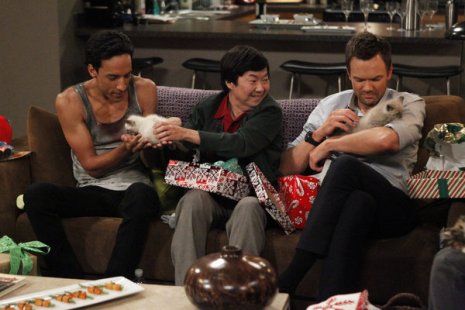
Community (a Christmas episode)

Merry Christmas!

We read, took a long walk, and ate turkey in front of the TV.

Did you know that Channel 23 shows reruns of Community, The Middle, and Modern Family?

I haven’t vegged out like this in a long time.

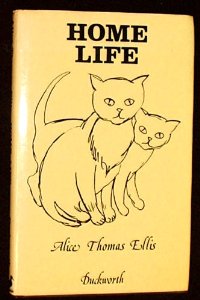
Home Life by alice thomas ellisIt was not exactly like the Christmas scenes in the brilliant novelist Alice Thomas Ellis’s Home Life columns.  Are you familiar with her light, charming essays about domestic life, written for The Spectator and collected in four volumes?

Home Life is vaguely like E. M. Delafield’s Provincial Lady, only urban, circa the 1980s.  A white Persian cat is in the sink, so Ellis has difficulty brushing her teeth; a man mistakes her for a prostitute when she is in a bar with Beryl Bainbridge; she gets snowed in in the country; and the pipes burst and inundate a set of Thackeray.

She had seven children, so I can’t imagine how she wrote so beautifully, though there is someone named Janet in the background, an assistant(?)/friend who helps run the household.

Here is a Christmas scene from “Liberated Lady” in Home Life, Vol. 2

Well, after all that fuss it wasn’t such a bad Christmas after all–really quite agreeable.  I always feel a bit daunted as I regard fifteen shining expectant faces and glance from them to the turkey crouching in a threatening stance, waiting to be carved, but as I’ve gone quite limp by that time anyway I leave the carving to any delightful gentleman who cares to try his skill:  Michael this year, and a very good job he made of it–and the ham.  Someone presided over the claret with his usual urbanity, and I even remembered to put the gravy on the table.  We all looked particularly lovely, especially me in a glitzy coat that Beryl gave me, which made me rather resemble a salmon who had been muscle-pumping, since it has Dynasty-type shoulder pads.

Did you dress up for Christmas?  I’m in corduroy stretch pants (I thought I’d never wear this gift from my mother but they’re heavenly indoors), a zip-up sweater, and a knee-length cardigan.  My husband is in jeans, sweater, and stocking cap.  (It’s freezing in here.  He keeps it at 60 when he’s home.)

I managed to clean the house for the great day, if you don’t count the books I transferred from the tables to the bedroom floor.

It was a good Christmas, as these things go.  Keep expectations low.

And, like everyone else, I start my diet tomorrow after the feast I didn’t particularly enjoy.

Our Bipolar Christmas

"I don't know what to tell you except it's Christmas and we're all in misery."  National Lampoon Christmas Vacation

“I don’t know what to say except it’s Christmas and we’re all in misery.”–Beverly D’Angelo in  National Lampoon’s Christmas Vacation

We didn’t put up a tree.

We’re not giving presents.

We’re roasting turkey tomorrow.

We’re treating Christmas as a grown-up holiday.

It is splendid so far.

We had a very dark Christmas one year when my cousin was in a mental hospital.  She went manic on Christmas Eve because of steroids for an ear infection.  It was a side effect of the steroids.

It began with her walking around the supermarket telling people the air was poisoned.  The manager wouldn’t sell her the items she’d gone to buy and said she couldn’t shop there anymore.

Then she called 911 three times to say the air was poisoned.

The police came.  “You can’t call 911 like that.”  They searched her house for drugs. “I have no drugs,” she told them.

They dragged her out of the house and she wrapped her legs around a pillar on the porch and screamed to a neighbor that they weren’t “the real police.” Another policeman showed up, was kind and won her confidence, and took her to the psychiatric hospital.

Not only was she manic, but she was also disoriented.  They took away her shoelaces. “What can I do with shoelaces?”  she asked reasonably.  They let her have dental floss, but she became terrified of the dental floss.  “What if someone strangles me with dental floss?”

She asked us to bring her journal, couldn’t sleep (there’s the mania), and wrote incoherently in her journal for hours.  The next day she said the nurses had been reading her journal.  (She imagined it, but she was manic, not a liar.)

In cases of mental illness, family is not always sympathetic.  Her boyfriend, her father, and another cousin and I went to see her, but her mother refused.  When my cousin called a few days later, her mother said, “What have you done now?”  My cousin wept.  She is a law-abiding citizen.  She had “done” nothing.  She was ill.

In the common room she made friends–she always makes friends–and asked us to bring in a treat.  We brought in milkshakes from McDonald’s.

She watched Star Trek with her new friends and became a Star Trek fan.  Yes, she knows everything about Star Trek.

The doctor told her the steroids triggered the mania, but thought she was also bipolar.  He sent her home with psychiatric drugs.  Honestly?  I don’t know if she’s bipolar or not.  Perhaps a bit of hypomania sometimes.  She is very talkative and impulsive, but so are a lot of people.

I am a generation older and feel maternal towards her.  She visits me often. She is loud but vulnerable.  I enjoy her company.  I know she is horribly lonely this time of year.

So Merry Christmas, everyone!  If you’re having a bad Christmas, remember:  it could be worse.

P.S.  My cousin is no longer banned from the supermarket.   They don’t recognize her as the crazy person who talked about poisoned air.