Rushing to the Library with Vita Sackville-West’s The Easter Party

The university library.

The university library has a remarkable collection.

It happens every three months.

Our books were due at the university library.

I was reading a library book, Vita Sackville-West’s The Easter Party, in my sanctum, the pillows propped up, a tea mug on the table, the computer handy for taking notes.  I would not see anybody for hours, because the football game was on in the other room.  It could have been baseball.  Who knew?

An evening of reading.

I peered over my glasses disapprovingly when a family member interrupted.

“Our books are due tomorrow.”
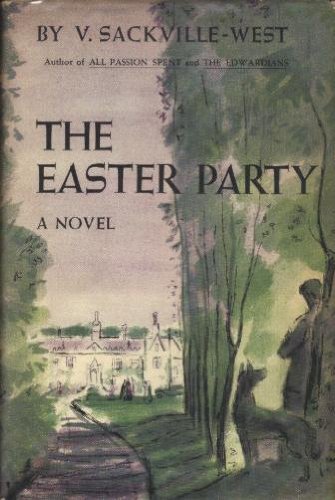
Vita Sackville-West The Easter PartyOh, dear.  I had to finish The Easter Party.  I had to finish it fast.  We are “extra-mural” borrowers–not affiliated with the university–and the fines are expensive. We drive 40 miles every three months (we can renew books for three months) because the library has a remarkable collection.  I don’t know what I would do without it.

Although Vita Sackville-West is probably best known for her love affair with Virginia Woolf, she also wrote two very good novels, All Passion Spent (1931) and The Edwardians (1930).   (I read them many years ago, so won’t write about them here.)  The Garden Party (1953) is uncharacteristically elliptical, reminding me very slightly of the novels of Ivy Compton-Burnett.  The plot:  an Easter party over a long weekend may save or destroy an unconventional marriage.

The novel begins in the consciousness of Rose, a beautiful 45-year-old woman with a secret.  Her cold husband, Sir Walter, lives for his work as a high-powered lawyer, and when he says he has a meeting that night, Rose says she will dine with someone else. Whether either one of them will be home before bedtime is questionable.

Before Walter goes to work, she sends out tendrils to see if he will tolerate a party over Easter weekend at Anstey, their country home.

She has already invited her unglamorous sister, Lucy, Lucy’s husband,  Dick, and their 22-year-old son, Robin.  Lady Juliet Quarles, a charming, likable, witty woman known for her affairs with men of all ages, will be there.  Walter is polite, but doesn’t really like company.

Later that morning, Gilbert, her brother-in-law, a neurologist,  calls and invites himself.

Lady Juliet is hilarious:  she likes everybody, calls everybody darling, and is very genial, even though she is known as a shallow socialite.  Gilbert pretends on the phone to be intimidated by the thought of meeting her, and when Rose assures her that Juliet is very nice, Gilbert says:

“Are you trying to tell me that Lady Quarles is cosy?  I f so , I don’t believe it.  Nothing that I have ever heard of her indicates anything of the sort.  it is true that my cognisance of her is limited to the piles of illustrated papers, all out of date, which I contemplate only when I visit, in a state of the greatest apprehension, my dentist or my doctor.

Sometimes Sackville-West is witty, other times her narrative is remarkably sad.  Rose’s secret is tragic:  she is a virgin, because Walter married her for appearances, and told her before their marriage he didn’t want to reproduce.  (Why they don’t use condoms or a diaphragm is beyond me.  Is Walter gay?  One wonders.)

Her physical desire for Walter she had after years of struggle been able to overcome:  it was stifled, dead.  And, anyway, she had often said to herself, pacing up and down her room at nigh, twisting her hands, throwing her head back, heaving her shoulders, breathing quickly and heavily in an anguish she scarcely understood, since she was sensually unawakened, anyway, she had said to herself, trying to regain control, what does the physical matter?  (Walter slept just along the passage; she had only to open her door, slip down the passage and find herself in his darkened room.  “Walter?”  she would say.  “Walter, my darling?”  And in another moment she would be in his bed, and all the barriers would come down.)  The physical thing did not matter.  The poets said so.

Gilbert, who dislikes the way his brother treats Rose, forms a sinister plan to save their marriage.  The plan involves Walter’s dog.  I was VERY anxious.

Sackville-West changes point-of-view often, writing from inside the heads (in the third-person) of all the characters in the Easter party.  The focus is on Rose and Walter.

I very much enjoyed this book. Not great, but very good.

And here’s a picture of the books I checked out at the library today.
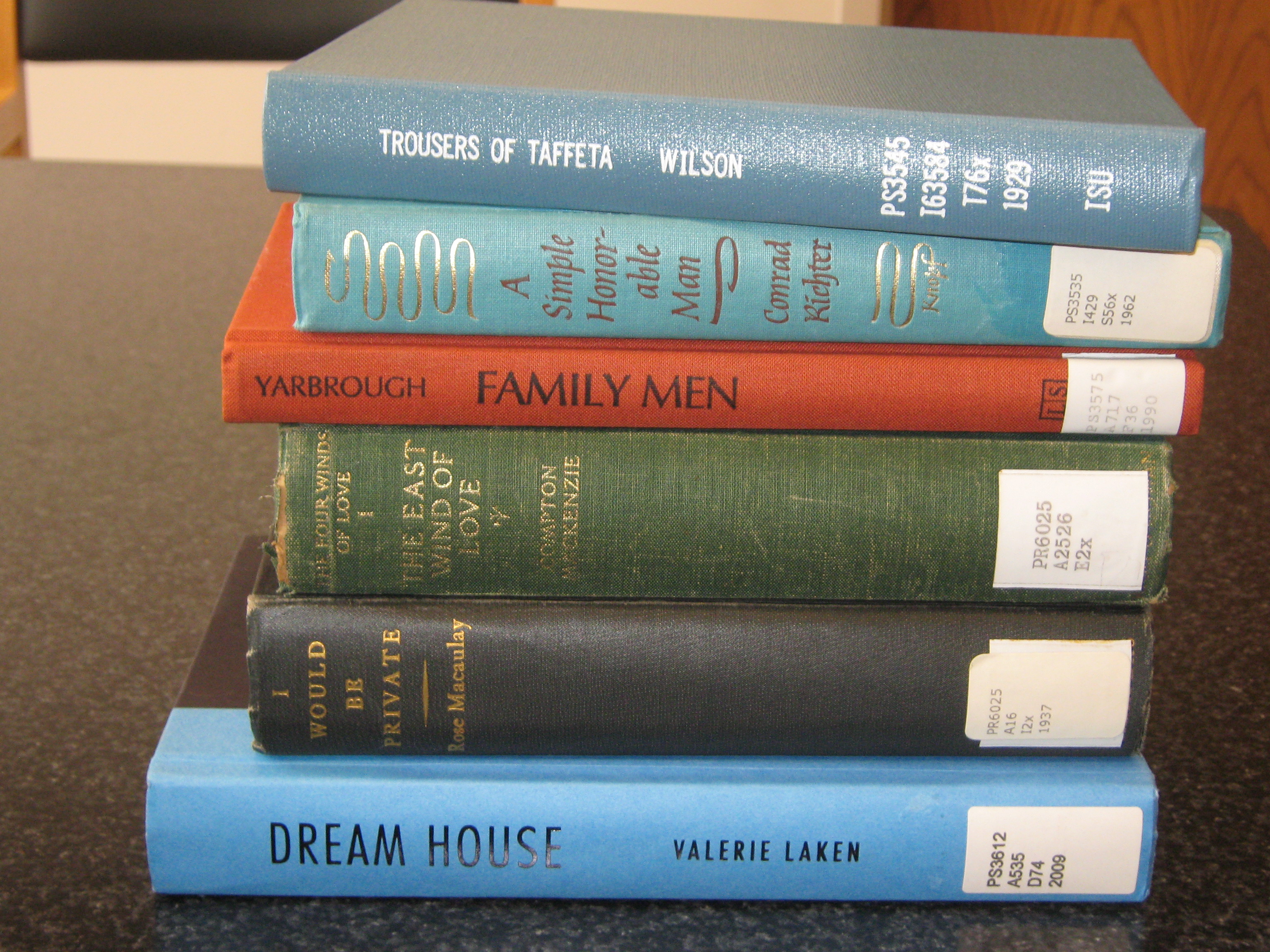
IMG_2716Trousers of Taffeta by Margaret Wilson (who won the Pulitzer in 1924 for The Able McLaughlins)

Conrad Richter’s A Simple Honorable Man

Steve Yarbrough’s Family Men (a collection of stories by the author of The Realm of Last Chances, my favorite novel of the year)

The East Wind of Love by Compton Mackenzie, author of Sinister Street

Valerie Laken’s Dream House (I know nothing about her:  it’s a gamble)
An Accidental Romance: In Which My Cousin and I Find “Athletic, Toned” Boyfriends

If a thing is right it can be done, and if it is not it can be done without; and a good man will find a way.”–Anne Sewall, Black Beauty

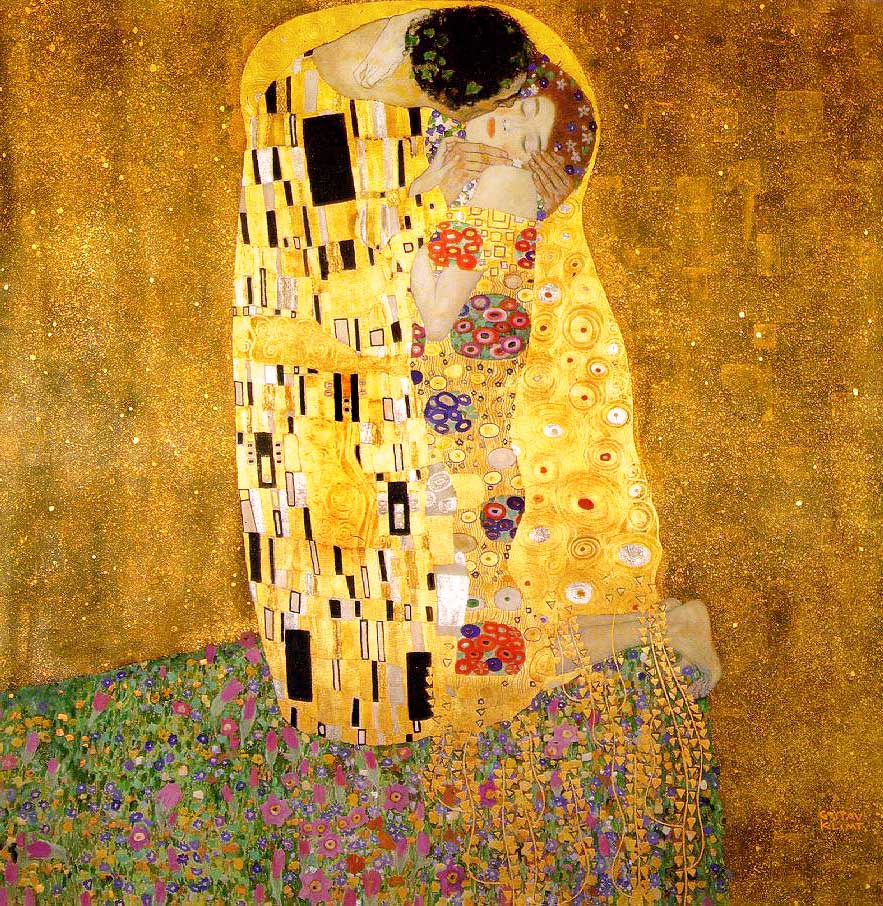
"The Kiss" by Gustave Klimt (one of my favorite paintings)

“The Kiss” by Gustave Klimt (one of my favorite paintings)

My cousin and I were drinking tea in the back yard.  I was reading aloud an article called “Boyfriend Boot Camp.” It was freezing, but the outdoors was the only place for girl talk.  There was a noisy football game on inside.

I went to boyfriend.com because my cousin was sobbing.  She pretended to sob over her favorite book, Black Beauty.   She used to have a horse named Black Beauty.  We all had that horse.  Our grandfather had a farm.  Every horse he owned was called Black Beauty.

But then she sobs that she will never have a boyfriend again.

I don’t think so.

“Now listen to this,” I say.

Boyfriends…Can’t live with them can’t live without them!  Is your boyfriend driving you crazy? Are you being the best girlfriend possible and not getting anything in return? Whip your man into shape! Put him in the Boyfriend Boot Camp and watch all your worries disappear!

Duh…my husband/boyfriend drives me crazy.

“I’ve had a lot of boyfriends.  Not one would go to Boyfriend Boot Camp,”  my cousin says.

“You need the right boyfriend,” I say, not knowing how boyfriend.com can help with this.  “I mean the one who doesn’t need Boot Camp.”

“Lower your expectations,” people said to me when I was divorced.  You know why they said  that?  Because all the men were married.

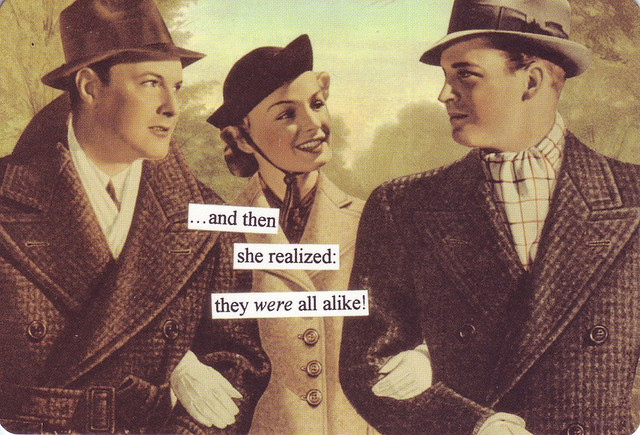
And then she realiezd they were all alike taintorThe perfect man, in their eyes, was a sweet, dull, single guy they set me up with who watched reruns of MASH, never read a book, and brought me a new toaster or a coffee maker every time he came over (which was not very often, because I ended it).

Very nice, but I became glassy-eyed.  I would rather have had a book or an Eric Clapton album.   We were incompatible.  I wonder if he ever got married.  I did.

“All I need is somebody brilliant, handsome, and rich,” my cousin adds.

“Who are you–Emma  Woodhouse?”

Then I explain who Emma is.  Then I tell her to lower her expectations.

So I read on, and  discover that expectations can be too low.

Does your boyfriend sell drugs? Another big problem! This one is more easily fixed however. This is something that is often used to supplement income. And it’s easy money, so your man isn’t exactly going to be willing to give it up so quickly.  But carefully explaining how this negatively affects you and your relationship will help. Don’t immediately rush to ultimatums, because that may not end very well.  By making it about you (for example, I feel like…) instead of placing blame on him, he will be much more responsive to change.

“Now that’s ridiculous,” I say.

“It is pathetic,” she admits.

Then the site refers us to Match.com.

I have no faith in dating services, but my cousin needs help.  She is at the wrong age–late 30s–for dating. Two years from now it will be better.

“I won’t sign up unless you do,” she says.

“Oh, come on!”

I finally agree to sign up, but I will not pay.  That means I won’t get the dating information.  I don’t need it.

My cousin busily answers the questions, laughing all the while, and so do I, skipping a huge proportion of them because it is never-ending.  She is looking for a man 20-40.  (“20?  Oh, come on!”)  I decide 50-70.   (“70?  Why not 100?”)  Finally I am presented with a bunch of pictures and told that I have an 88% match with one of them.

“How can I have an 88% match when I answered only ten questions?”

The men, all divorced (did I select “divorced” on the questionnaire?), claim, without exception,  that they are “athletic and toned.”  Some are much too old for me, and some of the pictures I suspect are old.   Some are photographed in their bachelor pads, others in bars.

I quickly realize that the age range is much too wide.  The fifties would be best for me, well, maybe the low sixties, but in the fifties men are dating women in their 30s.  So does that mean…oh, I can’t do the math, really!

My cousin posts a picture of herself with a zinnia in her hair.

She is thrilled with her matches.  Yes, they are all “athletic and toned.” She picks out several she thinks are “cute.”

“But they all say they’re looking for a friend, conversation, long walks…” I point out.  “Don’t you want somebody different?”

She laughs.  “This one is cute, this one isn’t, this one is, this one might do.”

I snap my laptop shut. We’ll see how it goes.

She seems like herself again.

Proust, Not Competitively but Companionably

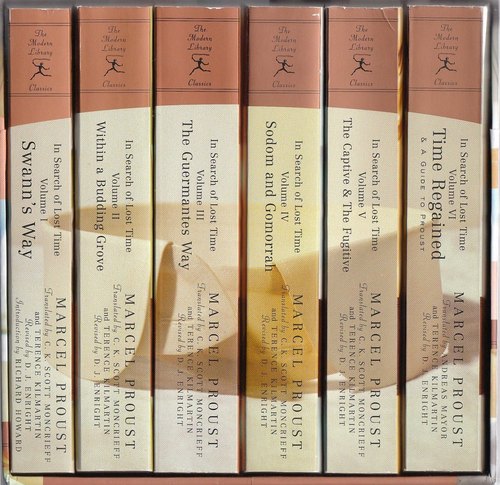
Proust In Search of Lost TimeFor the next year I plan to read Proust’s In Search of Lost Time. (Phyllis Rose’s The Year of Reading Proust isn’t enough.)  I’ve read the first two volumes of In Search twice, and then I start over again, since narrative isn’t a big part of it.

I’d like to read it with a group.  Starting with Swann’s Way again, of course.

I decided to check for a group at Goodreads.

First, I couldn’t sign in. I thought I was signed in for life.

“Sorry, we didn’t recognize that email/password combination,” it told me.

Well, even I didn’t quite recognize that password.

“Do you want to sign in with Facebook or Twitter?” it asks.

No, I do not.

I have a Twitter account (@MsMirabileDictu), but I don’t tweet.  It is, however, great for “cyber-stalking”:  NYRB, Gary Shteyngart, Mollie Katzen, my blogger friends, TLS, Ron Charles at the Washington Post, Maud Newton, and who is Andrew Holleran? I follow him, too.

By the way, leave me your Twitter address, and I’ll follow you.  Perhaps I’ll tweet someday.  I have sent four tweets, three by accident.

Anyway I finally signed in at Goodreads with a compromise password. The Proust groups are  moribund.

Same thing at LibraryThing. They have no Proust groups.

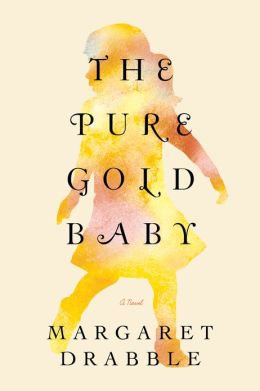
Drabble The Pure Gold BAbyHere is why I want to read Proust with a group.  I am in the middle of Margaret Drabble’s new novel, The Pure Gold Baby. and am inspired by her heroine, Jess, who is reading Proust with a friend.

Jess was reading Proust with an incentive.  She was reading him not competitively but companionably, in concert with an old schoolfriend from Broghborough with whom she had kept in touch.  They met rarely, for her friend Vivien lived in Edinburgh, where she was the assistant curator of a gallery, but they had preserved their intimacy through Viven’s occasional London visits and through sending one another postcards and letters….. (The reading group had not yet become a nationwide phenomenon.)  Jess and Vivien had already read their way through Ulysses, encouraging one another onwards by exchanging comments and moments of bewilderment and enlightenment, and now they were doing Proust.  Would they reach the end?  They were not sure.  it wouldn’t matter if they didn’t; nobody was watching them, nobody was marking them, there were no exams to sit, no teachers to impress.

Doesn’t this make you want to read Proust?

I need a Proust pen pal.

Seriously, I love Drabble’s heroines.  In her novel, The Seven Sisters, Candida, the narrator, studies Virgil with an adult ed teacher.  I  thought, I’m a Latinist: why not teach an adult ed class?  And so I taught an adult ed Latin class for two years.  Then we ran out of people.

I teaching Latin, in schoolmarm garb.

Teaching Latin, in schoolmarm garb.

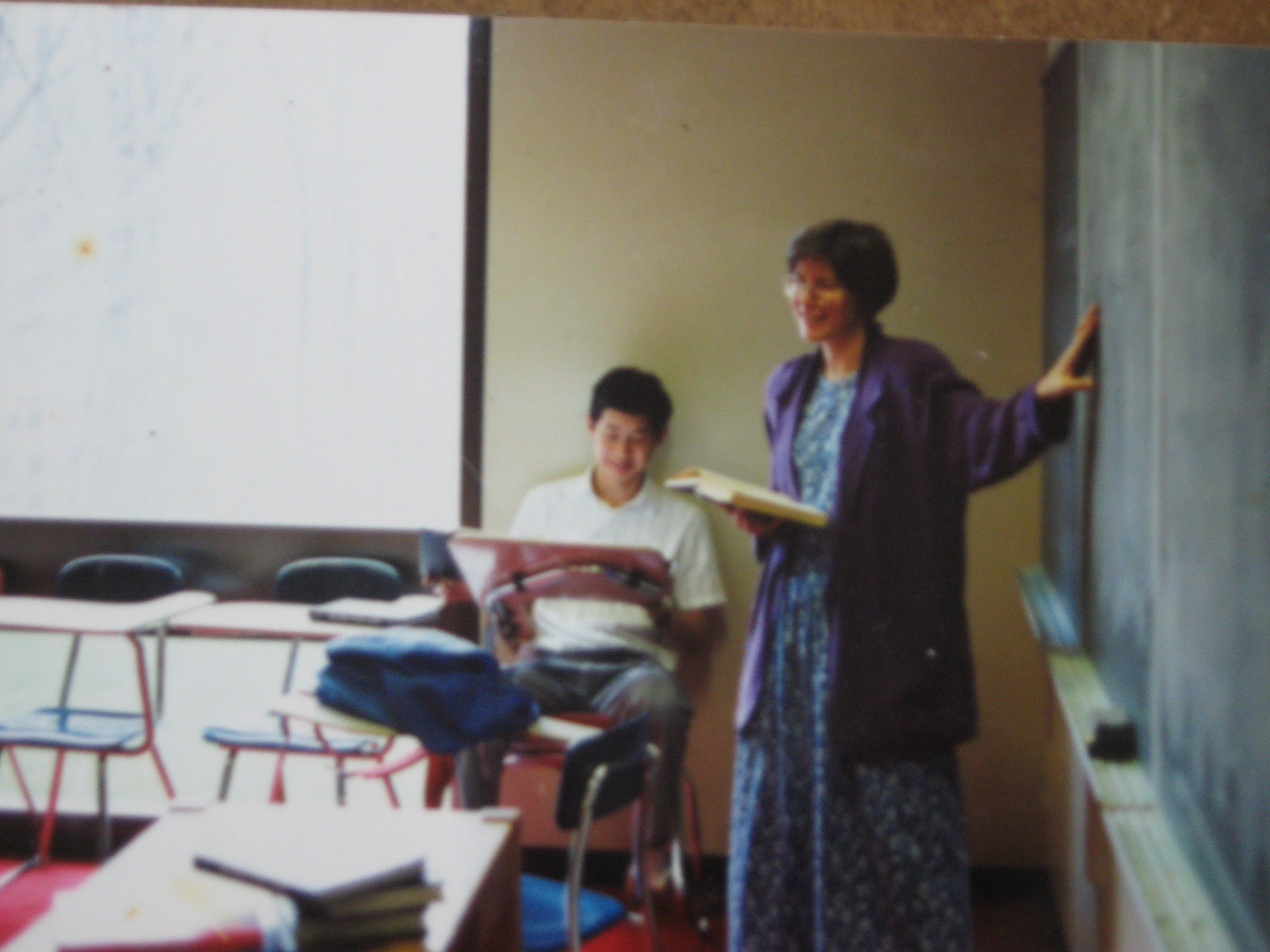
Here is a rather sweet, if blurry, picture of me teaching Latin in the ’90s, in schoolmarm clothes (important for discipline) and big glasses.  Sorry, I don’t have any pictures of my adult ed days.

So who’s going to read Proust with me?  Come on!  One person.

No one wants to?????!!!!!?????Maybe someone who reads French?

Oh, well.

Double-stacked, Cynthia Heimel, Clothes & Organic Food

IMG_2697

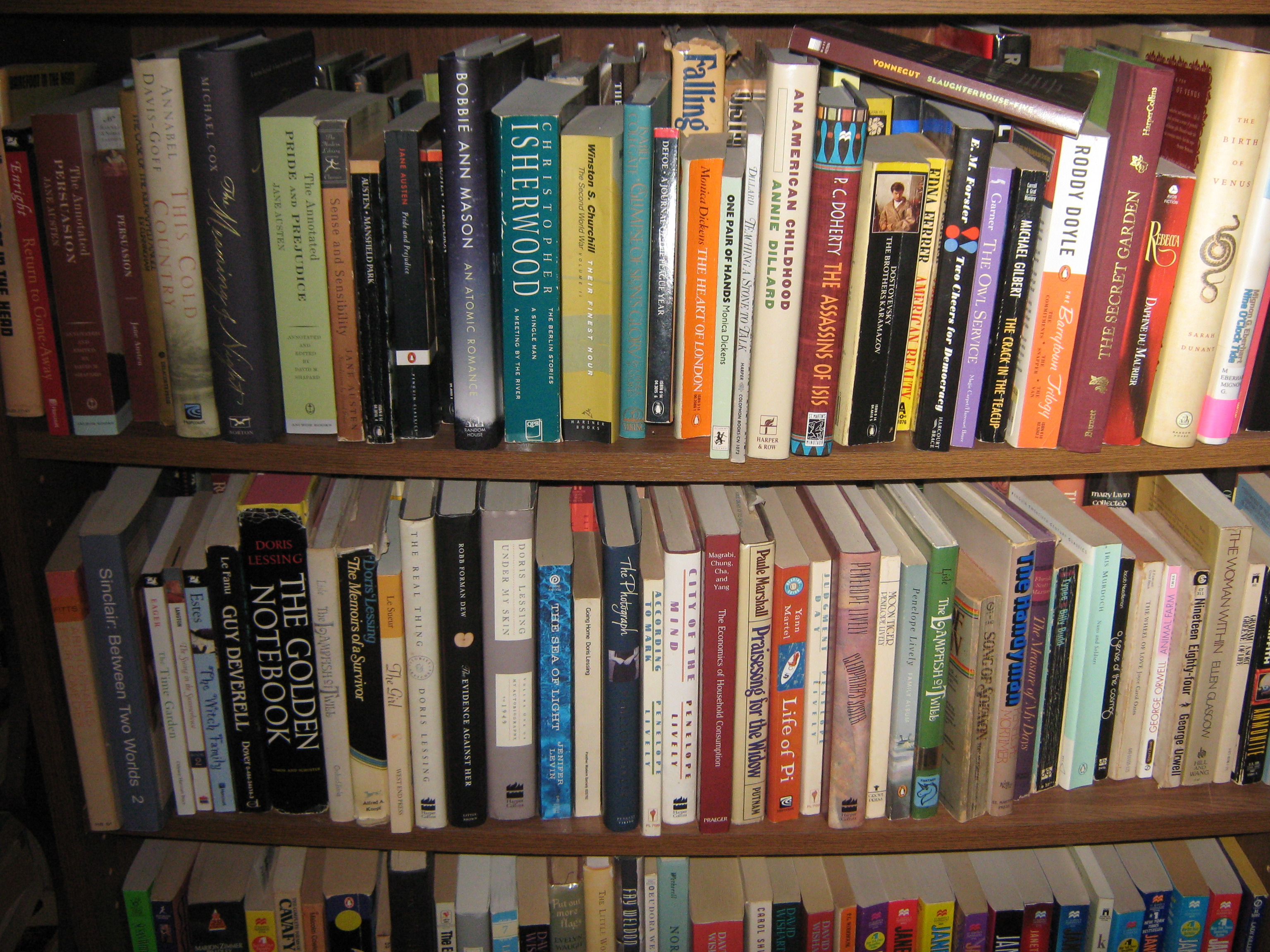
Double-stacked! Jane Austen to Christopher Isherwood to Doris Lessing…

I told myself sternly:  You will not buy more books.

You will not buy that skirt at the mall.

You will spend your money on organic food.

Suddenly I was part of the “Voluntary Simplicity” movement.

I have spent far, far more this year than I meant to, especially on books.

On the coffee table right now are:

  1. Colette’s Return from Love
  2. Conrad Richter’s The Light in the Forest
  3.  J. P. Donleavy’s The Ginger Man
  4. Barbara Pym’s Crampnot Hodnet
  5. Linda Gregg’s All of It Singing:  New and Selected Poems

And part of a chest of drawers now holds books.

As for my bookshelves…

They are double-stacked.  They’re in every room.

As a young woman I paid half the rent until I realized my income lagged far behind my husband’s.  I had a degree in School of Letters and another in Classics.  I was not prepared to live in the world. I favor liberal art degrees, but you can’t, for instance, be a doctor or lawyer (two of the very few professions I’ve heard of) unless you go back to school.   This is what my friends and I did: teach at private schools (you’re supposed to have a rich husband to do this), freelance, become a paralegal, or go back to school.

Some did all.

Books, books, books!  I said.  That’s what I want.

I journeyed to bookstores with a friend who was in a wheelchair.  She picked me up at my apartment:  she drove, I did not.  And we went to bookstores all over the city.

In those days we were huge fans of Cynthia Heimel’s humor books, among them Sex Tips for Girls, But Enough About You, and  If You Can’t Live Without Me, Why Aren’t You Dead Yet?.  We wanted to be Cynthia Heimel.  We sat over coffee and pastry and laughed and reflected. Did you have to live in New York to live such a life?  Possibly.

Heimel wrote about unconventional feminists who wanted boyfriends, nice clothes, and possibly kippers for breakfast.  We enjoyed the thought that at 40 she wanted to be “a post-feminist middle-aged maniac:  the strange old bird with one hundred dogs wearing an old leather jacket. ”

We were wild then.  My friends wanted things she’d never had because she was in a wheelchair.  We got some things…others not!

Take the inspiration of Heimel’s “What’s a Crone to Wear?” in Get Your Tongue Out of My Mouth, I’m Kissing You Good-bye!

I don’t know if I’m going insane (don’t answer that), but I’m walking down Melrose Avenue the other day (yes, I’m in Los Angeles, so what?  I’m not having a good time or anything) and I’m popping into one store after another, looking for a long skirt, and it’s like searching for the Grail.

The clothes are wool, though it’s warm.

…they’re going to shove wool down our throats until we gag and choke and die.

And then there are the fashions.

But the other thing, and this is the main thing, is that I’m looking at clothes for teenagers. And the more I look at these butt-skimming, crushed Velvet sausage casings they call dresses, at the distressed leather motorcycle jackets, at the spangled T-shirts with rock stars’ faces emblazoned across the chest, at the shiny spandex bicycle shorts, at the sequined bras decorated with plastic fruit, the more alienated I feel.

I went to the mall recently.  I can’t afford a lace sheath mini-dress for $325.  (Anyway, it wouldn’t do.)  I don’t want a cat sweatshirt.  You are either a slut or a spinster.  So I looked at a variety of tops, realizing I could wear them with slacks, and bought five so I’d have something new.

People treat me better when I wear “matron clothes.”  Arrive in your bicycling clothes and they’re arrogant.  Arrive in a “matron” top and jeans and they’re affable.

I don’t have any dresses anymore.  I have a baggy jumper, with butterflies embroidered on it, circa 2001.  I have a black dress, circa 1991.  I have a schoolmarm dress I got married in, so tiny it looks smaller than my first communion dress, which I also have, courtesy of my mother.

Every woman should have a dress in her wardrobe for emergencies.  I do not.

But I’m not spending money on clothes these days.  I’m spending it on organic food.

I recently made a food habit list.

  1. You will be a vegetarian.
  2. You will be a vegan.
  3. No, you will not be a vegan. That’s too strict.
  4. You will eat more whole grains.
  5. You will eat more local vegetable.
  6. You will drink green tea.

Here’s what you are allowed to buy:  cookbooks and lattes.

For instance, I bought Mollie Katzen’s new cookbook, The Heart of the Plate:  Vegetarian Recipes for a New Generation.  We love Mollie Katzen’s recipes.  I very much look forward to making Mushroom Lasagna, Green Beans and Beets with Pickled Red Onion, and Sweet Potato-Chickpea-Quinoa Burgers.

And I had a latte at Barnes and Noble yesterday.

We’ll see if I can stay simple!

Bicycle Burnout & Discrimination against Bicyclists

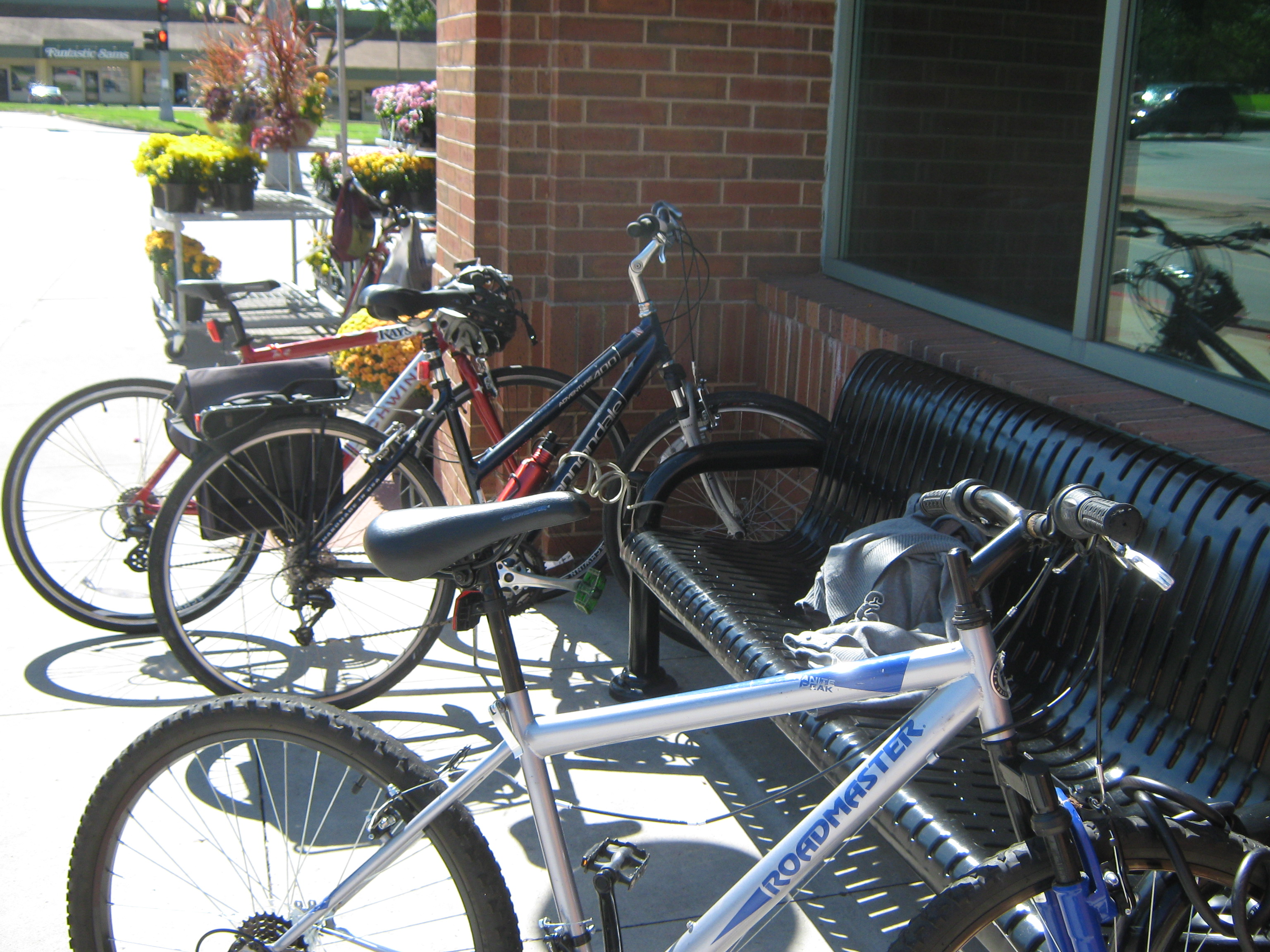
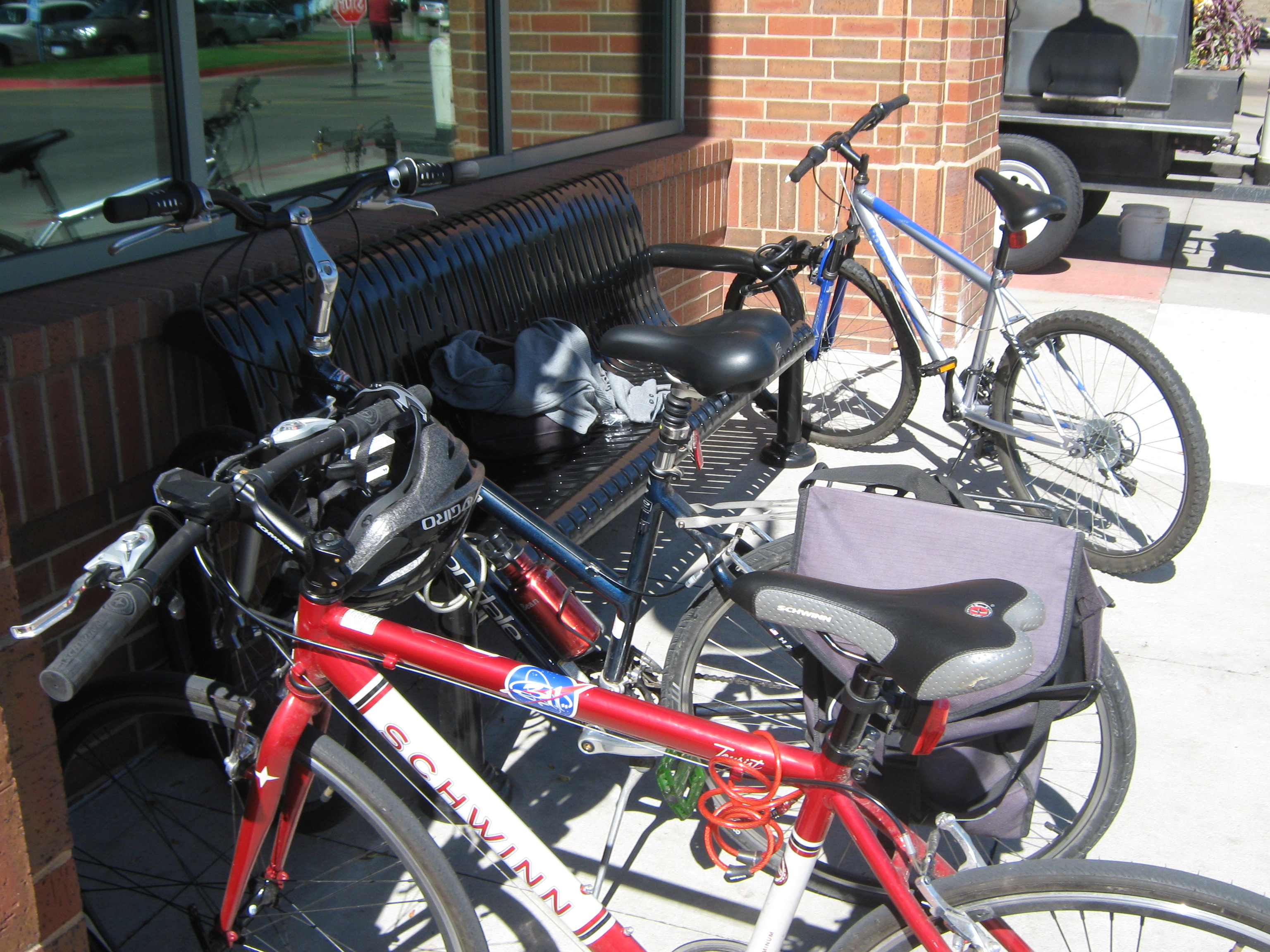
Locked to a bench!

We locked our bikes to a bench.

I love bicycling in the fall.  The sky is low and dazzlingly blue.

When you bicycle, you really look around.  You are not in a car.  You see the land, hear it, feel it all around you.

In July, however, I burned out on a 40-mile ride on the Root River Trail in Minnesota.

How does a bicyclist burn out? you may ask.

Lanesboro, Minnesota

Lanesboro, Minnesota

The Root River is an easy trail, but the farther you go, the tireder you get. We stopped for pie at World Famous Pies in Whalen. We rode a little farther, and when we turned around, we agreed to meet in Lanesboro, a lovely tourist town at the halfway point.  It is an easy trail, I told myself.  But it wasn’t.  I didn’t know how far we were biking.  I only knew it seemed long.

Then I couldn’t find my husband.  I rode past the deli where we sat on the veranda last year.  I rode past all the benches twice.  I finally found him sitting on a rock at the Visitors Center.

And it made me rethink our riding. I was exhausted. I am much slower than he is.  It seems unfair to slow him down.

Since then I have been city-biking.  There are amazing trails here, part of a 65-mile loop.

Bicycling is practical.  It is wonderful exercise, good for the environment, and an efficient means of transportation.  (In rush hour I can beat cars.)  But there is some discrimination against bicyclists.  This summer three trails are under construction and  there are no detour signs. No directions.  You turn back and guess.

And there are few bike racks.  Well, there are some downtown.

But at the mall, at Barnes and Noble, at Starbucks, at Target, there are no bike racks.

I often find a railing and lock my bike to it.

But today…

I went to the Hy-Vee to grab lunch.  There is a bike rack there.

Chrysanthemums and other fall flowers for sale blocked the bike rack (see picture above).

I couldn’t believe it.

Other bicyclists were locking bikes to the bench, so I did it, too.

Locking our bikes to the bench and Hy-Vee.

Locking our bikes to the bench at Hy-Vee.

That was like blocking the parking lot for cars.

DETOUR.  I rode to Barnes and Noble and the trail was closed.

Detour!

Detour!

There was a serious fence so I couldn’t go through.  Plus there were guys in hard hats.

Would they let someone with gray hair through?  I wondered.

I decided not to try.  There was a bulldozer.

So I rode on the sidewalk beside the strip malls and it was unpleasant.

On the way back I rode down a hill and tried the trail at a different point.  I didn’t expect construction for three miles. The workers might have knocked off for the day, I thought.  Then I could walk my bicycle through it.

A serious fence.

A serious fence.

I was wrong.  The trail was blocked after a quarter of a mile with another serious fence.  And no detour signs.

So I backtracked on a busy road and found a sidewalk.  Then I had to walk my bike part of the way.

Finally I found the trail.  It took an hour longer than it normally takes me.

At least I got some exercise.

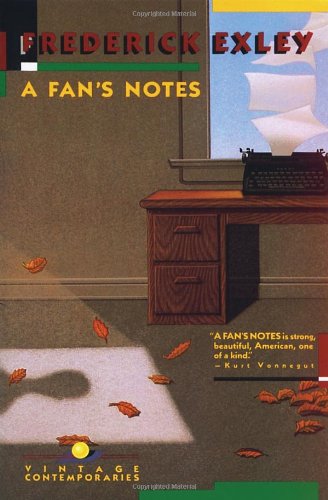
Frederick Exley’s A Fan’s Notes

A Fan's Notes by Frederick ExleyIn Frederick Exley’s A Fan’s Notes, a fictional memoir published in 1968,  the hero, also called Frederick Exley, cannot hold a job.  Exley, an alcoholic, is in and out of mental hospitals, sponges off his parents, or lives at a bachelor friend’s apartment where flamboyant, sad characters drop in all day, including an Italian who sometimes believes he is a hit man.

A Fan’s Notes should have been Top of the List for our Mental Health  Christmas.  One year my cousin became manic from a steroid prescribed for an ear infection (a side effect). At the hospital she was not herself:  she wore a bra over her sweater, sang Van Morrison’s “Days Like This” at the top of her lungs, and demanded that we bring presents for her “new friends.” And so we rather lamely distributed McDonald’s milkshakes and old books in the common room.

If only we’d had A Fan’s Notes.

Exley wittily delineates and skewers the customs and hypocrisy of the American middle class in a brilliant narrative akin to Richard Yates’s Revolutionary Road and Sue Kaufman’s Diary of a Mad Housewife.  Depressed Exley turns down advertising jobs before he gets them, teaches off and on at a high school, and drives from Glacial Falls to Watertown every weekend to get drunk and watch Giants games.

He is amazed by the limitations of the English department chairman and teachers.  (Note:  Many teachers are required to take more easy-A education classes than classes in their subject). One teacher informs Exley that he should not talk at meetings because “talking took time.”

As the year progressed I learned that due to this conspiracy of silence the department chairman was forced to carry single-handedly what were supposed to be give-and-take discussions.  Knowing he was no more ignorant than those boobs seated around me patronizing him, I felt sorry for him. … Unsure of our ability to read (our ability to talk hadn’t encouraged him), he read each and every item [on a mimeographed sheet] to us….  Matchlessly vapid, the items were such that I remember only one of them, and that only because to this day I have no notion what he meant by it:  The best place to make out your lesson plans is at your desk.

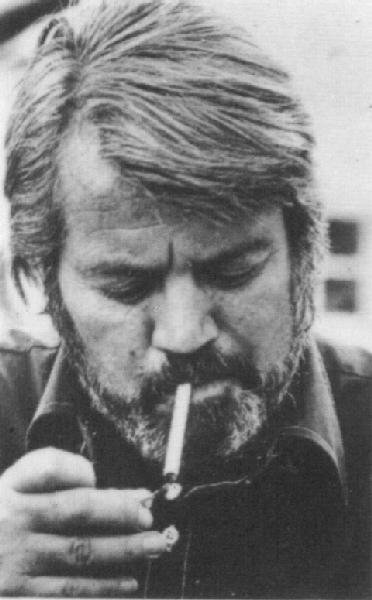
Frederick Exley

Frederick Exley

It’s not just teaching.  It’s everything that happens to Exley.  He is obsessed with football.  He is the son of a local high-school and college football star.  And he went to USC with Frank Gifford, though he did not know him.  Exley partly identifies with him, but also hates him.

Frederick is much smarter than most of his friends.  In one hilarious scene, when he visits his brother-in-law, the likable Bumpy, he notices that the photograph in the basement of James Mason as Brutus in Julius Caesar is incorrectly labeled Et tu, Brute?

“So?” Bumpy said.  “Well,” I explained, “Mason played Brutus, not Caesar.  That caption belongs back there under the one of Louis Calhern with his toga all bloodied and his right arm extended.  Obviously at Brutus.”  “Aw, what’s the diff?” Bumpy said, stuffing half a grilled-cheese into his mouth and, after a barely perceptible mastication, beginning to wash it down with a long swallow of beer.  Then he looked petulantly at me, as though I were an old spoilsport; then he belched.

Bumpy is wild about a quote from F. Scott Fitzgerald which Frederick recites on the site of the mental hospital where Zelda lived.  “I left my capacity for hoping on the little roads that led to Zelda’s sanitarium.”  Bumpy asks him to repeat it in bars.

This novel is unflaggingly male, teeming with beer, gin, football, TV, depression, hospitalizations, bachelor’s pads, and his friend’s gross-out talk about of cunnilingus (“How do you get past the smell?” asks  Mr. Blue, a siding salesman who lives with a woman Exley refers to as “the USS Deborah.” ).

I tried to read it once before.  I thought parts too sexist, but nowadays I feel more sympathetic to the plights of men (and it isn’t that sexist, anyway).  I know how men’s minds work.  Well, sometimes I do.

The writing is superb.  That’s  all I care about.

This is a classic.

Exley  won the William Faulkner Award and the Arts and Letters Rosenthal Award.

His other novels are Pages from a Cold Island and Last Notes from Home.

Kale

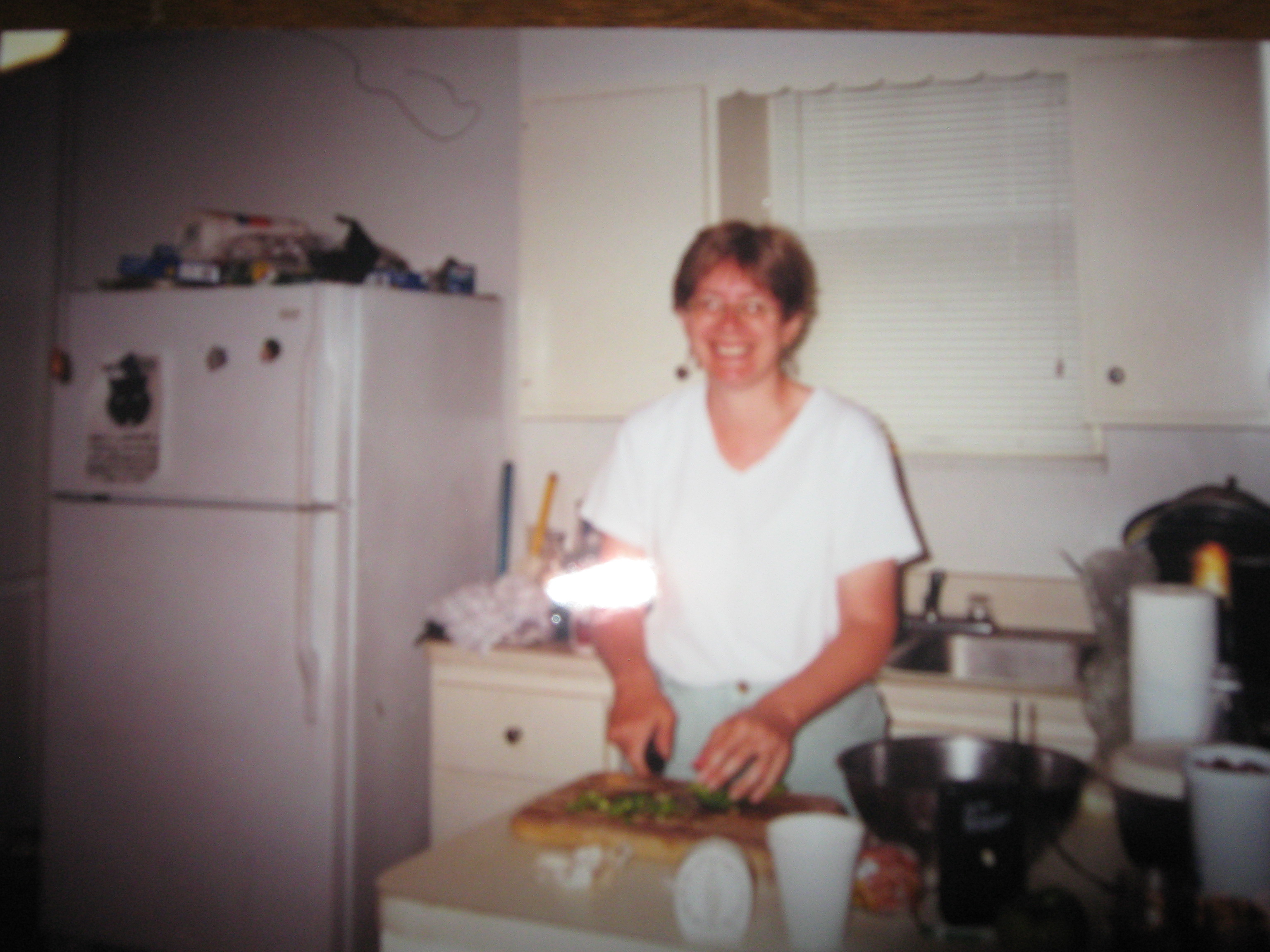
Ms. Mirabile: "I am Kale." (snap courtesy of family member,  c. 2000)

Ms. Mirabile: “I AM kale.” (kitchen snap courtesy of family member, c. 2001)

Here is why I want to be a women’s columnist.

Because I eat kale.  I love kale.  I can introduce women to kale.

I am kale.

No, I don’t mean that last.  It turns out Kale is a character in a Y.A. romance, Touch by Jus Accardo, though.  (I tried to find quotes about kale and was sent to the Goodreads page.)

Here is the quote:

As long as I know this” – he lifted our joined hands – “is mine to hold, I’ll wait for you forever.”

Kale, kale, kale.  (But I mean the vegetable.)  I can’t quite get into the “romance” style.

I also discovered that Alanis Morissette loves kale.  “Kale is my best friend,” she told Runner’s World.

I biked to Whole Foods earlier this week and had a pleasurable experience examining vegetables.  Kale was the only local item, from a farm in Grinnell, so I made a point of buying it. I filled a huge knapsack and a bike pannier with vegetables and other items, and worried that my half gallon of soy milk might explode in the pannier on the way home.  (They didn’t sell quarts.)   Fortunately I got home, the milk unexploded.

Kale salad

Kale salad

But what does one do with kale? Do people in your family like kale?

They should eat kale.  According to WebMD, kale “is the queen of greens.”  One cup of kale has  9% of the daily value of calcium, 206% of vitamin A, 134% of vitamin C, and 684% of vitamin K, and is a source of minerals copper, potassium, iron, manganese, and phosphorus.

It tastes good, too.

I’ve had a long, good relationship with a recipe for a kale sandwich on a baguette  (Moosewood Restaurant Low-Fat Favorites: Flavorful Recipes for Healthful Meals by the Moosewood Collective).

Everyone, given the opportunity, will eat this sandwich every night.  You can serve it while they’re watching football.  You know those guys who live for football?  They won’t bat an eye at this sandwich with kale, tomatoes, roasted red peppers, onion, and more.  It’s better than corned beef.

But I needed a new kale recipe.

And so I found an easy kale salad at allrecipes.com.

It is a delicious salad, with kale, tomatoes, dried cranberries, and roasted sunflower seeds, but be sure to add the dressing after you mix the other ingredients.  I dumped the kale, etc., in the dressing, according to the directions, and there was way too much dressing.

So next time I’ll know.

Here’s the recipe:

INGREDIENTS:
1/2 cup lemon juice
1 tablespoon canola oil
1 tablespoon olive oil
1 teaspoon white sugar
1/2 teaspoon salt
1/4 teaspoon ground black pepper
1 bunch kale, cut into bite-size pieces
1 large tomato, seeded and diced
1/2 cup roasted sunflower seeds
1/2 cup dried cranberries

DIRECTIONS:
1.    Whisk lemon juice, canola oil, olive oil, sugar, salt, and black pepper in a large bowl. Add kale, tomato, sunflower seeds, and cranberries; toss to combine.

That’s it!

Mirabile Does Middlebrow: The Fabulousness of Mrs. Humphrey Ward

She could see no good reason to act her ageI read the classics.

I read Ovid, Balzac, and Doris Lessing.

But for years I have read mostly books by women, many of whom are considered second-rate.

I conceived of “Mirabile Does Middlebrow” as a monthly “column” on middlebrow women’s novels.

I have written my share of “women’s columns” this year on subjects like bicycling, cooking, and shopping,  but I haven’t written a “Mirabile Does Middlebrow” since July.

Perhaps it is because middlebrow women’s books are passed around by word of mouth, not the written word.

I think of many women writers I have discovered in bookstores:  Mrs. Gaskell, Mrs. Oliphant, Ellen Glasgow, Bess Streeter Aldrich, Pamela Hansford Johnson, Dodie Smith, Rose Macaulay, Dorothy Baker, Martha Gellhorn, and Sue Kaufman.  Each has written at least one classic. Surely their exclusion from the canon is partly a gender thing.  Just as women themselves are pruned  from the culture when their fertile years are over (and men enter their prime), women’s books are severely weeded.  Many books simply disappear, to be replaced by books by younger writers.   (And this happens to men, too, to be fair.)

Women writers wonderfully convey the invisibility of older women.  In Emma Tennant’s hilarious Confessions of a Sugar Mummy, a sixtyish woman falls passionately in love with a younger man.  She tells us that Freud discovered the Oedipus complex, but failed to invent the Jocasta complex, “to look at the situation from the point of view of…his mother.”  In her work as an interior decorator, she meets the gorgeous French tile maker, Alain, and considers Botox and selling her flat to buy a house so she could live with Alain and his wife.  She’s out of control, but very, very funny.

in The Summer Before the Dark, Doris Lessing wrote about the marginalization of middle-aged women.  Kate, in her mid-forties, spends the summer on her own while her husband is in the U.S.:  he is having an affair with a younger woman.  Kate works as a translator at a conference and has an affair herself.   But afterwards she has a breakdown.  She walks back and forth in front of a construction site, dressed first in nondescript clothes, then wearing more fashionable clothes.  She is invisible one way, whistled at another.  She gradually realizes what middle age is.

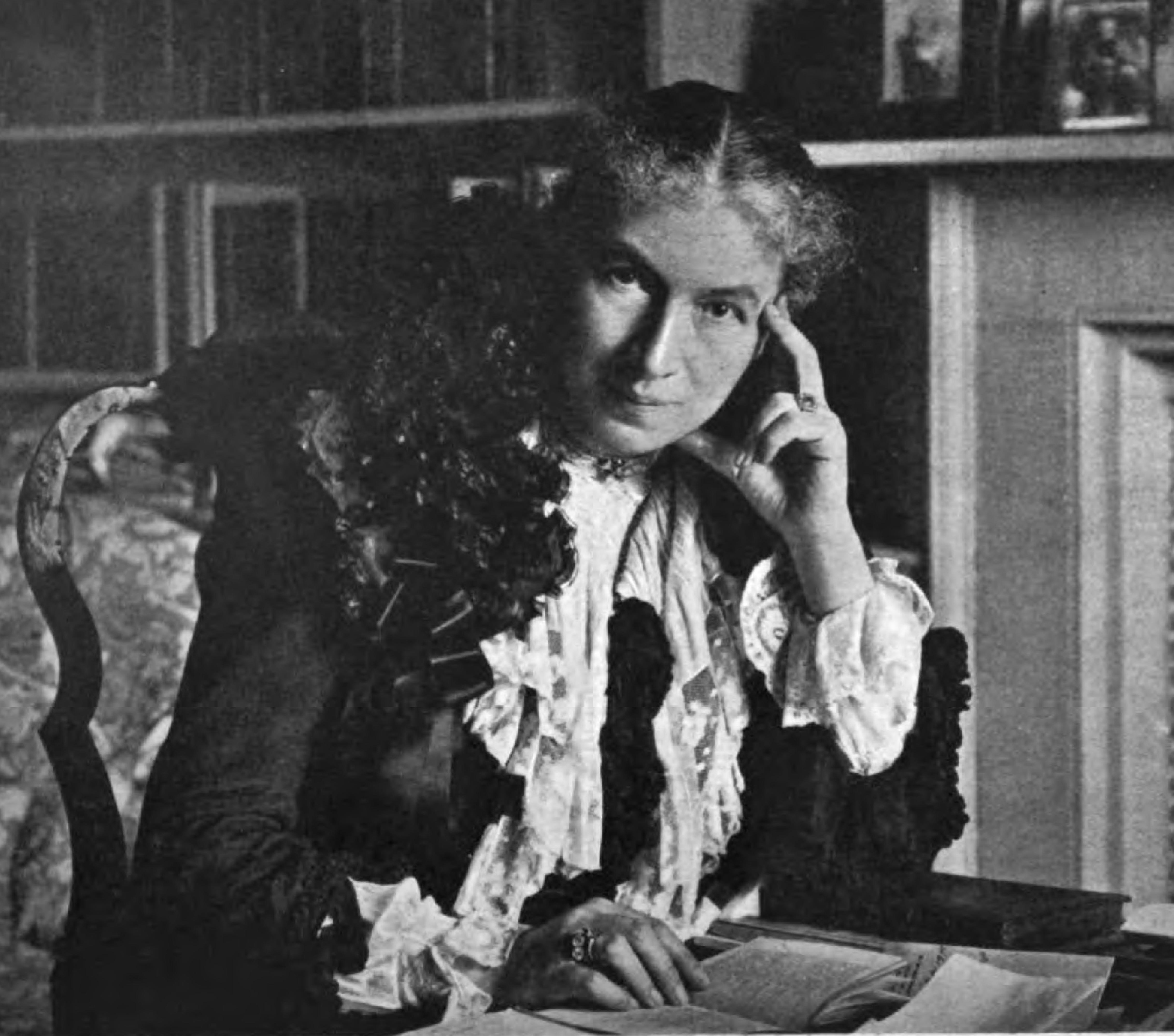
Mrs. Humphry Ward

Mrs. Humphry Ward

Mrs. Humphry Ward (Mary Augusta Ward, 1851-1920), is my new idol:  she was very productive in middle age.   A niece of Matthew Arnold, she began writing  compulsively after her marriage to Thomas Humphry Ward, a tutor and fellow at Brasenose College, and after she had three children.  Fortunately she had hired help:  she spent her mornings at the Bodleian library and wrote three hours every night.

She was at the height of her powers at 43 when she wrote Marcella, a stunning political novel, an almost-classic, in 1894.  It is comparable to George Meredith’s Beauchamp’s Career, with the difference that Ward sympathizes with the conservatives while Meredith favors the radicals.

Now I am a radical type, and Ward was founding president of the National Anti-Suffrage League, which does not go down well with me.

But Marcella is so engrossing I dismissed Ward’s politics. Like Mrs. Gaskell (North and South, Mary Barton) and Charlotte Bronte (Shirley), she is passionately interested in social justice. The spirited, beautiful heroine,  Marcella, becomes an adamant socialist while studying art in London, and when her father inherits Mellor Park, she is both happy to have status and determined to help the poor.  She loves being bowed to as lady of the manor, but also formulates a sensible scheme to teach the women a straw braiding method that will help them earn more money (this is never carried out, though). She wants her father to improve the cottages; and she opposes gamekeeping laws. She is horrified when Hurd, the husband and father of a poor family she has visited often, is condemned to death for killing a gamekeeper during a poaching confrontation.

Aldous Raeburn, a Conservative landowner running for a seat in Parliament, falls madly in love with Marcella.  Yes, we also fall for the sensible, strong, handsome, thoughtful 30ish hero, to the extent that who cares he’s a conservative?  But Marcella is strong-minded, and doesn’t quite love him:  she feels she cannot go on with him when he will not sign a petition to help Hurd.   And handsome Wharton, a Radical running for Parliament, who plays with his cooperative farm and radical newspaper, charms her.  He defends Hurd, though it costs him very little.  He knows Hurd is doomed.

Marcella is very naive politically.  She makes statements like:

Property!” said Marcella, scornfully.  “You can’t settle everything nowadays by that big word.  We are coming to put the public good before property.  If the nation should decide to curtain your ‘right,’ as you call it, in the general interest, it will do it, and you will be left to scream.

After the hanging of Hurd, she is depressed.  She goes to London and works as a nurse.  This is by far the most fascinating part of the book.  Marcella ceases to romanticize the poor and regrets her breaking of her engagement with Aldous.  She dramatically dislocates her arm when she intervenes in a man’s beating of his wife. She also transports Mrs. Hurd and her family to live with her in London.  And she sees her Socialist friends.

Parts of the novel focus on Wharton, the radical, who has won men’s hearts, but owes a lot of  money and is willing to do almost anything to pay his debts and keep his seat in Parliament.  Ward also documents  the complexity of class differences (which I probably don’t understand properaly since I’m not English, so I’ll let someone else analyze that).  Marcella’s father, though he is of good family ,is a social outcast due to a long-ago scandal; her mother hates the life at Mellor Park and longs to go to London and read novels; and Marcella increasingly sees Aldous’ side, though she herself remains more radical than he.

Not beautiful writing, but good enough.  I can’t wait to read more Mrs Humphry Ward.  How I love these Victorian women writers.

The Mother-Daughter Connection

IMG_2672

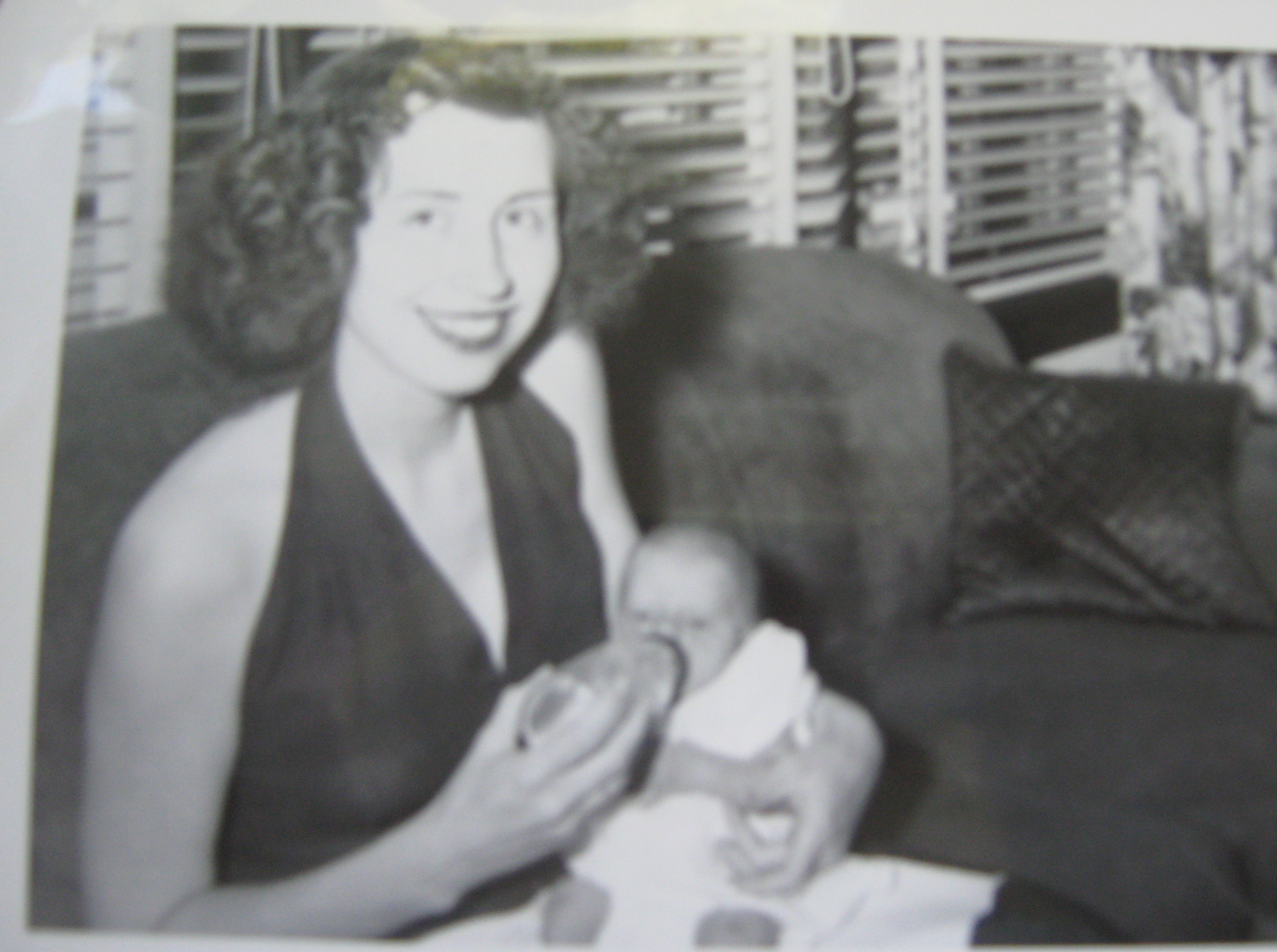
My mother, age 30.

My mother scrunched up her face when anyone said she was beautiful.

“Oh, no, I’ve always been plain.”

She spent a lot of time curling her hair.  She didn’t like straight hair.

Isn’t she lovely in this picture?

Her looks were variable.  When she was happy, she was pretty; when not, plain.  She conducted many arcane staring rituals in the mirror. She did her hair at the mirror on the chest of drawers.  In the living room she glanced at herself in the mirror above the fireplace.  She took the hand mirror to the picture window so she could see what her face looked like in natural light.

Me biking:  the blond years.

Me biking: the blond years.

Some of these rituals are now familiar to me. I comb my hair in front of the mirror on the medicine cabinet and then dash into the living room with a compact to “do” my makeup, which takes 5 seconds.  Yes, I’m an out-of-the-shower-into-the-streets person.

If only I looked like my mother!

There is no resemblance.

She was a housewife, much more fastidious about her house than I. She cleaned every bit of the house every day.  She loved shopping, loved TV, saw her mother every day, never took walks or exercised, took me to every movie that came to town (except “Darling,” much to my disappointment), read women’s magazines, made sure I read Little Women, and spent hours on the phone (which was a problem when I was an adolescent and we competed for the phone).

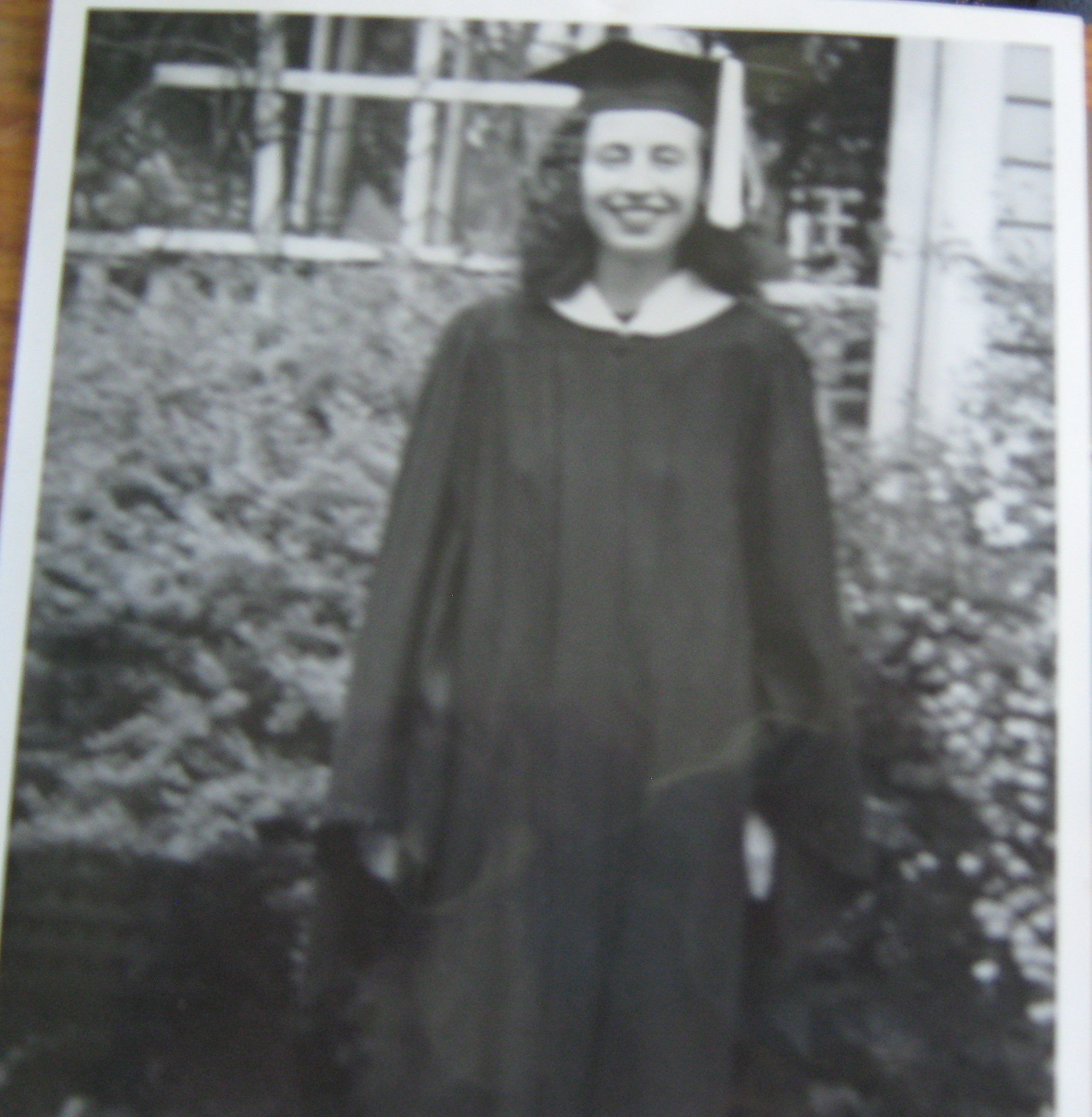
Mom, graduatingHere she is, a young graduate in political science. She rarely referred to her university experience. Rarely talked about politics.  Rarely read a book.

She disliked talking about the past.

“I like the present,” she told me over and over.

After I left my hometown, I seldom saw her.

I was busy. I taught, I wrote, I worked for abortion rights, I bicycled, I gave parties, I chatted, and I cooked vegetables.

In my 20s, after a run.

In my 20s, after a run.

I began to know her better in the last 10 years.

She was a little odd, an old woman from Dickens. So many knickknacks in her house.  Everywhere you looked.  She said she liked to eat food kids liked: hamburgers, fried shrimp, chicken patties…and she still lived to be a thousand or something.

Time together often seemed very long.  We would go to the mall and she would buy me a bewildering number of garments on sale:  a black-and-white-checkered sweater, a polyester Liz Claiborne vest, a Peruvian sweater at Ben Franklin…I haven’t worn most of these, I confess.

I would gamely put on lipstick in front of the mirror with her and pretend to be girls-all-together, but I wasn’t really like that.

My life has been about reading; hers about shopping and being a housewife.

She never remarried after her divorce.  What I hope most for her–but I don’t really believe in the afterlife–is that she finds a good husband in “Heaven.”

Quite seriously.

I know it’s not supposed to happen in the afterlife, but…

Think of all the Meg Ryan movies and Sandra Bullock movies she used to love.

Isn’t it time for her to have what she would most have liked?

I hope no theologists are reading this!

But it was very sad that she had to be alone.

I miss you, Mom!  And I hope you’re not scandalized by this.