Horace vs. Stephen King: Which is the Better Horror Writer?

Horace is rarely compared to Stephen King.  In fact, he is never compared to Stephen King.  I am the first to make the comparison.  And I don’t read Stephen King, because his books give me nightmares.

Although my “Truth in Wine” series of posts depicted Horace as an adorable oenophile who conversed with a wine jar, there are serious, even stern, facets to his character.  The six poems known as the Roman Odes (the first six odes of  Book III) are very disturbing. His descriptions of the wrath of Juppiter, Juno, and other gods are as blood-curdling as any passage in Stephen King. Yes, we are patriotic, but I am always disturbed by Horace’s famous line,  dulce et decorum est pro patria mori, “it is sweet and fitting to die for one’s country” (Carmina III.2).  It gave me flashbacks to writers’ conferences where the war veterans submitted disturbingly violent short stories in which the teachers had to find positive elements to praise in order to support the men psychologically.  And of course Wilfred Owen, the World War I poet, wrote his own response to Horace in the poem “Dulce et Decorum Est.”

Wilfred Owen

  Here’s the dulce et decorum bit of Wilfred Owen’s poem
If you could hear, at every jolt, the blood
Come gargling from the froth-corrupted lungs,
Obscene as cancer, bitter as the cud
Of vile, incurable sores on innocent tongues,—
My friend, you would not tell with such high zest
To children ardent for some desperate glory,
The old Lie: Dulce et decorum est
Pro patria mori.


Life was one long war in the first century B.C. in Rome.  Horace  had fought (on the wrong side) of the civil war between Octavian (later called Augustus) and Antony.  In his poetry, Horace alludes to the peace established by Augustus, who became a benign emperor, though never called that, in the wake of three civil wars.  Horace praises the cardinal virtues, the morals, and the old Roman religion:  Augustus wanted to reform the decadent society.   Some consider Horace’s Roman odes propaganda, but others point out the ambiguities that sometimes undercut the surface.

In Book III, Ode 6,  the dulce et decorum sentence is the crux of the fourth stanza,  which falls in the middle of Horace’s eight-stanza poem.  And the placement of the stanza emphasizes Horace’s  view of war and death.  Here is the entire stanza (the Latin below the English):

Dulce et decorum est pro patria mori:
mors et fugacem persequitur virum
nec parcit imbellis iuventae
poplitibus timidove tergo.               15

It is sweet and proper to die for one’s country.
Death chases even the man who flees
and does not spare the peace-loving youth:
it gets him in the back or the knees.

* “peace-loving” is often translated “cowardly”

Horace says that no one can escape war or death. They’ll get your back or knees if you turn away.    And does this knowledge of the inevitability of death make it easier for the survivors of war and the parents of the dead?  I am not a member of a military family.  I have never faced this situation. Would the Romans have found comfort in this philosophy?
Cool Books in Air Conditioning: Patricia Moyes’s Murder a la Mode & Graham Greene’s The Quiet American

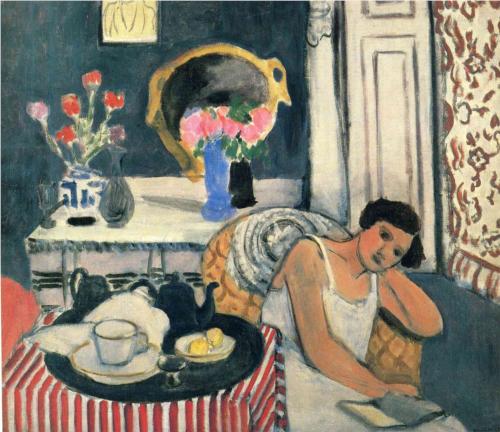
Matisse, “Woman Reading with Tea”

One never gets used to the Midwestern heat. My husband dislikes air conditioning, but in these record-high temperatures I couldn’t live without it.  Though I can be sprightly and cheerful  in front of fans blowing at top speed, I need the AC at night.

We struggled over the issue of AC for years.  No, my husband said.  But during a drought one summer, I bought the last air conditioner in town–I called many, many stores before I found one at Sears.  We stuck it in the bedroom window, wedged a copy of Anne Rice’s Interview with the Vampire beneath it, and then fanned out the plastic pleated shutters on either side.  Not the safest installation: the vampire Lestat held it up.

Even with central air and no vampire installations, the heat is exhausting. So I stayed home last week and took a mini-vacation indoors. And I read the perfect cool books. What can be cooler than the fashion world and a Graham Greene quasi-thriller?   I recommend:

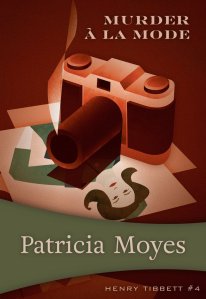
1. Murder a la Mode by Patricia Moyes.  Patricia Moyes’s mysteries are delectable, especially Murder a la Mode, a cozy classic–now back in print, published by Felony and Mayhem Press.  Set in the 1960s at the offices of a London fashion magazine, it captures the hectic quibbling and high-pitched tension of the staff’s hurrying to put out the Paris fashion issue.  Having returned late from the spring show in Paris, they are still bickering over layouts at midnight.  The art department is histrionic, and only the level-headed,  soon-to-retire editor Margery French can soothe Patrick, the art editor, who refuses to give a double spread to an ugly hat:  “that…that pudding on stilts.”  Teresa Manners, the posh fashion editor, has a pitch-perfect fashion sense and insists that the hat will be the axis of the season.  Meanwhile,   Helen, the assistant editor, must stay behind to write the copy and photo captions after the others leave. When Helen is found dead the next morning from  cyanide in her tea, Inspector Henry Tibbett investigates, with the help of his niece, Veronica, a model.  (P.S.  Moyes worked as an assistant editor at Vogue, so she gets the details of the fashion magazine just right.)

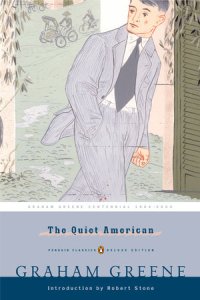
2.  Graham Greene’s The Quiet American. Greene is one of the most intelligent writers of the 20th century, and his intelligent  well-plotted novels are peopled with intelligent men who agonize, Greek tragedian-style, about their emptiness and angst.  I am not Greene’s biggest fan–I prefer his pop predecessor, W. Somerset Maugham–but his characters definitely know how to be cool in the most volatile situations.

That is true of The Quiet American,which I recently read to stay cool.  The narrator, Fowler, an English war correspondent in Saigon in the 1950s,  has witnessed battles, bombings, and atrocities in the war between the French  and the Vietminh guerrillas.  He knows just what his newspaper will or will not publish, and he regards himself as an observer, not an activist.

The British empire has fallen, and Fowler cynically watches the new world politics enacted in Vietnam.  But when an American comes to Saigon and threatens Fowler’s way of life (and the Vietnamese way of life), Fowler eventually must act.  Pyle, an American employed in the Economic Aid Mission, seems at first friendly and naive, irritating and sincere:  he earnestly believes that  “a third force” can save Vietnam.   Pyle wants not only to Americanize Vietnam but to poach on Fowler’s personal territory:  he falls in love with and steals Fowler’s mistress, Phuong, after chivalrously warning Fowler of his intentions.  But when one of Fowler’s contacts tells him the truth about the death-dealing “plastics” industry Pyle is setting up, Fowler must cross a moral line.

Gorgeous writing, even though this book is not for me.   Greene needs only a paragraph or two, or a line of dialogue, to establish character and mood.   In the following passage, he describes his first meeting Pyle at a cafe.  Pyle asks to join him, because there are no free tables.

“Was that a grenade?” he asked with excitement and hope.

“More likely the exhaust of a car,” I said, and was suddenly sorry for his disappointment.  One forgets so quickly one’s own youth:  once I was interested myself in what for want of a better term they call news.  But grenades had staled on me; they were something listed on the back page of the local paper–so many last night in Saigon, so many in Cholon:  they never made the European press.  Up the street came the lovely flat figures–the white silk trousers, the long tight jackets in pink and mauve patterns slit up the thigh.  I watched them with the nostalgia I knew I would feel when I left the region forever.  “They are lovely, aren’t they?” I said over my beer, and Pyle cast a cursory glance as they went up the rue Catinant.

The Pyles of the world turn out not to be what they seem, and the Fowlers have more to them than you noticed.  Love the writing, but am indifferent to the book.  It’s something about Greene:  not for me.

Dare We Buy Informally “Banned” Books?

The other day, I went to a used bookstore. For once I was very well-organized: I was looking for books  for my science fiction project, and I was determined to buy only books on my checklist.  But alas, I found nothing:  they did not have Liu Cixin’s award-winning novel, The Three-Body Problem, nor could I find Samuel R. Delany’s Babel-17, nor Vonda N.  McIntyre’s The Exile Waiting.

I had ridden my bicycle, and it was so hot outside that the asphalt glittered and a steamy haze rose off the cars.  I couldn’t face leaving immediately, so I browsed in the literature section. There was nada–we already have tons of Jane Austen, Trollope, and T.C. Boyle–but finally I noticed a copy of Sherman Alexie’s memoir, You Don’t Have to Say You Love Me.

Some years ago, my husband and I were very amused by Alexie at a reading in Iowa City:  he is as witty as a stand-up comedian.  But the minute I took the book off the shelf, I began to sweat.  Perhaps I was dehydrated, but it was also nervous sweat.  And then I remembered that Alexie is under a cloud due to sexual harassment allegations. As I recall, they were of the “he-kissed-me-in-a-bar-without-consent” category, and one was actually “he-didn’t-help-me-publish-my-poetry.” I don’t consider those serious accusations,  but I decided not to buy Alexie’s  book,  because I was afraid the surly young clerk would humiliate me or call me out.

I usually don’t give a damn what anyone thinks.  But then I remembered the cause of this Alexie-rooted fear. A month or two ago a Millennial blogger (sorry, no idea who it was) expressed indignation because one of Alexie’s short stories appeared in an anthology. Good God! Forget talent, and forget “innocent until proven guilty.”  If it’s posted on Twitter or Facebook, it must be true, right?

The award-winning Alexie is a witty, brilliant chronicler of Native American life.  He grew up poor on a reservation, and writes about it. Whether or not he is a perfect man,  he has not, as I understand it, committed a crime.

If great writers had to be role models, we wouldn’t have any of either sex. Hemingway, F. Scott Fitzgerald, Zelda Fitzgerald, Edna St. Vincent Millay–all pretty much assholes.

I bought nothing at the store that day.

Aetherial Worlds by Tatyana Tolstaya

I prefer novels to short stories.  I love long, enthralling nineteenth-century novels with vividly imagined characters.  But I wonder if the short form is more accessible to today’s readers, as they become more engrossed in the minuscule worlds of tiny phones.

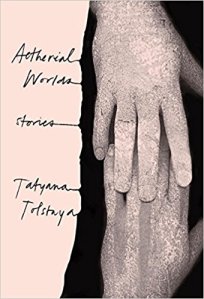
At any rate, the Russian writer Tatyana Tolstaya’s new collection of short stories, Aetherial Worlds, is my favorite new book of the year.  I have long admired Tolstaya, the granddaughter of the science fiction writer Aleksei Nikolaevich Tolstoy; she is a spellbinding writer of genre-crossing literature.  NYRB has published two of her books, The Slynx, a dystopian masterpiece, and White Walls, a collection of surreal and fantastic short stories.

Her new book, Aetherial Worlds, is a collection of elegant, wide-ranging stories, some realistic, some satiric, others surreal, still others fantasies.  In two of my favorite stories, the history of a house is central to the narrative.

In “The Invisible Maiden,” the narrator recalls childhood summers in the ramshackle dacha her mother fixed up, which was large enough to house seven children, the nanny, and two old women called “the grannies.” But the crazy unplanned house, she tells us, was built by “an imbecile” named Curly.

Curly’s stupidity manifested itself variously; for example, all the rooms on the first and second floors, save for one, faced north, and not a single ray of sunshine ever found its way to them. And so the house grew moldy and rotten, all the quicker because Curly, unable to refrain from stealing building materials, constructed the dacha with no foundation. In the faraway corner of the garden he erected a roomy Finnish outhouse with two seats—a two-holer—but as he absconded with the partition wall, an interesting opportunity presented itself: you could now visit the shitter in pairs. Curiously, no one ever took advantage of this.

The narrator describes not only their summers at the dacha but their fates as the years pass.  I especially love the character Aunty Lola,  an impoverished old woman who regards the dacha as her real home because she lives the rest of the year in a tiny converted janitor’s closet in a communal apartment.  The women of the older generation, including the nanny, have very different beliefs, habits, and histories from those of the younger generation. Tolstaya describes their experiences and eccentricities in detail.

The title story, “Aetherial Worlds,” is also the story of a house.  The narrator has moved from Russia to New Jersey to teach creative writing at a small college.  She buys a house near Princeton, “a long gray unfinished barn with a leaky roof, tucked away in the back of an overgrown plot in an unprestigious rural corner.”  Originally owned by an African American woman, the house has a gorgeous garden, and the narrator feels the ghost walking around the property.

She loves the house, which is entirely hidden by greenery in the summer, but teaching is a challenge.   Most of the students are lazy and cannot really read books.   When she asks an especially recalcitrant student to tell her what a story by Salinger or Hemingway is about, he answers, “I dunno.  I didn’t like it.”  She tries to be tactful when she criticizes them, because her job depends on student evaluations.  She learns the art of “psychological buffoonery” and to use simpler vocabulary. She explains,

And so the instructor must find more nurturing and beguiling ways to make the student realize he is a lazy ignoramus (if that is, indeed, what she wants him to realize), so that very student will be forced to admit it to himself and his friends will be able to corroborate it. Any earnest appeal to principles, to conscience, to exemplars worth aspiring to, or other such highfalutin crap that’s so popular in my homeland, doesn’t work here at all. Here one must provide nonstop entertainment for the group while simultaneously making each and every student feel they are number one, the subject of boundless and incessant care. All this without familiarity. And without fulsome praise. If a professor attempts to weasel their way into a student’s favor with too much fawning or too high a grade in the hopes of receiving a good evaluation, the student will only come to despise them and, upon getting the last word, shit all over them.

The years go by, and she does teach two brilliant student-writers, one of whom is autistic and believed by most to be mentally challenged.  (Later, he goes to the Iowa Writers’ Workshop.) But the fairy-tale house with its garden is at the center, until she decides she wants to live near the college and rents it to a young man who claims he wants “a sterile environment.”  And what happens next defines America for her in a nightmarish way.

Other stories are whimsical or satiric.    In “Without,” she speculates on a world without Italy.  “Greeks would be everywhere, there having been no Romans to conquer them–though that would, most likely, have been done, with great satisfaction, by the Persians once Alexander the Great died.”  In “The Window,” the character Shulgin learns that his neighbor is getting free appliances from a mysterious window in a Soviet building:  when the shutters swing open, regardless of whether they call out “coffee grinder” or “a package,” you must yell back, “Deal!”, or your life will become magically nightmarish.

Fabulous stories, of many different genres.

Bubble Tea, A Mystery Swap, and Cindy or Sandy?

My cousin and I are sitting on the porch on a windy day slurping bubble tea.  We’re wearing old paisley bandannas (circa 1970s) to keep the hair out of our eyes while we pore over books for our annual mystery swap. My pile has surplus copies of Dorothy Sayers’s Have His Carcase and Busman’s Holiday, while hers tends toward  Laura Lippman and Patricia Cornwell.  We’re opposites, but we both do love mysteries.

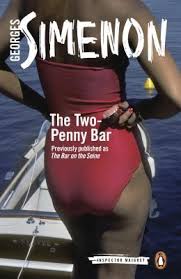
We agree to swap Simenons:  The Two-Penny Bar, a moderately enjoyable book in which Maigret learns from a condemned man about a murder committed six years ago, for Maigret and the Reluctant Witnesses, which my cousin (a librarian) stole from a discard pile at the library. Though I never understand the Maigret mystique–all Simenons are alike–at least they’re fast reads.

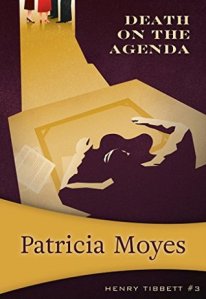
With some reluctance, I agree to part with one of my favorite Patricia Moyes books.  (“That isn’t in my pile; you’re cheating.”)  If you haven’t read Patricia Moyes, who wrote 19 books in the Inspector Henry Tibbets series from 1959 to 1993, I can affirm that they are utterly delightful.  In the third book, Death on the Agenda, Henry goes to Geneva to a police conference on devising ways to stop narcotics smuggling. Emmy, his wife, goes along to see friends and shop.  And Moyes, who once worked as an assistant editor at Vogue, describes fashions in detail:  I yearn for the peignoir Emmy buys, a “white chiffon peignoir scattered with embroidered roses and edged with lace.” But the day after a posh party,  Henry is accused of killing an American cop who’s suspected of leaking information to the drug dealers.  Emmy helps Henry investigate, and what a web of lies, sex, money, and crime they untangle!

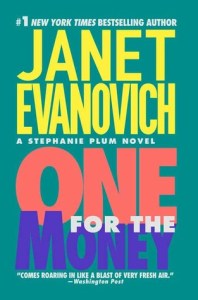
And so it’s philanthropy to part with a Moyes.  This is such a fun book!  But then we reach a crisis: should I trade my Janet Evanovich pile for her Laura Lippmans?  I love Evanovich’s heroine, Stephanie Plum, a doughnut-eating New Jersey bounty hunter, but the titles, which all have numbers (One for the Money, Four to Score), are interchangeable.  Which have I read?

“It doesn’t matter, because she eats doughnuts in every single book,” says my cousin practically.

We make the trade.

And then it happens.

A woman approaches.  With a clipboard.  That can’t be good.  And before we go inside, she is upon us.  She is campaigning for a candidate for the Democratic primary, and have I heard of Cindy?

“Which Cindy?” my cousin says.

The campaigner is startled.  “There’s only one.”

“I’m sure there are two.  Or is that Sandy?”

“I’m here for Cindy ___.  She’s concerned about Planned Parenthood, the environment, and mental health.”

I’m concerned about mental health,” my bipolar cousin says. “Does she know that a corporate psych hospital chain has been barred from moving in here, though the state has shut down five hospitals?  And that mental hospitals no longer allow the mentally ill to smoke, or take supervised breaks outdoors?”

Now the woman is rattled.  “Cindy wants to increase funds for mental health care facilities.”

Sandy wants to increase funds for research for psychotropic medications that will improve the lives of millions of people.”

“I do agree with Cindy on the environment,” I say, just to cut this short.  “I will vote for Cindy.”

The poor woman ticks off a bunch of boxes on her clipboard and thanks us.

“Now that,” I tell my cousin, “was outrageous.”

“I’m voting for Sandy.”

“Except there is no Sandy.”

Chill out and Dumb Down: Should I Throw out Georgette Heyer?

Vintage woman reading.

Chill out and dumb down.  We’re Americans in the summer of 2018.

I’m sitting in a hammock reading Balzac’s underrated classic,The Vicar of Tours, one of three stunning novellas in The Celibates, and at the same time wondering if an ice pack on my head would cool me off.  (It’s 95 degrees.) Then the landline rings and I step inside.

It’s my cousin the librarian, who calls 10 times a day from the reference desk.  “Look at The New York Times Book Review.”

“Why?”

“The summer reading issue,” she hissed.

I open my tablet.  And there it is.  In “73 Books to Read While the Sun Is Out and the Days Are Long,” there are no reviews of literary fiction.   None.  There are thrillers, true crime, cookbooks, and eight review-ettes of romance novels.  And, as you can imagine, it’s the latter that annoys me.  Should you want to read Wicked and the Wildflower, The Kiss Quotient, or Too Wilde to Wed, The New York Times is now the place for you.

“Who did this?” I ask.  Then we say in unison, “Pamela Paul!”

Since 2013 Pamela Paul has been the editor of The New York Times Book Review, and in 2016 she also became editor of the three daily book critics, who used to be in another department.   We don’t know what Paul’s credentials are (a book on parenthood? being a mom?) but things have taken a dramatic turn for the worse. The Times now has a romance columnist, has published two interviews with the best-selling Danielle Steel, and two of the daily critics have been “disappeared” (is this Argentina?).  No,  not really, but Michiko Kakutani and Jennifer Senior left last year.  Of the daily threesome, only the tough, incisive critic Dwight Garner remains, and he is almost warm and fuzzy now. There are two new critics who haven’t made much of an impression on me yet.

Is there a dumbness pollution in the newsroom?  Something’s amiss.

It kind of makes me want to throw out my Georgette Heyers.

SPECIAL ROMANTIC TREAT.  Here is the opening of one of the romances  reviewed, Eloisa James’s TOO WILDE TO WED.  It kills me that the NYT reviews this shit! It’s just not as good as Heyer.

Lord Roland Northbridge Wilde—known to his friends and family as North—had been taught at his governess’s knee that a gentleman defines himself by his respectful and decorous manner toward the fair sex. He did not ask indelicate questions, nor engage in boorish behavior.

Even, or perhaps especially, if the lady was his fiancée.

It never occurred to North that he might be tempted to behave otherwise. As a future duke, he confided it beneath his dignity to kneel while asking Miss Diana Belgrade for the honor of her hand in marriage, but he donned a coat that had been praised by the king himself. The ring he slid on his finger had belonged to his grandmother, the late duchess of Lindow.


The Culture of the TLS

Why do I read the TLS?  Who is its ideal reader? Is she a professor emerita with a Proust monomania, or an Eastern European immigrant barista who haunts Bloomsbury bookshops?

No, I am my own demographic. (We all are.) As a cranky, working-class, state-university-educated feminist, I have constructed a fantasy world of the TLS.  The poorly-paid critics and editors smoke hand-rolled cigarettes as they type on old-fashioned typewriters, wearing twin sets, buns, and ballet shoes, like Anita Brookner’s spinsters,  or chatting pretentiously like the poet Dorothy Merlin and her savvy bookseller husband Cosmo in Pamela Hansford Johnson’s  satiric novel, Cork Street, Next to the Hatter.  They are all, in short, living in the mid-to-late 20th century.

Yes, I love the worlds of Brookner and Johnson, but I understand that the TLS is nothing like that.  I subscribe to the TLS for three reasons: (a) the  reviews of books on classics, (b)  reviews of and features about women’s literature, and (c) the entertaining literary column, “N.B.”, by J.C.

Last week the critic Dwight Garner at the New York Times explored the  TLS culture in an entertaining profile of  Stig Abell, “A Scrappy Makeover for a Tweedy Literary Fixture.” Abell, 38, is the editor, a Shakespeare enthusiast, and author of a new book, How Britain Really Works: Understanding the Ideas and Institutions of a Nation, which has just been published in the UK.

Garner writes, “When Stig Abell was named the editor of the venerable Times Literary Supplement, or TLS, two years ago, the baffled reaction among book people was nearly audible. Stig who?”

A former editor of  the Sun, which is apparently a tabloid, Abell does have literary qualifications:  he earned a double first in English from Cambridge and had written reviews for the TLS, the Spectator, and other newspapers.

Stig told Garner, “We want to keep our core audience.  But there are many others out there — they do all sorts of things professionally — who remember a time, perhaps in college, when they fed their minds and stretched themselves. They want that feeling again. We want those readers, too.”

Abell is hiring more women writers and writers of color. Sales are up.

I shall keep my fingers crossed and hope they continue to use correct grammar (they’ve had some wobbly pronouns) and publish brilliant articles.  Details, details!

And good luck!

Pop Lit Weekend: Mysteries, Histories, & Historical Novels

We planned to go to Iowa City on Memorial Day. We planned to picnic at Lake McBride–without wine, despite Horace’s urgings (see yesterday’s post).  Then we would decorate my mother’s grave.   Memorial Day has long been the American Day of the Dead, without the tacky plastic skeletons.  When did it became a military holiday?

But it was too hot to travel:  100 degrees.  And so we stayed indoors and read pop lit.  Here’s what I read:

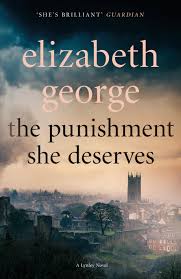
THE LIGHT READ.  Elizabeth George may be the greatest American mystery writer today, and she is by far the most fervent Anglophile.  Writing from Washington state, she sets her page-turners in the UK, and the latest, The Punishment She Deserves, is a brilliant, twisty psychological novel.  Her pairing of detectives is rooted in the Golden Age tradition of upper-class sleuths with their butlers or batsmen, or,  in its later 20th-century incarnation, police officers of different ranks like Reginald HIll’s fat, rude Detective Superintendent Andrew Dalziel and university-educated Sergeant Peter Pasco.  George’s protagonists, Inspector Thomas Lynley, the eighth Earl of Asherton, and spiky Detective Sergeant Barbara Havers, an overweight working-class woman who lives on chips and cigarettes, work together brilliantly, despite divisive class differences (which are stressed).

In The Punishment She Deserves, Lynley and Havers conduct a nightmarish Rubik’s cube of an investigation of an investigation of the suicide of a deacon in police custody.  Picked up in the middle of the night 19 days after an anonymous caller accused the deacon of pedophilia, Ian Druitt is found hung from a doorknob by his priestly garb–a stole–in a room at the station. Not only is it a weird suicide, but  Gaz Ruddock, the police community support officer, had been keeping an eye on his boss’s hard-drinking son, Finn, a multi-pierced college student who volunteered with Ian at an after-school program, and reporting to his mum.  Finn insists the accusation against Ian are trumped-up, and other townspeople say the same.  And what do the drunken college students Gaz picks up from bars and drives home know?  Was Ian’s death a suicide or murder?

HISTORY OR HISTORICAL NOVEL?  Are you a fan of Robert Graves’ I, Claudius?  Do you wish you could find similar novels about the other Roman emperors?

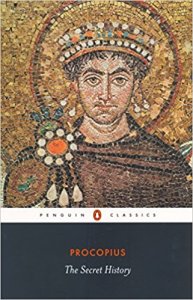
Procopius’s The Secret History reads just like a novel. Best-known as the author of two histories which celebrate the achievements of the eastern Roman emperor Justinian, Procopius did a complete reversal in this gossipy little book. Was this page-turner in the literary form of a Greek invective an articulation of what he really thought, or was it written because he changed his mind? The translator of the Penguin edition, Peter Sarris, explores the possibilities.  He  writes in the introduction, “…Procopius comes across as an extraordinarily creative author who was able to take the inherited literary forms of antiquity and rearrange, recombine and reappropriate them in ways that look novel.”

Most historians describe Justinian’s passion for religion, law, and administration, and praise his brilliant general Belisarius.  But Procopius reviles the corruption of Belisarius, a general often called the Last Roman, his wife, Antonina, a murderous witch who has studied magic, the emperor Justinian, who he says destroyed Rome, and the empress Theodora, a former prostitute and obscenely nimble actress.  These are not the characters I know from other histories.

In the first chapter, “The Tyranny of Women,” Procopius relates many scandals about Antonina and Theodora. He begins,

Belisarius was married to a woman of whom I had something to say in the preceding books.  Her father and grandfather were charioteers who had displayed their skills both in Byzantium and Thessalonica; her mother was one of the theater tarts.  She herself in her early life had lived a profligate kind of life and had thrown off all moral restraint; she had been continually in the company of her father’s magic-mongering friends and had learned the arts essential to her trade.  Later when with all due ceremony she married Belisarius, she had already given birth to one child after another.  So it was already her intention to be unfaithful from the start, but she took great care to conceal this business, not because her own conduct gave her any qualms, or because she stood in fear of her spouse–she never felt the slightest shame for any action whatever, and thanks to her regular use of magic she had her husband wrapped around her little finger–but because she dreaded the vengeance of the empress; for Theodora was only too ready to rage at her and bare her teeth in anger.

This is a remarkable read.  But do you see why I consider it a historical novel rather than a history?

Truth in Wine, Part 3: Horace’s Nature-and-Wine Cure

This is the third in the “Truth in Wine” (veritas in vino) series, inspired by reading ancient lyric poetry. The Greek and Roman poets, from Archilochus to Horace, wrote of the empyrean pleasures of drinking wine. And though I do not drink wine, which makes me very sleepy, Horace’s wine in moderation becomes a metaphor for tranquility in daily life.  His Epicurean odes encourage us to live in real time, rather than in our anxieties about the future.

If you worry, as I do, about politics, war, air pollution, the still-distant goal of equal pay for equal work, nuclear power, and the practice at staring at phones instead of the sky–in short, everything–Horace’s “Nature-and-wine cure” is the perfect remedy.  In this charming ode (Carmina II.XI), he tells his friend, Hirpanus Quinctus, to stop worrying about enemy tribes (the Cantabrian and the Scythian) and drink wine and sit under a tree.  So Happy Memorial Day weekend!  Once you get past the first difficult stanza, you will love the ode. And you can read my other posts on truth in wine here and here.   N.B.  “Quenching the cups of burning wine” refers to mixing the wine with water.

Here is my translation:

Horace, II.XI

Hirpanus Quinctus, stop worrying about what
the warlike Cantabrian or the Scythian are scheming:
the Adriatic sea separates the Scythian from Rome.
Don’t fret about the needs of life:

the demands are few. Smooth youth and grace
flee behind us when dry old
age drives away playful loves
and easy sleep.

The same charm of spring is not always
on the flowers, nor does the blushing moon
shine with one face. Why do you fret your
inconsequential mind with endless plans?

Why do we not loll carelessly
and drink under the tall plane or pine tree,
our white hair fragrant with roses,
and anointed with Syrian

balsam oil, while we may? Bacchus
drives away our gnawing cares. What boy will
more quickly quench the cups of burning Falernian
with flowing water?

Who will call the inconstant courtesan
Lyde from home? Bid her to come with
her ivory-decorated lyre, her disheveled hair bound
in a knot in the style of the Spartan.

Knut Hamsun’s “Victoria” & E-books vs. Audiobooks

I recently read and enjoyed the Nobel Prize winner Knut Hamsun’s poetic novella, Victoria (1898).  The style is graceful and melancholy, and though we may feel uneasy about the alternation of ecstasy and torment in the pre-pharmacological/electronic age, Hamsun moodily explores the difference between intense emotions and real experience.

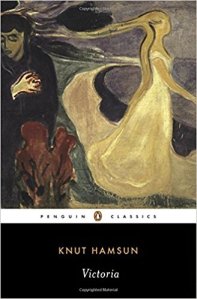
This is the kind of book you love in adolescence.  I was discomfited by Hamsun’s romanticism, but I also felt nostalgic for a simpler time. The lyrical Norwegian novelist’s books were in vogue in the seditious ’70s, when I found them at used bookstores, drawn to the psychedelic/pop art covers.

From what I remember of that more idealistic time, I liked anything offbeat or rebellious.  And there is an underlying theme of resistance in his strange little novels.  Dreamy prose, romanticism, class differences, alienation:  Victoria had all the components, and the style was elegant.   This time around I read the Penguin, translated by Sverre Lyngstad in 2005.

Hamsun asks questions about love and idealism.  Can you fall in love and maintain a passion unconsummated? The poet-hero, Johannes, a miller’s son, is obsessed with Victoria, a neighbor at the castle.  When asked as a child to row Victoria in a boat with her brother and a snobbish friend to the island, he plans to show her the caves, the quarry, and birds’ eggs.  But the class-conscious (and brutal) Otto, a 15-year-old “gentleman,”  treats Johannes like a servant, and tells him to go back and mind the boat. Johannes is surprised but not disheartened because he lives in his imagination.

As the years go by, Johannes and Victoria admit on various occasions that they love each other, but drift apart. Johannes returns to the city and becomes a successful poet.  One day he runs into her while she is spending a few days in town.  And in one of many beautiful passages, Hamsun describes their not-quite chance meeting.

A day in September.

This out-of-the-way street was his favorite promenade; here he strolled as in his own room, because he never met anybody, and there were gardens behind both sidewalks, with trees having red and yellow leaves.

How come Victoria is walking here?  What can have brought her this way?  He was not mistaken, it was she; and perhaps it was she who had walked there yesterday evening, when he looked out the window.

Victoria tells him she has read his poetry, and he emphasizes that the poems are about her. He notices she is wearing a ring, and asks if she is engaged to Otto, now a lieutenant. She is tight-lipped about this, and seems angry that he brings it up.  Before they part, she tells him that she loves him.

And nothing comes of it. Victoria is engaged to Otto. She expects Johannes to marry Camilla, a beautiful young girl he saved from drowning.  And in one of the most grueling scenes in the novel, they misunderstand each other at her engagement party.

It ends in tragedy.  How could it otherwise? Ironically, the writer survives, but Victoria dies.  Nineteenth-century writers often kill off women. Will Johannes be able to write again?  Of course he will.

No, it’s a lovely book, but not quite for me at this time of life.

Coincidentally, the 19th-century Swedish novel, Niels Lyhne, by Jens Peter Jacobsen, tells a similar story, with a poet at its center and doomed love.  Was this the Scandinavian love story of the 19th century? (It was a coincidence that I read these two together.  And I thoroughly enjoyed Niels Lyhne, too.)

E-BOOKS VS. AUDIOBOOKS.

Publishers tell us book sales are thriving.  Well, if they say so.  Judging from our independent bookstores, which stock fewer  titles every time I visit,  the physical book has not quite triumphed.

E-book sales are flat, but reporters gloss over the publishers’ control of the (now high) pricing of e-books, which cost as much as paperbacks. Books are much nicer, granted, but e-books have their advantage, in terms of lightness and the size of type.

The studies say people don’t understand what they read on e-readers. I wonder what on earth they mean. The experience may not be quite as pleasant, but type is type.

And I wonder why audiobooks aren’t studied and compared to books.    The experience of listening to a book is even further from the experience of reading a book.

But then I figured it out.  Audiobooks are expensive!

$$$$$$$$$$$$$$$$$$$$$$