
 Although I didn’t rush out and buy Joanna Trollope’s new novel, Sense and Sensibility, a modern version of Austen’s novel, or Ronald Frame’s Havisham, a retelling of the story of the misanthropic spinster of Great Expectations, I am very keen on retellings of Victorian novels.
And tomorrow a new one will be published, Minae Mizumura’s A True Novel, a modern Japanese version of Emily Bronte’s Wuthering Heights, translated by Julie Winters Carpenter.
Wuthering Heights used to be my favorite book, though for that reason I am a little reluctant to go near it again.
But I feel I should reread it before A Modern Novel.
On the other hand, I read it often in high school.
According to The New Yorker, “like Emily Brontë’s classic story of stormy love, the events in Mizumura’s novel are relayed through layers of narrators….Mizumura, who moved to America with her family when she was a young girl, then moved back to Japan as an adult, injects elements of autobiography into the story’s primary voice, a novelist named Minae who grows up in New York. ”
It sounds fascinating.
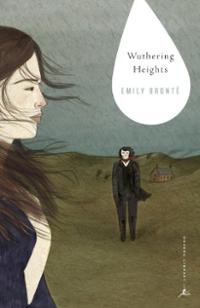 But what does Bronte’s Wuthering Heights mean to a woman in her fifties? I am no longer willing to fall in love with every dark, difficult, charming, tortured romantic character who comes my way.
Nor would Heathcliff be able to see me at my age. Cardigans and a string of pearls? (Well, I’m working on the string of pearls thing.) Gray hair? I now belong in a Barbara Pym novel, flirting with curates.
And will Bronte’s prose stand up?
When I was 15, the year I lived with my father after my parents’ divorce, I read Wuthering Heights several times. He didn’t get it. “Are you reading that again?”
Silence.
“That moldy thing?”
Silence.
“Shouldn’t you be out stealing cars or something?”
Silence.
That year, I probably rode in a car once. I would never learn to drive. People didn’t think I was serious. I was.
And though I did have some happy times with my father–once he bought me used ice skates at Novotny’s, and we had a happy day “skating” on the pond at City Park, i.e., my friend and my father held me up on the ice because my ankles weren’t strong– we were very different. I belonged in a Bronte book; he belonged in an episode of Happy Days.
While he worked nights, I sat around the apartment and read. Charlotte and Emily were two of my favorite writers. They had bad taste in men. I just thought that’s the way it was. My soulmate would be intense, ardent, and fierce.
Somehow I really wanted Heathcliff to dig up my grave.
When Catherine dies:
May she wake in torment!” he cried with frightful vehemence, stamping his foot, and groaning in a sudden paroxysm of ungovernable passion. “Why, she’s a liar to the end! Where is she? Not there–not in Heaven–not perished–where? Oh! you said you cared nothing for my sufferings! And I pray one prayer–I repeat it till my tongue stiffens–Catherine Earnshaw, may you not rest as long as I am living! You said I killed you–haunt me, then! The murdered do haunt their murderers! I know that ghosts have wandered on earth. Be with me always–take any form–drive me mad! only do not leave me in this abyss, where I cannot find you! Oh, God! it is unutterable! I cannot live without my life! I cannot live without my soul!”
Gorgeous writing! But this would never happen to me. Really, honey (talking to my younger self now), this isn’t your kind of thing.
In Charlotte Bronte’s Jane Eyre, a book I can no longer read, Mr. Rochester is a less emotional, slightly more believable version of Heathcliff. When he falls in love with Jane, the governess, and tells her that beautiful Blanche, his guest, is “a strapping wench,” we are thrilled. Though we don’t doubt Mr. Rochester should be in love with Jane, we’re appalled in retrospect by the mad wife in the attic and can’t help but think he was after Jane because he thought a young woman would tolerate this better than the Blanches of this world if it ever came out.
He was wrong.
I was always wildly in love with dark, moderately good-looking boys and men who unfortunately were somewhat unkind. Once I borrowed a bike from a boy I was in love with, and when I did not lock it upon returning it–it had been unlocked, and I wanted to make sure he had the key before I locked it again–he berated me. (By the way, this was just a lock and key, not a symbol.)
And, yes, some of my boyfriends later had a hard time celebrating my successes.
Did the Brontes influence us? Or is this an archetypal cavewoman’s idea of men?
I will read Wuthering Heights today and let you know.
 mirabile dictu