
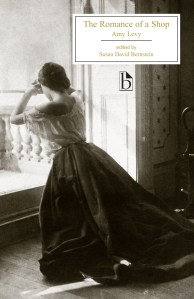
 Let me ‘fess up. I knew nothing about Amy Levy (1861-1889) before I read The Romance of a Shop. I’d mixed her up with the witty Ada Leverson, the author of the charming trilogy, The Little Ottleys. But I enjoy novels about women in the workplace, and found Levy’s book entertaining, if very slight.
The four Lorimer sisters are bereft: their father has died, and they must support themselves. But what can they do? Gertrude, an aspiring writer, regretfully consigns her scribblings to the trash and hatches a plan. She discusses careers with her sisters, the charming 20-year-old Lucy, the irrepressible 17-year-old Phyllis, and their simple half-sister, 30-year-old Fanny, who has “somewhat the appearance of a large and superannuated baby.”
Fanny seems to have a slight intellectual disability. She cannot grasp the idea of business and insists naively that Gertrude must become a famous writer.
Gertrude’s face flushed, but she controlled all other signs of the irritation which poor hapless Fan was so wont to excite in her. “I have thought about that, Fanny,” she said; “but I cannot afford to wait and hammer away at the publishers’ doors with a crowd of people more experienced and better trained than myself. No, I have another plan to propose to you all. There is one thing, at least, that we can all do.”
And that one thing they can do is photography, since they have long had their own home studio and professional equipment. So they rent a studio and start a photography business in London. They live in an apartment above the shop. Fanny does the housekeeping.
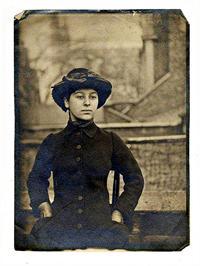
Amy Levy
I was very interested in Levy’s treatment of their work. What does Levy tell us about photography? It is a demanding career and a hard life. They have very few customers, and very little money. One of their first jobs is to photograph the dead wife of Lord Watergate, and Gertrude does this alone, to spare her sisters. Later, a neighbor, Frank Jermyn, an artist, befriends the Lorrimers, and introduces them to his artist friends, so they have work photographing studies and paintings. Unfortunately, one of the artists is the debauched Sidney Darrell, who causes much grief. Frank, Lord Watergate, and Darrell are important characters.
Does being women get in the way of their career? After a while, it actually helps them. They are a novelty. And their social circle expands.
I wish there were more about work, and less about love. Soon the novel descends into a romantic melodrama. I had read that this is a predecessor of George Gissing’s The Odd Women. It is not.
Oddly, it slightly resembles Louisa Alcott’s Little Women, sans humor. And I am quite sure Levy would have read that girls’ masterpiece, published in 1868. There are some parallels between the Lorimers and the March sisters. Gertrude, the writer and more-or-less studio CEO, is rather like Jo, the writer; Lucy is charming and practical, like Meg; Phyllis is a spoiled Amy with worse manners; and Fanny is a grotesque doppelganger of Beth, who possibly has Aspergers. Somebody even dies.
Levy, a novelist, poet, and essayist, was the first Jewish woman to attend Newnham, Cambridge. Her best-known novel, Reuben Sachs, was written partly as a response to George Eliot’s Daniel Deronda, which she considered too romantic.
By the way, Reuben Sachs has been published by Persephone. And all of Levy’s books are also available as e-books.
 mirabile dictu