
I have an almost infinite capacity to lose myself in Victorian novels.
Glued to book: “Oh, you’re going skiing/snowboarding/ice-fishing today? Bye!”
Hours later I realize I don’t have the faintest idea where they went.
Anthony Trollope is one of my favorites. His style is so strangely modern that I forget that he is a Victorian. His graceful sentences are long but plain and without rhetorical flourishes.
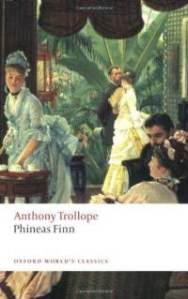 Trollope is a brilliant writer–as good as Dickens, though in a very different style. I started long ago with his two famous series, the Chronicles of Barsetshire and the political Pallisers novels. I am not sure which I read first, but I know I was so glued to The Pallisers on TV that it is amazing I got any work done. In addition to all those hours of watching, I read all six of the Pallisers books in record time: Can You Forgive Her?, Phineas Finn, The Eustace Diamonds, Phineas Redux, The Prime Minister, and The Duke’s Children.
Phineas Finn is a perfect novel for those of you who like politics. I figured that out when I read New York Times columnist David Brooks’s 2011 op/ed piece on Phineas Finn, “Politicians Behaving Well.” Brooks is a conservative Republican and I am a radical Democrat, but both of us like Trollope.
Trollope is a universal taste.
We do, however, see the idealistic politician Phineas differently.
Phineas Finn parses politics, but Trollope also describes the hero’s idealism. He explores the way politics shapes not only the public good but personal character and happiness.
Phineas, an Irish doctor’s son, a handsome, earnest, charming young barrister, has many friends among the upper classes in London. When an influential friend, Barrington Erle, urges him to stand as a Liberal for Parliament in Loughshane, Ireland, Phineas is very eager. Although the Finns have no money, Phineas’s father, Dr. Finn, has influence with the Earl who controls the borough, and the Earl finances the campaign.
But 24-year-old Phineas doesn’t understand that even the Liberal party recruits candidates who will always vote with the party.
Phineas tells Mr. Erle proudly,
“Let me assure you I wouldn’t change my views in politics either for you or the Earl, though each of you carried seats in your breeches pockets. If I go into Parliament, I shall go there as a sound Liberal–not to support a party, but to do the best I can for the country. I tell you so, and I shall tell the Earl the same.”
And Mr. Erle tells him that won’t be acceptable.
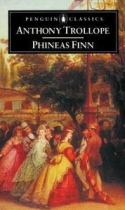 What do you do to get ahead in politics? Must you be obsequious? Yes. Phineas is politically savvy at first, doing what everyone tells him to do, but eventually it gets tiresome. He wants to make a difference. But he is caught in a political snare: he owes too much to his backers to be independent. The final deal-breakers is a tenants’ rights bill which his party refuses to sponsor. Phineas stands up.
But I’m getting ahead of myself.
Even one vote makes a difference, as I know from attending the Democratic caucuses, but I admit I am most interested, and I won’t be alone in this, in Phineas’s courtships of three women. Trollope has a gift for drawing believable, lively, though not always likable, women characters, and he is particularly successful with Lady Laura and Violet Effingham.
Although Phineas has flirted with a lovely but apolitical young woman in Ireland, Mary Flood Jones, who thinks he may marry her, he is under the influence of Lady Laura Standish in London, a brilliant, vivacious, ambitious tall redhaired woman who is interested in politics. Does Phineas love her, or does he love her connections? It is not clear. But when Laura ambitiously marries George Kennedy, a rich, chilly, domineering politician through whom she hopes to have political influence, she almost immediately realizes her mistake. Kennedy tries to control her by narrowing her interests and cutting her off from friends. Eventually she cannot live with him, and returns to her father. She regrets having turned down Phineas.
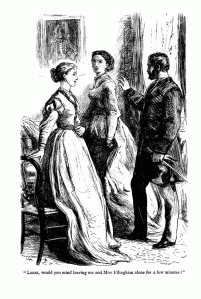
Phineas with Laura and Violet
But Phineas has turned his affections from Laura to her friend Violet Effingham, a beautiful but eccentric heiress who talks flippantly about John Stuart Mill. And this quasi-relationship–Violet isn’t particularly interested in him–causes problems, because Laura’s brother, Lord Chiltern, is in love with Violet, Laura’s father found Phineas a parliamentary seat after he lost his Irish one and believes Phineas owes him loyalty, and jealous Laura says Phineas should forget about Violet for Lord Chiltern’s sake.
In the end, political integrity is Phineas’s saving grace. And I think this is why we so much like Phineas Finn. We would like to see this integrity in more politicians.
I look forward to rereading Phineas Redux. Trollope’s detailed portraits of his characters’ obsessions with sex, money, and politics remind us that the world has not changed all that much.
 mirabile dictu