
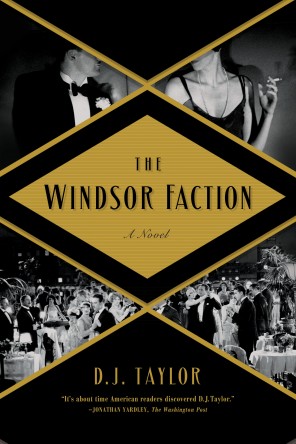
 D. J. Taylor’s The Windsor Faction, a brilliant, richly colored alternate history, is the kind of book some might call literary fantasy. He poses the questions, What would happen if Edward VIII had not abdicated the throne because Wallis Simpson died in 1936? And what if he were a fascist sympathizer?
This is one of those un-put-downable novels that readers both of literary and genre fiction like.
The clarity and momentum of Taylor’s prose remind me of Connie Willis’s entertaining Hugo-winning historical science fiction novels, Blackout and All Clear. Although Taylor’s book does not feature time travel (then it would be SF/fantasy), both writers describe the edgy atmosphere of English life in wartime.
The Windsor Faction might make my Best Books of 2013 List.
It has so much going for it.
It might have a shot at the Hugo.
It is absolutely brilliant, but I admit I didn’t absolutely love it. And does a common reader need to love a brilliant book to count it as best?
Probably.
Taylor’s novel is told in multiple forms and from multiple points of view: a traditional third-person narrative from the perspective of Cynthia Kirkpatrick, a bored young woman living in Colombo with her parents, who, when they return to England, works at a spy-ridden literary magazine in London; the diary of Beverley Nichols, a journalist (known for humorous gardening books like Merry Hall) who collaborates with the King on a speech he delivers on Christmas; newspaper articles and editorials about the death of Mrs. Simpson in 1936 and the beginnings of the war in 1939; and the notes of Johnson, a humdrum spy who attends fascist meetings to apprehend conspirators against the war.
Sometimes it’s difficult for us Americans to know what is English history and what is alternate history. At first I thought, Beverley Nichols? Not the garden writer! But, by Jove, it is indeed. I read the Author’s Note to clear things up.
Cynthia is my favorite character, and I much preferred the sections about her: I like her questioning of the humdrum lives of her parents and her hope to do something fascinating in London. When she visits the Bannisters, the family of her boyfriend/fiance, Harry, who died in the East, she feels a fraud. She did not love him. In Harry’s old room, she finds a draft of a letter to another girl. She is surprised to learn that the girl had enormous breasts.
She looks at the boys’ stories and Loeb editions of Greek writers on his shelves.
The copies of The Liveliest Term at Templeton and The White House Boys stared back at her, and she thought that there were whole areas of English life that she had altogether failed to understand, that there was some vital qualification missing form her repertoire that would have enabled her to better comprehend Henry Bannister and his kind, to sympathize with them, and deal with them, and not be so discountenanced by their actions or the letters they wrote to anonymous girls, with (apparently) enormous breasts, that they left lying around in Loeb editions of Xenophon for people to stumble upon after their deaths.
Very enjoyable, though perhaps the suspense fizzles out a little bit at the end.
AND HERE IS WHY IT MIGHT MAKE MY BEST LIST.

Ms. Mirabile: “But do I love it?”
Some will think it’s very silly to begin making my “Best of 2013 ” list now, but I just noticed there are only four books on my list that were published in 2013 (see sidebar).
They are brilliant books.
I also love them.
But this was the year I intended to read more contemporary books.
All right, I haven’t. I have read more than 100 books, but only 13 books published this year. I do start a lot of new books and put them aside, like Colum McCann’s TransAtlantic. I am picky, picky. If I don’t like a contemporary book, which I seldom do, I reread War and Peace (which I’m doing now).
But I’d better get hopping if I want 10, or even five, new books on my Best of ’13 list.
I’ve just decided that Taylor’s book WILL make my list. It’s brilliant, and that has to be enough. I can’t love everything.
What new books do you recommend?
We’re not big readers of new books, are we?
 mirabile dictu