
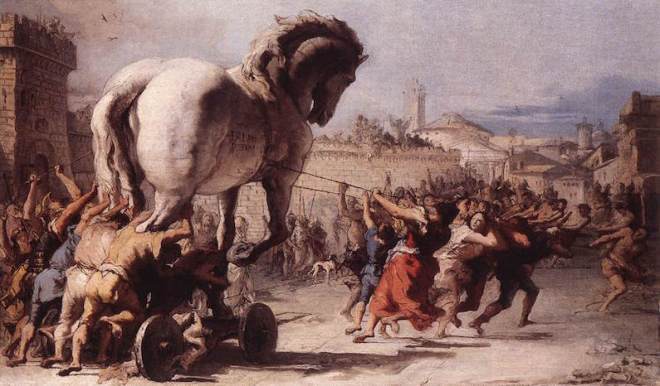
Detail from “The Procession of the Trojan Horse in Troy” by Domenico Tiepolo (1773)
Welcome back to the readalong of Virgil’s Aeneid. Since it’s a holiday weekend, I’ll write briefly about Book 2 today and try to get to 3 later this week. (The schedule is printed at the bottom of this post: Book 3 is “optional”in our readalong.)
BOOK 2
 At the end of Book I, Dido urged Aeneas to tell the story of the fall of Troy. And, by the way, the heroine Dido is based on Cleopatra, the powerful Egyptian queen. More about this later.
In Book 2, Aeneas relates the story of the fall from his personal point-of-view. And it is the poignancy of his “self-narration” that makes Book 2 unique. Homeric heroes like Odysseus may express pain and grief in order to manipulate others’ emotions, but Aeneas is a “counter-epical hero” who reveals his very real desolation, doubts, loss, and regrets.
And yet Aeneas is the cultured hero of a lost Trojan civilization, and the story is shaped for reception at a banquet. Of course he is trying to win her compassion.
Here is the first line of Aeneas’s speech, in Latin and three translations.
The Latin:
Infandum, regina, iubes renovare dolorem
Allan Mandelbaum’s translation:
“O Queen—too terrible for tongues the pain/you ask me to renew”-
Robert Fagles’ translation:
“….Sorrow, unspeakable sorrow,/ my queen, you ask me to bring to life once more”
My literal translation: “Queen, you bid me to renew pain.”
The arrangement of the Latin words is very clever, and not quite translatable: I have color-coded two Latin words in blue, infandum (unspeakable, unutterable, shocking), the first word in the line, and dolorem (pain), the last word in the line. These two words belong together: Infandum… dolorem (unspeakable pain). The arrangement emphasizes the unspeakable pain that surrounds Aeneas and Dido: the queen (regina), the command/question (iubet) and the renewal (renovare) are encircled by the phrase “unspeakable pain.”

Laocoon and his sons.
And then Aeneas tells the story of the fall of Troy. The great Bernard Knox, in his essay, “The Serpent and the Flame: The Imagery of the Second Book of the Aeneid,” analyzes the imagery that dominates Book 2. The priest Laocoon, who says the famous words, “Timeo Danaos et dona ferentis” (“I fear Greeks even bearing gifts”), warns the Trojans not to bring the strange gigantic wooden horse left by the Greeks into the city. Then two huge serpents glide across the sea from Tenedos, and stangle Laocoon and his two sons.
And a Greek trickster, Sinon, whose name means “destruction,” claims the Greeks have sailed away due to an oracle and built the Trojan horse to appease the gods. He insinuates himself in their midst. His name recalls the Latin words sinuo (wind, curve) and sinus (fold, curve). The words serpentes (serpents, snakes) and serpere (creeps) recur. A new fear insinuat (winds) into their hearts after Laocoon and his sons died, but they take the horse into Troy anyway. The flames also take on snakey shapes. At one point they are described as serpentes (winding).
I do feel Aeneas’s unspeakable pain (infandum dolorem) as I read Book 2. I am especially moved by the loss of his wife Creusa. Do let me know what interests you in Book 2: particular scenes, poetic details, any effects characters. There are many, many interpretations of this poem, so all comments are welcome.
N.B. I promised to write about Sarah Ruden’s translation today, but, alas, I have misplaced the book. I organized my classics books–all except this one apparently.
SCHEDULE:
Jan. 15-21: Books II and III (the “short version” is Book II)
Jan. 22-28: Book IV
Jan. 29-Feb. 4: Books V and VI (the “short version” is Book VI)
The schedule for February, including the “short version,” will be announced later.
 mirabile dictu