
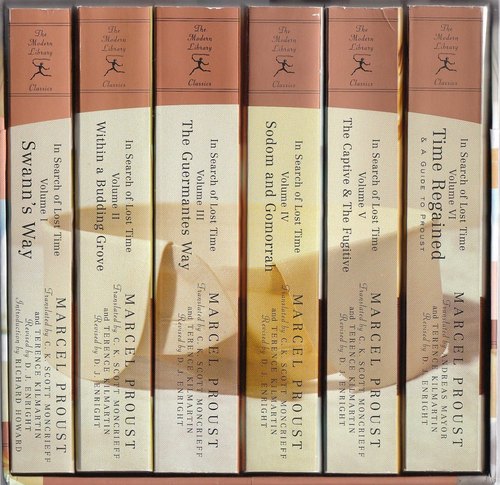
The Modern Library set, translated by C. K. Scott Moncrieff and Terence Kilmartin and revised by D. J. Enright.
I have been reading Proust for three weeks.
In Search of Lost Time is a page-turner.
That is a comment on middle age, is it not? When I first read Swann’s Way, it seemed a collection of beautiful, haunting, digressive essays.
Now I see form and story, as well as elegaic essays, and will write soon about the second volume, Within a Budding Grove.
But I wonder, Which translation should I be reading?
I am reading the Modern Library paperback editions, translated by C. K. Scott Moncrieff and Terence Kilmartin and revised by D. J. Enright. I used to have a fragile, falling-apart seven-volume Modern Library set in the original Moncrieff translation. My husband read Proust in the Moncrieff and Kilmartin translation.
But is the original Moncrieff even better?
In an article in the Oct. 31 issue of the TLS, “Faun’s Way,” a review of Jean Findlays’ Chasing Lost Time: The Life of C. K. Scott Moncrieff, A. N. Wilson says that Findlay’s excellent biography reminds readers of Moncrieff’s literary genius and raises the question of whether his translation is better than Proust’s original. Moncrieff’s is not a literal translation, but Proust himself very much admired it. Joseph Conrad preferred Moncrieff’s rendering to Proust.
Wilson writes,
Many of us with A level French are not quite able to read A la Recherche without frequently repairing to our frayed Harrap’s Dictionaries, and feel, if we are honest, that we have got more out of Proust by reading him in Scott Moncrieff’s pocket-sized, beautifully bound blue volumes, with their perfect dust wrappers designed by Enid Marx. Many of us, indeed, would surely want to go further, and to say that we have derived more pleasure from these twelve volumes than from any other reading experience, and that, as well as basking in Scott Moncrieff’s prose, and luxuriating in the comedy of Proust’s characters, we have also learnt what little we know about life from reading and rereading them.
He goes on to say, “Scott Moncrieff’s twelve sky-blue volumes, therefore, belong to that special category of translations which are themselves literary masterpieces.”
And now I’m saying to myself, F–, f—, f—, I have the wrong translation then.
Coincidentally, I found a reference to the sky-blue Proust in Barbara Pym’s Less Than Angels. When Tom, an anthropologist, writes from Africa about a memory that was “a moment out of Proust,” his girlfriend Deirdre is dismayed.
Must I then read Proust? she asked herself despairingly, seeing the twelve blue volumes with red labels in Catherine’s bookshelves, for she was not much of a reader at the best of times.

The 12-volume sky-blue set of Scott Moncrieff’s Proust.
All right, I don’t have the sky-blue Chatto & Windus, but I’m not panicking. I love my paperback editions, whoever is responsible for the translation. The French editions of A la recherche were revised, first in 1954 and then in the ’80s: hence the revisions by Kilmartin and then Enright.
I did find one of my old Modern Library editions (more than slightly foxed), The Captive. Looking at the first page, I see very few differences in the translation.
Here is a sentence from Moncrieff:
The first sounds from the street had told me, according to whether they came to my ears dulled and distorted by the moisture of the atmosphere or quivering like arrows in the resonant and empty area of a spacious, crisply frozen morning; as soon as I heard the rumble of the first tramcar, I could tell whether it was sodden with rain or setting forth into the blue.
Here is the Enright revised:
The first sounds from the street had told me, according to whether they came to my ears deadened and distorted by the moisture of the atmosphere or quivering like arrows in the resonant, empty expanses of a spacious, frosty, pure morning; as soon as I heard the rumble of the first tramcar, I could tell whether it was sodden with rain or setting forth into the blue.
Does anyone have a preference?
Presumably there are whole paragraphs that don’t appear in the original Moncrieff. But if you read the original Moncrieff, it is still Proust. Yes?
And there are the recent Penguin translations, each by a different translator. Lydia Davis translated Swann’s Way.
Which Proust are you reading, or have you read?
Back to my Modern Library much-revised paperback editions!
 mirabile dictu