

Renee Nere et Jean, illustration from L’Entrave’ (The Shackle) by Colette, Editions Mornay, Paris, 1929
Men don’t read Colette.
If you do, let me know.
Whenever I write about Colette, women chime in and comment that they love her work. Of course I have no way of knowing if these commentors are really women, but I assume that most of them are. All the stats collected by WordPress (and one thing I like about WordPress is that it limits the available stats, protecting our privacy to an extent) will not tell me if you are male or female.
At a dinner party one night a couple of male friends let me know how much they dislike Colette. They began to discuss French philosophy and literature. When the name Michel Foucault came up, I practically put my head down on the table. Women hardly ever talk about Foucault. I had never been to a party where people talked about Foucault. I have never read Foucault. I will never read Foucault.
Then the discussion became a little more general.
Red-faced from bicycling in the sun and bored because I had gone half an hour without speaking, I suggested that Colette was one of the best French writers of the 20th century. One man declared that her books are overwritten. Another said they were too simple. Another said he had disliked My Mother’s House in French.
And so I helped the women clear the table. It is not that I gave up: I just didn’t want to argue.
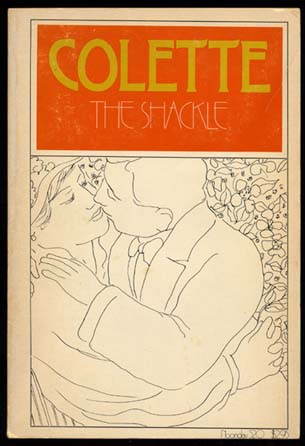 I reread Colette’s The Shackle today partly because this is my Gal Lit week, partly because this erotic novel is short, and partly because it is a feminist predecessor of the Fifty Shades of Grey trilogy. (N.B. I read 50 pages of Fifty Shades of Grey, and found this throwback S/M novel about a submissive virgin and her sadistic billionaire lover not only execrably written but actually sad: self-respect is not a priority for heroines in chains and handcuffs).
Renee Nere, the narrator of Colette’s autobiographical novel, The Vagabond, is a strong, intelligent heroine who, after her divorce, gives up writing to work as a music hall mime. In the sequel, The Shackle, Renee has inherited money, quit her job, and gone on vacation to the Riviera. The novel begins with her seeing her ex-lover, Max (“Big Ninny”), strolling with his wife and child along the Promenade in front of her hotel. She is not exactly jealous, but she is aware of her sexual frailty. She had not imagined him married.
Renee loves her solitude but finds it hard to be alone. She spends most of her leisure with friends she has met in the hotel: a couple, Jean and May, who have a violent sexual relationship, and Masseau, an opium addict. Renee herself abstains from both sex and opium.
Renee knows more about May’s sexual relationship with Jean than she wants to. May comes to Renee’s room frequently to tell her about the latest “three o’clock…grand beating up.”
Look at that,” she said abruptly, thrusting her downy arm under my nose. “That’ll be black tomorrow.”
I examined, with the proper interest, two yellowish-brown bruises cricling each of May’s arms like bracelets.
“The filthy brute!” she muttered, not without deference. “And, you know, he ruined my dress, a dress that cost fifty louis–all because I felt in a lucky mood and I wanted to go and play at Monte Carlo. He’s going to find out what it costs him, that dress!”
Thirty-six-year-old Renee considers twenty-five-year-old May very young and silly. At the same time she is aware that their fighting, which goes on in public as well as in private, is an integral part of their sex life. When May moves into her own room after a fight, Jean admits his attraction to Renee; Renee wretchedly flees to “chaste Switzerland.” Four days later he and Masseau track her down; Renee and Jean take the train to Paris.
Colette’s description of the consummation of their relationship in Jean’s house in Paris is both erotic and humorous. Renee admits she likes a little bit of bullying.
Then I… reserved my strength to fight him off, for he had begun to overwhelm me; he was climbing round me, paralysing both my arms. He made himself purposely heavy, he made himself as clinging as a tenacious weed. I could not get up or even uncross my legs; I struggled conscientiously, half-pushed over backwards, supporting myself on one arm and muttering under my breath: ‘This is idiotic…this is really too idiotic’ until my simple, female sentimentality suddenly burst into that resentful, indignant cry: ‘You don’t even love me!’
She finds it restful to give in to sex. She enjoys but is also annoyed by his mastery.
Arrogant, completely assured of his triumph, he displayed a barbarous contempt of methods. Hair, skirt, fine linen were all rumpled and crushed together as if he had not time to undress me. It was I who muttered, in shame: ‘Wait!’ It was I who undid buckle and ribbon and removed pins that might hurt; it was I, lying on my back on the carpet, who made my slightly bruised body a cushion for Jean.
Colette doesn’t take herself too seriously, and I much prefer her lyrical eroticism to James’s porn.
The novel is not just erotica: Renee also explores her fear to commit to a serious relationship. Although Jean wants her to move in with him, she finds solitude at her hotel a relief. Anyway, they rarely talk. Can a healthy relationship be based on physicality? she wonders.
Renee is also haunted by age: her skin is no longer as beautiful as a young woman’s, i.e., as beautiful as May’s, her chin is no longer so firm, and she fears that Jean’s seeing her at her most imperfectly disheveled will extinguish his love. I find her vulnerability touching and very realistic
And so what will happen with their relationship?
You’ll have to read it to find out.
 mirabile dictu