
“To the working planetologist, his most important tool is human beings… You must cultivate ecological literacy among the people.”–Frank Herbert’s Dune
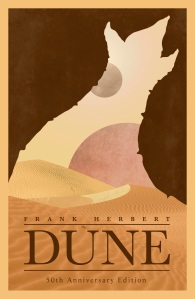 Frank Herbert’s Dune, winner of the Nebula and Hugo Awards in 1966, is an ecological classic. In the early 1970s, I lived for a few months with a family of professor/political activists, who, in their free time, organized a food co-op, played guitar, and read the science fiction novel Dune. Dune is set on Arrakis, a desert planet. Not only did I find it a compelling story, it taught me about water conservation. Still, it was hard to see what was in front of my eyes (and occasionally my nose) during my extremely self-conscious clean teens. I had a glimmer of why my friends showered only a couple of times a week, but didn’t make the personal connection and continued to shower daily. “You’re the cleanest person we know,” they teased. Their water bills undoubtedly went up with me in the house..
I recently reread Dune. It is, to a large extent, about the politics of water. Water is the most precious commodity on the planet, though the ruling class are never dehydrated and live in luxury. The native Fremen in the desert must wear “stillsuits” that recycle every drop of sweat and urine while they travel or work in the spice mines. When someone dies, the water is taken from the body to be reused, because 70% of the body is water. Plastic dew collectors save every drop of condensation for growing plants. Dangerous sand and dust storms blow up to 700 kilometers an hour and “can eat flesh off bones and etch the bones to sliver.” There are also giant worms. But the planetologist, who knows exactly how much water is needed to make the planet green over the next few hundred years, teaches the people how to change.
 At the center of the book is the Atreides family, who have recently moved to Dune to rule part of the planet. During a coup, Duke Leto Atreides is killed, but his wife, Jessica, a trained priestess with psychic powers, and son Paul, trained by his mother in matters of the mind, escape to the desert. The learning and mastery of ecology is the difference between life and death.
The usurping baron kills tens of thousands of people, including Kynes, the radical planetologist, who is seen as a threat because of his ties to the Fremen. Left in the desert to die, Kynes meditates on water and Arrakis, in a scene reminiscent of stream-of-consciousness scenes in Tolstoy’s War and Peace, when men wounded or dying become extra-sensitive and alert to the beauty of the world they are leaving.
Herbert’s style is usually straightforward and brisk, but here is one of his more poetic passages.
He tried to think of moisture in the air—grass covering this dune… open water somewhere beneath him, a long qanat flowing with water open to the sky except in text illustrations. Open water… irrigation water… it took five thousand cubic meters of water to irrigate one hectare of land per growing season, he remembered.”
The reader of Dune wants to become more ecologically literate, but she inevitably wonders: HOW WOULD MY HAIR LOOK?
Herbert does not mention hair much, but he writes frequently about the odors. At one point, a character tells the Atreides,
“There’s little to tell them from the folk of the graben and sink. They all wear those great flowing robes. And they stink to heaven in any closed space. It’s from those suits they wear—call them ‘stillsuits’—that reclaim the body’s own water.”
Ah, the unwashed smells of the early ’70s. I did know a few men who occasionally stank. The women never stank: they no doubt kept themselves cleaner, with quick dabs of the washcloth. But here’s a fun fact: even though radicals showered less, no one used deodorant. Even I, the mad showerer, didn’t. We weren’t going to support capitalists who made us feel bad about our bodies! (And there really is no need. We still have water.)
The climate is in a worse mess now, as was predicted, but my guess is that people use more water, not less. According to the EPA, the average American uses 100 gallons of water a day. Good God, that is a lot. In the 60s, we washed our hair once or twice a week. By the time I was in my twenties, most washed their hair daily. All that washing of hair increases the time of the shower or bath.
Because I was rereading Dune, I was intrigued by a recent essay in The Guardian by Donnachadh McCarthy, with the headline,”I shower once a week. Here’s why you should too.” McCarthy statistics about the amount of water used in daily baths and showers and the cost. He points out that the daily bath
is terrible for the environment and our bank balances. That’s one reason I have reverted to a weekly shower, with a daily sink-wash that includes my underarms and privates. But there are health consequences too.
He writes that soap products can damage the skin and cause medical problems. It is true: I myself am allergic to some soaps.
We cannot all be like Donnachadh McCarthy, but are we the last generation to enjoy this luxury of daily baths? Think of the drought last summer, and the paradoxical paucity of clean drinking water during the frequent floods in the Midwest. If only water conservation could be made to seem glamorous. Never going to happen, I’m afraid!
 mirabile dictu