
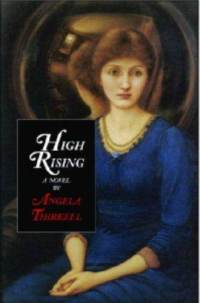
 I have an almost complete set of Angela Thirkell’s Barsetshire series.
It started when a friend shrieked, “Pomfret Towers!”
We were at a bookstore.
She wanted to know if I had read Angela Thirkell.
“Yes,” I said vaguely.
I had tried something by Thirkell when I was about fifteen, expecting a cross between Jane Austen and Georgette Heyer. Her style was too prolix for me.
In 2000, however, I read and enjoyed Thirkell’s interwar novels, though I found her later novels badly organized and disappointing. (True Thirkellites don’t think so.) The American publisher Moyer Bell reissued many of Thirkell’s books In the ’90s and the early 21st century, and Virago has just reissued the first two of her Barsetshire series.
Thirkell’s unique sensibility occupies a zone between the sharp wit of Nancy Mitford and the silliness of P. G. Wodehouse. Her world of upper-class England is sympathetic, if snobbish, and she paints her endearing characters with a kind of droll detachment. She thrills us with witty dialogue about peculiar subjects like folk-dancing, bad poetry, and “why on earth headmasters’ wives in novels fall in love with assistant masters, or assistant masters with them, for that matter.” Thirkell, the granddaughter of Burne-Jones, and a widow with children, wrote her humorous Barsetshire series, set in a fictional county based on Trollope’s Barsetshire, to support her family.
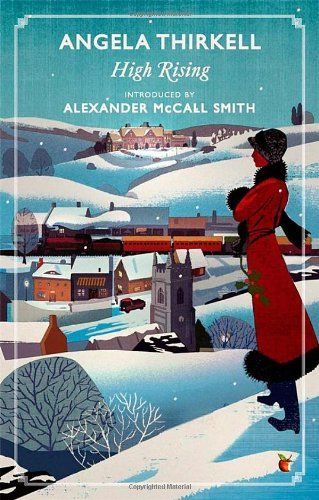
In a recent rereading of High Rising, the first novel in the Barsetshire series, I enjoyed Thirkell’s verbose, artificial, but engaging style. After a few pages, I was hooked on the fascinating intrigues of her eccentric characters.
 Writers have fun writing about writers, and Thirkell’s heroine, Mrs. Morland, is her alter ego. Laura Morland, a widow with four children, writes thrillers about a fashion designer named Madame Koska, who is forever finding cocaine, or worse, in her shop. Laura’s hairpins fall out as she tries to plot her novels, or, indeed, does any kind of thinking, and people are forever picking them up for her. Her secretary, Anne Todd, who also cares for a mentally ill mother with a bad heart, loves to read about fashion, and when Laura is overwhelmed, Anne sometimes writes the fashion magazine articles for her from Mrs. Morland’s notes.
It is a good secretary-bad secretary kind of novel.
Anne is the good secretary, but Una Grey, the evil, dominating, neurotic, perhaps lower middle-class (anyway, she’s not acceptable) secretary of George Knox, the biographer, is trying to seduce and marry her boss. Laura, Anne, and even the servants are up in arms, and are terribly worried about Sibil, George’s silly daughter.
And I must say Una is very unlikable, though she is portrayed as competent, and even sometimes charming.
Thirkell is brilliant here. The juxtaposition of good secretary-bad secretary is fascinating. Does it have something to do with class? The secretaries rule behind the scenes. Anne is Laura’s equal, though poor: they were friends before she began to work for her. But Una is nobody’s friend, and is much condescended to.
There are, of course, other subplots.
Family is a very important theme. Three of Laura’s four sons are grown up, but Tony, the youngest, is at boarding school. When she fetches him from school for Christmas, he jabbers for hours about his model railroad, and asks repeatedly if he should buy the Great Western model engine for seventeen shillings, or the L.M.S. for twenty-five shillings. Confident Tony is unperturbed when his mother finally snaps over his moving his railroad into the main part of the house, but Thirkell shows how characters should behave: adults should have their own lives, and children should not be allowed to impinge on them. Laura oes to Tony’s prize-givings at school, makes sure he washes his hands, and listens to his poems, but she is not a soccer mom.
Weddings take place in all of Thirkell’s books. People are always proposing to Laura, but she doesn’t want to get married. Laura’s publisher, Adrian Coates, who published a volume of poetry as an undergraduate and still shudders when anyone mentions it, is a frequent visitor at Laura’s house in the village High Rising, and at one point he proposes marriage to her. At another point, the voluble George also proposes, and this strikes Laura as ridiculous: he is as loquacious as Tony.
Anyway, Adrian is really in love with Sibil, George’s daughter. She has been throwing them together. And George is interested in…you’ll never guess!
I love all the gossip about publishing. Here is Laura on her books, when she first meets Adrian at a dinner party and he asks to see her book. She says,
“It’s not highbrow. I’ve got to work, that’s all. You see, my husband was nothing but an expense to me when he was alive, and naturally he’s no help to me while he’s dead, though, of course, less expensive, so I thought if I could write some rather good bad books, it would help with the boys’ education.”
I know exactly what she means. I love good bad books!
Anyway, these are very light novels.
Don’t worry. I don’t read just good bad books. I’ll write about a classic soon.
 mirabile dictu