

Mirable Attempts Contemporary Fiction.
I’ve been reading the classics lately.
Balzac and Bronte. Lost Illusions and Villette.
I’ve written long, long posts.
Although there are a few, very few, outstanding contemporary American writers, I’ve struck out with almost everything lately. I can’t even tell you how many cats died in the first hundred pages of Antonya Nelson’s Some Fun, a collection of short stories and a novella.
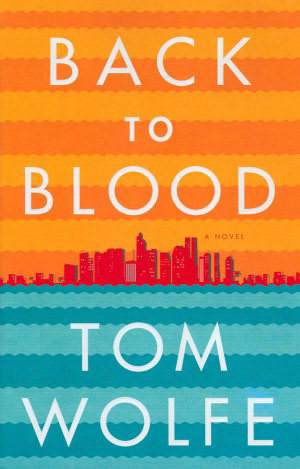 I started reading Tom Wolfe’s Back to Blood. His verbal pyrotechnics dazzle, and it’s a very entertaining novel. Set in Miami, it interweaves the stories of several colorful characters, including Edward T. Topping IV, a new editor of The Miami Herald who is reeling from Cuban-American hate mail; Nestor, a Cuban-American marine patrol officer who alienates the Cuban community after he rescues an illegal immigrant and hands him over to the Coast Guard; and Magdalena, a beautiful Cuban-American psychiatric nurse.
Some love Wolfe. I always find him a little draining. This 704-page novel reads like an exceptionally vivid, long piece of new journalism. Lots of ellipses…lots of noises like Smack, Beep, and Click!
By the way, in the first chapter, the editor and his wife are going to Balzac’s, “the coolest of hot spots.” Since I’ve been reading a lot of Balzac, do you think I’m meant to read this book?
If you like it, you like it. It’s good bedtime reading. I’m reading it in 60-page increments. I’ll post on it when I’m finished.
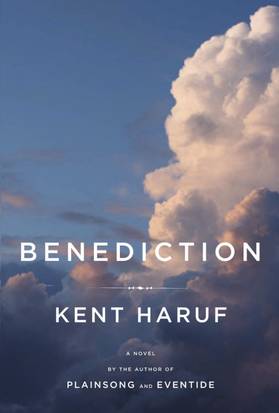 I finished Kent Haruf’s Benediction. It is a simple novel, very well-written, set in a small town in Colorado, mainly the story of a hardware store owner who is dying of cancer and his family.
Dad Lewis has only a few months to live. His devoted wife Mary is caring for him alone, but it becomes too much for her: she ends up in the hospital with exhaustion.
She explains on the phone to Dad,
I don’t have any pep. That’s all.
When she comes home three days later, she calls her daughter, Lorraine, for help.
The dialogue is brilliant. Simple one-liners mostly. When Lorraine arrives:
Oh, Daddy.
Yeah. Ain’t it the goddamn hell.
She took his hand and held it. Are you in a lot of pain?
No, not now.
You don’t have any pain?
I’m taking things for it. Otherwise I would. I was before. Well, you look good, he said.
Although when it comes down to it, I don’t know anyone in small towns who talks like this, the dialogue is convincing and pitch-perfect in a novel. It could be adapted for a play.
Other characters include Berta May, their next-door neighbor, and her granddaughter, Alice, who has come to live with her because her mother has died of cancer; the new pastor, Lyle, who alienates his parish by speaking against the war in Iraq; and Willa Johnson and her daughter, Alene, two church members who visit and become like members of the family. Alene, an unmarried, retired third-grade teacher, and Lorraine, whose daughter died, both befriend the child, Alice, because childlessness is the most heartbreaking lack in their lives.
This novel reads very, very fast.
Dad’s illness is sad and very realistically described. Eventually he has to wear diapers and his wife and daughter clean him up. He starts hallucinating: he believes he is having a conversation with his gay son, who ran away years ago.
My online book group on AOL read Haruf’s novel Plainsong, which, as I recall, was a big hit in the ’90s. The characters from Plainsong are mentioned in Benediction.
I imagine Haruf’s other books are set in this part of the country, too, but I haven’t read them.
I don’t have much to say about Benediction, but it is very good. One of those award-worthy books, but perhaps too straightforward to be remembered.
 mirabile dictu