
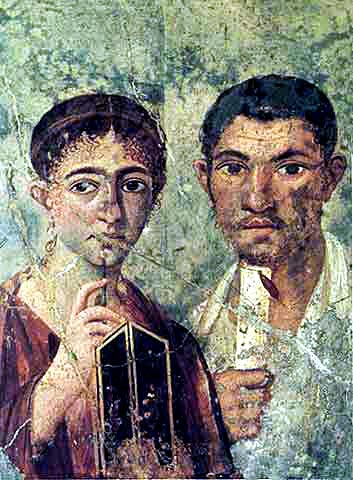
A Roman pair with stylus and scroll.
I taught a Latin class through adult education. Had I known how much work it was, I might not have done it.
I spent a full day each week typing worksheets.
If you’ve been out of the work force for a while, as a housewife or, God forbid, unemployed, you lose touch with the culture. You don’t have the faintest idea how people think or talk . They walk down the street staring at their apparati (Gary Shteyngart’s word for phones/Blackberry/tablets/gadgets) and rarely look at the scenery. But do they procure Clozapine secretly from their sister the doctor so the CIA won’t realize they’re bipolar (Homeland), or chat about squalid love scams to Dr. Phil (Dr. Phil)?
That’s just TV.
And do they say “awesome” all the time?
That’s real.
Latin is not a spoken language, so I don’t teach fun phrases like, “Want a drink?” I did, however, teach the phrase in vino veritas, “There’s truth in wine.” Far be it from me not to prepare them to drink in bars in ancient Rome.
Mostly I kept the tone up with drills on Latin vocabulary and grammar.
They will never make a mistake about “who” and “whom” again.
We did exercises in Wheelock (our textbook), read Pompeiian graffiti (pages of which I photocopied from books), and studied English derivatives.
I explained that we studied Latin to read the literature, and brought in passages from different poets, Virgil, Catullus, Ovid.
Then I had a problem. My books started to fall apart. One day I was holding Wheelock when part of the cover fell off. The pages were already smeared with the marker pens for the whiteboard.
 Other books began to disintegrate. Take my Lewis and Short Latin dictionary, which I bought long ago for $30 in a used bookstore, and which now costs $198 at Amazon. I was telling my students lore about some of the rare words used in Latin poetry. Ovid, for example, is the only Roman poet to use the word agitabilis, an adjective which means “light” or “easily moved,” and which he used to describe air.
The binding of Lewis and Short suddenly cracked.
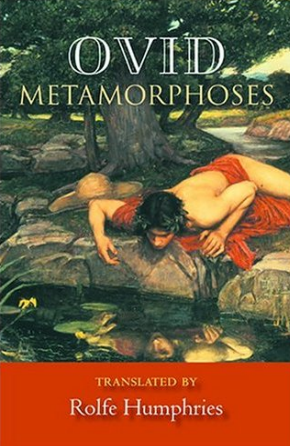
Then I read them the passage in Rolfe Humphries’s translation of Ovid’s Metamorphoses. He translates agitabilis aer as “the moving air.”
“and shining fish were given the waves for dwelling
And beasts the earth, and birds the moving air.”
Then pages started falling out.
Poltergeist!
Fortunately we got kicked out of adult ed the third term when we didn’t have enough people for a class and the poltergeist didn’t follow us to the coffeehouse.
But seriously, my Latin books are old. I have had to replace several of them.
If I lived in an ideal blog world, publicists would offer me copies of Latin books. They would replace my mildewed Catullus, and send me Ciceror’s Pro Caelio.
Meanwhile, I am investigating ways of cleaning mildew, and am pretty darned good with tape.
 mirabile dictu