
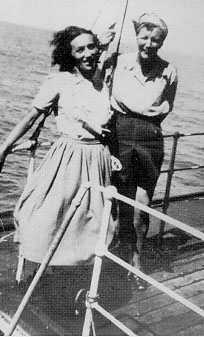
Mary Renault (right) and her partner Julie Mullard
It is one of the oddities of being born female, that if we want to read novels by women, we often end up reading middlebrow fiction. Women’s literary fiction does not always thrive, men and women do not necessarily like the same novels, and men’s and women’s books are marketed differently. In our household, “he” reads Dave Eggers; I read Karen E. Bender. “He” reads Graham Greene; I read Elizabeth Taylor. Although I also read Eggers and Greene, I guarantee that “he” will not read Bender or Taylor unless they are reviewed in The New Yorker. Bender’s book was not widely reviewed; and there was no mention in The New Yorker of the novelist Elizabeth Taylor’s centenary in 2012, though her stories were published there in the ’50s and ’60s.
Women’s novels often straddle a thin line between the personal and the political. The personal is political, as we used to say in the ’70s, though I’m not entirely sure what that means. Eggers is political, in the way that Dreiser was political; Greene is political, in the way that Joseph Conrad was. Often we read out-of-print women’s novels or Virago reissues, which are important in women’s history, if not quite classics. Are Pamela Frankau’s complex novels about men’s and women’s lives and gender issues classics? Yes, some of them are. How about Rumer Godden’s Kingfishers Catch Fire? Yes, this story of a British pre-hippie woman trying to live simply in colonial Kashmir without understanding the racial issues meets my criteria. How about Mary Renault? I’m not sure yet.
 The TLS recently published two articles on Mary Renault, whom I have avoided over the years, because I am not a keen reader of historical fiction. In Daniel Mendelsohn’s “Moral Conqueror: Mary Renault in the grip of Alexander the Great” (available only to subscribers), he writes fascinatingly about her Alexander the Great trilogy, and made me reconsider my judgment of Renault as a pop writer. And so I am devouring Fire from Heaven, the first in the trilogy. It is pop fiction, but it is pop in a “high” middlebrow way.
Mendelsohn, a classicist who has written for The New Yorker (and every other publication with “New York” in the title”), grabs you from the beginning in his spirited article about Renault.
‘I have never studied anything so interesting.’ So the historical novelist Mary Renault in a 1969 letter to a friend, summing up her lifelong fascination with Alexander the Great–the back-country prince who, in a scant twelve years, took possession of the world, and in so doing seized the imagination of its inhabitants for ever after; the historical subject with whom, thirty years after her death, Renault remains most closely identified.
Renault is a great storyteller, and I am very much enjoying this coming-of-age of Alexander novel, though it seems a little too obviously divided into “scenes”: the gripping opening scene in which Alexander wakes up to find a snake wrapped around him, and creeps through the palace to return it to his witch mother, only to find that it has come to him because he is an ancestor of Herakles. His father, King Philip, has only one eye, and he compares him to Polyphemus the Cyclops. Would I have caught these allusions as a teenager when I read Renault? No, my experimental school had us play simulation games and do “independent reading” instead of studying history, mythology, or literature. I wasn’t interested in classics until I was at the university.
Renault’s retelling of Alexander’s acquiring the huge, at first terrifying, terrified horse Boukephalos is moving and compelling, if perhaps a bit sentimental. (I find myself thinking, “Go, horse!” as I do in every horse story, from Black Beauty to Jane Smiley’s Horse Heaven.) Boukephalos, originally called Thunder by Renault, has been offered explensively to Philip, Alexander’s father, by a trader, but everyone can see the horse is crazed and dangerous.
The royal trainer walked round to the front of the horse, making cheerful soothing sounds. It backed, stamped and rolled its eyes. He clicked his tongue, saying firmly, ‘Thunder, boy, hey, Thunder.’ At the sound of its name it seemed to quiver all over with suspicion and rage. Jason returned to noises. ‘Keep his head till I’m up,’ he told the groom ‘that looks like one man’s work.’ He approached the horse’s side, ready to reach for the roots of the mane; the only means, unless a man had a spear to vault on, of getting up. The saddlecloth, had it been on, would have offered comfort and show, but no kind of foothold. A hoist was for the elderly, and Persians, who were notoriously soft.
Alexander speaks up when Philip refuses to buy him, and bets that he can handle him. If he can, he gets the horse; if he can’t he buys it for Philip. And since he has figured out the nature of the horse’s fear, he is able to mount it and ride safely. He calls the horse Boukephalos, or Oxhead.
Renault is not in the class of Hilary Mantel, but I can’t stop reading this captivating novel. My Nook has to be recharged, though. E-readers aren’t perfect.
The TLS also ran a review of Mary Renault’s The Charioteer, a 1953 gay novel, recently reissued by Virago. In Jonathan Keate’s “Mary Renault’s Chariots of Ire,” he explains that this novel about a gay relationship is set during Blitz in World War Ii. Mary Renault was gay, and met her lover while training as a nurse.
In The Charioteer, Renault recaptures this atmosphere by setting her narrative against the same hospital background in which she and Mullard had first met as trainee nurses. Much of the novel’s action takes place in the wards of a London infirmary during the Blitz, where surgeons are expected to deal with incendiary bombs and ward sisters double as military police. An overwhelming air of the transient, of relationships snapped in two by peremptory circumstance, of emotionally fraught lives among bedpans, sutures and sedatives, lends an urgent authenticity to the novel.
If I had bought this on Monday, when I downloaded a sample, I could have had the e-book for $2.99. Not understanding that it was a CyberMonday opportunity, I missed my chance.
Still, one of these days it will turn up at the library.
 mirabile dictu