The Bookstore Tour of London & Mrs. Miniver’s Green Lizard-Skin Appointment Book

stack_of_booksToday I thought of something that made me laugh while I was walking down the street.

On the Bookstore Tour of London, as I now call it, why not arrange to work for a day or two in a used bookstore?

I can’t look at culture all the time.

I would happily shelve books, catalogue books, do anything but handle money, which I probably won’t master in the UK.  And I would bet I could sell some hard-to-move book in return for a book. Or I would bet to sell a regional novel from the Midwest, something by Bess Streeter Aldrich, Wright Morris, or Ruth Suckow. And I have worked for books before.

When I first moved to this city, I worked at a used bookstore in return for books.  As I wrote here on January 25:

One window was boarded up, and the other impossibly dusty.  A few books had been dumped  in the window, apparently by someone who had forgotten to shelve them.  If you wanted a coverless copy of The Oxford Book of English Poetry, out-of-print science fiction by David Lindsay, or a wacky 1950s Big Book of Games, which emphasizes  games that require passing an apple from under your chin to another’s, this was the place for you.

There was no order.  I put books into the right sections, then alphabetized them.

But then the store shut down.  The owner, a cattleman who came in to the city occasionally, was sick.  His siblings decided to pulp all the books.

Yes, I am not joking.

Now I’m sure in London there is less book pulping.

Well, I may write to a bookstore and see if anyone will let me volunteer for a day.

Here is the list of bookstores I got from your comments on my “My Mother’s London” blog.

Persephone bookshop
Oxfam
Oxfambloomsburybookswordpress.com
Skoob Book
Any Amount of Books
Henry Pordes
Foyle Charing Cross
used bookstores Charing Cross
Daunt Books

Do any of these look like American-for-a-Day bookstores?

Ho hum.  I do like to entertain myself.

THE GREEN LIZARD-SKIN APPOINTMENT BOOK.  Jan Struther’s Mrs. Miniver, a collection of short columns about a housewife in The Times in 1937, is charming and entertaining, if much less witty than E. M. Delafiled’s comparable Provincial Lady books, written as columns for Time and Tide.

I particularly enjoy the  scene where  Mrs. Miniver  goes to a stationer in London, compares three appointment books, and buys a brown calf, “a pleasant little volume,” instead of the very expensive, gorgeous green lizard appointment book she wants.

Then on the bus:

Halfway down the Pimlico Road she suddenly pressed the button and jumped off the bus….

At this very moment, perhaps, the green lizard-skin diary was being bought by somebody else–some wholly unsuitable who merely wanted to get one in a hurry; a rich, earnest woman who would fill it with committee meetings, or a business man who would not even glance at the binding when he opened it to jot down the words “Dine George.”  While she herself with all her dearest activities soberly confined in brown calf would be thinking about it in an agony of regret.

She loves the lizard-skin diary.  And  she needs it.

What I was wondering is:  What is your green lizard-skin diary?  ANd have you ever had such an experience?

Mrs. Miniver, Middle Age, & Matron Clothes

Greer Garson as Mrs. Miniver

Greer Garson as Mrs. Miniver

Mrs. Miniver suddenly understood why she was enjoying the forties so much better than she had enjoyed the thirties: it was the difference between August and October, between the heaviness of late summer and the sparkle of early autumn, between the ending of an old phase and the beginning of a fresh one.

I very much enjoyed reading Jan Struther’s Mrs. Miniver, a collection of charming columns she wrote in the 1930s for the London Times.  Mrs. Miniver is a fictional character based on Struther.  In 1939 the columns were published as a novel (you can read the entire book at this website.)

As a housewife/cook/bicycling blogger, I think it would be lovely to be Mrs. Miniver.  In the very first chapter, when she is musing about being in her forties, she comes home to a fire in the fireplace and tea laid out on the table by the servant:   “…there were honey sandwiches, brandy-snaps, and small ratafia biscuits; and there would, she knew, be crumpets.”

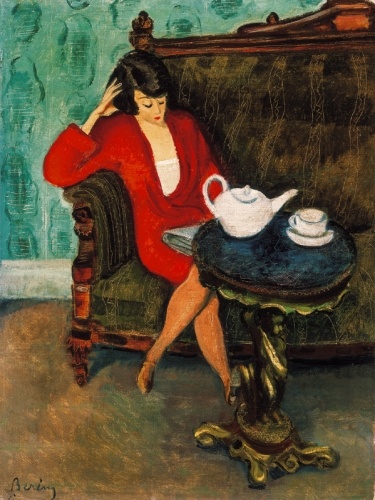
"Red-dressed Woman in a Green Room" by Róbert Berény

“Red-dressed Woman in a Green Room” by Róbert Berény

Perhaps it is easier to examine the vicissitudes of life wisely if one has servants.  She loves her three children but is not trapped by them (her oldest son is at Eton), one of her greatest problems is getting used to a new car, she endearingly buys an expensive green lizard engagement diary instead of a new hat, and she does not need romance:  she describes marriage as two crescents bound at the points, with a leaf-shaped space in the middle “for privacy or understanding, essential in a happy marriage.”

The forties…  All gone!  Mrs. Miniver had better circumstances. The fifties have been better for me.  The forties were a time of heartbreak, of working for an unstable boss, and coping with an early menopause.  For almost a year I actually missed menstruating.  Tampons.  The stain of blood on a white skirt on the bus.  (A whispered “Miss!  Your period.”)  Then there were hot flashes.   There was blushing. I refused to support the pharmaceutical companies by taking hormones (which was brilliant, since they were shown to cause cancer).

Finally, in my  fifties, I began to feel the “sparkle of early autumn” Mrs. Miniver writes about.  There is a confidence in one’s fifties, a cessation of trying too hard to please, and a willingness to try new things.

Of course you miss your younger body.

But you can, if you want, let go of:

  • dyeing your hair blond
  • baking eggplant parmesan in a small kitchen where every surface is covered with ingredients and you must move into the dining room to put it all together–probably in tears!
  • saying “Have a nice day!” to the guy who plays his drums late at night
  • pretending you will bicycle 100 miles with your husband/boyfriend/girlfriend (35 is my limit)
  • saying you’ll read James Joyce’s Ulysses
  • wanting a large leather hobo bag that costs $1,495 (throw out your TV!  That’s where you saw it.)

You will, on the other hand, need more makeup and a better wardrobe.

The Loved and Envied enid bagnold beautiful coverIs aging the last frontier for women in literature?  Certainly many honest, bold writers have written about sexuality in middle- and old age. Lessing’s The Summer Before the Dark, a novel about a woman’s coping with midlife, is one of my favorite books.  Her novel Love Again is about love at the wrong time of life:  a 65-year-old theater manager and writer, who hasn’t had sex in 20 years or missed it, falls in love with a flirtatious American actor in his twenties.  Erica Jong is the author of the memoir, Fear of Fifty.  Virginia Woolf writes about the 50ish Mrs. Ramsay in To the Lighthouse.  Elizabeth von Arnim’s Mr. Skeffington is a coming-of-middle-age story about a beautiful woman turning 50.  Enid Bagnold’s The Loved and Envied tells the story of a group of friends who are dealing with aging.  May Sarton published diaries on aging.

And of course there are many more.

Which writers do you recommend on aging?  And what are your thoughts on different decades of life?

BOOKS & MATRONS. I was recently treated with respect at Barnes and Noble.  Why?  Because I wore MATRON CLOTHES.

Some of you may remember that I bought “matron clothes” for my mother’s funeral in August.  I rushed into a department store, took a jumble of suitable tops into the dressing room, and bought the first five that fit. In my feminine top over stretchy jeans, I was  promptly served my latte at B&N in about 30 seconds.  When I bought a book, the clerk did not a smile–that would have been going too far–but there was courtesy.

The moral?  Dress up!