
As I grow older, there is nothing I like better than rereading the classics. If I only have three or (optimistically) four decades left, I want to go out with the Charlotte Bronte-Jane Austen party.
 Last month I partied rather intensely with Bronte and Austen. I reread Jane Eyre and Northanger Abbey.
I hadn’t read Charlotte Bronte’s Jane Eyre in 20 years, because I’m such a Villette devotee that I feared disappointment.
And I hadn’t been able to face Austen’s Northanger Abbey, because it is so slight.
Villette, Charlotte Bronte’s masterpiece, is Jane Eyre for adults (I have written extensively about Villette here), and it is by far the better of the two books. Indeed, the heroine of Villette, Lucy Snowe, has a more challenging time as a woman (she is sexy but too plain to attract the hero) and as a teacher has no training and must figure out both how to teach and how to discipline a class of unruly girls. She has it harder than the plain, girlish Jane Eyre, who fulfills all our romantic dreams. Jane Eyre is Charlotte’s dream autobiography; Villette is the realistic version.
The good news? I loved Jane Eyre. It is a beautifully-written work of great literature, not just for teenagers. Bronte penned a stunning, fast-paced, emotionally pitch-perfect blockbuster.
Jane Eyre is an orphan who stands up for truth–and who of us hasn’t felt like an orphan?. Her cruel aunt banishes her to a charity school, where she is forced to wear a sign that says “liar” because her vicious aunt told the lie that she was a liar. She wins many friends at the school, and becomes a teacher, and finally lands a governess job at the romantic house, Thornfield Hall. The owner, witty, rakish Mr. Rochester, whose love child, Adele, is her charge, falls in love with here.
Bronte’s dialogue is witty and, if not quite realistic, compelling. Who can help but fall in love with Mr. Rochester when he jokingly compares his dog Pilot to his bastard, Adele, by his opera-singer girlfriend, Celine Varens?
But unluckily the Varens…had given me this fillette Adele, who, she affirmed, was my daughter; and perhaps she may be, though I see no proofs of such grim paternity written in her countenance: Pilot is more like me than she.”
And Rochester presents himself as a hero: he says Celine deserted Adele, so he took “the poor thing out of the slime and mud of Paris , and transplanted it here, to grow up clean in the wholesome soil of an English country garden. Mrs. Fairfax found you to train it;…”
And on an emotional level, we love it that the plain, smart heroine wins the hero’s affections.
But we worry about the mad wife in the attic who constantly sets the house on fire, seeming to know that Jane Eyre is there, and exactly who she is. The mad wife is at the center of Jean Rhys’s sequel, Wide Sargasso Sea. I didn’t think Wide Sargasso Sea was very good when I read it years ago; I tried to reread it last month, and my original judgment stands. But I do like the idea of it. Anybody know any modern versions of Jane Eyre?
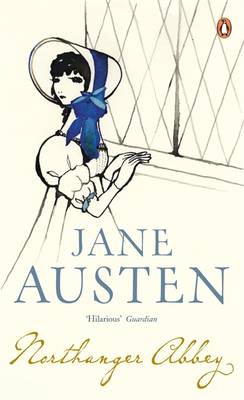 I reread Austen’s Northanger Abbey so I could read Val McDermid’s retelling, also called Northanger Abbey, the second in a series of updated Austen novels (the first was by Joanna Trollope, Sense and Sensibility).
Austen’s Northanger Abbey is thoroughly enjoyable, a novel about a novel reader so absorbed in Gothic fiction that she is constantly fantasizing about ghosts and murders. But it is mainly the story of a likable, if ordinary and rather silly, young woman, Catherine Morland, who goes to Bath with her neighbors, and falls in love with Henry Tilney. The difference between Northanger Abbey and Austen’s other novels? There is no suspense; we know immediately who will get the girl, and whom the girl will get. And the writing is uneven.
Naturally, we all fall in love with Henry, because he, like Catherine, is a novel reader. He says,
The person, be it gentleman or lady, who has no pleasure in a good novel, must be intolerably stupid. I have read all Mrs. Radliffe’s works, and most of them with great pleasure. The Mysteries of Udolpho, when I had once begun it, I could not lay down again,–I remember finishing it in two days–my hair standing on end the whole time.”
He also teases her about writing in her journal, and predicts she will go home at night and write abouit their meeting.
Austen is always witty, and I laughed aloud as I read this.
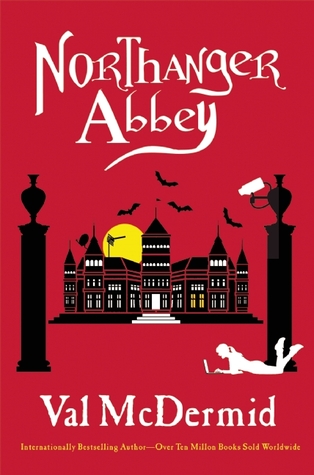 I have read half of McDermid’s Northanger Abbey, and it, too, is lots of fun. The 21st-century Cat is a fan of paranormal romances, and , indeed, at one point she wonders if Henry is a vampire. He teases her about updating her Facebook page, rather than writing in her journal, and she spends a lot of time texting. A missed appointment has to do with Henry’s sister’s having written down the wrong phone number. McDermid is an award-winning mystery writer, and she is up to the challenge of rewriting Austen’s lightest novel. Don’t expect too much here, but it is charming and will certainly make good “summer reading.” The writer who has signed on to update Pride and Prejudice or Emma will have the greatest difficulty!
 mirabile dictu