
I feel like going to my hometown to look at my mother’s house.
It was sold a couple of years ago.
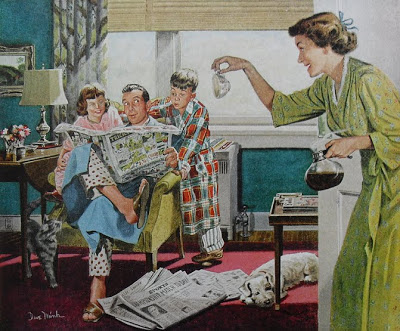 Last summer we coasted by in our car, and saw a couple of young men there.
It is a small ’50s brick ranch-style house.
Our whole family somehow squashed into this tiny house in the ’60s. Every inch was defined by my mother’s personality. She loved decorating. There were knickknacks everywhere. Somehow the decorating got obsessive in the late ’60s. She decorated the way I buy books.
Much of life in the ’60s was spent in the “finished basement.”
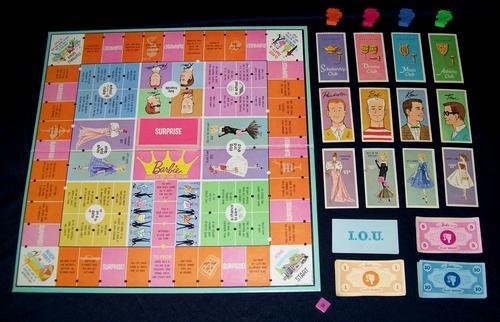
Barbie Queen of the Prom
We played Barbie Queen of the Prom (one of the main objects of the board game was not to get stuck at the prom with Poindexter, the nerdy guy!), played hide-and-seek with our Tammy and Pepper dolls by taking apart the cardboard dollhouse furniture (a ping pong table, a couch, and a soda fountain) and hiding the dolls inside, listened to Herman’s Hermits (“Mrs. Brown you’ve got a lovely daughter”), and made troll sleeping bags from those little cloth Chiclet gum bags.
We walked across the Summit Street bridge to the little grocery store to stock up on Chiclets.
Sometimes we went down by the tracks, and one brave friend hopped on a train. (I was uncoolly scared for her.)
When the popsicle man came, my mother paid for the whole neighborhood (the other mothers made themselves scarce).
I had slumber parties and Beatles records.
I was chauffeured to Iowa Book and Supply to buy E. Nesbit books and Jane Eyre.
It is fair to say I was a lee-tle spoiled.
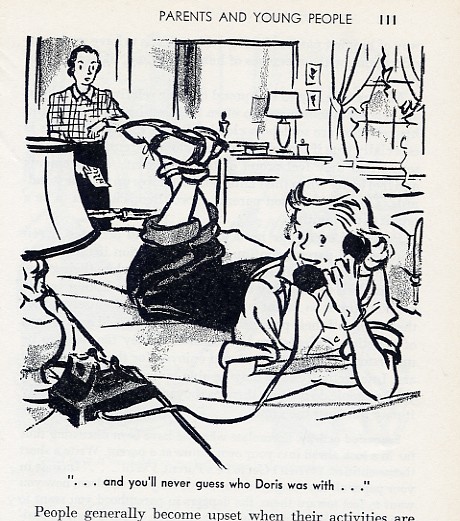 In my teens I spent a lot of time on the phone.
I had a Peter Max poster in my bedroom.
We rode our bicycles.
When the snow melted and we couldn’t bear to stay inside another minute, we played H-O-R-S-E on the basketball court in the back yard. (My father had poured the cement and scavenged a pole to which he nailed the basket.)
We camped (illegally) in the woods at Hickory Hill Park and felt sweaty and uncomfortable getting up in the morning dew.
We hitchhiked to a rock concert, knitted, and read Hermann Hesse.
I wanted to move into a beautiful Victorian house on Summit Street.
“No, we like it here,” my mother would sigh.
It didn’t occur to me that houses cost different amounts of money. Unless they were mansions, of course.
We tried to break up a fight behind the co-op where we volunteered. Two women were fighting, one pulling the long hair of the other so that her head was at an uncomfortable angle, and all I could think to do was to hold the hair so there was less tension and weep, “Stop, stop, stop.” Finally an adult came along and broke up the fight.
The years passed, we were gone, my mother stayed on. The house was Dickensian. She kept herself busy.
Then one day all the meaning was taken out of her house.
We sat in a freezing air-conditioned room waiting for the cardiologist. “I’m cold,” she complained over and over. She was wearing a hooded long-sleeved top, and I told her to put the hood up. I asked the nurse to turn down the AC, but you know how these things go… there’s a system.
Old people are always cold. Never go anywhere without a jacket.
I didn’t know that then.
The doctor was tactless. “Her heart condition will not improve.” This was the first I’d heard of it. My mother just smiled. He recommended various kinds of care and made it sound as though death were imminent.
She is still alive.
But when I went back to her house that night, knowing she would never live in it again, her “cozy eccentric” style seemed meaningless without her. I swept dozens of refrigerator magnets and odd bric-a-brac into bags so I could sit in the kitchen without thinking of her. The whole house felt so sad.
It is amazing how little meaning objects have without their people.
She still has some of her bric-a-brac where she lives now.
I kept the photo albums, nothing else.
 mirabile dictu