

Condtion: Back left-hand corner and bottom edge are curling.
My new copy of Chimanda Ngozi Adichie’s Americanah was crisply enticing. I started reading it addictively: I have perused this beautifully-written page-turner in coffeehouses, at picnic tables, and while stir-frying vegetables. It is a bit ragged after this intense reading. The back cover’s left-hand corner and bottom edge are curling. It is now a “good reading copy” rather than “Like New.”
When I sold my books to used bookstores as a student–a woman needed to buy tampons!–I learned to keep my books clean and neat. I never splayed a book open, pages down. I never ate while reading, because I learned that chocolate and tea stains brought down the price. The best used bookstores sell such books at reduced prices.
Because I buy many used books, I am fascinated by the descriptions of the condition of used books at Amazon. They often depend on the bookseller’s conscience. “Acceptable” books are usually “unacceptable” to me. I have been known to return a “Very Good” used book because of underlinings.
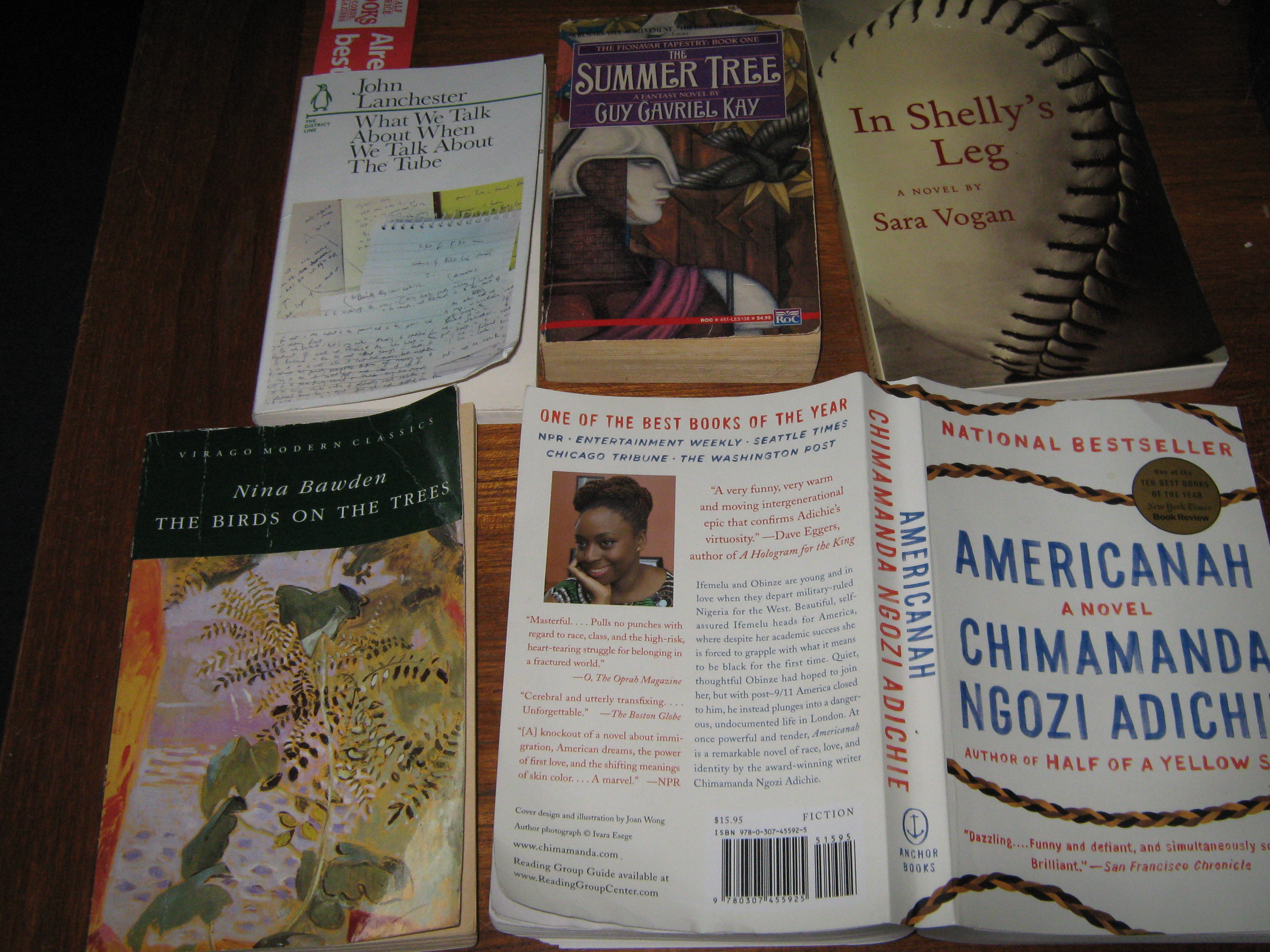
Books with curls and bent covers.
Misled by reviewers or bloggers, I buy many books that are, in the language of our household, “BP (barely passable).” I donate these to book sales, thus creating used books. I have a problem with new books. I find 21st-century books much worse than 20th-century books. Although most reviewers probably try to be fair, I sometimes detect a conflict of interest, or suspect that an ass-licking reviewer is trying to get “blurbed” by the writers he or she reviews.
One learns to read between the lines of reviews. Occasionally the reviewers just seem to be odd choices for an assignment. A mediocre novel recently got a rave in The New York Times Book Review. Then I noticed the reviewer was a science writer. Why should I be interested in a science writer’s opinion of a novel?
The problem with the publishing of so many mediocre books is that they create a mistrust of new books.
Today in The Des Moines Register, which is more or less Iowa’s state newspaper, I read a profile of Paul Ingram, a bookseller at Prairie Lights in Iowa City. He is well-known for recommending books to customers. He says,
It’s tougher nowadays because what they are publishing is worse. Publishers need to be conservative so they don’t want to try anything different. I have five or six zombie books come in and I hate it. I can’t bear it, yet my customers want it. I ended up buying them all because I can’t tell the difference.”
Margaret Drabble told The Telegraph in 2012,
I have had a weird feeling that I’m being dumbed down by my publishers and it’s interesting there’s an agenda of how it should be in the marketplace.”
If even Margaret Drabble feels she’s being dumbed down, we know the publishing industry is in trouble. The used book industry flourishes, though.
 mirabile dictu