

“What are you going to major in in college, Sheila?”
“Liberal arts.”
“I think teaching is such a good profession for a woman. Good starting salary. Good vacations, and it’s always something that a girl can fall back on. Even if you get married, it’s always something you can go back to when the kids are older.”
—Sheila Levine Is Dead and Living in New York, by Gail Parent
How I laughed over the passage above! I had the same conversation with my own mother. The narrator of this witty novel, Sheila Levine, is adamant about not wanting to teach. She wants to do something creative after college, preferably something that will get her written up in Vogue.
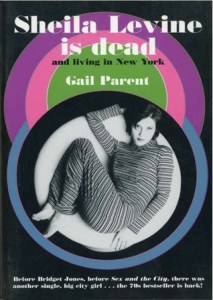
I kept underlining passages as I chortled over Gail Parent’s 1972 novel, Sheila Levine Is Dead and Living in New York. (I ‘d never heard of it until it came up recently as a recommendation at Amazon.) Written in the form of a suicide note, it reads like women’s stand-up comedy, hilarious, poignant, and unabashedly unpolitically correct: Sheila has problems with “women’s lib.” Unlike the beautiful heroines of ’70s feminist best-sellers like Erica Jong’s Fear of Flying and Alix Kates Shulman’s Memoirs of an Ex-Prom Queen, Sheila Levine is an overweight sexy girl who doesn’t attract the men she is attracted to. She doesn’t mind being an easy lay: she enjoys sex. She is very funny, but we do feel her pain and grief increasingly as the book goes on.
Sheila is tired at 30 of being a single Jewish woman in New York. She wittily describes her history of bad dates, her smashed expectations of finding romance, the sharing of a one-bedroom apartment with two roommates and an impecunious gay man sleeping on the couch–and the scenes are familiar, though Parent’s language is blunter and brasher than is likely to appeal to the overly-sensitive ears of today’s delicate feminists. Don’t faint or swoon, okay? Parent is a very good writer. Although I am of a later generation than Sheila and never thought in terms of husband-hunting, we all had our hair-raising stories of single life, and were very happy to get married. Those who didn’t marry cope in their own way, some very well, some very badly.
 Sheila has a lot of sex at Syracuse University, never with men she really likes, but she enjoys the sex. And she cynically describes the ritual of smart women working as hard for that Mrs. degree as for the B.A. After sophomore year, if the juniors don’t have boyfriends, they transfer to another school, because they can’t compete with the incoming freshmen. After transferring to NYU, where Sheila majors in drama/education, she can’t decide if she’s in love with Hinley, the professor-director, who gives her a C- in children’s theater, or Joshua, the star actor of all the plays. By the way, Sheila is their gofer. Hinley has given her the key to his apartment, and all three hang out. Imagine her surprise when she finally figures out they are a gay couple.
After graduation, the employment agencies keep referring her to typing jobs, though she specifically says she isn’t interested. She finally finds a “creative” job through the Jewish community of friends and relatives of her parents. Rose Lehman’s sister knows of a children’s record company which is expanding, “owing to a Christmas hit he had where a lot of squirrels sang.” (Oh my goodness, remember Alvin and the Chipmunks?) All of Sheila’s Jewish friends get jobs through friends and family. And it is a resource, with the competition in New York.
Housing is a huge problem in New York. I am horrified by the descriptions of the places she and her college roommate, Linda, see when they hunt for an apartment in the East Village.
Somehow they have believe they’ll find a cute place like an apartment in a Doris Day movie.
Sheila explains,
My roommate, Linda, and I decided way back in Syracuse that if weren’t married by the time we graduated, we probably would at least be engaged, and we would live together in Manhattan. Why not? Didn’t Doris Day always have a precious, little two-bedroom apartment, all yellow and light-blue and cuddly? Nothing pretentious–just a modest fifteen-hundred-a-month apartment in a gorgeous brownstone that poor Doris paid for with her unemployment check. The sheets and pajamas alone must have cost a fortune. Four years of college apiece, and Sheila Levine and Linda Minsk didn’t know that Hollywood had been deceiving them all these years. We thought that if we were good girls and looked hard enough, Doris Day, when she was carried off into blissful matrimony, would sublet her place to us.
I found this book fascinating: it’s also blessedly short, so you can read it in a day. Sheila is raised from toddlerhood to expect to get married, and is so depressed that the culture, including movies, revolves around that and then doesn’t deliver, that she plans to commit suicide, even after she meets a man who gives her orgasms (he also gives her a fungus!). The novel goes in a very odd direction. I enjoyed this enormously, once I got into the mode of the style of another time!
Parent is a screenwriter who has won two Emmys, and her other books are out-of-print. There’s not much information about them online, but if anyone knows a good place to start, let me know..
 mirabile dictu