

Sue Kaufman, author of Diary of a Mad Housewife
Many onliners swear by Viragos and Persephones.
As I say often, I do not elevate name-brands to a cult.
But if I were going to pick one over the other, I would go with Viragos. There are some real Virago classics.
Not always, though. Anyone who has suffered through Mary Renault’s meritless, humorless, weirdly sentimental early novel, The Friendly Young Ladies (Virago), or Joanna Cannan’s equally meritless, poorly written and, by American standards, scandalously class-conscious novel, Princes in the Land (Persephone), will admit the fallacy of going for greens and greys. (Okay, some of you will never admit it! I getcha.)
American fiction is, alas, strangely underrepresented by Virago and Persephone, with sensational titles like the fun, trashy Valley of the Dolls and Beth Gutcheon’s mediocre best-seller, Still Missing. Of course, American fiction is not these publsihers’ forte.
We obviously have an advantage here in America in that we have access to more American fiction.
I am an Anglophile, but I do need to spend time with my homegirls: American voices are different. In general I would describe American women’s fiction as grittier and sexier, closer to the raw work of Philip Roth than the elegance of Barbara Pym (Virago) or the sincerity of Dorothy Whipple (Persephone).
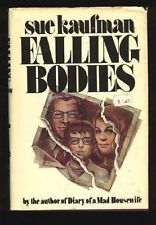 And if I had my own publishing company, I would instantly reissue the books of Sue Kaufman, the author of Diary of a Mad Housewife, an American classic. Her 1974 novel, Falling Bodies, is a sad and often hysterically funny novel about a woman whose family is falling apart.
I have been absorbed in Falling Bodies for two days, and I feel that Kaufman is writing about my own life, though the heroine Emma and I could hardly be more different. I live a middle-class life in a house in the Midwest; she is the wife of a very well-off vice president of a publishing company in a huge apartment in Manhattan.
And yet… I understand Emma.
Every chapter starts with a day and time of day, like Monday 8:21 a.m. Sometimes we go through entire days, sometimes through just a few hours.
Emma has had a rough year. Her mother has died of cancer, and she herself has been hospitalized for an FUO, a fever of unknown origin. (One year I almost died from blood poisoning from an insect or spider bite: the doctors weren’t sure what. And last year my mother died, and, like Emma, I was upset by the sub-standard care.)
In the hospital, she witnessed a suicide. A man jumped out of a window and his body fell past her room. Once home, she is terrified that she will see another falling body crash on the sidewalk.
Slowly we go through Emma’s life from the time she gets out of the hospital and is so weak she can barely walk around the block; to encounters with a sexy, crazy friend from Radcliffe, Minda,who likes to talk about her analysis; through a tense dinner party at which all the men fall all over Minda and the black caterer and Hispanic maid fight; through a huge blackout that affects the East Coast.
Emma’s family problems are paralyzing, partly because she cannot go back to her social worker job until she has fully recovered from the illness. Since her hospitalization, her husband and son both seem to be having a nervous breakdown. Harold, the vp of a publishing company, has a terror of germs and contamination. And her son is bringing home mechanical parts he finds in trash cans.
Harold and Benjy think Emma is the one who has gone crazy. And she is upset: her mother-in-law has hired a maid from Colombia. And talk about crazy…
When she has finally recovered, she goes to a Laurel and Hardy revival.
She was striding briskly along, considering the comic aspects of Tepp’s telling her to pick off where she’d left off and to resume a ‘normal life’ (whatever that was)–when she passed a neighborhood theater , with a marquee announcing ‘LAUREL AND HARDY FESTIVAL–LOTSA LAFFS,’ and without a moment’s hesitation, bought a ticket and went in. And for the next three hours sat, not thinking, not smiling, not laffing, watching Stan Laurel’s every move, watching every expression that crossed his Silly-Putty face. Stan Laurel was, she realized, from the first moment he came shuffling and dipping onto the screen, her spiritual twin. Her Doppelganger–to use the overworked kind of in-voguey word that drove Harold-the-ex-editor crazy. That sad and infinitely rubber face…. That genius for flapping and stumbling and unfailingly doing the absolutely wrong thing…. The real Emma, the one hiding behind the “cool” blond facade everyone saw.
Who hasn’t felt like that? Though in my case I might identify more with Amy Poehler in Parks and Recreation amd Jean Squib in Nebraska.
Parts of the novel are told from Harold’s and Benjy’s point-of-view. Maria and Benjy deliver some entertaining monologues during the blackout.
This is a novel for any woman who has had a rough year. If, like Emma, you’ve told the nurse that your mother says she has not received her medication and the nurse has denied it, it is a short step to the doctor’s telling you that you are crazy and banning you from the hospital room for the night. Emma’s mother reacted negatively to opium, as mine did. And while no doctor told me off–there was no doctor, as far as I could see– she died before the delivery of the medication that would have relieved her stertorous breathing.
I really loved this book, My guess is that it’s more a women’s book–I can’t see my husband’s reading it–but it is a deftly-consctructed, often funny story of what happens to a woman under a lot of stress.
 mirabile dictu