
 Sometimes we like light reading.
We’re waiting at the doctor’s or the vet’s. There are no magazines except People or Us.
A light novel is perfect while lounging under the linden tree. I don’t want to read James Joyce outdoors.
Whether at the doctor’s or in the back yard, I can lose myself in Elizabeth von Arnim’s amusing novels or D. E. Stevenson’s light romances.
The Adventures of Elizabeth in Rügen (1904) is the third book I’ve read by von Arnim this summer. It continues the exploits of the narrator of Elizabeth and Her German Garden (1898) and The Solitary Summer (1899). It is really travel writing, with a slender plot. According to Penelope Mortimer, author of the introduction to the Virago edition, von Arnim wanted to branch out from her meditations on the garden, nature, and solitude.
In 1901, the real Elizabeth traveled around the Baltic island of Rügen with a friend. She wrote a kind of guide book, with a few charming characters and comic episodes to flesh it out.
In the novel, the narrator, Elizabeth, wants to be alone, so she travels only with her maid, Gertrud, and her coach driver, August.
There are many humorous scenes. When a motorcar comes roaring by on the road, Elizabeth and Gertrud jump out of the carriage, sure that the horses will bolt. The horses don’t bolt, but August keeps on driving, unaware that the carriage is empty. The women are hungry and tired, but eventually they find the picnic basket, which also fell out of the coach. They have several adventures before they finally catch up with August.
Later, Elizabeth encounters a cousin, Charlotte, on the beach. Charlotte is married to a German philosopher, but after six years and babies who were stillborn or died shortly after birth, she went to England to become a feminist lecturer. She is, alas, one of those obnoxious comic feminists, and yet Elizabeth also has sympathy for her.
…and the next I heard she was in England,–in London, Oxford, and other intellectual centres, lecturing on the cause of Women…. Charlotte’s family was so much shocked that it was hysterical. Charlotte, not content with lecturing, wrote pamphlets–lofty documents of a deadly earnestness, in German and English, and they might be seen any day in the bookshop window Unter den Linden. Charlotte’s family nearly fainted when it had to walk Unter den Linden. The Radical papers, which were ony read by Charlotte’s family when nobody was looking and were never allowed openly to darken their doors, took her under their wing and wrote articles in her praise.
Charlotte is made ridiculous, but in von Arnim’s later novel, The Pastor’s Wife, another heroine, Ingeborg, is sympathetically portrayed when, after several pregnancies and a long illness, she announces to her husband that she will no longer have sex with him. The doctor backs her up, and the heroine finally has time to read and study. So by 1914, when The Pastor’s Wife was published, von Arnim was definitely a feminist.
There is another important subplot in Rugen. When Elizabeth and Charlotte run into Charlotte’s philosopher husband, Elizabeth devises a plot to get the two back together again. Will it work? It seems unlikely.
A very enjoyable novel.
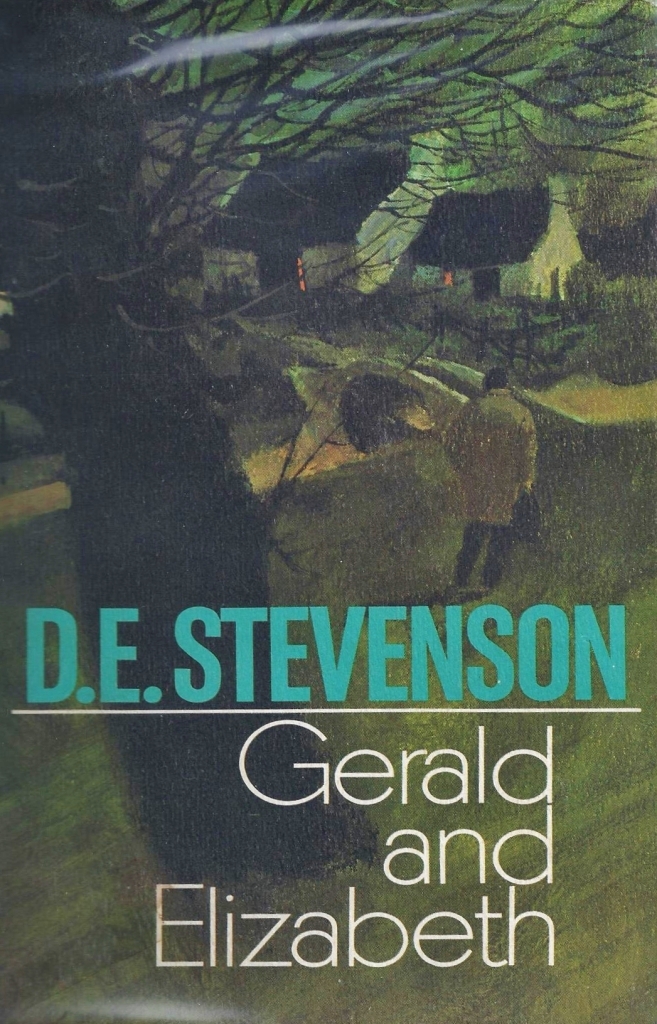 D. E. Stevenson has many fans. A few years ago, Sourcebooks started reprinting some of her books: Miss Buncle’s Book, Miss Buncle Married, The Two Mrs. Abbots, The Four Graces, and The Young Clementina. My favorite, Mrs. Tim of the Regiment (the first of four Mrs. Tim books), is available from Bloomsbury.
Stevenson is sometimes rated in the same category as Angela Thirkell, though Thirkell is a better writer.
I have very much enjoyed Stevenson’s books, though I must admit, some are better than others. Gerald and Elizabeth is charming, but the plot is a utterly unbelievable. The naive hero, Gerald, framed for the theft of diamonds, returns to England from South Africa, where he was an engineer in a diamond mine. He has no money and no references. But his sister, Elizabeth, a famous actress, sees him in the audience at the theater and insists he come live in her flat. From there, everything slowly gets better, as you can imagine.
The book is feather-light, but I very much liked the characters.
Is there a sequel to this? Because even though Elizabeth’s life is wrapped up, I didn’t feel Gerald’s was.
If you want to read Stevenson, I very much recommend the books in print, or The Baker’s Daughter.
What is your favorite light reading this summer?
 mirabile dictu