
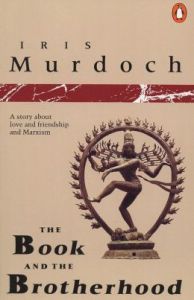
 Liz Dexter of the blog Adventures in Reading, Writing and Working at Home has organized an Iris Murdoch readalong this year. What a fabulous idea! My favorite Murdoch is The Sea, the Sea, which won the Booker Prize in 1978. This lyrical, philosophical novel about a retired actor and his obsessions won the Booker Prize in 1978 and is truly a classic.
I plan to catch up on the reading next month, but meanwhile here is a journal entry I wrote in 2011 about her 1987 novel The Book and the Brotherhood.
Much of Murdoch’s clever, fast-paced novel takes the form of intellectual conversations among a group of radical middle-aged friends who have long financially supported their friend Crimond, a brilliant political writer whom they knew years ago at Oxford. He has been working on a book forever, and will he ever publish? One of the friends wonders if they should continue to support him.
It all begins at Commem Ball at Oxford, many years after their graduation. For the first 53 pages we observe their intricate relationships and learn their history. There is dancing, but they jabber a lot. They discuss Marxists, Platonists, Liberation theology, and the New Philosophy.
The group’s obsessions, interactions, and love affairs are described with intellectual clarity, but their talk can also be wearing. Their relationships are intricate, and their sexual connections are a bit off. The intelligent, wealthy Rose is in love with their “leader,” Gerard, a gay retired civil servant. (Murdoch often describes such relationships, as I recall.) . Jenkin, an unmarried schoolteacher, is completely sexless, and Duncan, a diplomat, was half-blinded years ago in a fight with Crimond over his wife Jean.
Crimond, who is mad, vicious, and enjoys Russian roulette, betrays their trust and ruins a few lives. After he dances with Jean at the ball, he runs away with her, repeating his first betrayal. He tries to persuade Jean to drive her car into his at top-speed so they can preserve their happiness in death.
Murdoch also describes the younger generation: Tamar, Gerard’s young cousin, is persuaded by her mother, Violet, to leave Oxford; Gulliver, a failed writer, is slightly older and self-destructive; and Lily, a wealthy woman, wants to get to know the intellectual group.
What is to be done now that Crimond has destroyed Duncan’s marriage? Will Crimond’s book ever be finished? The committee meets and cannot decide what to do with him.
Murdoch’s writing is excellent, but 607 pages is too long. You have to read a lot of dialogue like this: “I am left to burn, I am left to die…For God’s sake, Tamar, don’t leave me, stay with me, tell those wicked people to go away! What have they to do with us? You’re all I have–I’ve given you my life!”
It is brilliant, though talky. Not my favorite, but Murdoch cannot write a bad book.
 mirabile dictu