
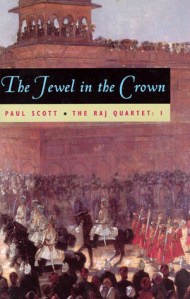
One Monday in 1984, after going through two boxes of Kleenex in a single weekend and losing my voice, I stayed home from work and read Paul Scott’s The Jewel in the Crown, the first novel in The Raj Quartet.
Was it a great book, or was I simply swept away by the British TV series shown on “Masterpiece Theater?” Scott, who won the Booker Prize not for a volume of the tetralogy but for Staying On, a superb novel about an English couple who stay on in India after they retire, is most famous for The Raj Quartet, which has a much broader sweep.
I recently reread and loved The Jewel in the Crown. It is so vast, so ambitious, told brilliantly in interwoven chapters of traditional narrative, interviews, a memoir, and journals.
Set in 1942 in the city of Mayapore, The Jewel in the Crown delineates the escalation of tension between the British and Indians over the question of independence. The British temporize and justify their presence by the proximity of the Japanese and possibility of invasion; the Congress is sympathetic to Ghandi and his followers, who practice civil disobedience in their campaign for independence. There is a huge cast of characters, both Indian and British. The catalyst of the action in The Jewel in the Crown? Attacks on two Englishwomen during riots after the Indian Congress votes to support Gandhi and independence.
I certainly do not have the background to discuss colonialism in India, but I was especially struck by the central role of two English women of different generations and contrasting attitudes toward India and the Raj, Miss Edwina Crane and Miss Daphne Manners.
In the opening chapter Scott introduces us to cranky, eccentric Miss Edwina Crane, the Superintendent of the Chuch of England mission schools, who has spent most of her adult life educating Indian children. She loves India, and her work here has saved her from a drab life as a governess. But she regards Gandhi’s civil disobedience as a betrayal of the Raj, and when she takes his picture down, the Indian ladies she has entertained at tea every Tuesday stop coming. Miss Crane entertains English soldiers instead. She muses,
Reacting from her newly found distrust of the Mahatma and her disappointment in the behavior of the ladies (the kind of disappointment she had actually become no stranger to), she wondered whether her life might not have been better spent among her own people, persuading them to appreciate the qualities of Indians, instead of among Indians, attempting to prove that at least one Englishwoman admired and respected them.
 Miss Crane’s hubris during a day of social unrest and rioting–she insists on returning home from the village where she has spent the night at the house of an Indian teacher and his family, though the phone lines have been cut and the police advise her there has been violence–results in the murder of the Indian teacher who insists on accompanying her, when she simply can’t make herself put her foot on the accelerator and drive through the crowd. After his death, Miss Crane’s entire view of every good deed she thought she had done in India is dust. She commits suttee, as if she were the wife of the teacher.
The true heroine is Daphne Manners, a young orphaned English woman who is the niece of a former governor of the province. After she is orphaned (her father and brother die in the war), she visits Lady Chatterjee (“Aunt Lili”), an Indian aristocrat, at MacGregor House in Mayapore. Daphne becomes acquainted both with the English at the club (where Aunt Lili can’t go) and with Indians. Daphne falls in love with india and with Hari Kumar, a handsome Indian raised in England who returned to live with his aunt in India after his father’s death. He is working well below his potential as a reporter for an Indian paper. Both Daphne and Hari are in India to stay; but Hari is not acknowledged as English in India because of his color. And they live on opposite sides of the river: they are not actually supposed to socialize. Aunt Lili tolerates their meetings but does not encourage them. Daphne loves India; Hari hates it.
Then Daphne is gang-raped by a group of Indian men the night after Congress votes for independence. Ronald Merrick, a racist policeman who wants to marry Daphne and is out to discredit Hari, arrests Hari and six “political” men who obviously have nothing to do with the rape. This appalling incident shatters Daphne. But surprisingly she decides to keep the child. She and Hari have been lovers, and she hopes the child will be hers.
This is really a vast novel, complex, intelligent, vivid novel. Here’s a brief example of the writing, in the opening paragraphs:
Imagine, then, a flat landscape, dark for the moment, but even so conveying to a girl running in the still deeper shadow cast by the wall of the Bibighar gardens an idea of immensity, of distance, such as years before Miss Crane had been conscious of standing where a lane ended and cultivation began: a different landscape but also in the alluvial plain between the mountains of the north and the plateau of the south.
It is a landscape which a few hours ago, between the rainfall and the short twilight, extracted colour from the spectrum of the setting sun and dyed every one of its own surfaces that could absorb light: the ochre walls of the houses in the old town (which are stained too with their bloody past and uneasy present); the moving water of the river and the still water of the tanks; the shiny stubble, the ploughed earth, of distant fields; the metal of the Grand Trunk road. In this landscape trees are sparse, except among the white bungalows of the civil lines. On the horizon there is a violet smudge of hill country.
Gorgeous writing and a great book!
You can read about the tetralogy in detail in Peter Green’s stunning 2013 article in The New Republic, “The Origins of Paul Scott’s Vast Masterpiece.”
 mirabile dictu