
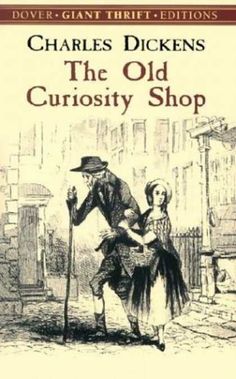
 It took me one and a half years to read Dickens’s The Old Curiosity Shop. On Jan. 28, 2014, I blogged after 200 pages:
I love Dickens, but …couldn’t get past the wax works.
(The main characters, Little Nell and her grandfather, briefly travel in a caravan with Mrs. Jarley and help her with her waxworks show.)
I am a fan of Dickens, especially of his dark final novel, Our Mutual Friend.
But his fifth novel, The Old Curiosity Shop, is a strange blend of darkness and sentimentality. It was hastily scribbled for a literary magazine, Master Humphrey’s Clock.
The good news: The scenes, though plotless and often pointless, are extremely vivid.
The bad news: The characters are caricatures. The portrait of the child heroine, Little Nell, is mawkish. Little Nell was created out of Dickens’s excessive mourning for his wife’s 17-year-old sister, Mary Hogarth, who lived with them and who he claimed in a letter to his friend Forster “died in his arms.” Dickens wore her ring for the rest of his life.
The plot of The Old Curiosity Shop, such as it is, is the disturbing flight of Little Nell and her grandfather.
Little Nell, a very responsible 13-year-old child, takes care of her gambling Grandfather, the owner of the Old Curiosity Shop. He has been bankrupted by a savage dwarf, Quilp, and is now imprisoned in the shop. Quilp has a weird fixation on Nell, whom he repeatedly terrifies by teasing her with the question if she will be his next wife. (Quilp does have a pretty wife.) Nell and her grandfather go on the lam. They take refuge with kind people along the way, and, most interestingly, with showbiz types, including a pair of Punch and Judy puppeteers and Mrs. Jarley, who owns a waxworks display. Quilp tries to track Nell and her grandfather, but fortunately the Single Gentleman is also looking for them. Who will find them first? Quilp or the Single Gentleman?
 The most sympathetic and interesting character is Richard Swiveller, a friend of Little Nell’s dissipated older brother. Swiveller, though easily manipulated, and placed by Quilp as a clerk to a corrupt lawyer, Sampson Brass, and his tougher, smarter sister, Sally Brass, is very kind and has a good sense of humor. Dick Swiveller helps an orphan child, who is a kind of shadow of Little Nell, and nicknames her the Marchioness. The Marchioness, the Brasses’ maid, has been imprisoned in a kitchen and starved, and Swiveller sends out for food and teaches her to play cards.
The novel ends with several deaths. I won’t tell you whose, but it really is monstrous.
Fortunately my favorite character survives.
Aldous Huxley said it best when he criticized Dicken’s “really monstrous emotional vulgarity.”
The history of Little Nell is distressing indeed, but not as Dickens presumably meant it to be distressing: t is distressing in its ineptitude and vulgar sentimentality…. Mentally drowned and blinded by the sticky overflowings of his heart, Dickens was incapable, when moved, of recreating, in terms of art, the reality which had moved him, was even, it would seem, unable to perceive that reality.
I love Dickens, but this one is a disappointment.
In his later novels, Dickens develops some of the character types from The Old Curiosity Shop into slightly more rounded, sympathetic characters, i.e., the malicious dwarf is transformed in David Copperfield into Miss Mowcher, the coy but essentially kind dwarf manucurist, and Little Nell becomes Jenny Wren in Our Mutual Friend, a smart, saucy, crippled child who takes care of her drunken father and supports them as a dolls’ dressmaker. Jenny takes no nonsense: her alcoholic father is more manageable than Little Nell’s addicted gambler grandfather.

Jenny Wren takes no nonsense from her alcoholic father.
 mirabile dictu