
 Do we need reading gimmicks? Every book website has one. At Goodreads, you can participate in the 2016 Reading Challenge by filling in the number of books you want to read. At The Millions, there is a Proust Book Club (but three months into it, the writer/leader is still on Swann’s Way). At the Modern Mrs. Darcy, the 2016 book challenge might as well be called “Read Whatever You Want”: its 12 categories include “a book you’ve meant to read for a long time” and “a book published this year.”
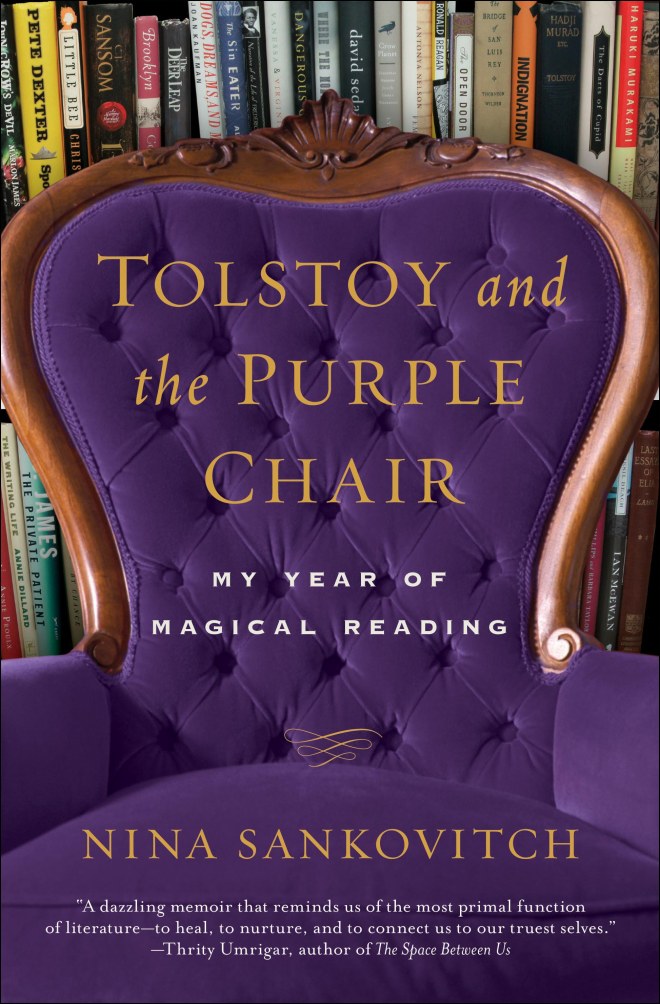
Books, too, are often organized around gimmicks, and I don’t mean this is a bad thing. I am reading a fascinating reading memoir, Nina Sankovitch’s Tolstoy and the Purple Chair: My Year of Magical Reading. After her sister Anne-Marie’s death from cancer, Sankovitch spent three years in constant motion instead of mourning, coaching her son’s soccer team, leading a PTA committee, and following a strict fitness regime. Finally she was exhausted: she realized she needed to sit still to grieve. And so she spent a year reading one book a day and blogging about the experience. It helped her with the grieving process.
Sankovitch, a former lawyer, was so busy at home raising four children that many friends thought she’d quit the project. She worked while the children were in school or between chores. In her year of a book a day, she read shorter books than usual, but since she could read 300 pages in four hours, she still had one up on most of us. (Oh, I wish I could read that fast!) She chose books at the library by the width of the cover: one inch equals about 250-300 pages She knew she had to spend an average of six hours a day reading and writing. The writing took her longer than the reading. I think many of us can relate to her thoughts on keeping up her blog.
Just a few days’ experience of writing reviews had shown me that a review had no definite time allotment. It could take me half an hour or five hours, depending on how much the book meant to me and how easy or hard it was for me to translate what the book meant into words on my computer screen. I averaged out the reviewing time to about two hours and planned accordingly.
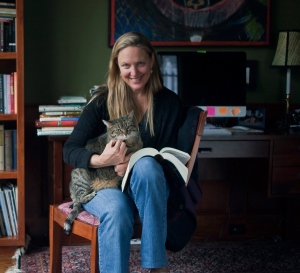
Nina Sankovitch
Sankovitch may not be a great critic, but she is a great common reader, and perhaps that is more important. I very much enjoy her interweaving of memoir with her reviews. And her recommendations are fascinating: Muriel Barbery’s The Elegnace of the Hedghog, Saramago’s Death with Interruptions, José Eduardo Agualusa’s The Book of Chameleons, and Elizabeth Maguire’s The Open Door, a fictionalized biography of Constance Fennimore Woolson. I am looking forward to reading some of the books on this list
Other writers, too, have organized their books around reading gimmicks. You’re on your own with the first three on the list, but I have read and can recommend Denby’s.
- Phyllis Rose’s The Shelf: From LEQ to LES: Adventures in Extreme Reading. This retired professor chose a shelf of fiction at the New York Society Library and read her way through it.
- Andy Miller’s The Year of Reading Dangerously. Before his 40th birthday, he wanted to catch up on classics he’d never read. He starts with Bulgakov’s The Master and Margarita.
- Ann Morgan’s The World Between Two Covers, inspired by her year-long journey through a book from every country in the world. Her blog is called A Year of Reading the World.
- David Denby’s Great Books: My Adventures with Homer, Rousseau, Woolf, and Other Indestructible Writers of the Western World. He returned to Columbia University to rediscover the classics.
Let me know your favorite books about reading, or reading projects!
 mirabile dictu