
It is hot. Prairie hot. It is in the 90s. Willa Cather’s A Lost Lady hot. But there is no Marian Forrester to bring us lemonade. I bring the lemonade.
Here’s how we cope: loll in the hammock and read until it cools off, when we may or may not take a walk. I like to lose myself in a trilogy or quartet.
Here are 10 recommendations of trilogies and quartets for summer reading.
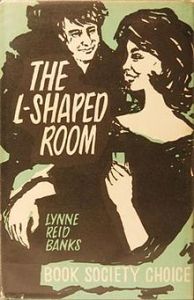 1. Lynne Reid Banks’s THE L-SHAPED ROOM, THE BACKWARD SHADOW, and TWO IS LONELY . In The L-Shaped Room (1960), pragmatic Jane Graham, a former actress who is respected at her PR job, daren’t tell her friends when she gets pregnant. In a bug-infested L-shaped room, she muses on her life and befriends some unconventional Londoners. The two sequels, published in the ‘70s, relate Jane’s further adventures. (And I posted on The L-Shaped Room here.)
 2. Edna O’Brien’s THE COUNTRY GIRLS TRILOGY AND EPILOGUE. In this lyrical coming-of-age story, Caithleen and Baba, two bickering, mischievous friends, contrive their own expulsion from a convent school and move to Dublin to pursue fun and love. And then they get married. Do they live happily ever after? O’Brien occasionally overwrites the wispy, romantic parts, but it’s all true to women’s literary heritage.
 3. Anthony Burgess’s THE COMPLETE ENDERBY (Inside Mr. Enderby, Enderby Outside, the Clockwork Testament, Enderby’s Dark Lady). The poet hero, Enderby, happily writes in the lavatory. And then he wins a poetry prize and everything changes. Women are attracted to his fame, such as it is; a pop star plagiarizes him; he teaches poetry cluelessly; and writes a screenplay based on a poem by Gerard Manly Hopkins. It has been years since I read it, but I loved these comical novels.
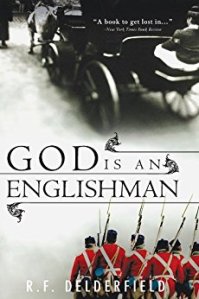 4. R. F. Delderfield’s Swann trilogy, GOD IS AN ENGLISHMAN , THEIRS WAS THE KINGDOM, and GIVE US THIS DAY. Want to go pop-literary? Delderfield’s fascinating ’70s trilogy, set in the 19th century, focuses on work. Every character, male or female, must work to fulfill himself or herself. Idleness leads to confusion and mistakes. The hero, Adam Swann, a former soldier, founds a haulage firm after a railroad employee explains there is a need for wagons to carry merchandise from cities and small towns to the railroad. He and his spirited wife, Henrietta, with whom he originally has a rocky relationship, build a dynasty of employees and family.
 5 Award-winning Australian Elizabeth Jolley’s THE VERA WRIGHT TRILOGY (My Father’s Moon, Cabin Fever, and The Georges’ Wife). Her style is Virginia-Woolf-meets-D.-H.-Lawrence, a poetic yet blunt stream-of-consciousness mixed with erotic strangeness and lies. Vera, a hero-worshipping nursing student/adulterer/false friend/unwed mother/housekeeper/doctor, is the unreliable narrator of unreliable narrators. Vera lies and cheats to get attention and makes weird lateral and downward career moves. She is a fascinating heroine.
 6. Pamela Hansford Johnson’s HELENA TRILOGY. These complex, witty novels, Too Dear for My Possessing, An Avenue of Stone, and A Summer to Decide, delineate the the changing relationship between the narrator, art historian Claud Pickering, and his histrionic stepmother, Helena, amidst the disintegrating class boundaries of postwar society. It is as good as Anthony Powell’s Dance to the Music of Time!
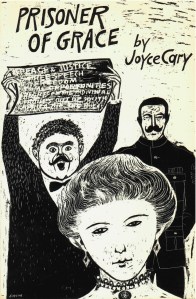 7. Known as Joyce Cary’s SECOND TRILOGY, these stunning novels, Prisoner of Grace, Except the Lord, and Not Honour More, center on the mercurial career of Chester Nimmo, a Union man who becomes a politician and savvily changes his politics with the winds of public opinion. His story is told from three different points of view, his own, his wife Nina’s, and Nina’s cousin Jim’s.
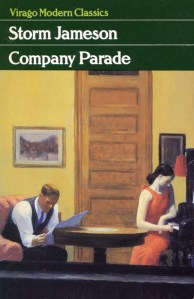

8. Storm Jameson’s THE MIRROR IN DARKNESS TRILOGY. Jameson is one of my favorite leftist writers, so it is odd I’ve never blogged about this trilogy, Company Parade (1934), Love in Winter (1935) , and None Turn Back (1936). I once wrote about it for a bookish newsletter, which I apparently threw away because it was only a newsletter! (Who knew I’d want to post it someday?) Set after World War I, these superb novels explore the life of Hervey Russell, who moves to London while her husband is still in the Air Force, copes with an unhappy marriage and a child she can’t take care of easily, poverty, radical politics, publishing, falling in love, and the General Strike. Jameson is not the smoothest writer, but she is very intelligent.
 9. Eleanor Porter’s MISS BILLY TRILOGY. In Miss Billy, Miss Billy Married, and Miss Billy Makes a Decision. Porter, the author of Pollyanna, tells the story of Billy as an orphan-heiress. At 18, upon the death of her aunt, she contacts her father’s best friend, William, because she is his namesake. Thinking she is a boy, William invites her to live with him and his two brothers in Boston at “the Strata,” thus called because each of the three brothers has his own “stratum” or floor on which to pursue his interests. William collects antiques, Cyril is a musician, and Bertram paints. These charming, funny novels follow Billy’s adventures from age 18 into young adulthood. (The books are free at Project Gutenberg).
Kristin Lavransdatter: a cult classic!
10. Sigrid Undset’s KRISTIN LAVRANSDATTER TRILOGY. This gorgeous trilogy, written in luminous medieval-style language, chronicles the life of a Norwegian woman in the 14th century. Nobel Prize winner Undset dazzles with her vivid descriptions of Kristin’s childhood, teens, love affairs, marriage, religious dilemmas, religious pilgrimages, and the disappointments of life with Erlend, her weak husband. I love Undset!
 mirabile dictu