The Amateur

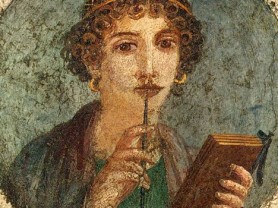
pompeifresco-278x208 roman writerI dropped out of my writers’ group after I stopped writing my novel.  As with so many of my writing projects, I spent a month polishing the first chapter, then wrote the next nine chapters in nine days.  It’s far more fun to write, write, write than to polish.

But I love writers’ groups. I miss the excitement of the rustle of paper as the copies of manuscripts are breathlessly distributed. I miss the diverse population of the shaggy ex-freaks, the chic professionals, the retired women with their graceful novels-in-a-drawer, and the talented slackers with their drug memoirs.

Stories are not attacked in writer’s groups.  The feedback is kind.

It isn’t school.

Nobody’s going to tear your story apart.

An editor is not going to reject you.

I still remember my friend, Cassandra, rolling back and forth over a rejection letter from a poetry editor in her wheelchair.

“My poetry is goddamned better than theirs!”

And, yes, it really was.

I am a dilettante.  My husband says, “Get offline and write that book that will support our retirement.”  (But haven’t all the vampire books been written?)

Anyway, I enjoy blogging.  I write whatever I want, personal stuff, book notes, and mini-essays.

But “blog” is a disparaging word, and bloggers should find another word for their writings.

In 2012, Sir Peter Stothard, editor of TLS, Dwight Garner, a critic for The New York Times, and Jacob Silverman, a freelance writer for Slate, attacked amateur online writers, claiming that the blog and social media have weakened traditional criticism and publishing.   Even the novelist Howard Jacobson mocked blogging in his novel, Zoo Time:  “The blog is yesterday,” the hero wants to tell his gloomy publisher, who believes the blog “is the end of everything.” He says the problem lies with “myBlank and shitFace and whatever else was persuading the unRead to believe everybody had a right to his opinion.”

What they don’t understand is that blogging is very much about voice.

The blogger, D. G. Myers, an intelligent writer whose conservative views are usually very different from my own, articulately championed blogging recently.

Blogging is not merely an amateur’s medium. It is a dissent from the professionalization of literature, where professionalization is represented by English departments and creative writing workshops and print magazines and large publishing houses which are subsidiaries of even larger conglomerates. What Jacques Barzun calls the professional’s fallacy (namely, the superstition that understanding is identical with professional practice) has transformed the institutions of literacy into closed shops. If you’re not employed in the literature racket, you might as well, in literary terms, not exist.

Although there is much mockery of the blogger who announces, “Peter Buck is a god!” there are many gifted amateurs who write thoughtful, interesting essays and reviews.  Are novelists and nonfiction writers professional?  Not until they’ve published.  And there are not enough traditional publishers anymore to support talented amateurs.

There are many different style of blogging.  There are the intellectual bloggers, like Ellen Moody and D. G. Myers, who write scholarly notes and reviews.  Ellen often writes about women’s books, Myers about Jewish literature.

Blogger Pioneer Woman now has a cooking show on the Food Network.

Blogger Pioneer Woman now has a cooking show on the Food Network.

Then there are the domestic bloggers: Pioneer Woman intersperses her stories of an impossibly interesting ranch family with recipes, and is so popular she has published cookbooks; Dovegreyreader, though billed as a book blogger, is also domestic, pulling us into her world with anecdotes about her family and pets.

Some women bloggers on my “sidebar” are not what I’d call domestic writers: they intersperse personal writing with musings on books, but they do not sentimentalize family life (something I have been guilty of occasionally).  Among these areBelle, Book, and Candle and Thinking  in Fragments.

Most of the male bloggers on my blogroll are remarkably impersonal.  I know only the sketchiest details about the personal lives of Asylum, Kevin in Canada, and Tony’s Book World.

Two exceptions to this rule of the Impersonal Male are A Common Reader and Stuck in a Book.  A Common Reader writes good book reviews, but he has occasionally mentioned his music and included a video of his performance of one of his songs (excellent), which made me think very well of him.  Stuck in a Book focuses on middlebrow women’s books, but he also writes comically about bookstores, baking, and outings with his twin, who is apparently his opposite in matters of reading tastes.

One does not need to don the “professional” journalist’s or scholar’s voice to write a book blog.  And even if the blogs read like rough drafts, it is easy to see the talent, intelligence, or humor between the lines.

I don’t know how long blogs will last as a genre.  It seems to me that people are turning to shorter and shorter forms, like the tweet.  Blogs are part of what I call the “long-attention-span indoor culture.”  As our climate changes and society fragments (looting after Hurricane Sandy:  you know the kind of thing), huge numbers of people will stay indoors, addicted to the internet.  The more they can get us to blog and tweet and stay indoors, the less trouble they’ll have.

And, yes, I’d better go write that vampire novel, because I’ve got Climate Change blues.
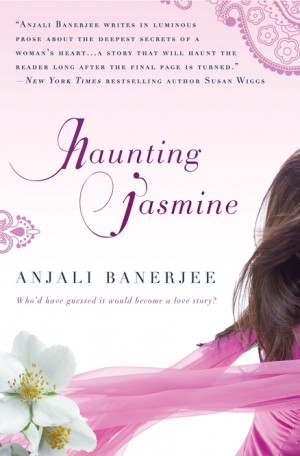
Middlebrow American Women’s Pick # 1: Anjali Banerjee’s Haunting Jasmine

Ignore the violet cover with glitter.

Think Virago of tomorrow.  Someone can design a better cover.

Imagine a better cover.

Imagine a better cover.

I am reading several middlebrow American women’s novels this year, and my  Pick of the Week, or maybe two weeks,  is Anjali Banerjee’s charming novel, Haunting Jasmine.  If you haven’t worked in a bookstore, it will make you wonder why you didn’t abandon your profession to open people’s lives with books.

Two-thirds well-written comedy and one-third romance, Banerjee’s feather-light novel describes the transformation of unhappy Jasmine Mistry, a beautiful Eastern Indian woman raised in the Pacific Northwest whose divorce has left her emotionally numb and insecure about her high-powered financial job.  When her aunt asks her to mind her bookstore for a month on Shelter Island while she goes to India, Jasmine jumps at the chance.

But Jasmine needs a cell phone connection for her job at all times, hard to get on the island, and believes a bookstore is a business.  She thinks she can increase her aunt’s profits by soulless business practices.  She tells us:

“[My aunt] promised me refuge among the classics, although I haven’t had time to read a novel in years…. The weight of technology pulls on the shoulder strap.  I barely have room for the usual supplies–compact, lipstick, tissue, aspirin, allergy pills, charge cards, receipts, and a bundle of keys, including the one that opens the exercise room at the office.  Not a single novel, and yet, what do I have to lose?  How hard can it be to sell the latest Nora Roberts or Mary Higgins Clark?”

Books are just entertainment, she thinks.

She says the dusty, shabby store needs bright lights and best-sellers.  Tony, her fellow bookstore clerk, tries to explain that the customers like the antiques and eclecticism.

Her aunt proudly explains a desk belonged to E. B. White, the candle-holders to Jane Austen, and the mirror to Dickens.

What Jasmine doesn’t understand is that the bookstore is haunted.

And after she stays the night at her parents’ instead of at Auntie’s, the ghosts show they’re disturbed.

Gradually, Jasmine begins to understand what a bookstore is, and realizes that voices are telling her what the right book is for the individual customer.

Tony says she has to moderate the book group, and she thinks the women are very silly, but suddenly comes up with just the right question about Pride and Prejudice, which she hasn’t read in years.  The women thanks her.  She is also a success with the children’s story group after  she switches from The House at Pooh Corner, which makes them cry, to The Tale of Peter Rabbit and dons bunny ears.

But the most important thing?  She falls in love with Connor Hunt, a doctor who has worked in Africa. When she finds a memoir with a photo of Connor Hunt who looks just like him, she assumes it is his father.

But…

The last third of the novel, the romance part, is a little hesitant and less compelling, but overall I enjoyed this moving novel a lot.  I love Jasmine’s voice and her bookish transformation.

And if you have a favorite bookstore novel, let me know.

Nancy Mitford’s The Pursuit of Love

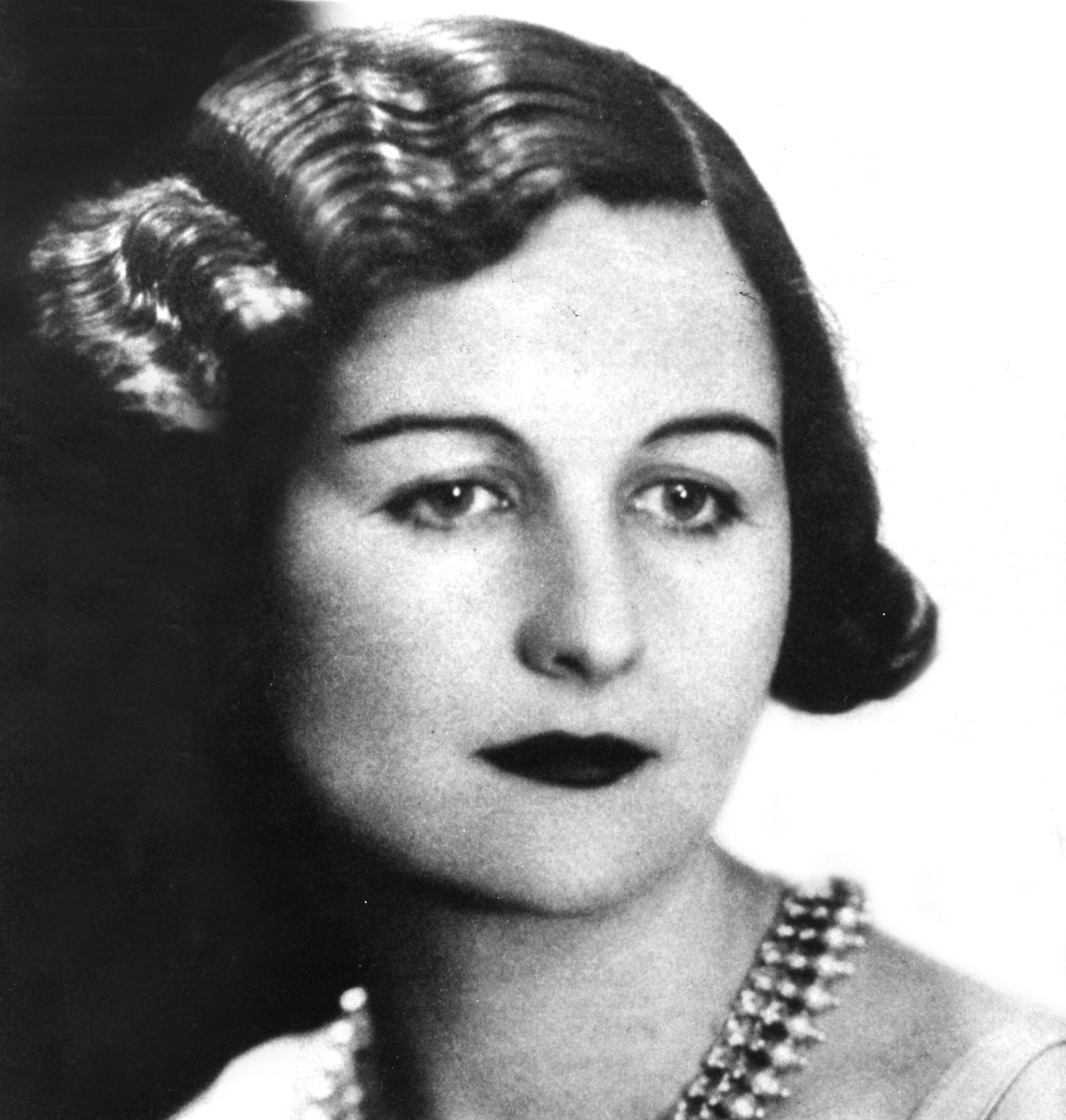
The beautiful Nancy Mitford

Nancy Mitford

I love Nancy Mitford’s charm, wit, and intelligence.  I have read and reread The Pursuit of Love, Love in a Cold Climate, and Don’t Tell Alfred, her three novels narrated by the charming Fanny (and surely they should be collected in one volume, but only the first two ever make it into an omnibus).

Nancy, a friend of the comic writer, Evelyn Waugh, is an extremely funny writer, but, unlike my other humor idols, P. G. Wodehouse and Angela Thirkell, she has a serious side.   Her heroines fall headlong into a consuming romantic love that leaves time for little else, and isn’t this the way we all feel about love when we are young?  In The Pursuit of Love, Linda needs love so much that she keeps falling in love with the wrong men until finally by chance she meets Fabrice, a charming rich dilettante, who, after finding  her crying at the railroad station in Paris, installs her as a mistress in a very modern apartment.

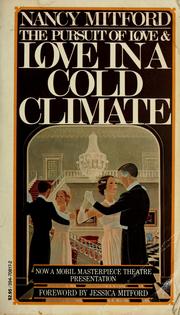
Love in a cold climate and pursuit vintage

I have recently read reviews of Lisa Hilton’s The Horror of Love, about Nancy’s relationship with Colonel Gaston Palewski, the French commander and associate of Charles de Gaulle who inspired the character of Fabrice in The Pursuit of Love, .

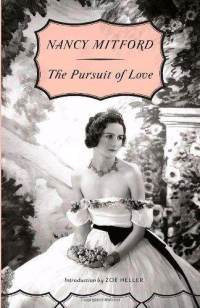
pursuit-love-nancy-mitford-paperback-cover-artSince I don’t have a copy of  the The Horror of Love, I did the next best thing:  I reread Mitford’s autobiographical The Pursuit of Love. The novel is narrated by charming Fanny, the outsider, who was deserted long ago by her mother to be raised by her Aunt Emily, and is a frequent visitor of her cousins, the Radletts.  She describes the eccentricities of the flamboyant Radletts with grace and humor.  Fanny is a quiet presence in this book, and she and the outgoing Linda are one another’s alter ego. Fanny spends long vacations at the Radletts’, and Linda is her best friend.

The Radletts live at Alconleigh, one of the coldest houses in literature:  the central heating doesn’t work very well, and the fireplaces are ineffective.  The linen closet is the warmest room in the house, and that is where they spend their time.  But the “violent, uncontrolled”  Uncle Matthew is too busy to notice the chill:  he spends much time hunting, discussing animals with the gamekeeper, and rages when the children free animals from traps.

It is said that Uncle Matthew hates Fanny, because she is the daughter of an old Eton rival; he also hates her mother, “the Bolter,” a very funny character who frequently leaves her husbands for new lovers, and whose marriages nobody can quite keep track of. When the Bolter first left with one of her lovers, Aunt Sadie wanted to adopt Fanny, but Uncle Matthew informed Aunt Sadie that he hated children.  (They had only two then.)  Fortunately there was Aunt Emily, a single woman, to care for her.

But Uncle Matthew has his good side:  he organizes child hunts, giving the children a head start and then hunting them with bloodhounds, and Fanny and Linda adore it (as did Nancy and her sisters in real life).  And he also entertains Linda in later life, making a speech at the House of Lords about not letting women in because of the restroom facilities.  (I think it was the House of Lords:  I’m not British!)

Eventually, the children grow up, and Fanny concentrates on the vivacious Linda in love.  Linda is obsessed with love even in her teens, and spends all her time daydreaming, until an eccentric aristocratic neighbor, Lord Merlin, insists that Linda develop her intellect or she will bore people.

the-pursuit-of-love-by-nancy-mitfordLove happens when Linda meets Tony, a banker, and, though Lord Merlin knows it will be a disaster, she marries him.  His conservative life-style is not for her, but fortunately, she meets a bunch of chatty socialites, some of them gay men, it would seem, who wait for Tony to leave the house and then spend all day chatting to Linda.  Next she marries Christian, an absent-minded Communist who barely notice her.  But life among the Communists is amusing for us.  When Linda works at the red bookstore, it finally makes a profit.  Mitford writes:

It was run by a huge, perfectly silent comrade, called Boris.  Boris liked to get drunk from Thursday afternoon, which was closing day in that District, to Monday morning, so Linda said she would take it over on Friday and Saturday morning.  An extraordinary transformation would then occur.  The books and tracts which mouldered there month after month, getting damper and dustier until at last they had to be thrown away, were hurried into the background, and their place taken by Linda’s own few but well-loved favorites.  Thus for Whither British Airways? was substituted Round the World in Eighty Days, Karl Marx, the Formative Years was replaced by The Making of a Marchioness, and The Giant of the Kremlin by Diary of a Nobody, while A Challenge to Coal -Owners made way for King Solomon’s Mines.

When Linda meets Fabrice, it is true love.  Both know at once that there is something different about their lvoe.  They love to chat, they both love Paris, they have good times together, and she adores being his mistress.

Then the war comes.

Excellent book.

ON THE MITFORD INDUSTRY. Many bibliophiles, including me, cannot get enough of the Mitford sisters:There is “Mitford Industry,” as Jessica Mitford calls it in the introduction to the 1982 Vintage edition of Nancy Mitford’s The Pursuit of Love and Love in a Cold Climate.  Because of Nancy’s autobiographical novels, readers are obsessed with the family to the point that not only have there been biographies, memoirs, letter collections, and BBC adaptations, but even a musical, The Mitford Girls.

The six sisters are  Nancy, the great writer; Jessica, the Communist and great journalist; Diana, imprisoned for fascism; Unity, the Nazi; Deborah, the duchess; and Pamela, the rural one.

Jessica writes:

It was, of course, Nancy who started it.  Without her, there would be no Mitford industry.  If only she could have lived to see the unlikely fruits of her early endeavors.  “How I shrieked!” she would have said.

I would love to read all the Mitford industry books, and have so far read two biographies and two collections of letters.

Gladys Taber’s Country Chronicle & Surveillance in the ’70s

Stillmeadow

Stillmeadow

I discovered Gladys Taber’s The Stillmeadow Road, a charming book about country life, at my mother’s house.  It seemed I had given it to her for Christmas one year, and like so many presents we give others, it was the perfect gift for me.   I read it during a blizzard, while my mother was in the hospital, and soon I was deep in Taber’s beautiful Connecticut winter of birds, beauty, cooking, shoveling, and frozen pipes.  It gave me courage to face the next day, wading through thigh-high snowdrifts to get to the hospital.

Taber, who graduated from Wellesley and earned a master’s at Lawrence College,  wrote cookbooks, the Stillmeadow series, and fiction.  She was also the author of the  “Diary of Domesticity” column for the Ladies’ Home Journal and  the “Butternut Wisdom” column for Family Circle.

Taber and her husband bought Stillmeadow, a 1690 Connecticut farmhouse, as a vacation home with another couple in 1943.  Taber and her friend Jill had been roommates in college, and desperately wanted a country getaway.

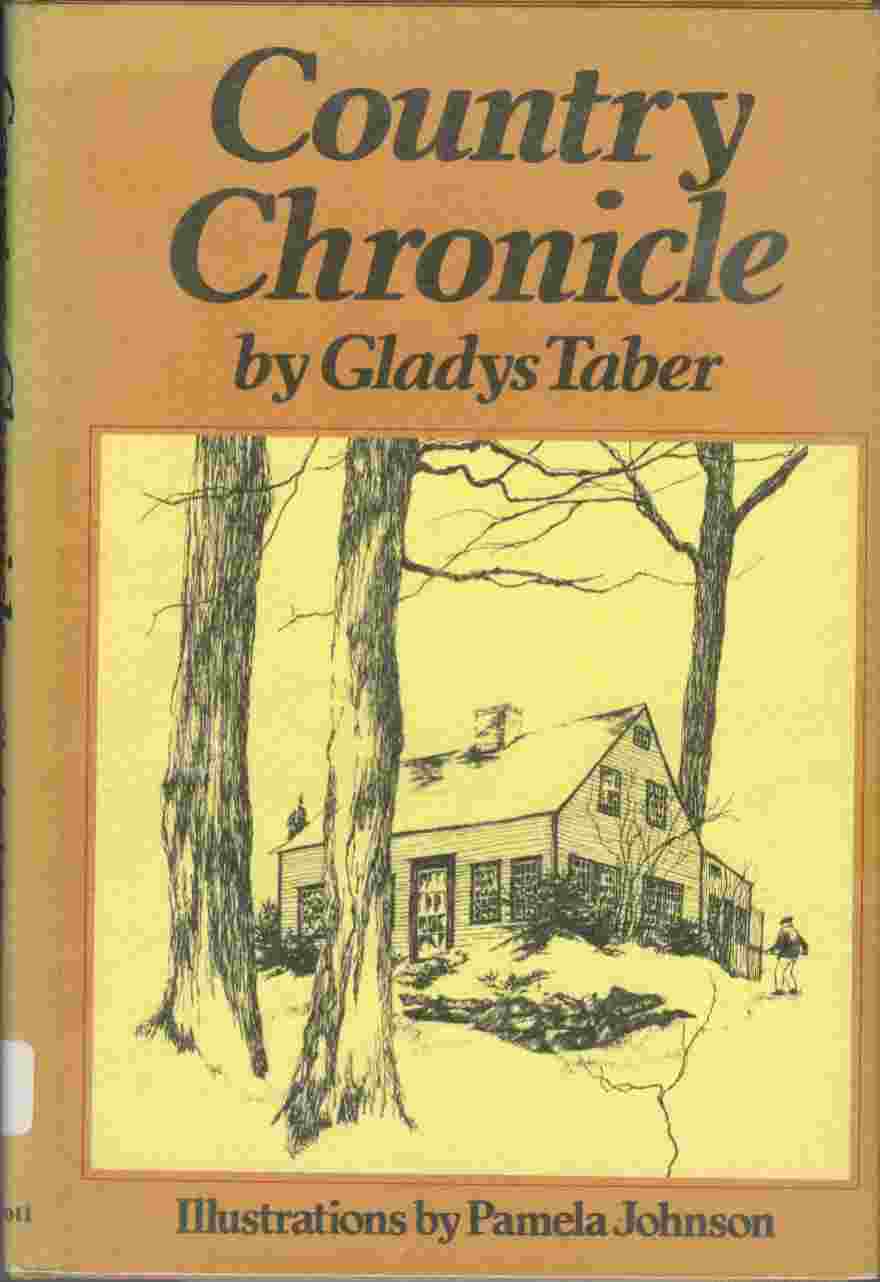
Country Chronicle by Gladys TaberIn Country Chronicle, published in 1974, she retells the story of buying Stillmeadow.  Taber writes:

“Eventually both families came to the city and faced the smog and noise and confusion and the problems of raising three children in gloomy apartments.  Jill’s son, David, was four, her daughter, Barbara, six, and my daughter, Connie, eight.  And one day as we walked the children along Central Park West, I looked up at the hazy sky and said, ‘If only we could get to the country for a weekend, a real weekend!’

‘Even a small piece of land we could put tents on,’ said Jill.

There was so much wrong with the house that they did camp in it at first.  Gradually, they fixed the leaking pipes and replaced primitive appliances.  After their husbands died, Gladys and Jill moved from New York City to Stillmeadow permanently.

Country Chronicle is one of her more charming books.  Her reminiscences of family, neighbors, and pets are endearing.  I love her tales of cats and dogs:  Amber, the tiny cat with intestinal problems, grew up to be a gourmet who liked asparagus tips and fried shrimp; Silver Moon, a dog, needed a glass of tomato juice every day; and Sister liked beef stew, but disliked carrots, and picked the carrot out and arranged them around the plate.

Taber also writes thoughtfully about the environment, electric clocks, and our “push-button culture”:   “When power fails, as it sometimes does even in summer, we do not know how to manage.”

One of the most surprising features of the book is her musing on  the lack of privacy in the U.S.  One spring she was chosen “to be investigated by the Census Bureau.”

“It’s strictly confidential, I was assured, for the census bureau is airtight against snoopers.”

“…But suddenly I began to wonder, and I did not want to fill all those pages about my way of living.  We live in a climate of fear nowadays, second only to Communist countries.  Newsmen go to jail rather than divulge the source of their special information.  Houses are wired, telephones tapped, and the FBI has millions of names, innocent or not.  The Watergate incident came to my mind as Mrs. S. took out her pen.”

The census woman asked Gladys idiotic questions about when she last bought sheets, how old her toaster was, and how much she spent on food.  (She had no idea.)   She wanted Gladys to keep notes on how much she spent for the next three months.  Gladys “began to wonder how much 17,000 of these elegant portfolios, complete with pad and pencil and glossy pockets, must cost our rich government and how much the investigation cost and how far the money would go for food in poverty areas.”

Today our world is much less “snoopproof” than Gladys Taber’s in the ’70s.  The Internet provides marketers with  information gratis (and sometimes government agencies, though I know the internet corporations protect people to an extent).  There are shopping records, and then there are our beloved e-mails, blogs, Twitter, and Facebook.  Even if we are writing for ourselves,  we all have the experience at least once of being read by someone who dislikes us. A divorce lawyer, or an employer can take things on Facebook out of context.  (I’m always reading iabout people who have lost their jobs because of what they said on Facebook.)

Even our e-readers track information about how fast we read, how long we read, and what we highlight.  And, lord knows, I love my e-reader.

Our computers are our friends:  we keep in touch with family and friends, organize political meetings, or read newspapers.  We write.  We make friends.

But it is disconcerting to think that all of it can be used for surveillance.

Calendars, “Just Not Trying Hard Enough,” & Ursula K. Le Guin’s Superb Stories, The Unreal and The Real

I can't forget it's January!

It’s January!

Some bloggers have calendars.  They mention on their sidebars what they’ll be reviewing when.

I have a calendar, but I’m not very organized.  I use it mainly for notes on what to chat about to my doctor.

Note:  Tell Dr. that I saw Iowa City Crash.

The Iowa City Crash

The Iowa City Crash

The Iowa City Crash is a rugby team.  I don’t know my doctor well–it’s usually, “You’re doing well and keep bicycling!”–but he has rugby paraphernalia in his office. Last summer I saw a Crash game.  I must admit I paid little attention because I was finishing something on my laptop.  Nonetheless, it was something to chat about.

Note.:  Learn the names of a few players and ask your husband to describe a couple of the “episodes” in the game, or whatever you call them. 

I learned Brad Fuhrmann, a coach and player, is Australian, and there are also four or five Irish players.

And I found a quote from Brad Fuhrman in a newspaper:  “We expect to win at least one game; otherwise we’re just not trying hard enough.”

Aren’t sports adorable?

If I could just use my calendar wisely, perhaps I could organize my blog along the same principle as chats with my doctor.

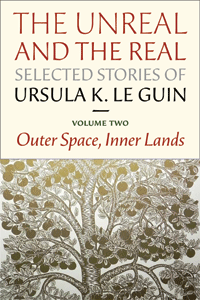
Tell blog audience that I read Ursula K. Le Guin’s The Unreal and The Real:  Selected Stories of Ursula K. Le Guin, Vol. Two, Outer Space, Inner Lands.

I do intend to write about it.  The thing is, I am writing about it in this very post.

Jan. 28I have one other thing planned, though I so far show no sign of writing it.

On Jan. 28, a round-up of Middlebrow American Women’s Literature: Jo-Ann Mapson’s Finding Casey, the sequel to the award-winning Solomon’s Oak; The Painted Girls by Cathy Marie Buchanan, author of The Day the Falls Stood Still); Whitney Otto’s Eight Girls Taking Photos; Sherry Jones’s Four Sisters, Four Queensand Haunting Jasmine by Anjali Banerjee.  

You’ll love my upcoming Middlebrow Women’s Lit post:  “otherwise I’m just not trying hard enough.”

And now on to:

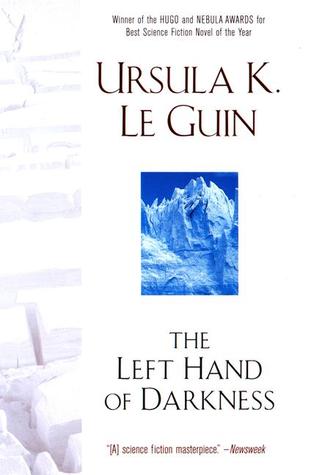
left hand of darkness URSULA K. LE GUIN’S The Unreal and The Real:  Selected Stories of Ursula K. Le Guin, Vol. Two, Outer Space, Inner Lands. 

Ursula K. Le Guin was the first science fiction/fantasy writer I read as an adult.  Growing up, I read E. Nesbit’s books, Jonathan Key’s The Forgotten Door, and A Wrinkle in Time over and over, but then I gave up genre fiction. Later, in my twenties, a friend recommended  Le Guin’s The Left Hand of Darkness, and I was amazed to discover parallels between her work and literary writers like Borges and Calvino.  Several of her novels and story collections are also reminiscent of Doris Lessing’s, or vice versa.

And many of you know that.  But for those of you who don’t, I would put her in line for the Nobel Prize for Literature, except that it seems no American writer will ever win the Nobel again.

Unreal And Real outer space, inner lands le guinSmall Beer Press recently published two volumes of Le Guin’s stories, and I was eager to read them.  I read the second volume first, because it is a collection of her science fiction and fantasy stories, selected by Le Guin herself, while the first volume, Where on Earth, spotlights her more “realistic” fiction.  (And perhaps I’m not quite as interested in that.)

Le Guin writes in the introduction of Vol. 2:  Outer Space, Inner Lands about the blurring of boundaries between genre fiction and literature.  She writes about the  relationship between myth, legend, science fiction, fantasy, and magic realism.

She says of genre:

“Genre, a concept which could have served as a useful distinction of various kinds of fiction, has been degraded into a disguise for more value-judgment.  The various “genres” are now mainly commercial product-labels to make life easy for lazy readers, lazy critics, and the Sales Departments of publishers.”

“It’s not my job as a writer to make life easy for anybody.  Including myself.”

Many of Le Guin’s powerful books could be cross-listed as SF/fantasy and literature, but, with the exception of Lavinia, her historical novel about he Italian princess who marries Aeneas (in The Aeneid), I have found all of them in the SF section.  Booksellers shelf Doris Lessing’s science fiction in the literature section, because she began as a literary writer, but Le Guin, best known as an SF writer, and remarkably fluent,  doesn’t get the same courtesy.

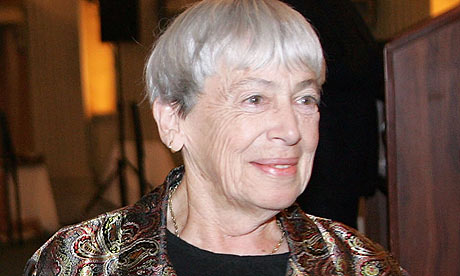
Ursula K. Le Guin

Ursula K. Le Guin

There are many different kinds of stories in Outer Space, Inner Lands. Some of them take the form of ethnological reports on other planets.  In “Solitude,” an ethnologist and her two children, Borno and Serenity, spend several years on Eleven-Soro.  Narrated many years later by the ethnologist’s daughter Serenity in the form of a report, the story melds Serenity’s happy memories of her own coming of age with her mother’s sadness and isolation.  Serenity, who was a young child when they moved there, was accepted by the inhabitants of the “aunt-ring,”  learned the songs and stories the women told, and had an opportunity to “make her soul.”  Her mother was not allowed to attend their singing/storytelling sessions.

Serenity learned above all to avoid magic, tekell, “an art or power that violates natural law”:  the technology on her home planet, or even just one person trying to dominate another.   Her mother calls this superstition, but to Serenity it is common sense: even in marriage, there is tekell, because one person can control the other.   “You have no power over me,” she says to her mother when they want to take her back to their home planet.

The family cannot stay together on the planet.  Borno must leave with the other boys in adolescence to live away from women and jostle for power.   He sticks out the violent life for one year, then comes home and tells his mother he wants to go back to their planet.  Serenity’s dilemma is that she loves her family but utterly believes in the society she has been brought up in.

In another thoughful,  gripping story, “Nine Lives,” two men, Pugh and Martin, have been alone on Libra Exploratory Mission Base for years.  Their first glimpse of a member of an incoming support team on a video communicator floors them:  “Do they all look like that?  Martin, you and I are uglier than I thought.”

Le Guin writes about the difficulty of meeting strangers.  It is particularly tough for Martin and Pugh, alone for so many years.

“It is hard to meet a stranger.  Even the greatest extravert meeting even the greatest stranger knows a certain dread, though he may not know he knows it.  Will he make a fool of me wreck my image of myself invade me destroy me change me?  Yes, that he will.  There’s the terrible thing:  the strangeness of the stranger.”

But it is even more disturbing when  a support team emerges from the ship, and they are shocked to see  five men and five women clones–a tenclone. Later, nine of the clones die in a horrible earthquake, and the tenth, who almost dies, is in deep shock. He gradually learns from Martin and Pugh that doing the safe thing is not always the wise thing.  Breaking the rules can help one survive.

In my favorite story, “Betrayals,” an elderly woman has retired to a hut outside a remote village to meditate and learn to die.  She reads about a planet where there is always peace,  takes care of a dog and cat, and allows a Romeo-and-Juliet-type couple to take refuge in her house occasionally for love. But then she discovers that her neighbor, the Chief, a former tyrannical revolutionary leader who served time in prison, is ill with a cough that develops into pneumonia.  She doesn’t want to help him–she doesn’t care for him–he is there to die–but a lifetime of habit makes it necessary to do all she can.  She learns about the versatility of human beings, and that neither she, nor the chief are ready to die.

Great stories.  I like some better than others, but there is not a dud among them.

Now I must get my copy of Volume One.

Promised Land: How I Raised My Carbon Footprint (Slightly) to Go to a Pretty Good Movie

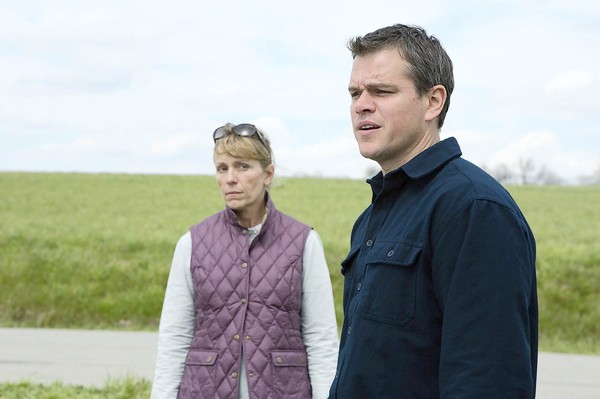
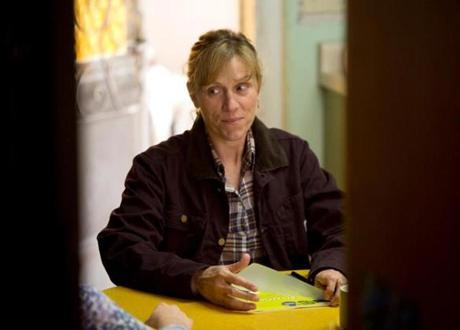
Matt Damon and Frances McDormand in "The Promised Land"

Matt Damon and Frances McDormand in “Promised Land”

The serious movies, as opposed to the frivolous movies, have been out for a few months now.   If I want to bet on the Oscars, I need to get to a theater, right?

But the ex-urban mall, which opened on the county line and put the inner-ring suburban theaters out of business, has made it more difficult for us urban bicyclist to go to the movies.

We looked at the paper.

The Hobbit looks frankly horrendous, and anyway at age 11 I inscribed the end-paper of my paperback copy of The Hobbit  with the words A HOBBIT IS ROTTEN.

And I can’t imagine sitting for two and a half hours through Lincoln, with the brilliant Daniel Day-Lewis in a weird kind of Lincoln drag, though I’ve heard nothing but good about the film.

So what does it take to get me to a movie?

In this case it was a car, which raised my carbon footprint stats slightly.

We went to see Promised Land, starring Matt Damon, Frances McDormand, and John Krasinski.  Written by Matt Damon and John Krasinski, and based on a story by Dave Eggers, this simple but effective film, set in rural Pennsylvania, examines the environmental impact of “fracking,” or hydraulic fracturing, which is the process of drilling for natural gas by injecting water, sand, and chemicals into the ground.

And the movie has enough clout that one natural gas company, Marcellus Shale Coalition, is up in arms and has paid for a 15-second pro-fracking commercial to be shown before Promised Land in theaters in Pennsylvania.

Unprecedented, right?

So, yeah, we were there!

The premise of the story is simple:  Steve (Matt Damon) and Sue (Frances McDormand),  two soulless sales people for Global, a natural gas company, try to persuade the struggling poor farmers  of a small town in rural Pennsylvania to sell their land cheaply so the company can make millions off it.

Of course Steve and Sue are not soulless.  Steve, a bland young man from Eldridge, Iowa, thinks he knows inhabitants of small towns: his hometown died when the Caterpillar company closed, and he genuinely believes it is best for the farmers to sell and get out.  But we see him struggling to keep up to speed on environmental issues:  his research skills are nil, he depends on word of mouth, and is shocked to learn  that the articulate rabble rouser (Hal Holbrook) who has raised environmental questions at a town meeting is not “just a high school science teacher,”  but has a Ph.D. and was an engineer at Boeing.

Sue is  a down-to-earth woman with a wry wit and direct beyond-gender style  that works well in the small town, who talks to her kid by Skype and tries to keep Steve on track when his beliefs are shaken.

Frances McDormand in "Promsied Land"

Frances McDormand in “Promsied Land”

Both are complicating their lives with short affairs:  Steve is attracted to a teacher he meets in a bar and gets dead-drunk to impress her by playing a drinking game called “Absolute Madness.”   Sue  is attracted to the good-looking owner of the general store, and, without even being drunk,  sings a hymn at open-mike night at a bar, because he has suggested she should make a fool of herself to win friends.

Then the charming Dustin (John Krazinski), an environmentalist who has come to town to stop them, steps up to the mike after Sue’s performance and gives a speech about fracking.  Then he sings Bruce Springsteen’s “Dancing in the Dark” and gets everybody dancing.  The people are suddenly on his side.

You can imagine how unhappy Sue and Steve are.

But details are important.  Although Dustin educates us about the fracking issue, he enters the town in a truck, which struck me as very odd.  An environmentalist in a truck?

Get a small car at the very least!

And this detail turns out to matter.

John Krasinski

John Krasinski

Dustin plants anti-Global signs around town depicting dead cows on a farm that was polluted by fracking.  The farmers begin to realize this is about more than money.  And Dustin also  teaches an elementary school class the horrors of fracking with a demonstration of what happens to a toy farm when chemicals, water, and sand are dumped from a plastic bag:  the farm goes up in flames.

And Steve is wondering what is really going on.  He vulnerably asks Sue if there is any truth to what Dustin says about fracking.  She says no, but obviously doesn’t know any more than Steve does.

Steve is the character who undergoes the biggest change.  He is horrified when a poor man who has signed the contract to sell his land shows up at the bar in a convertible he has just bought.

He is beginning to learn the havoc he wreaks.

Now I can’t give away the ending, but let’s just say there’s a twist.  Fracking is horrible, but people are…

Well…

Also horrible.

At one point Dustin says to Steve something along the lines of, “You would be good at what I do.”

And we do see that.

This is not a great film, but it’s a good one.

The acting is exceptional.

Every word McDormand utters is perfect for her character, and I would give her an Oscar for this, though that probably isn’t in the cards for this movie.  She is a salesperson/mom on the road, doing the best job she can and killing time until she can get home to her son, and she means it when she tells Steve,” It’s just a job.”  Her mobile lined face is expressive.

Matt Damon is always deadpan, and sometimes he comes across as quiet and thoughtful, but in this case he does a good job of being bland and not too bright.  His face frowns and squints as he tries to come to terms with what is what.  He believes in his job, and when he suddenly doesn’t believe, it shakes up his whole life.

As for John Krasinski, I’m amazed.  I’m used to his smirking on The Office, a show that bores me so much it always seems to last far, far longer than half an hour, and I didn’t expect this level of charm and vitality.  He plays a different character here!  So that means he can act?  Blimey!

Yes, he can.

Fracking isn’t an issue in my area of the country, but it is one we should all pay attention to.   According to an article in Common Dreams, ” New York and Maryland have suspended fracking, in order to assess its environmental and health impacts.”

Let’s suspend it in Pennsylvania, too!

Go for the wind power and solar power, guys.  That’s where the future is.

Anthony Trollope’s Phineas Finn

I have an almost infinite capacity to lose myself in Victorian novels.

Glued to book:  “Oh, you’re going skiing/snowboarding/ice-fishing today?  Bye!”

Hours later I realize I don’t have the faintest idea where they went.

Anthony Trollope is one of my favorites. His style is so strangely modern that I forget that he is a Victorian.  His graceful sentences are long but plain and without rhetorical flourishes.

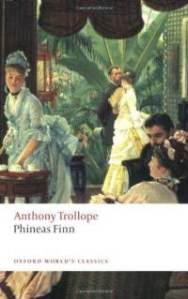
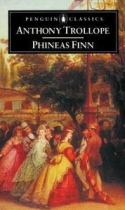
phineas-finn--anthony-trollope-paperback-cover-artTrollope is a brilliant writer–as good as Dickens, though in a very different style.  I started long ago with his two famous series, the Chronicles of Barsetshire and the political Pallisers novels. I am not sure which I read first, but I know I was so glued to The Pallisers  on TV that it is amazing I got any work done.  In addition to all those hours of watching, I read all six of the Pallisers books in record time:  Can You Forgive Her?, Phineas Finn, The Eustace Diamonds, Phineas Redux, The Prime Minister, and The Duke’s Children.

Phineas Finn is a perfect novel for those of you who like politics.  I figured that out when I read New York Times columnist David Brooks’s 2011 op/ed piece on Phineas Finn, “Politicians Behaving Well.”  Brooks is a conservative Republican and I am a radical Democrat, but both of us like Trollope.

Trollope is a universal taste.

We do, however, see the idealistic politician Phineas differently.

Phineas Finn parses politics, but Trollope also describes the hero’s idealism. He explores the way politics shapes not only the public good but personal character and happiness.

Phineas, an Irish doctor’s son, a handsome, earnest, charming young barrister, has many friends among the upper classes in London.  When an influential friend, Barrington Erle, urges him to stand as a Liberal for Parliament in Loughshane, Ireland, Phineas is very eager.  Although the Finns have no money, Phineas’s father, Dr. Finn, has influence with the Earl who controls the borough, and the Earl finances the campaign.

But 24-year-old Phineas doesn’t understand that even the Liberal party recruits candidates who will always vote with the party.

Phineas tells Mr. Erle proudly,

“Let me assure you I wouldn’t change my views in politics either for you or the Earl, though each of you carried seats in your breeches pockets.  If I go into Parliament, I shall go there as a sound Liberal–not to support a party, but to do the best I can for the country.  I tell you so, and I shall tell the Earl the same.”

And Mr. Erle tells him that won’t be acceptable.

Phineas FinnWhat do you do to get ahead in politics?  Must you be obsequious? Yes.  Phineas is politically savvy at first, doing what everyone tells him to do, but eventually it gets tiresome.  He wants to make a difference.   But he is caught in a political snare:  he owes too much to his backers to be independent. The final deal-breakers is a tenants’ rights bill which his party refuses to sponsor.  Phineas stands up.

But I’m getting ahead of myself.

Even one vote makes a difference, as I know from attending the Democratic caucuses, but I admit I am  most interested, and I won’t be alone in this, in  Phineas’s courtships of three women.  Trollope has a gift for drawing believable, lively, though not always likable, women characters, and he is particularly successful with Lady Laura and Violet Effingham.

Although Phineas has flirted with a lovely but apolitical young woman in Ireland, Mary Flood Jones, who thinks he may marry her, he is under the influence of Lady Laura Standish in London, a brilliant, vivacious, ambitious tall redhaired woman who is interested in politics.  Does Phineas love her, or does he love her connections? It is not clear. But when Laura ambitiously marries George Kennedy, a rich, chilly, domineering politician through whom she hopes to have political influence, she almost immediately realizes her mistake.  Kennedy tries to control her by narrowing her interests and cutting her off from friends.  Eventually she cannot live with him, and returns to her father.  She regrets having turned down Phineas.

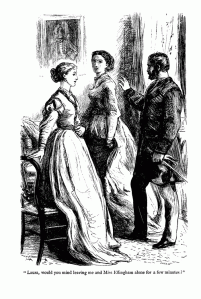
Laura, Violet, and Phineas-

Phineas with Laura and Violet

But Phineas has turned his affections from Laura to her friend Violet Effingham, a beautiful but eccentric heiress who talks flippantly about John Stuart Mill.  And this quasi-relationship–Violet isn’t particularly interested in him–causes problems, because Laura’s brother, Lord Chiltern, is in love with Violet, Laura’s father found Phineas a parliamentary seat after he lost his Irish one and believes Phineas owes him loyalty, and  jealous Laura says Phineas should forget about Violet for Lord Chiltern’s sake.

In the end, political integrity is Phineas’s saving grace. And I think this is why we so much like Phineas Finn. We would like to see this integrity in more politicians.

I look forward to rereading Phineas Redux.  Trollope’s detailed portraits of his characters’ obsessions with sex, money, and politics remind us that the world has not changed all that much.

Best of 2012: My Lucky Eleven & His Top Five

Happy New Year’s Eve!

Should old acquaintance be forgot…

And what are the rest of the words?

new year's eveAre you going out tonight?

I always thought I’d grow up and dance like my mom at the Elks a la ’60s.

I don’t have a party dress.

So I am cooking a delicious home-cooked dinner, baked chicken with garlic and apples (Laurie Colwin’s Home Cooking).

And we are writing our “Best of 2012” lists.

Here are my Lucky Eleven Best New Books of 2012, and I’ve added a couple of Special Categories for other older books.

I unwittingly included two rock and roll novels and one jazz novel on my list.  I’m not sure how that happened.

And after MY list, I am including my husband’s Top 5!  So enjoy our lists!

Top 11 New Books of 2012 (All Published This Century)

1.  Michael Chabon’s Telegraph Avenue, a superb novel about a used record store in Oakland faced with the prospect of a corporate media store moving in.

2.  Joydeep Roy-Bhattacharya’s The Watch, a retelling of Antigone set in the war in Afghanistan.

3.  Ruth Prawer Jhabvala’s A Lovesong for India:  Stories from East and West.  This stunning short story collection is divided into three parts, “India,” “Mostly Arts and Entertainment,” and “The Last Decades,” and is set in India and the U.S.  Jhabvala  won the Booker Prize for her novel Heat and Dust and two Academy Awards for best adapted screenplay for Merchant-Ivory films, A Room with a View andHowards End.   Isn’t it time she won an American award?

4.  The Night Train by Clyde Edgerton, a charming, humorous novel inspired by James Brown, Civil Rights, and the ’60s.  Edgerton describes a friendship between an African-American boy and a white boy in a small Southern  town.

5.  A. M. Homes’s May We Be Forgiven.  A brilliant, horrific, often funny satire of the American Dream.  Family prevails, but it is threatened by violence and trauma.  Were the Nixon years, bad as they were, more idealistic than the 21st century?  The main character is a “Nixonologist.”

6.  Scarlett Thomas’s enchanting novel, Our Tragic Universe, crackles with wit.   The narrator, Meg, is a waifish, depressed science fiction writer who is in love with a married museum director, has a psychic dog, B, and a close friend, Libby, a deli owner and inspired knitter whose life is equally complicated.  I loved this and must read another Thomas novel soon.

7.  Nick Hornby’s Juliet, Naked, his best novel.  The heroine, Annie,breaks up with her boyfriend of 15 years, Duncan, a middle-aged man obsessed with Tucker Crowe, a rock star who retired in 1984.   Their interests are oddly parallel:  she curates the town museum, he curates a Tucker Crowe website.  But she wants a child, and knows she will never have one with Duncan.   A disagreement about Tucker Crowe’s new record, “Juliet, Naked,” on the website eventually sparks a friendship between Annie and Tucker.  Kind of romantic, but not too-too.

8.  Zadie Smith’s NW.  Four characters from the same rough neighborhood in London (NW) manage to transcend class, or fall way, way down.  Sad and funny.  A lot about the internet culture.  I didn’t love this book, but it is very good.

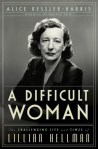
LillianHellman A Difficult Woman9.  Alice Kessler-Harris’s A Difficult Woman:  The Challenging Lives and Times of Lillian Hellman.  A brilliant biography of Hellman, who was one of our best American writers, but has been denied her place in the canon because of accusations of lying, her politics, and her attacks of  leftists for their cowardice during the McCarthy era.

10.  Howard Jacobson’s Zoo Time, a satire of the publishing industry.  He is one of England’s most brilliant writers, and he is very funny.

11.  Will Self’s Umbrella.  Excellent Joycean novel, which I am rereading in 2013, and let me know if anyone is “sponsoring” a read of this.  A psychiatrist discovers that some of his patients were actually victims of an encephalitis lethargica epidemic.  Very sad, and I have to admit I was initially interested because of its relevance to my life:  I was hospitalized for a bug bite and almost died, and encephalitis was one of the illnesses they ruled out (though not this strain).

AND SPECIAL CATEGORIES OF OTHER BOOKS

BEST TRANSLATION

Lydia Davis’ translation of Madame Bovary

BEST OUT-OF-PRINT BOOK

Dear Beast by Nancy Hale.  A more “grown-up” American version of D. E. Stevenson’s Miss Buncle’s Book.  A woman’s novel about the small Southern town where she lives becomes a best-seller.

BEST NEGLECTED NOVEL

Margaret Wilson’s The Able McLaughlins.  Won the Pulitzer:  an excellent novel about pioneer farmers in Iowa.

AND NOW FOR AN UNPRECEDENTED ADDITION.  MY HUSBAND HAS AGREED TO LET ME PUBLISH HIS TOP 5 LIST:

My top five (in no order):
Melville:  One of His Favorites

Melville: One of “His” Favorites

1. The Passage of H.M. by Jay Parini – I would recommend this book to anyone. Dickens is a character in this book!

2. One of Ours by Willa Cather. One of the saddest books I have ever read.

3. Zeitoun by Dave Eggars.  I don’t know how this guy does it. A great and shocking story about the Katrina disaster.

4. The Yiddish Policemen’s Union by Michael Chabon. I listened to this book driving to Buffalo. It was great. They interviewed him on the last disk. He said he was inspired to invent this story when he came across the book “Teach yourself Yiddish” in a used bookstore.

5. The Sweetest Dream by Doris Lessing. I enjoyed all the Lessing books that I read, but this one was the best. I will read more of her.

Other very good reads: As I Lay Dying, Moby Dick, Big Breasts and Wide Hips (still reading).
Not a bad year at all.

See you next year!