Reading with Bronchitis: Swann’s Way and Laughing at Odette

Me biking, the year I broke my arm.

Biking a few weeks after the broken arm fiasco.

Last night, I lay in bed panicking.  It hurt to cough.  It hurt to breathe.

Did I need to go to the hospital? I wondered.

No.  I would lie in bed and gently breathe until my doctor’s appointment the next day.

Going to the emergency room in the middle of the night is not an experience one wants to repeat. Long, long ago, in a city far, far away, I foolishly went running at night and tripped on the sidewalk and broke my arm.  At the hospital I waited four hours in a filthy emergency room (no soap in the restroom) and all they gave me was a sling.  Does that left arm look a little hyperextended to you?  Yup.  That’s ER care.

No, I would wait to see the doctor.  Because I knew it was bronchitis, not pneumonia.  A cough, chills and sweating, aching lungs, and a fading feeling when I tried to take a walk.

But had it ever hurt to breathe?  It’s been 20 years since I had bronchitis.  I didn’t remember that.

I was in pain, but I am glad I didn’t visit the ER in the middle of the night. The diagnosis is bronchitis and an hour after taking the antibiotics for bronchitis, I COULD BREATHE AGAIN and was on my bike.

And after the bike ride, I was laughing at Odette.

What do I mean by laughing at Odette, you might want to know.
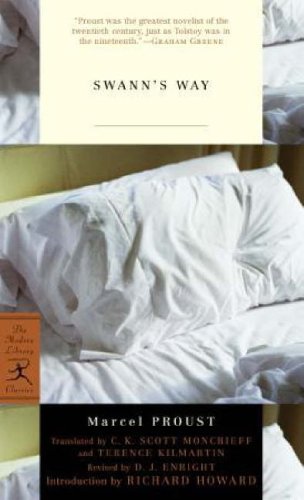
Proust Swann-Way-Modern-Library-Classics-0812972090-LI’m rereading Proust’s Swann’s Way, the first volume of In Search of Lost Time, previously translated more elegantly, to my mind, as Remembrance of Things Past.

Not being a French literature scholar, I find it difficult to write about Proust.  Would that I had read Swann’s Way with Sam Jordison at the Guardian Book Club in 2013.  He eloquently said,

I’m guessing that a healthy proportion of people who pick up the book don’t even get beyond page 51. Within a similar word count, Raymond Chandler could have got through two murders, six whiskies, half a dozen wisecracks. Raymond Carver could have described at least six suburban households descending into despair. And Hemingway had almost finished The Old Man and The Sea. Yet, in pure plot terms, pretty much all that happens in those first pages of Proust is that the young Marcel struggles to fall asleep.

Although little happens, there are moments of wild joy.  Proust is for those who revel in lyrical, sensual language rather than traditional narrative. Three thousand pages pass while the narrator Marcel meditates on the subject of memory and describes the visual and sensual cues that evoke the past.  Reading Swann’s Way is like falling into a luxurious feather bed of exquisite language.   Marcel, the narrator, remembers as a boy he couldn’t sleep unless his mother kissd him.  He describes every detail of life at Combray, where the family lives in the summer with his great-aunt, from his Aunt Leonie’s two rooms to the hawthorns he admires on walks to the emotions evoked by the joyful reading of his favorite author, Bergotte, and the joy of his first serious writing.

Swann, a brilliant, thoughtful, charming man who moves in high society, is s a close friend of Marcel’s family.  He is pitied for an unfortunate marriage to a woman who blatantly is unfaithful. Marcel’s aunts don’t quite understand how well-connected Swann is in society.  They like him purely for his kindness, courtesy, and conversation.

The  second section of the novel, “Swann in Love,” focuses on Swann’s passionate affair 15 years ago with Odette, a former courtesan.  The prose is often erotic, and Proust does very definitely know how to evoke the development of an erotic relationship.

Odette is often comical.  Like Marcel’s aunts, she doesn’t understand the meaning of the social circles Swann moves in.  Because his friends, high-ranking government officials and aristocrats, don’t go to the parties and balls she has heard are fashionable, she concludes that Swann’s friends are bores, though she appreciates the first-night theater tickets and racing tickets .

She hoped that he would continue to cultivate such profitable acquaintances, but in other respects she was inclined to regard them as anything but smart, ever since she had passed the Marquise de Villeparisis in the street, wearing a black woolen dress and a bonnet with strings.

“But she looks like an usherette, like an old concierge, darling!  A marquise, her!  Goodness knows I’m not a marquise, but you’d have to pay me a lot of money before you’d get me to go round Paris rigged out like that!”

So funny!

A few of my impressions so far.

Light Reading with a Cold: Dorothy Sayers’s Five Red Herrings & R. A. Dick’s The Ghost and Mrs. Muir

woman with cold cartoon huge.101.505042I have been trailing around Iowa with a very bad cold for a couple of weeks.  Actually, I don’t so much trail as look wistfully out the door.

Life consists of hacking open cold medicine packets with sharp objects, applying Vicks Vaporub (one of my sweaters is now a wearable form of Vicks), and sleeping on the sofa.   I do hope no one else has this cold, but if you do, I wonder, what are you reading?

I have been reading light, short books.  Here are recommendations:  a mystery and a ghost story.

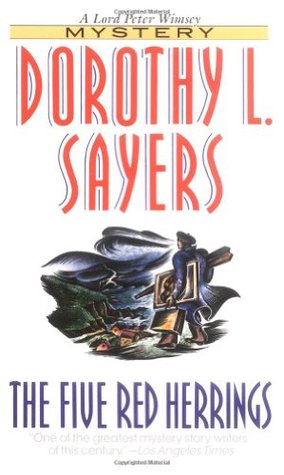
Five Red Herrings Dorothy Sayers 1326761.  Dorothy Sayers’s Five Red Herrings. I love Golden Age Detective Stories of the 1920s and ’30s, and Dorothy Sayers’s Lord Peter Wimsey novels are especially charming and elegantly written.   Set in Scotland, Five Red Herrings is a whodunit about the murder of an obnoxious artist.  The hero, Lord Peter Wimsey, an eccentric, witty, affable amateur sleuth, is vacationing in Galloway, accompanied by his valet, Bunter.  The scenery is beautiful, and everyone “either fishes or paints.”  Wimsey has a way of fitting in wherever he goes.

Into this fishing and painting community, Lord Peter Wimsey was received on friendly and even affectionate terms. He could make a respectable cast, and he did not pretend to paint, and therefore, though English and an ‘incomer’, gave no cause of offence. The Southron is tolerated in Scotland on the understanding that he does not throw his weight about, and from this peculiarly English vice Lord Peter was laudably free.

When Campbell, an artist who has quarreled with everyone in the community, is found dead in a pool at the bottom of a steep granite slope, it looks like an accident.  His easel is at the top of the slope, and the police think he stepped back to examine his painting and fell.  It is Wimsey, of course, who  realizes Campbell was murdered when he notices something crucial is missing from the artist’s bag of supplies.  Six artists are suspected, and the mystery involves a stolen bicycle, train time-tables, and the personal painting styles of the suspects.

This is one of Sayers’s most enjoyable books. I must admit I just let the train time-tables wash over me, but the puzzle is clever, the information about art is fascinating, and I enjoy the company of Peter Wimsey.

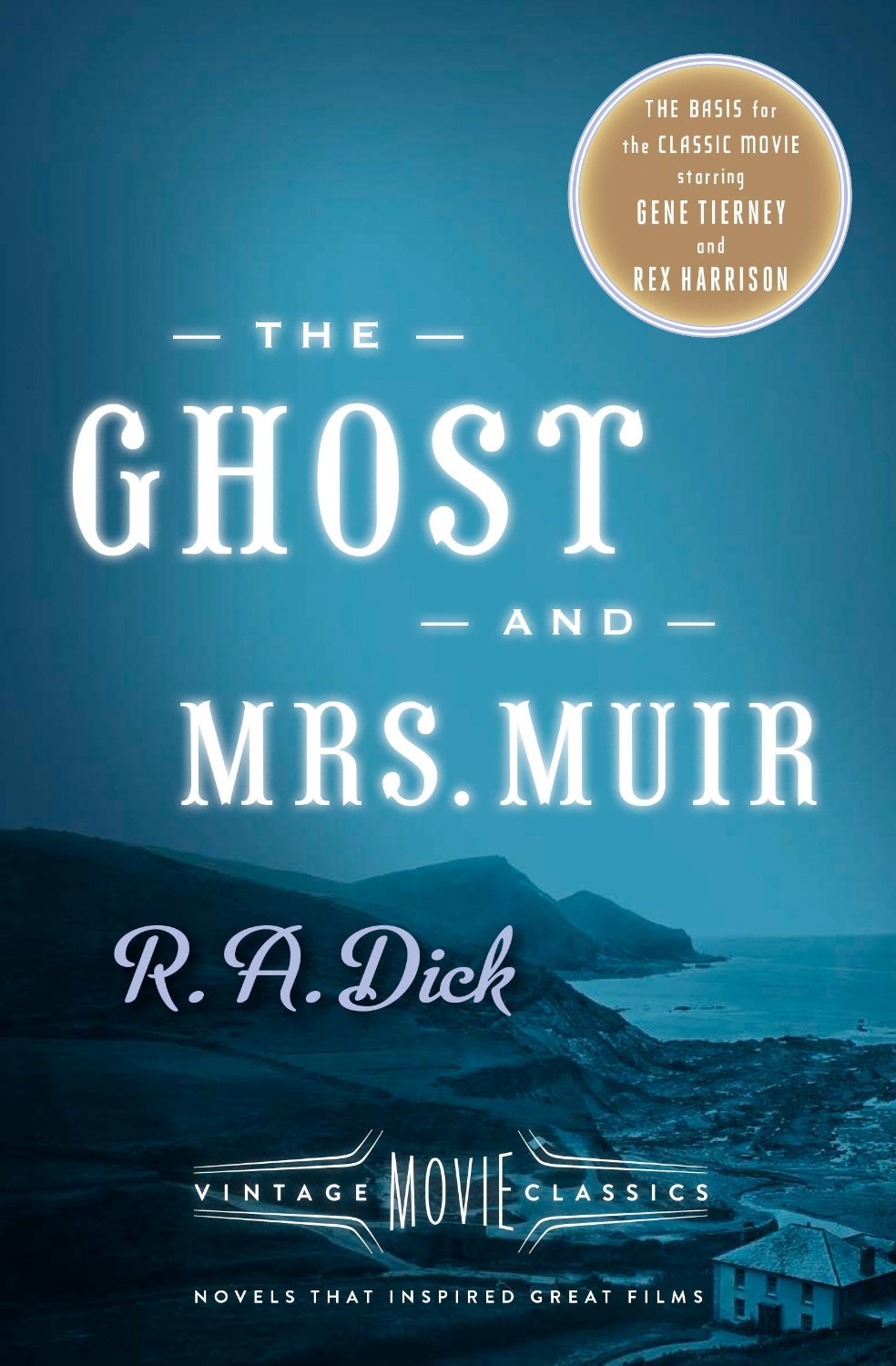
2.  R. A. Dick’s Thghost and mrs. muir r. a. Dick 81D8vVMXZyL._SL1500_e Ghost and Mrs. Muir is the latest in the Vintage Movie Classics series of reprints of books that inspired famous movies.  Among the books recently reissued in this series are Booth Tarkington’s Pulitzer-winning Alice Adams, Edna Ferber’s Cimmaron, and Fannie Hurst’s Back Street (which I wrote about here).

I couldn’t resist The Ghost and Mrs. Muir, because I am a fan of the movie with Rex Harrison and Gene Tierney.    Guess what?  This light, graceful novel, published in 1945, is even better than the film.  It is spare,  very funny, and a joy to read.  The Irish writer Josephine Aimee Campbell Leslie wrote under the name of R. A. Dick, believing that a man’s name might help sales, according to the introduction.

The premise of the book is simple.  Mrs. Muir is a lovely, gentle widow who was dominated by her husband and his family,  Now that her husband is dead, she is determined that she and her two children will be independent.  They will live at Gull Cottage in the seaside village of Whitecliff, far from all relatives.  The realtor is reluctant to show her the house, because, yes, Gull Cottage is haunted, but Mrs. Muir soon befriends the ghost, Captain Daniel Gregg, and  he agrees not to make himself known to the children.  He will restrict his hauntings to her bedroom, where they have many spirited conversations and disagreements.  When she runs low on money, he dictates his colorful memoir to her, Blood and Swash, which, anonymously published, becomes a best-seller.  The book is so fascinating that Lucy’s publisher reads it in her presence and forgets she’s there. It is a subject at a stuffy dinner party where Lucy’s son, a pompous curate, the Bishop, and other members of prominent society condemn the book.  And this is a very funny scene, because none would ever suspect of Mrs. Muir’s role in the writing.

Charming, funny, and gracefully-written.  I am likely to read this again soon.

Getting Controversial: When Corporations Clash and Why I Shop at Amazon

I’m a liberal Democrat.  I’m Pro-Choice and I vote.  I don’t drive because burning fossil fuels has wrecked the environment.  I don’t shop at WalMart.

I do, however, shop at Amazon.

The Amazon feud with Hachette about e-book pricing, which, by the way, has gone on absurdly long, is not a matter of priority to me politically.  If Hachette chooses not to take care of its authors–Amazon did, after all, propose that Hachette writers should earn 100% of the e-book profits until the superstore and the publisher have reached a deal–how will my failure to buy other publishers’ books, classics, and used books support the publishing industry?

The Kindle does not concern me.  I have a Nook. I already pay higher prices for e-books than Kindle users do.  This is not my battle.

Pray, where would I buy books if not at Amazon?  I live in an insurance town.  The number of bookstores is minuscule.  We have Barnes and Noble and two tiny independent bookstores.  If not for Amazon, how would I find the books of Mrs. Humphry Ward, Pamela Frankau, and Margaret Wilson?  I very much prefer books to e-books.  Particularly in recent months, I have tired of reading on a screen.  Are others, too, going back to the physical book? One can hope.

Everyone in my family is liberal, and yet we all shop at Amazon.

Some groups of writers have organized against Amazon’s  decision to make Hachette books harder to buy, i.e., by not allowing pre-orders and claiming that the books will take one-to-three weeks to deliver.  According to the Wall Street Journal,  the Authors Guild, which has about 8,500 members, met with Justice Department officials in August to request an investigation of whether Amazon is violating antitrust law in its tactics with Hachette Book Groups.  Another group, Authors United, with more than 1,000 members, has written a letter to the Justice Department about the same antitrust issue.

This actually does not seem to me a huge number of writers.  The New York Times stresses the presence in Authors United of white male stars like Philip Roth and Salman Rushdie.  Can ordinary writers afford to make a big issue of this?  I very much doubt it.

So I was relieved when two highly-respected writers, Paulo Coelho and Germaine Greer, recently spoke in favor of lower e-book prices.

Publishers Weekly reported last week that Paulo Coelho told an audience at the Frankfurt Book Fair that change could not be stopped.

“It is a lost case,” Coelho said.

“Paulo, you’re saying the war is lost?” Juergen Boos [the fair director) asked.

“I’m not saying the war is lost,” Coelho replied “I’m saying we humans are still here because of our capacity of adapting ourselves. The war is not lost. It is the opposite. The war is won. Culture is now available all over the world. People can read.”

On Aug. 28 on BBC Radio 4’s “The Report,” Germaine Greer said,

“Amazon wants to sell e-books at less, so they should,” she said. “They should cost less because they don’t have to be put together, stitched, printed, designed, blah, blah, blah. If you skip all that and all you have got is a ribbon of text on a Kindle then it should cost you pennies frankly.”

Of course one of my heroes, Ursula K. Le Guin, emailed the New York Times to say that Amazon’s treatment of Hachette authors was censorship.

“We’re talking about censorship: deliberately making a book hard or impossible to get, ‘disappearing’ an author,” Ms. Le Guin wrote (The New York Tin an email. “Governments use censorship for moral and political ends, justifiable or not. Amazon is using censorship to gain total market control so they can dictate to publishers what they can publish, to authors what they can write, to readers what they can buy. This is more than unjustifiable, it is intolerable.”

One cannot sanction censorship.

I just can’t make everything my cause.  If I didn’t buy so many books, it would be easier.  I am not going to special-order everything I want from an independent bookstore and pay twice the price when I can order it myself.

Sometimes you have to do what’s good for yourself.

Bookishness: Barbara Pym’s Quartet in Autumn & A Giveaway of Margaret Kennedy & D. E. Stevenson

THE GIVEAWAY.  No sooner have I washed the dust off from the Planned Parenthood Book Sale–and there is a lot of dust on old books, as you can imagine– than I’ve discovered I have duplicates of three of them.   If you would like Margaret Kennedy’s Together and Apart (Virago), Margaret Kennedy’s The Ladies of Lyndon (Virago), or D. E. Stevenson’s Celia’s House  (a VERY used ex-library book), leave a comment.

Pym Quartet in AutumnCATCHING UP ON MY READING JOURNAL.  I have read some short books this week because I have been immobile with a cold/flu thing.  Barbara Pym’s classics are perfect when one is sick.  They are light, the writing is elegant, and her understated humor is original and diverting.  Characters are always drinking Ovaltine, sorting out clothes for jumble sales, and getting to know the curate.  A good flirtation with a curate:  that’s what we need!   Only do we have curates in the U.S?

Quartet in Autumn is not what I’d call a typical Barbara Pym. Shortlisted for the Booker in 1977, it is a dark comedy about two men and two women who work in an office.  Retirement is imminent for these characters in their sixties, and their future will be determined to a large extent by their living arrangements.  Letty, a sympathetic spinster, lives in a bedsitter, always has a library book going, and will not buy dyed carnations.  Edwin, a cheerful widower and a homeowner, needn’t live on his salary, is conventionally religious, and spends his leisure attending church services and events  Norman, an odd, cranky man,  lives in a bedsitter, goes to the library to sit but not to read, and dislikes travel but enjoys travel brochures.  Marcia, the most peculiar of the lot, doesn’t throw away rubbish, keeps her milk bottles in a shed in the back yard, and is visited by a volunteer social worker, whom she scorns.

Working in an office is a strange way of life, and what one does can be obscure.  When I worked in an office, we spent much of the time chatting, and were only really busy one week out of every month.  Pym’s description of the work world fills me with mirth.  The office life revolves around shared rituals like drinking instant coffee or tea, chatting about hypothermia, and going to the library on the lunch hour.  No one in the building knows exactly what work this quartet does, and it is understood that their jobs will be phased out and they will be replaced by computers.

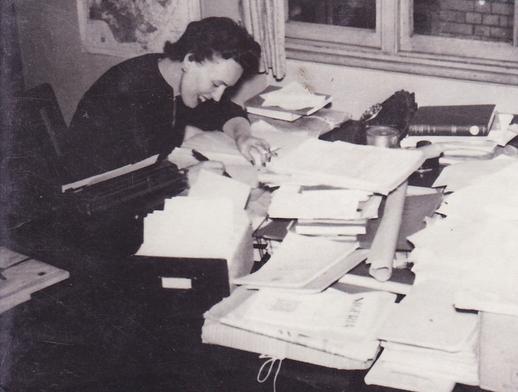
Barbara Pym at the International African Institute

Barbara Pym at the International African Institute

Living alone can be dicey in old age, and, oddly, various churches both help and hinder their plans.  Letty had planned to retire to a village with an old friend, Marjorie, a widow, but when Marjorie gets engaged to the new vicar who is 20 years her junior, that is the end of that.  What, Letty wonders, has she done to end up alone?  Why has no one ever wanted to marry her?  And yet stasis is impossible:  she must make a change even if she stays in London, because her landlady has sold  the house to a boisterous Nigerian priest of a Christian sect, and Letty is no longer comfortable there.  Edwin, through his  church connections, finds Letty a room in the house of a cantankerous woman in her 80s, Mrs. Pope.  Letty stays in her room and reads library books, but they sometimes watch TV together in the evenings.

One of the few characters outside the quartet is Janice Brabner, the social worker.  Confronting Marcia in her dusty house is disconcerting, but Janice keeps visiting.

You’ll be retiring,’ Janice Brabner had said.  “Have you thought at all about what you’re going to do?”…

Marcia had never revealed what exactly her job was but Janice guessed that it hadn’t been particularly exciting.  After all, what kind of job could somebody like Marcia do?  She wished she wouldn’t keep staring at her in that unnerving way, as if she had no idea what what was meant by Janice asking what she was going to do when she retired.

“A woman can always find plenty to occupy her time,” Marcia said at last.  “It isn’t like a man retiring, you know.  I have my house to see to.”

After Letty and Marcia retire, heir disappearance into retirement activities is fascinating.  This is not a hopeless book–Pym’s never are–but it is unsettling and at times acerbic.  The quartet comes together again, and the ending is surprising.

A Bookish Weekend in Des Moines: The Planned Parenthood Book Sale, Oct. 9-13

The Planned Parenthood Book Sale in Des Moines

The Planned Parenthood Book Sale in Des Moines

Ready to spend a bookish day in Des Moines?

The Planned Parenthood Book Sale takes place Oct. 9 to Oct. 13 at the 4-H Building at the Iowa State Fairgrounds. I can attest that it is possible to spend two to four hours browsing the 600,000 books, CDs, DVDs, records, VHS tapes, games, puzzles, posters and collectibles.

We try to go on Opening Night, or “Dealer Day,” as I call it.  When the sale opens at 4 p.m., the book scouts madly rush in with their electronic scanners beeping and buzzing.  One friend says “book scouts have ruined the sale,” and I admit I am nostalgic for the pre-scanner device years.   (Perhaps the scanner technology is silent by now:  I haven’t kept up.)  We show up  late because we don’t like being squished and joggled by book scouts.

Did I find anything tonight?

Of course I did.

Here’s a sampling:

NEW PAPERBACKS

Elena Ferrante’s The Story of a New Name ($3).

Maria Semple’s Where’d You Go, Bernadette?  ($3)

D. E. Stevenson’s Mrs. Tim of the Regiment ($4)

VIRAGO

Dorothy Edwards’ Rhapsody ($1.50)

CLASSICS

Trollope’s Why Frau Frohmann Raised Her Prices and Other Stories ($3)

Saul Bellow’s The Adventures of Augie March ($3)

Joyce Cary’s Mr. Johnson (50 cents)

H. G. Wells’ Secret Places of the Heart ($3.50)

INTERESTING (AND UNEXPECTED)  OLD BOOKS

Rumer Godden’s Black Narcissus ($1.50)

Thorne Smith’s Skin and Bones (75 cents)  (N.B.  Thorne Smith is the author of Topper)

NANCY DREW

Carolyn Keene’s The Secret at Shadow Ranch ($2, a 1931 edition with proper grammar and a more sophisticated style than the later “updated” editions)

TRAVEL

Jean Moorecroft Wilson’s Virginia Woolf’s London:  A Guide to Bloomsbury and Beyond ($3)

A pretty good haul!

One assumes that some of the great books we missed will show up at Jackson Street Booksellers in Omaha.

P.S.  Afterwards you can grab a bite at Tursi’s The Latin King, a traditional Italian restaurant with 1950s decor (was the ceiling red, or did I dream that?), A Dong (a great Vietnamese restaurant), or, for the adventurous, Zombie Burger, where you can eat an “East Village of the Damned” (burger with blue cheese, caramelized onion, lettuce, tomato, onion, mayo:  sounds dreadful).

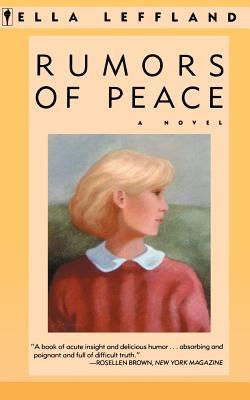
Ella Leffland’s Rumors of Peace

Ella Leffland’s Rumors of Peace, a 1979 novel reissued by Harper Perennial as A Rediscovered Classic, has been on my reading list for years.  Not only did it get great reviews, it also was recommended by women in my family.

Rumors of Peace Ella Leffland 51ta+zxseSL._SY344_BO1,204,203,200_This bold, often comical, intense coming-of-age novel is not quite a classic, but it is a delight to read.

Set in California during World War II, Rumors of Peace begins as an American idyll.  Suse, the narrator, the daughter of Danish immigrants, is a ten-year-old tomboy truant who loves twirling on the monkey bars and playing kickball.  She gets bad grades in school, but other than that she has a happy life.  Outsiders may think her hometown of Mendoza, California, is ugly, dominated as it is by a Shell Oil refinery, but she and her friends think it’s just fine.  Although she is vaguely aware that her parents are distressed by the war in Europe, it doesn’t affect her until Pearl Harbor is bombed.

Suse loves to read fairy tales, and her description of family life has a fairy-tale atmosphere

On winter evenings, after slopping through my homework, I curled up with Andersen’s fairy tales.  A fire crackled in the wood stove, and there came a pleasant muted din from the cellar, where Peter was relegated with his snare drum.  Karla sat sketching at the dining-room table, and from the radio came the wise, confident voices of Information, Please, which my parents listened to over their evening coffee.    When summer came, we moved onto the front porch in the evenings.  The crickets chirped from the dry grass.  My dad’s cigar glowed in the dark, an orange dot.  From somewhere in the distance you could hear a game of kickball.  The night was warm, the air thick with stars.

But after the bombing of Pearl Harbor, everything changes for Suse.  She becomes obsessed with war and worries endlessly about  her brother, Peter, a soldier whose letters are censored .  Suddenly she hates the “Japs,” and thinks all of them should be interned or killed, though at the same time she feels guilty about the familiar Japanese florist who is forced to close his shop.  And then when her Italian-American best friends have to move, she is even more confused.  Eventually she realizes that her own Danish parents are more truly foreign than those Japanese and Italians whose families have been in California for two or three generations.

ella leffland rumors of peace old paperbck197912Adolescence also happens to Suse, with war always looming in the shadows.   In junior high, she is put in the “dumbbell class,” because her grades are abysmal.  Here she meets Peggy, the underachieving daughter of a cultured doctor and an architect.  Suse is fascinated by Peggy’s older sister, Helen Maria, a brilliant classics student who commutes to Berkeley and speaks with a fake British accent at home because she wants to go to Oxford.

Nothing stays the same in adolescence. Suse is surprised when Peggy loses weight and begins to study so she can be promoted to the college prep track.  Helen Maria approves of Peggy’s studying but gives up on her when it turns out Peggy’s goal is only to become popular. Isolated from Peggy,  Suse, too, begins to want something different.  She decides math will be her subject, and after she is tutored by a young genisu  Suse gets an A and is  promoted into college prep algebra.

Suse likes knowing what’s going on in class, but she finds the students duller than those in the dumbbell class.  Conventionality is transparently shallow. She continues to hang out with a very bright, imaginative boy known in his younger years as “Dumb Donny.”

There was something prim about these College Prep types, too neat, too much like each other.  In dumbbell class you had variety.  You had bold, sleazy girls , with penciled eyebrows and greasy lipstick, and boys in pachuko haircuts and leather jackets, who slouched around narrow-eyed like Humphrey Bogart, and you had certain Okie kids who never got rid of their Okieness but still looked unwashed and farm-bred and talked in a gray-sounding drawl…

As the narrative progresses,  Suse matures.  She begins to see people as three-dimensional, with lives that don’t necesssarily connect with hers.   She gets crushes on teachers and at 14 falls for Helen Maria’s ex-boyfriend, Egon, a German Jew who quits school to be a translator.  Helen Maria, whose goal is to go to Oxford at the end of the war, invites Suse to visit her in Berkeley and continues to inspire Suse to read andgstudy.  But it seems there will always be more devastation:  the war is almost over when the U.S. drops the atomic bomb on Hiroshima and Nagasaki.

This is the kind of multilayered novel that generates an excellent book club discussion. I’m sure English teachers will enjoy it, too.  Suse’s most difficult problem is to learn to enjoy peace without worrying about the shadow of the next war war.

A very smart, enjoyable book.  I do recommend it.

The Gone with the Wind Revival

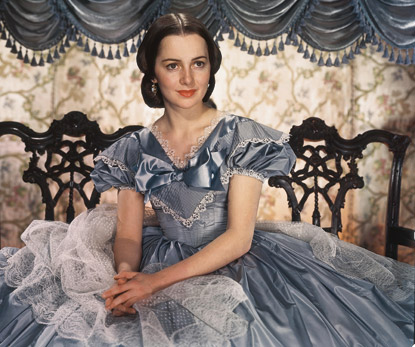
Olivia De Havilland as Melanie

Olivia De Havilland as Melanie

In celebration of its 75th anniversary, the movie Gone with the Wind was screened in 650 theaters over the weekend.

My mother was a fan of the book and movie and collected GWTW memorabilia.  It is far from my favorite film–that would be Days of Heaven–but I went for sentimental reasons because she and I would have enjoyed going together to GWTW had she been alive.

My mother was a huge consumer of pop culture and went to two or three movies a week well into her eighties.  To see GWTW in a theater was like reentering her world.

The four hours flew as this sumptuously-filmed Southern costume drama, replete with witty repartee, unfolded.

Clark Gable as Rhett Butler and Vivien Leigh as Scarlett O'Hara in 'Gone with the Wind' by Clarence Sinclair Bull

Clark Gable as Rhett Butler and Vivien Leigh as Scarlett O’Hara in ‘Gone with the Wind’ by Clarence Sinclair Bull

The Pulitzer-winning novel Gone with the Wind is a saga of the South and a bildungsroman that follows Scarlett O’Hara from her youthful infatuation with Ashley Wilkes and her reluctant friendship with Mellie, the woman he marries, through the Civil War, three marriages, and the Reconstruction.  Of course there is romance with blockade runner Rhett Butler (Clark Gable) and Ashley (Leslie Howard) the  gentleman–both are billed as  sexy men– but the actresses get the most screen time, and the film rests squarely on the shoulders of strong women.  I was very impressed by the performances of Vivien Leigh (who won the Oscar for Best Actress in 1940) as the flirtatious but powerful Southern belle Scarlett, and Olivia de Havilland, who radiated intelligence and passion as Melanie Wilkes. And don’t forget Ona Munson as Belle Watling, the  prostitute who insists on giving money to the Rebel cause, Hattie McDaniel as the stern Mammy/duenna of etiquette (winner of the Oscar for Best Supporting Actress), and Leona Roberts as the  wife of Dr. Meade.

Melanie Wilkes especially fascinates me.  Often dismissed as the good girl, she is actually a strong woman with fiercely liberal ideas about doing good. She nurses dying men in the Civil War, stands by Scarlett after she is caught kissing Ashley, and is the only woman of her social class who will talk to Belle Watling, the prostitute who offers money to the war effort. (Later Belle provides an alibi for Ashley, Rhett, and Dr. Mead to the Yankees.)

“And, Miz Wilkes, if you ever see me on the street, you — you don’t have to speak to me. I’ll understand…”

“I shall be proud to speak to you. Proud to be under obligation to you. I hope — I hope we meet again.”

“No. That wouldn’t be fittin’ neither.”

I really enjoyed this immensely.

Complaints:  the theater didn’t know what to do with the overture.  Back in the day, the lights would be on but the curtains closed while the overture played.  Then the curtains would open and the film would begin.

We sat in the pitch dark and listened to the overture.  The audience thought something was wrong with the  film.

Complaint 2:  the intermission wasn’t long enough.  I had barely time to go out and buy a cup of coffee ($4.50:  I’m still in shock!) before the film started..

It really is a lovely film, though.

Just last March I saw an exhibition of photos of Vivien Leigh at the National Portrait Gallery in London.

Marilynne Robinson at the Iowa City Book Festival

Marilynne Robinson on a footbridge on the Iowa River

Marilynne Robinson on a bridge on the Iowa River.

We don’t get much intellectual stimulation in the lovely Midwestern city where we live.

And so last night my husband and I traveled to the Iowa City Book Festival to see Marilynne Robinson in conversation with Ayana Mathis.

The brilliant Robinson, surely the best American writer working today, has taught for 25 years at the Iowa Writers’ Workshop in Iowa City (my hometown).  She is the winner of the PEN/Hemingway Award for Housekeeping, the Pulitzer Prize for Gilead, the Orange Prize for Home, and the National Humanities Award.

Although Iowa Citians can presumably see Robinson doing her ordinary daily stuff around town, the Englert Theater was packed.  We got there at 7 to get a good seat.  People piled in, especially gray-haired and white-haired people like ourselves.  (We’re the audience.)  One endearing thing about Iowa is that everything starts on time.  The event started on the dot of 7:30.

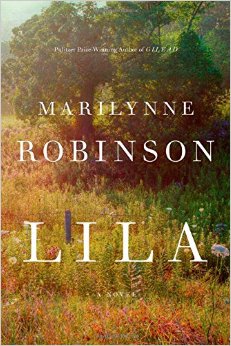
Lila by Marilynne Robinson 616Eizn12dL._SY344_BO1,204,203,200_Robinson read from her new novel, Lila, a sequel to Gilead and Home, all three set in Iowa.  She is a superb reader, and chose a dramatic scene with a lot of dialogue.  Lila, the heroine, who eventually marries Reverend Ames, the narrator of Gilead, converses with a homeless boy who has found her money under the floor of a shack.

Like Silas Marner, I thought. But it is only $40, which has taken Lila a long time to save.  Lila tells the boy he can keep the money and offers him a place to stay because the shack is cold.  The boy says he is a killer, and wonders if she has ever known a killer.  She says she has.  She knew a woman who killed her abusive husband.

I have not read Lila (the publication date is Tuesday), but the novel, or at least parts of it, are set during the Depression. Both Lila and the boy are drifters.  Lila, neglected as a child, was eventually kidnapped by the well-meaning Doll, another drifter.  And, homeless in Gilead, Iowa, years later, Lila makes friends with Reverend Ames, who is simply besotted with her.

After the reading, Robinson had a “conversation” with her former student Ayana Mathis, whose novel The Twelve Tribes of Hattie was an Oprah club selection.  Unfortunately the theater was pitch-dark, so I could not take notes.  Apologies for anything I got wrong.

Mathis was a bit nervous (she seemed in awe), and her questions were really comments on literature rather than straightforward questions.

Poverty is an important issue in Lila.  Mathis asked about the difficulties of describing the extreme poverty during the Depression, and Robinson replied that there is also extreme poverty today, only it is taboo to mention it.  She says that every time she gives an interview, she can count on her remarks on poverty not appearing in the article.

She dedicated Lila to Iowa, and says that she has learned a lot from living here. After researching a subject, she usually concludes that everything she has thought and most of what is written is wrong.  She says that because Iowa is a flyover state, very few people know anything at all about it.  She says that is also true of northern Idaho, where she grew up.

Here is an approximate quote from Robinson:  “They think they know everything about it BECAUSE they’ve never been here.”  There was much laughter.

She added that the University of Iowa was the first university to give an MFA to an African-American woman:  the sculptor Elizabeth Catlett, in 1940.

“That’s very Iowa,” she said.

When she researched the history plays of Shakespeare for her dissertation, she concluded that everything written on the subject was wrong.  But she wrote 300 pages anyway, “all of it wrong,” she said.

Many of her essays deal with religion, and it’s clear that the intellectual Christians had flocked to the theater. During the Q&A period, someone asked a question about divinity in literature.  (And I’m sure the question was a great deal more complicated than that, but I couldn’t quite hear it.)  She says that Rev. Ames is her Northern star (or perhaps she said lodestar) for Christianity, despite his faults.

She spoke of small acts of kindness being examples of the divine.

“We never know why things happen,” she says.

Amen.

A woman mentioned that Robinson was compared to Dostoevesky and Tolstoy in Joan Acocello’s excellent review of Lila in The New Yorker.

Robinson seemed a bit confused by this.  “A writer compared me to these other writers?  I’m always glad to be in good company.”

Somehow I thought of Doris Lessing, my favorite writer.  I never heard her speak, and I wish I had.  Both Robinson and Lessing are great independent thinkers, powerful women.

Robinson will be reading and speaking in the U.S. and England this fall, so check your newspaper’s listings.

What’s Wrong with New Books & Books We’d Like to See in Print

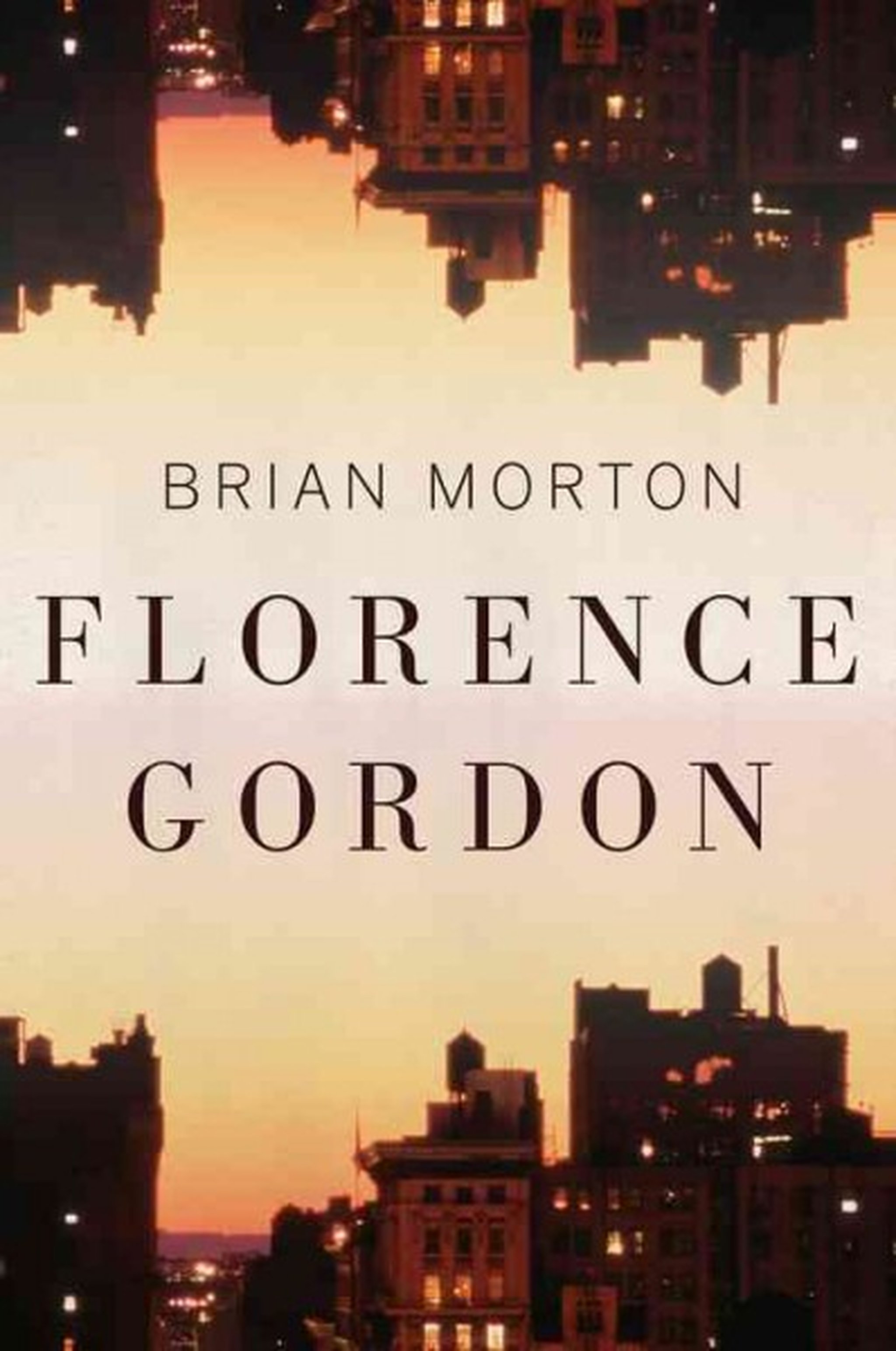
Biran Morton's Florence Gordon 9780544309869_custom-a7883da3ea029954586e04a85f3180c5665f5f17-s99-c85Recently I read Brian Morton’s entertaining new novel, Florence Gordon.

This gracefully-written novel begins well, but it quickly morphs from the point of view of Florence, a  cranky 75-year-old feminist intellectual, into a multi-generational multiple-POV soap opera about a family beset by the problems of long-distance romance and infidelity.

It’s awfully demure, considering the brilliance of this writer.

All right, it is a good read.  Many of you will enjoy this.

It is certainly a stand-out among the many unimpressive new books I read in September.  It even made me cry.

And yet I thought it could be better.

Some of the chapters are very short, less than one page.  I didn’t admire that trendy brevity.

And the characters are flat.  Florence’s son, Daniel, a cop, is likable but boringly stoic, and Janine, his skittish psychologist wife, wants to have sex with her boss, and that’s pretty much her raison d’être  (But can she type?)   Only their daughter, Emily, a thoughtful girl who learns how to take care of herserlf from Florence’s example of belligerent selfishness, seems worthy of her brilliant grandmother.

I wondered briefly if the editor dumbed down the book.

A few years ago, Margaret Drabble told the Telegraph she worried about dumbing down.  “I have had a weird feeling that I’m being dumbed down by my publishers and it’s interesting there’s an agenda of how it should be in the marketplace.”

I don’t worry about Margaret Drabble’s being dumbed down:  she changed publishers.

Are the problems with new books due to mediocre writing, or bad editing?

Those of us who aren’t in the publishing industry have no idea.

Does the publishing industry know what readers want?  I don’t think so.  Perhaps we’re tracking down old books on the net or turning to reprint presses because we’re looking for something different.

Below is a short list of worthy out-of-print books I’d like to see reissued. I’m not saying these are classics.  They’re certainly not better than Brian Morton’s book. But they’re pretty good books.

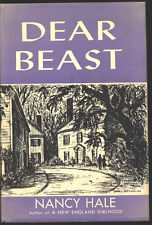
Dear Beast hale mUTvjMztFkfn7v-gZI9ypBg1.  Nancy Hale’s Dear Beast. Set in the South and New York, this lively comedy is the story of Abby Daniel, an unhappy housewife who writes a novel about life in a small town like Starkeyville, Virginia, where she lives unhappily with her bitter husband, an over-educated bookseller.

When her anonymous book becomes a best-seller and a Life photographer comes to shoot photos of Starkeyville, Abby cannot resist admitting she wrote the book.  But no one in Starkeyville acknowledges to Abby that they read the article in Life.  So she moves to New York…

Nancy Hale, the first woman reporter for The New York Times and a frequent contributor of short stories and autobiographical pieces to r, had illustrious ancestors. She was the daughter of two painters, Philip L. Hale and Lilian Westcott Hale, the granddaughter of Edward Everett Hale, author of The Man Without a Country, the great-niece of Harriet Beecher Stowe (Uncle Tom’s Cabin) and Lucretia Peabody Hale (The Peterkin Papers), and a descendant of Nathan Hale.

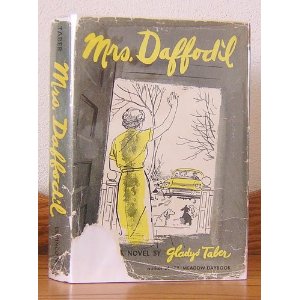
2.  Gladys Taber’s Stillmeadow books and Mrs. Daffodil.

stillmeadow-roadThe Stillmeadow books are collections of columns and essays about Gladys Taber’s life in a 1690 farmhouse in Connecticut.These slight, charming essays are not in the same league as Wendell Berry’s or Annie Dillard’s, but they are plain, restful observations of the country that will delight those of us who understand there is no such thing as a quiet life in the country. Move to the country and you will appreciate nature, but it will not prevent the well from drying up, the septic tank from leaking, or the dishwasher’s breaking. Taber balances her lyrical vignettes about the changing seasons with wry descriptions of skunks living under the storage house, and her forgetting where she buried the jar of homemade brandied peaches (a treatment that was supposed to improve their quality).

Taber (1899-1980), who graduated from Wellesley and earned a master’s at Lawrence, wrote 50 books and was a columnist for Ladies’ Home Journal and Family Circle. According to one online article, she and her husband bought Stillmeadow, a country house, in 1943 with another couple.

taber mrs-daffodilI also love her autobiographical novel Mrs. Daffodil.  Like Taber, the heroine, Mrs. Daffodil, writes a syndicated column called “Butternut Wisdom.” She also writes short stories about young love, because she has discovered people are more interested in love stories than they are in stories about ordinary older people like herself. And through this writing, she supports herself, her married daughter and graduate student husband, and her housemate, Kay, a widowed college friend who agreed to share the country house after her husband died.  This is a very, very funny book.  I wish someone would bring it back into print so I could afford it!

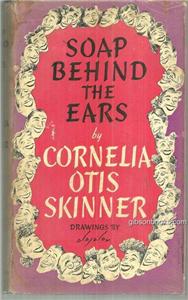
3. Cornelia Otis Skinner (1899-1979), an actress and writer, is perhaps best known for the book she co-wrote with Emily Kimbrough, Our Hearts Were Young and Gay, a hilarious memoir of their trip to Europe after college.

skinner soap behind the ears 674925900_tpSoap Behind the Ears is one of her best collections of humor pieces and parodies. I love her parody of For Whom the Bell Tolls, surely Hemngway’s worst novels.  In “The Defense of Long Island,”a piece vaguely reminiscent of E. M. Delafield’s The Provincial Lady in Wartime, patriotic American women worry about the defense of Long Island at the beginning of World War II. They go door-to-door with questionnaires, and, as Skinner tells us, “are frantically engaged in an activity they call doing ‘something about’ it.” In “A Bicycle Built for One,” she describes a disastrous experience on a bike with no brakes.  In “The American Quest for Tea,” she writes about the inability of American hotels to provide good tea.  And in “The Volga Tongue” she  writes about attempting to teach herself Russian by the popular “gramophone” method.

A fun book!

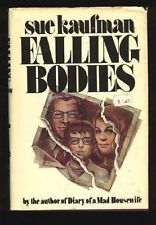
Falling Bodies sue kaufman4.  Sue Kaufman’s Falling Boies.  Kaufman is best known as the author of Diary of a Mad Housewife, an underrated American classic. Her 1974 novel, Falling Bodies, is a sad, mordantly funny novel about a woman whose family is falling apart.

Every chapter starts with a day and time of day, such as, “Monday 8:21 a.m.”   The heroine Emma has lost her mother to cancer, and she has been hospitalized for an FUO, a fever of unknown origin. In the hospital, she witnessed a suicide. A man jumped out of a window and his body fell past her room. Once home, she is terrified that she will see another falling body crash on the sidewalk.

Emma’s family problems are paralyzing, partly because she cannot go back to her social worker job until she has fully recovered from the illness. Since her hospitalization, her husband and son both seem to be having a nervous breakdown. Harold, the vp of a publishing company, has a terror of germs and contamination. And her son is bringing home mechanical parts he finds in trash cans.

Harold and Benjy think Emma is the one who has gone crazy. And she is upset: her mother-in-law has hired a maid from Colombia. And talk about crazy…

I really loved this book, My guess is that it’s more a women’s book–I can’t see my husband’s reading it–but it is a deftly-constructed, often funny story of what happens to a woman under a lot of stress.