Do We Need Book Reviews?

image

I have a lot of books.  So do you, or you wouldn’t be here.  The volumes on my shelves range from Louisa May Alcott’s Little Women to Zola’s The Ladies’ Paradise, from Apuleius’s The Golden Ass to Xenophon’s Anabasis, from science fiction titles at Small Beer Press to  Viragos.

This year I have cut my subscriptions to several book review publications.  Why?  It’s a matter of budget, and it’s a matter of what I need.  Perusing my book journal has taught me that the books I read usually (a) predate this century, (b)  are in the canon, or are neglected classics, and  (c)  have not been recently reviewed.  I do not really need The New York Review of Books, the TLS, or the LRB cluttering up my house.  I have time to read two articles per issue, if that.   We get The New York Times once a week now.  That’s enough.

Most books I’ve read this year were already on my shelves, but there are ten exceptions.  Book news on the internet was often the impetus rather than reviews.

  1. The Misalliance by Anita Brookner.  Impetus:  news of her death.
  2. Fifteen Dogs by Andre Alexis.  Impetus:  news that it won the 2015 Scotiabank Giller Prize and the 2015 Rogers Writers’ Trust Fiction Prize
  3. My Name Is Lucy Barton by Elizabeth Strout.  Impetus:  interview in The New York Times.
  4. Anthony Powell’s What’s Become of Waring.  Impetus: a new book, The Prose Factory, by D. J. Taylor, which I pre-ordered from Amazon before any reviews were out.
  5. MFK Fisher’s The Theoretical Foot.  Impetus:  a column in BookPage (a book promotion paper; this was the closest to a review)
  6. Danielle Dutton’s Margaret the First.  Impetus:  a selection at Emily Books (an online book club)
  7. Catherynne M. Valente’s Radiance.  Impetus:  a science fiction blog
  8. Sheila Kaye-Smith’s The End of the House of Alard.  Impetus:  a Best Book of Year at the Spectator a few years ago.
  9. Kenzaburo Oe’s Death by Water.  Impetus:  Review copy.
  10. Alan Silitoe’s The Loneliness of the Long-Distance Runner.  Impetus:  Review copy.

The internet has raised many questions about traditional publication. Online resources really are cutting my need to subscribe to review publications. Many newspaper book pages are now free on the internet, or at least the first 10 articles are free each month.  Perhaps this is a mistake: I do not know how free articles benefit the publications at all.  Newspapers are closing down all over the country and the employees must be frantic.  I think that is why critics are so elegaic about their careers.  They do not see a future for criticism.  I’m not Cassandra, so I do not know the answers.  It is frightening to see our world change in just a few short decades.

Then there are blogs.  Dovegreyreader has rocked the world of English publishers by selling books worldwide when she is enthusiastic.  How many readers does she have?  Ten thousand a day, I read some years ago?  I love her writer’s voice, but do not often share her taste, so the reading of the blog does not translate into buying theb ook.  I do read the enthusiastic blogs on my blogroll (well, the ones that are not shut down), but  I have difficulty finding out about new ones.  The bloggers I read do not read the newest books:  they read classics, reprints of neglected books, or well-written books by women.  They set aside weeks for reading Virginia Woolf or Hermann Hesse:  very laudable!  Currently the blogger Kaggsysbookishramblings is rereading Dorothy Richardson’s Pilgrimage, and Ellen Moody has recently written on Trollope’s Orley Farm.

And so here we are in the second decade of the twenty-first century, wondering what the fallout will be from my personal decision to cancel some subscriptions.  I hope there will be none.  I hope the internet will be a friendly place for critics and bloggers to co-exist.

Anti-War Lit: Kurt Vonnegut’s Slaughterhouse-Five, Pat Murphy’s The City, Not Long After, & a Top 10 List

“The destruction of Dresden was my first experience with really fantastic waste.  To burn down a habitable city and a beautiful one at that … I was simply impressed by the wastefulness, the terrible wastefulness, the meaninglessness of war.”–Kurt Vonnegut

Vonnegut

Kurt Vonnegut Jr. in 1979.

We live in a violent culture.  Wars, shootings, bombings…

How do we cope?  Most of us can’t.  So we don’t think about it, we knit, cook, and go to movies, and occasionally anti-war classics become comfort reads.  Here is a brief look at two anti-war novels by Kurt Vonnegut and Pat Murphy, followed by a short list of anti-war books.

No anti-war list would be complete without  Kurt Vonnegut’s 1969 novel, Slaughterhouse Five. This satiric novel, immensely popular in the ’60s among draft dodgers and anti-Viet Nam War activists, is his best-known, if not his best  book.  In the opening chapter, Vonnegut says that he has tried for 23 years to write a novel about the fire-bombing of Dresden, which he witnessed as a prisoner of war and survived because the Germans locked the prisoners in a slaughterhouse at night.  He points out that nearly twice the number of people died in Dresden as in Hiroshima.

We read Vonnegut not for his style but for his unusual point of view and inimitable wise-guy voice.  He begins,

slaughterhouse five vonnegut 4120yizU-2L._SY344_BO1,204,203,200_All this happened, more of less.  The war parts, anyway, are pretty much true.  One guy I knew really was shot in Dresden for taking a teapot that wasn’t his.  Another guy I knew really did threaten to have his personal enemies killed by hired gunmen after the war.  And so on.  I’ve changed the names.

At the end of Chapter One, Vonnegut claims the novel is a failure.  But it is not:  it segues into the  story of the anti-hero, Billy Pilgrim, an ineffectual optometry student drafted in World War II and then imprisoned by the Germans.  This improbable soldier has other problems, too:  he has become unstuck in time: his time travel takes him to Ilium, New York, his hometown, Dresden,  and the planet Tramaldore, where all events are simultaneous and he says he has witnessed his death.  Billy is a huge fan of the science fiction writer, Kilgore Trout (who appears in several of Vonnegut’s novels), and his contact with Trout may be part of the problem.  Psychiatrists think Billy is crazy.  But is he?

I plan to reread some Vonnegut this year and will get back to you.

******************************************************************

Pat Murphy

Pat Murphy

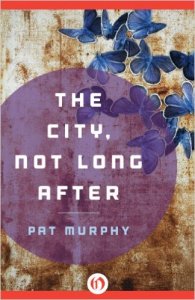
I recently read Pat Murphy’s stunning anti-war  novel, The City, Not Long After.

Murphy is an award-winning science fiction writer who won the Nebula Award for The Falling Woman, which I wrote about here, and founded the James Tiptree, Jr. Award for promoting gender awareness in science fiction, with Karen Joy Fowler.

The City, Not Long After, published in 1989, takes place after the Plague destroys civilization.

San Francisco is now a ghost city, inhabited mainly by artists and a few very smart librarians.    But Mary Laurence, a former peace activist from San Francisco who blames herself for the plague, leaves the city and gives birth to her daughter in an abandoned farmhouse.  She is in such pain that she screams at the ghost of her husband to help her. An angel comes instead, and offers to help if she can name the baby.  But sixteen years on the naming still hasn’t happened.  And so her daughter, the heroine, is referred to as “Daughter’ or, later, simply “the woman,” because the angel still hasn’t named her.

The woman, clearly a predecessor of Catniss in The Hunger Games (perhaps Suzanne Collins read this), learned to make snares, slingshots, and a cross-bow from studying the weapons article in an encyclopedia, and  has helped her mother survive.  She also becomes fascinated by San Francisco after finding a snow globe containing a miniature San Francisco.

As if the plague and fevers weren’t bad enough, a new warmonger, General Fourstar, wants to establish “order” in the West, and after he arrests her mother for entertaining a book dealer (books are outlawed by the army), Mary catches a fever.  When she is dying she  claims she is going to San Francisco, and makes her daughter promise to follow with the news of Fourstar’s planned invasion.  The woman thinks Mary is delirious, but then she sees a flash of the angel.

And so she goes to San Francisco with news of the war, but also to find her mother.

Pat Murphy The City, Not Long After 51SPe3FYPSL._SX322_BO1,204,203,200_Murphy’s style is simple but effective.  Here is a description of the woman’s first sight of San Francisco.

The woman looked toward San Francisco and doubted, for the first time, the wisdom of her journey.  Looking at the city in her glass globe, she had not dreamed that it would be so large and so strange. She thought for a moment of returning to the valley, where she knew the best places for hunting, the groves where quail nested, the meadows where deer came to graze. She shook her head and spurred her horse onward, following the ribbon of freeway.

After they fully understand what the General wants, the artists plan to fight a war without violence., with art installations.  The descriptions of the art installations are gorgeous.

It’s a lovely little book.

AND A SHORT ANTI-WAR LIT LIST (and please let me know your own favorites):

  1. Joseph Heller’s Catch-22
  2. Homer’s The Iliad (best in Greek, but Richmond Lattimore’s translation rules if you’re stuck with English.  There is also a new translation by Caroline Alexander, supposedly the first woman’s translation of The Iliad ever published.)
  3. Pat Barker’s Regeneration trilogy
  4. Vera Brittain’s Testament of Youth
  5. Chang-Rae Lee’s The Surrendered
  6. Jayne Ann Phillips’s Lark & Termite
  7. Joydeep Roy-Bhattacharya’s The Watch (it’s a retelling of Antigone in Afghanistan)
  8. Herman Wouk’s The Winds of War
  9. Virgil’s Aeneid (best in Latin, but there are several good translations:  Richard Fagles’ is excellent,
  10. Bobbie Ann Mason’s The Girl in the Blue Beret (I wrote about it here)

Reading Ovid’s Amores

Livia roman sculpture 498349221

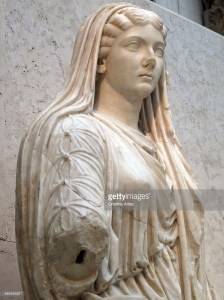
Roman statue of Livia Drusilla, wife of the Emperor Augustus. She would have sat through many poetry readings.

In a previous life I may have been a Roman matron who raptly listened to poetry readings at dinner parties.  Latin was my third foreign language, and perhaps because it was the third I found it easy.  I breezily won the Latin prize in college and was one of two students to pass the Ph.D. Latin exam my year.  Latin is complex and highly inflected, and I quickly realized that some of my very intelligent fellow students enjoyed the study of history or linguistics but were incapable of translation.  We who could translate stuck together (and salute you)!

Throughout my long life, I have been especially fond of Ovid, a brilliant poet who eventually was banished to an island by Augustus for carmen et error (a poem and an error, perhaps one of his racy poems).  He is best known for his epic poem, The Metamorphoses, which is superbly funny and clever and the source of our knowledge of Greek and Roman myths.  It is also one of the few Roman poems that is really wonderful in translation.

Ovid’s love elegies (Amores), addressed to a fictitious mistress, Corinna, are very light and saucy. He is the last of three Roman elegists whose work is extant, the others being Propertius and Tibullus.  Ovid  incorporates the stock themes, style, vocabulary, and situations of elegy.  It seems odd that it would have flourished only in the first century B.C., but its roots are in Roman comedy.  It does not go back to Greek lyric poetry.

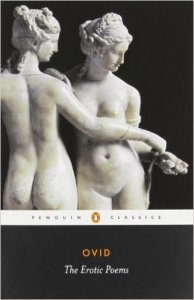
Ovid Amores 419-MO1CbKL._SX320_BO1,204,203,200_Ovid’s elegies in Book I are frivolous and fun.  A love affair with a married mistress is not easy, and we learn it often involves metaphorical chains.   In Amores I.6, the narrator begs a doorkeeper to take the chains (catena) off the door and make a small gap so he can slip in sideways and see his married mistress.  He says he has shrunk so he can do this.  I love the idea of a guy dieting so he can sneak in.

I went on to Amores I.7 , expecting more silliness, but the use of chains in this poem are different.  The narrator has assaulted his mistress:  he asks to be put in chains by any friend who may be present. And it is one of Ovid’s poems that shock us  feminists (we all love Ovid, but scholars have written about  rape in Metamorphoses) because the treatment of the violence is light.  We see it from a Roman male point of view, and there is repentance, but perhaps not very seriously.

Here is the opening of the Latin elegy (my translation is below)

adde manus in vincla meas (meruere catenas),
dum furor omnis abit, siquis amicus ades:
nam furor in dominam temeraria bracchia movit;
flet mea vaesana laesa puella manu.

Here is my literal translation.
N.B. The word order in Latin is flexible, so the impact of the original is very different. (You only get approximations.).

Put my hands in bonds  (they deserve chains)
until all madness leaves, if any friend be here.
For madness moved my rash arms
My girl cries wounded by my raging hand.

The narrator has struck his mistress. Violence against women is common in our society, and against men too, but we do not expect to read a love elegy about it.  The narrator regrets his actions, but his hyperbolic mythical comparisons don’t apply–in fact, they undermine the expression of his sorrow.  He compares himself to Ajax, driven mad by Athena so that he slaughtered sheep instead of the Greek leaders he wants vengeane on.  The narrator’s mistress is like Cassandra, the prophetess who was dragged from a Trojan temple by the Greeks, “except that Cassandra’s hair was bound with a priestess’s headband.”  Ovid has torn her hair, but he adds that she didn’t wear a headband.  And he adds that disordered hair is becoming to her.

And yet we forgive Ovid.  He realizes that if he had struck a Roman citizen, he would have been punished. He mocks himself, comparing himself to a military hero who is celebrated in Rome, where the crowd that follows the chariots will cry, “Oh, a girl has been conquered by this brave man!”

Her face is scratched and her tunic is torn.  It is while he looks at her, pale as a marble statue, that he first began to know he hurt her.  He says her tears are his blood.  But he lightens up again: at the end he advises her to scratch his eyes and tear his hair.

This subject of violence against a woman is common in Roman poetry.  It has also been treated by Propertius and Tibullus.

I must admit, I do not know what to make of this poem.  And I do not know of a very good translation of Amores.  Peter Green’s translation for the Penguin, The Erotic Poems, is adequate but wordy.  Some poetry does translate better than others.