A Swedish Slap in the Face & Five Literary Links

                                                           Five writers who didn’t win the Nobel for Lit.

I love Bob Dylan.

I sang “Idiot Wind” in college during my period; had “Bob Dylan revivals” in my apartment; forgot him during his Jesus freak period;  saw him in concert in early 2000s; and clapped when he won Grammys and an Oscar.

But…I have to say…and I don’t want to offend Bob or any rock stars…  isn’t it a Swedish slap in the American face to give the Nobel Prize for Literature to an American musician?

Dylan wins the Nobel.

Dylan wins the Nobel in 2916.

We have a rich, vibrant literary canon. Think Philip Roth, Joyce Carol Oates, Sharon Olds, Ursula K. Le Guin, Marilynne Robinson, Ann Beattie, Michael Chabon, Jonathan Lethem, Anne Tyler, Louise Erdrich, Louise Gluck, Charles Wright…and so many more.

Toni Morrison deservedly won it in 1994.  No American since.  Now Bob.

I’m flummoxed.

All right, just another bizarre Nobel decision.

And now for five Literary Links!

phone-0m7p7lxsd2w5rke1. Timothy Noah writes at Slate about “The Death of the Phone Call.”  Here’s an excerpt:

It’s a lonely business, this life without telephone calls.

I have a friend named Joe, whom I don’t see often because we live in different cities, and always have. He’s not a close friend, but I like him enormously. I used to phone Joe, or Joe would phone me, a couple of times a year. No particular reason—we’d just check up on each other, exchange a bit of gossip, talk about politics or journalism or our families. I saw Joe recently at a party, along with his second wife and their young son, and was caught up short when I realized that I had no idea what their names were. I had no idea because Joe and I had stopped phoning each other sometime around, well, 2007. When I introduced myself to Joe’s wife (her name turned out to be Dawn) I noticed that my name was no more familiar to her than hers to me.

2. Top 10 books about intelligent animals at The Guardian.

3.  Michael Dirda writes about Ursula K. Le Guin at The Washington Post: “At 86, Ursula K. Le Guin is finally getting the recognition she deserves — almost”

4. Mary Beard considers  Cicero and Clodius, among others, in “What Is a Demagogue?” at  “A Don’s Life,” at the TLS.

5. Gubbinal at Slouching towards Senescence writes about The Fall of the Magicians by Weldon Kees, a Nebraskan poet I’ve never heard of.   She says, “Kees was one of the stranger blokes of the 20th century poetry world and also among the best.”

I love Nebraska lit and can’t wait to read this!

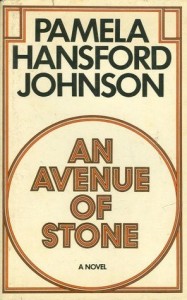
The 1947 Club: Pamela Hansford Johnson’s An Avenue of Stone

1947-club-pinkKaren of Kaggsysbookishramblings is a voracious reader, a sociable blogger, and an indefatigable co-organizer of “The 1947 Club.” What is the 1947 Club? Bloggers and other readers agree whimsically to read and post on books published in 1947–any and all books published in 1947!

It is not so much that I’m unsociable as absent-minded, so I was pleasantly surprised this year when I managed to read a couple of Viragos for Virago month and two books for Women in Translation Month. “So, Go for it, Kat!  You can read a book from 1947,” I told myself.  So It’s  halfway through the 1947 week, and I was about to embark on a book published the wrong year. Yup.  I have this thing:  dyslexia with numbers.

Now that I’m on the right year, I would like to recommend one of my favorite books of 1947 (and of all time), An Avenue of Stone by Pamela Hansford Johnson.

If you don’t know Pamela Hansford Johnson’s stunning novels, you are missing out.  Best known as Dylan Thomas’s girlfriend and C. P. Snow’s wife, she had enough talent and merciless observations to put those two boys in the shade.  A few years ago  I interviewed her biographer Wendy Pollard here.  I appreciated Pollard’s serious work and hope it revived interest in Johnson.  And it is a very good sign that Bello Pan has reissued Johnson’s books in paperback and as e-books.  (Unfortunately the e-books aren’t available in the U.S.)

avenue-of-stone-johnson-my-picture-img_0067-copyingAnd now I am going to cheat a bit by posting old notes on An Avenue of Stone from 2009.

Pamela Hansford Johnson’s Helena trilogy, of which An Avenue of Stone is the brilliant centerpiece, shows Johnson at the height of her powers.  The first book in the trilogy, Too Dear for My Possessing (1940), is a coming-of-age novel:  Claud, the narrator, bickers with and competes against his beautiful, controlling, often wicked stepmother Helena.  After his father’s death, his life is inextricably intertwined with Helen’s, for better or worse.

an-avenue-of-stone-johnson-ebook-9781447215578an-avenue-of-stone-400x0x0To read the second novel first, An Avenue of Stone (1947), is both an advantage and a liability.  Each novel is self-contained, so the order doesn’t matter.  And I loved An Avenue of Stone so much that I went on to read the other two. Johnson says in the introductions to the American reprints that she was learning her craft when she wrote the first book, Too Dear for My Possessing (1940).  The second and the third novels, An Avenue of Stone and A Summer to Decide, published in 1947 and 1948 respectively: “So, between books 1 and 2, I had seven years of learning to write…

She continues in the intro to Avenue, “I was no longer giving way to a too-easy romanticism; I was able to give the book a rather more solid structure.”

An Avenue of Stone is an unforgettable masterpiece. In this brilliant novel, set at the end of World War II, the narrator, Major Claud Pickering, an art historian and writer, describes the volatile relationships of his stepmother, Helena, amidst the deprivations of rationing and the disintegrating class boundaries of the postwar society.

The novel begins with Helena’s ramblings about class.

“As a class,” Helena said, “we are doomed…”

avenue-of-stone-johnson-american-4616293Helena, a former chorus girl who married into the upper class and has established herself as a glittering hostess, loves to talk about the rebellion of the proles. As the novel begins, the sixty-something Helena is entertaining guests with outrageous complaints about the collapse of society, illustrated by exaggerated anecdotes about rude bus conductors and insolent shop girls. After her second husband, Lord Archer, dies, leaving the majority of his money to Helena’s daughter, Charmian, and, shockingly, to his former lovers, Helena can no longer live on the grand scale to which she is accustomed. She is persuaded to let her hunky chauffeur go and move into an apartment with Claud and Charmian. Helena, unused to living without admiration, becomes vulnerable to a kind of asexual love affair with Johnny Field, an irritatingly self-denigrating young man, whom Claud introduces into the household, assuring her that Johnny needs rest and “does nothing but read.”

At first she uses Johnny as a lackey to pass appetizers at parties and install linoleum at her cottage , but later she is fascinated by him and insists that she can’t live without him. Claud and Charmian can’t bear the situation and move out. Johnny the unlikely gigolo, is, surprisingly, a magnet to older women. One of Lord Archer’s former lovers, Mrs. Olney, a lamp shade maker, also tries to lure him to live with her.

Claud’s observations of this unlikely triangle are the center of the novel. But his wry observations keep him in the forefront, and it is for his voice that we read. This very slightly reminds me of Anthony Powell’s novels.

In Which I Discover I Have the Same Notebook as Miss R in Peter Stothard’s “The Senecans”

senecans-stothard-51dv9clhtalI am  behind on book blogging, as some of you may have noticed, whether because of the recent trip to London or the waning of light–who knows?  And I am also behind on reading new books.  (I do intend to read one a week.).  Right now I am in the midlle of Peter Stothard’s engrossing book, The Senecans:  Four Men and Margaret Thatcher.

Stothard, a former editor of the Times Literary Supplement and The London Times, is not only a journalist but also an Oxford-educated classicist who has written two other  brilliant books, Alexandria:  The Last Nights of Cleopatra and On the Spartacus Road. I come to this book through my love of classics, but many will be drawn to the history and politics.  In this gracefully-written memoir,  he recounts his fascination with Nero and Seneca and compares Thatcher to Nero and at least one of her advisors to  Seneca.  (As a young editor at the Times, he met with them regularly.)

The catalyst for the book is, in part, a series of interviews by a Miss R., a young historian researching the Thatcher era.  She questions Stothard about his journalistic relationships with Thatcher and her advisors Stothard’s prose is always sharp, observant, and often lyrical. (More about this next week.)

He is also witty and often very funny.  I burst out laughing when Miss R. shows up at Stothard’s office with a new notebook labelled Seneca..

When Miss R arrives today she is most pleased by her own notebook, smug I would say but don’t.  This is not a new electronic device.  She holds it so that I can see the printed name, with a stamp from Foyles bookshop, SENECA, its cover page orange and the next place lemon, both colours faintly silvered.  The printed letters of the name are blue-black, the colour of her nail varnish.  SENECA belongs to one of the bookseller’s SCHOOLS OF THOUGHT.

I have the same notebook!  Well, almost.

I couldn’t seem to get out of  Foyles. I bought two  of these small School of Life notebooks. Why?  They remind me of the blue books we wrote exams in. (I always liked the look of those blue books.)

I didn’t find Miss R’s Seneca notebook, but I have Heidigger and Caulfield.

I love notebooks.  I have so many.

Here are some other notebooks I have loved:

The Semikolon notebooks are a tiny bit bigger than the School of Life.  They also fit in a purse.  I used the purple when I tutored a Greek student.  And I took notes in the orange notebook during my mother’s hospitalization a few years ago: “She seemed depressed today.  She didn’t want to cooperate with the PT.  She stopped in the hall after about 10 feet and said she wanted to rest.  The PT said, “Two more rooms and we can rest, okay?”)

I love the paperback Apica notebooks.  The “Ideas for blog” notebook had a a few ideas for a blog, then turned into a bicycling journal.

I used the Miquelius 4 notebook to prep for an adult ed Latin class a few years ago.  (I am teaching indirect statement–which you can see if you can read my indecipherable writing.  And if you can read it, I’ll give you a free book.)  The smaller one is full of lists.

I have so many notebooks.  Too many notebooks.  What is your favorite notebook (if there is a brand)?

Autumn at Last: Virginia Woolf’s The Years & Peter S. Beagle’s Summerlong

Finally autumn.

Finally autumn.

It has been a warm green autumn.  The leaves are finally changing, or at least some of them are.

bike-on-bike-trail-in-autumn-fall

Still greener than usual, but it’s lovely.

These days I try to grab the beauty of the moment. I try not to think much about the future. The climate has changed so quickly.  We’ve known about climate change since–when?–the ’50s?

Still greener than usual on the trails, but I admit it’s lovely.  Very warm, though.

Meanwhile…

Here’s what I’ve been reading:  Peter S. Beagle’s Summerlong, Virginia Woolf’s The Years, Stevie Smith’s Novel on Yellow Paper (to be reviewed later, or tbrl), Anita Brookner’s Visitors (tbrl), Elizabeth McKenzie’s The Portable Veblen (tbrl), and Winston Graham’s Jeremy Poldark.

summerlong-beagle-474760Tonight I’m writing about Peter S. Beagle’s Summerlong and Virginia Woolf’s The Years.

Seasonally appropriate and socially pertinent is Peter S. Beagle’s new novel, Summerlong. Beagle, the winner of the Locus, the Hugo, the Nebula, and the Myythopoeic awards, is best-known for his ’60s fantasy classic, The Last UnicornI also very much enjoyed his novella, Lila the Werewolf, and I See By My Outfit, a travel memoir of his cross-country motorcycle trip in the ’60s.

His strange new urban fantasy, a retelling of the Persephone myth, set in Seattle and on an island on Puget Sound, is about climate change:  it explores fertility, flowerings, harvest, and death.  He portrays a magical spring and summer, caused by a divine contretemps between Persephone and Hades.  Persephone has left her husband Hades, is hiding out in Seattle, and is working as a waitress. As you can imagine, both Hades and her mother Demeter are searching for her.

But the gods are in the background, beings from another world.  Beagle focuses on the human protagonists who mirror the gods:  Abe, a retired history professor and a blues fan, and  Joanna, a fiftysomething flight attendant who loves basketball and is tired of flight.  The two have been lovers for decades.  Abe lives in a house on Gardner Island while restless Joanna has an apartment in Seattle.  Her dream?  To go kayaking and camping, even though she cannot swim. She also worries about her daughter, Lily, a lesbian who makes bad decisions about relationships.

Botticelli's Primavera

Botticelli’s Primavera

One night, when Abe and Joanna are eating dinner at the Skyliner diner, Abe is struck by the resemblance of Lioness, their smart, savvy, beautiful waitress, to Botticelli’s Primavera. Before you know it, Abe has invited Lioness to move into his garage, and  the beautiful spring on the island is magically extended into summer and fall, with flowers from all seasons blooming at the same time. Abe and the neighbors observe some odd scenes:  Lioness talks to a lost baby orca; she also teaches the neighborhood children how to pick flowers from different seasons out of a hole in the earth.  (Then she tells them they cannot.)  Some wonder if she is a witch.

Abe and Joanna bloom, too.  Abe begins to play harmonica with a blues group, and Joanna takes kayaking lessons.  But Lily falls in love with Lioness, and Joanna meets Lioness’ mother at the market and a mysterious man who rides the ferry back and forth…

Here is a beautiful description of the magic climate.

Even stranger than having their  own exclusive climate was the fact that Joanna had no sense at all of the summer passing. Well into June and early July, the air still kept the soft green taste of April, and the constant smell of damp grass and earth, even when there had been no rain. The rain came as regularly as in Seattle, but on Gardner Island it fell at dawn, leaving the day glittering behind it, or in the night, steadily, but so lightly that the mist had all evaporated by morning. Leaves that should have begun to change color by now, and even to drop, showed no such inclination; the rhododendrons framing the Yandells’ house were blossoming more explosively than ever, and Joanna’s own new-planted fuchsia bush already looked as maturely established as they.

This book is very slight but lovely.   Occasionally Abe and Joanna’s encounters with the gods  are jarring,  but the blurring of boundaries between the triangle of gods and humans is very sophisticated.  I think this is worth a second read.  I am adding it to my collection of retold fairy tales and myths.

Here are a few impressions of Virginia Woolf’s The Years.

virginia-woolf-the-years-penguin-51g4k2w4c5lPublished in 1937, it was Woolf’s most popular novel, but unpopular with the critics.  More conventional than many of her books, it is a family saga, yet also a vivid, searching exploration of the vicissitudes and significance of everyday life. The narrative is broken up by  stream-of-consciousness and painterly descriptions of London.

Some critics consider it a failure.  What exactly is a failure when Woolf writes? Woolf questions the conventional trajectory of life through her characters’ impressions and soliloquies. I consider The Years a cross between the well-plotted realism of John Galsworthy  (much criticized by Woolf in her essay “Modern Fiction”) and D. H. Lawrence’s lyrical radiance and brilliance.  (This makes it both deliciously readable and offbeat.) And Woolf suggests the sense of the passage of time, as she does in To the Lighthouse.

It tells the story of fifty years in the life of the Pargiter family in London. Each chapter is headed by a year.  In the first chapter, “1880,” Colonel Pargiter’s wife is dying:  he goes to the club and visits his mistress, Mira.  And while his daughter  Eleanor, a  vibrant spinster who keeps the family together and works for a charity, deals with her mother’s illness and death, her father and siblings are repulsed by the smell of decay and try to go their own way. (The Colonel and the teenage Delia are glad when Mrs. Pargiter is finally dead.)  But family life is cheerful:  they have a kettle that won’t boil, and there is much humor over waiting for the kettle.  Milly tries to fix the wick with a hairpin; Delia crossly says it will do no good.  One by one the others trickle in.  Martin sits in his father’s armchair, and gets up hastily when the Colonel come s in. Rose has a dirty pinafore, and is rebuked:  after dark she sneaks off to a shop by herself and is terrified.

the-years-woolf-51vuxnu0fplThe years pass.  One by one the Pargiters leave home, but through the years Eleanor stays and looks after her father.  She is very independent, though, volunteering to help the poor and organizing charities.  Throughout her life she has a strong connection to her siblings, cousins, and their offspring, though they fled the nest as soon as possible.  They are a diverse bunch: Edward, a classicist at Oxford, Rose, a feminist and political activist who goes to prison, Martin, a banker, Morris, a barrister.  Then there is their cousin Kitty, who escapes the burden of growing up in Oxford and the pressure to be a female scholar by marrying a rich lord but continues to meet with Eleanor about charity. Cousins Sara (Sally) and Maggie are a generation younger than Eleanor and are poor after their parents’ deaths. Rose is shocked when she visits their cheap rented rooms.  Maggie eventually marries.

There are many, many more Pargiters.

One of my favorite passages is in the chapter “1914”:  Kitty rides a train to the country after hosting a stressful dinner party.

…One’s not a child, she thought, staring at the light under the blue shade, any longer.  The years changed things; destroyed things; heaped things up–worries and bothers; here they were again.  Fragments of talk kept coming back to her; sights came before her.  She saw herself raise the window with a jerk; and the bristles on Aunt Warburton’s chin.  She saw the women rising, and the men filing in.  She sighed as she turned on her ledge.  All their clothes are the same, she thought; all their lives are the same.  And which is right? she thought, turning restlessly on her shelf.  Which is wrong?  She turned again.

The years in the novel are 1880, 1891, 1908, 1910, 1911, 1914, 1917, 1936.  I am sure some have studied the significance of these years.  Not I!

It ends with a family party.  Woolf obviously loved parties. She wrote about them so well.  I loved the book.

Foraging at the Planned Parenthood Book Sale

planned parenthood book sale 635787938090989435-dmrdc5-5c0tm3808qq457a6n6a-originalShopping at the Planned Parenthood Book Sale in Des Moines is a family tradition.  My grandmother went to the sale in the ’60s, and I envied her 19th-century editions of Thackeray’s Henry Esmond and George Meredith’s Diana of the Crossways. My husband and I have faithfully attended the sale since moving back to the Midwest.

Founded in 1961, the Planned Parenthood Book Sale is held twice a year in the 4-H Building on the Iowa State Fairgrounds.  I have found Viragos, an almost complete set of Trollope, and out-of-print books by Lawrence Durrell, Angela Thirkell, Dorothy Canfield Fisher, Alice Adams, Robert Graves, Margery Sharp, Violet Trfusis, Edna Ferber, and on and on.

Last night was Opening Night.  The scouts had already picked over the books.  Truly, there were gaps in the classics section and the books were already leaning.

If you don’t find something right away, you keep going.   We found a few classics, some literary novels, vintage mysteries, SF, family sagas, and so on.  Honestly?  This collection looked very like last spring’s, which makes me wonder what happens to all the books we donated over the summer.  It needs an infusion of new old books.

Here’s what I found, after hours of going through what felt like every book in the fiction section.  (Of course I didn’t mind.)

augustus-john-williams-22086279Many of you know John Williams’ Stoner, a Willa Catherish novel about a modest English professor with an unhappy marriage and a career stymied by departmental politics.  What you may not know is that his historical novel Augustus, told in the form of documents, letters, and memoirs, is even better. It won the National Book Award in 1973.  I read this long ago but didn’t have a copy, so this was an exciting find.

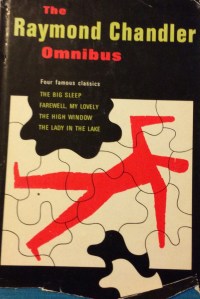
raymond-chandler-omnibus-planned-parenthoodOddly, I’ve never read Raymond Chandler.  This Raymond Chandler omnibus includes The Big Sleep, Farewell, My Lovely, The High Window, and The Lady in the Lake.

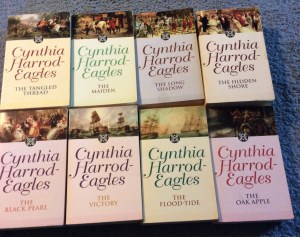
planned-parenthood-cynthia-harrod-eagles

Bloggers have praised Cynthia Harrod-Eagles and I hope the Morland Dynasty books are historical novels a la Poldark rather than romances.  (I actually bought a huge pile of them, but I can’t fit them in one picture.)  It was a pity buy, so let’s hope they’re fun. Even if they’re fodder for Little Free Libraries, that’s okay.

planned-parenthood-ford-and-jhabvalaI have never seen this novel by Ford Madox Ford.  I idolize Ruth Prawer Jhabvala, a novelist best known for  her screenplays for the Merchant-Ivory films, so was pleased to find this early novel. I cherish the thought of spending time with Jhabvala again.

planned-parenthood-adams-and-kittle

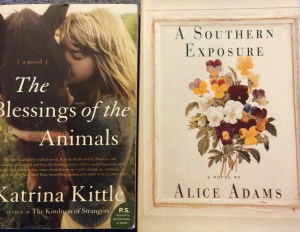
Katrina Kittle’s graceful novels are good reads, even though issue-oriented. And, on a different note, Alice Adams’ stunning literary novels (also praised by Tony’s Book World) are out-of-print so I was thrilled to find this book for only $1.  (It has never been read!)

planned-parenthood-mcewant-and-bender

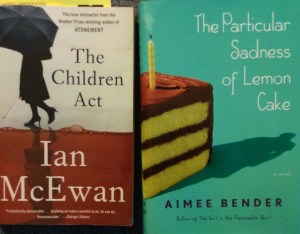
I’m behind on my Ian McEwan reading, and Aimee Bender’s The Particular Sadness of Lemon Cake was well-reviewed a few years ago.  (She is the sister of the brilliant Karen E. Bender, whom I interviewed here a few years ago.)

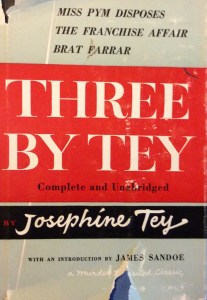
planned-parenthood-teyHow can you go wrong with an omnibus of Josephine Tey?

planned-oryx-and-crake-atwood

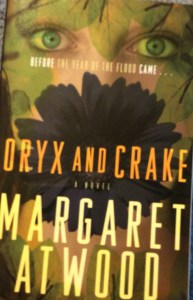
I’ve been planning to read Atwood’s SF trilogy and here’s the first book.

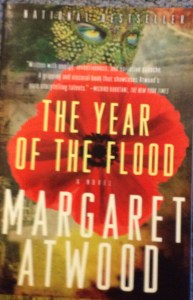
planned-atwood-the-year-of-the-floodAnd here’s the second book.

Yup, Cathy Guisewite is my favorite cartoonist.  I have so much in common with Cathy.  The eating, the shopping, well, maybe not the shopping, but feeling the social pressure of being a woman in the twentieth century….  Well, I know it’s the twenty-first cnetury, but Cathy got canceled!

the-other-by-thomas-tryon-9780449226841-uk-300This horror novel by Thomas Tryon, an actor turned writer in the ’60s, has been reissued by NYRB.  An eerie novel about twins.

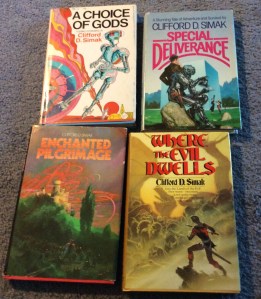
Book club editions of Clifford D. Simak.

Book club editions of Clifford D. Simak.

Clifford D. Simak, an American science fiction who won three Hugos, a Nebula Award, and was name SFWA Grand Master, is neglected these days, but his work is very good.  He is best-known for City, a poignant novel about robots and talking dogs.  He has a thing about robots, and, as so often in literature, they are more human than humans.  My favorite of his books is They Walked Like Men, a very witty, very original novel about a journalist who discovers, with the help of a talking dog, that Earth’s real estate is being taken over by aliens.  (I wrote about it here.)  I know nothing about these “new” books, except they are some of his later books, and I have heard those are uneven.  Each book was only $1, so if it’s fodder for Little Free Libraries, that’s okay.

And there were a few I didn’t get around to taking picutres of.

Another box of books to add to the other boxes of books…

The Winner of the Giveaway of Mary Stewart’s Novella Is…

wind-off-the-small-isles-stewart-51fyyphh5tlJennifer!  Congrats!  I drew your name out of the “hopper,” i.e., bag, and am sure you’ll enjoy the book.  Send your address to mirabiledictu.org@gmail.com

Better luck to the rest of you next time!

Seneca on Reading & Feminism on Dancing with the Stars

I have been rereading Seneca, one of my favorite Roman philosophers.  As you can imagine, I am fascinated by his views on reading.  He tells us to read the greats and not to buy  too many books.  If you need to build a book shed in the backyard, as critic Michael Dirda says he did,  Seneca will solve your space problem.

seneca-letters-from-a-stoci-97411In Letter II in the Penguin edition of Seneca:  Letters from a Stoic (translated by Robin Campbell), Seneca says,
A multitude of books only gets in one’s way.  So if you are unable to read all the books in your possession, you have enough when you have all the books you are able to read.  And if you say, ‘But I feel like opening different books at different times,’ my answer will be this:  tasting one dish after another is the sign of a fussy stomach, and where the foods are dissimilar and diverse in range they lead to contamination of the system, not nutrition.  So always read well-tried authors, and if at any moment you find yourself wanting a change from a particular author, go back to ones you have read before.

Good advice:  but I love having a multitude of books!   Many bloggers read two or three or several books in a given period, switching from one to the other, and then back again.  (We’re reading like book review editors.)  Did Seneca predict twenty-first century ADHD?  Was there ADHD before it was invented?  Or do we modern readers simply read as many books as possible to compensate for online diversions?

FEMINISM ON DANCING WITH THE STARS. 

Rose talking to Hough.

Rose (in black) talking last night to Hough (in pink) about body-shaming.

Dancing with the Stars pits celebrities you’ve never heard of with  their pro partners against other celebrrities.  (The Olympic athletes are the only ones I know.)

In the “video packages” before the dances (and why not call them “videos?”), editors shape our view of the stars.  Some are presented during training sessions as whiny prima donnas, others as gracious and charming, still others as outrageous bad boys and girls.

Yes, it is fun; it is also trashy.   Scantily-dressed women shake their booties (literally last week to a song called “Shake Your Booty”) while men keep their pants on but bare their waxed chests.  If you’re a Second Wave feminist like myself, you believe it is degrading for women to wear the skimpy costumes that define them in these dances.  On DWTS, feminist values are reversed:  all dances must be “hot,”as they have said for several seasons, or “sexy,” a disyllabic word they have all mastered.  To be fair, judge Bruno Tonioli has a colorful, sometimes extensive (ahem!), vocabulary!

But the director is taking the show in a trashier direction this season.  Now we hear the judges’ private conversations  and the pros’ coaching during the dances. It was only a matter of time before there was a conflict.   One of the stars, Amber Rose, a talk show host, told judge Julianne Hough that she felt “body-shamed” when Hough remarked last week to the other judges that Rose’s dance made her “uncomfortable.” Poor Rose was stuck dancing to “Shake Your Booty.”  Yup.  That was her degrading assignment.  Rose wiggled her butt over and over and over.  It was like Pole Dancing Night, sans pole.

Why did we see this conflict on the air?  I don’t like squabbles on TV.  It was like a scene from Valley of the Dolls, where women are valued only for their bodies and are terrified as they age. Frankly, these beautiful young women haven’t got the faintest idea what  body-shaming is-yet.

Bit Rose made a good point.  She said all the “girls” are scantily dressed, and she felt she was singled out because of her body. (And she was:  they gave her the humiliating song because she has a voluptuous butt.)  She also said she was afraid she would be considered too “sexy” if she did much more than wiggle

Refusing to dance to some of these songs, because they are sexist, or to wear those costumes, would be a good start in squashing the body-shaming.  But you don’t know that when you’re young.

P.S.  Amber Rose’s dance with Maks was stunning last night. She deserved higher scores.

Mesmerizing Books to Read While Traveling: Muriel Spark’s Robinson & Elizabeth Jane Howard’s After Julius

reading-on-train-xtravel-jpg-pagespeed-ic-ujk3mh4q1o

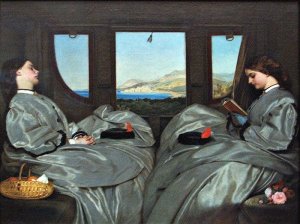
“The Travelling Companions” by Augustus Egg (1862)

No one tells you how dull travel is!  When you’re not looking at art or getting lost in foreign cities, you’re sitting in airports or hotels.  You read and read, which is a good thing, but it must be the perfect book under these circumstances.  It must be short or sassy!

Here’s what I read on a recent trip:

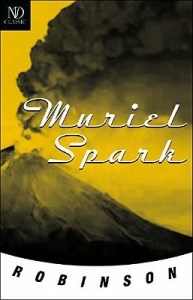
robinson-spark-1201571. Muriel Spark’s Robinson.  The incomparable Spark is bold, witty, and acerbic, one of the most polished stylists of the twentieth century.  I recently discovered her novel Robinson, a modern riff on Robinson Crusoe, which is so blessedly short (178 pages) that I earmarked it for vacation.
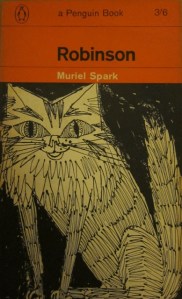
The novel opens with the narrator January Marlowe’s memories of her escape from a fiery death in a plane crash.    She was one of three survivors of the crash on a tiny island  owned by a the eccentric, wealthy Robinson, a mystic who rebelled against the dogma of the seminary.  His sidekick, Miguel, is an orphan whose father, a migrant worker, died while picking Robinson’s pomegranates.

Spark wickedly begins this sassy novel:

If you ask me how I remember the island, what it was like to be stranded there by misadventure for nearly three months, I would answer that it was a time and landscape of the mind if I did not have visible signs to summon its materiality:  my journal, the cat, the newspaper-cuttings, the curiosity of my friends; and my sisters–how they always look at me, I think, as one returned from the dead.

robinson-spark-holiday-2012-014The problem with being stranded is not so much the loneliness as the fellowship.  January is a devout Catholic with a sense of humor who often prays with her rosary, while strict Robinson grimly disapproves of religious relics. Suave Jimmie, another survivor, is a charming conversationalist who shares his secret flask of brandy with January and obligingly helps out with chores.  Odd man out is Tom Wells, the survivor we love to hate as he plots to gain ascendancy in the hierarchy on the island.

Robinson suspects Tom is a blackmailer: he accuses Robinson of stealing his important papers, i.e., proofs for a New Age magazine. He also sells lucky charms of dubious provenance.  And, as Robinson disapproves of the rosary, you can imagine what he thinks of lucky charms.

Then  Robinson disappears.  What will happen?  Will Tom take over?  And there is much to consider:  religion, politics, survival, hierarchy…

So much fun to read!

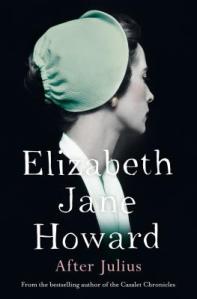
2. Elizabeth Jane Howard’s After Julius.  Howard’s “literary-pop” fiction is gorgeously-written while at the same time her plots sizzle with love affairs and upper-class family drama.  I have enjoyed several of her books, especially the Cazalet Chronicles.

elizabeth-jane-howard-081b7fa0-73f0-11e3-_499743c

Elizabeth Jane Howard

A new biography of Howard was just published and there seems to be a revival of her work in the UK.

All right, I loved After Julius!  It is perfect vacation reading.

It is a very intriguing women’s novel.  Julius’s widow and two daughters have problems in love. Big problems!  And the memory of steadfast Julius does not help.  He was a  predictable man who worked steadily in the family publishing company,  until one day he quixotically embarked on an amateur rescue in a boat (and he knew nothing of boats) of three soldiers at Dunkirk. (Only two survived the rescue.)

after-julius-elizabeth-jane-howard-9781447211525after-julius-400x0x0What do you do with that kind of loss?  It is a trauma to lose a husband or father, let alone under these cirumstances. Julius’s two daughters shore each other up by sharing a flat in London.  Twenty-seven-year-old Emma, a quiet woman who has carried on the tradition of being an editor in the family publishing company,  spends her weekends reading and washing her hair at her mother’s country home. At work she fumes that she would like just once to see a really good manuscript on her desk instead of all the junk. (And we sympathize!)  She has never had a boyfriend  and does not want a boyfriend, because she as nearly violently date-raped when she was 19.  Though she got away, she has never recovered.
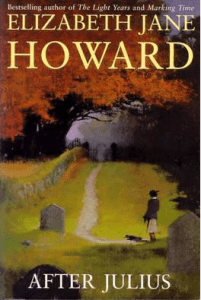
On the other hand, her older sister, Cressy, a widow in her late thirties, is promiscuous.  Widowed after a year of marriage–her husband died in the war–she has since carried on with many married men.  She is also a concert pianist, but knows she isn’t any good. And psychologically she, too, is still wounded by the loss of her father.

howard-after-juliusEsme, Julius’ widow, seems to have the hardest time, though she is the best-adjusted:  she gardens, reads, and does volunteer work, but she is alone.  She was unfaithful to Julius, and then her much younger lover, Felix, dumped her after Julius’ death.  It’s not that she feels guilty about Julius.  She didn’t realize that she was just a fling for a younger man. She didn’t want to marry anyone else. But now Felix, a doctor in early middle age, is back from the Near East and plans to stay in England.  After staying with a doctor friend and his lovely family, he  impulsively asks Esme if he can come for  the weekend and…  What on earth is he doing?
During the novel, the young women do slowly bloom.  There are second chances for young women.  But what about Esme, who is nearly sixty?  The only thing Felix now recognizes about Esme is her legs.  Poor Esme!

Unfortunately, Cressy steals her fire during Felix’s visit.  He can’t get over Cressy’s gorgeousness.

He picked up a copy of Country Life and went and sat in a chair with it.  ‘If I could just get a bit more used to her appearance,’ he thought, staring moodily at a blurred photograph of the Queen presenting a cup to some winner of a jumping competition, ‘then I wouldn’t have to keep trying to remember it when she wasn’t there.’  Perhaps, he thought, finishing his drink without noticing it, it would be easier if she was there.

It’s a literary potboiler!  Howard, the beautiful wife of Kingsley Amis (they divorced!), is as glamorous as Cressy, and probably did have experiences like hers!

I adored this book (though it’s not her best).

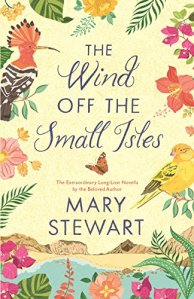
Mary Stewart’s Centenary: A Giveaway of The Wind off the Small Isles

wind-off-the-small-isles-stewart-51fyyphh5tl

Want a free copy of the new edition of Mary Stewart’s lost novella?

Mary Stewart fans, unite!  September 17 was the centenary of Stewart’s birth.

moon-spinners-stewart-81b9179589ad8a34a3fba2288e026856

My favorite Stewart book.

I love Stewart’s beautifully-written Gothic novels.  Her independent heroines travel to exotic places, exchange witty repartee with devastatingly attractive men, and stumble upon crime scenes and solve mysteries.  Today this genre is known as “romantic suspense.” What they don’t tell you is that Stewart quotes Shakespeare, Keats, and other poets.

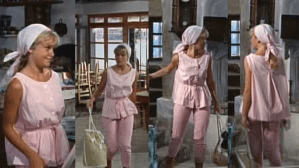
For me it started with The Moon-Spinners, Disney’s movie based on Stewart’s novel.  Afterwards I read Stewart’s  novels over and over, wanted  to wear a pink pants outfit with matching kerchief like Hayley Mills’s in the movie, and travel to Crete.

moonspinners-pink-hayley6

Hayley Mills in the outfit!

This summer I reread two of Stewart’s novels, Thunder on the Right, which I wrote about here, and The Ivy Tree, a cross between Daphne du Maurier’s  Rebecca and Hitchcock’s Vertigo:   it is narrated by a woman who is a dead ringer for a dead woman, or is she?

Excerpt from an earlier edition of The Wind off the Small Isles.

Excerpt from an earlier edition of The Wind off the Small Isles.

Mary Stewart’s long-lost novella, The Wind off the Small Isles, first published in 1968, was reissued in September.  (You can read about it at Leaves & Pages or at The Guardian here and here.)  Although this novella is captivating and rather sweet, a Gothic about two writers’ assistants (one female, one male) who discover the truth about a nineteenth-century couple’s elopement on a volcanic island, it is a a one-time read for me. Does anyone want it?  Anybody is the U.S. or Canada is eligible (I have postage cost issues with the rest of the world, alas!), whether you have won a previous draw or not.  It’s a matter of getting a book to a good home!

If you would like The Wind off the Small Isles, leave a comment here or email me at mirabiledictu.org@gmail.com