
 Wouldn’t it have been fun to read Balzac as each volume of The Human Comedy was published in the nineteenth century? We would have read him furtively while cleaning our master’s study (I was a maid in my previous life, which is why I abhor cleaning), or openly if we were impoverished spinster stenographers wearing fingerless gloves in an unheated garret. I first read Pere Goriot in just such a chilly rented room.
I have read many Balzacs in Penguin paperbacks, but a complete set of The Human Comedy, a series of approximately 95 novels and stories, has not been translated since the nineteenth century. Have you read Modeste Mignon? Here we must thank the nineteenth-century translators. There are no modern translations of Modeste Mignon. Clara Bell, who was commissioned along with Ellen Marriage and Rachel Scott by George Saintsbury at the end of the 19th century to translate Balzac’s work, wrote at breakneck pace because she needed money and the pay was low. Modeste Mignon is very readable and often enthralling but the long correspondence between the heroine and her lover drags. Okay, you’re permitted to skim the letters.
It is an amusing novel about love and novel-reading: what could we readers like better? The heroine, Modeste, an avid reader, is determined to fall in love, though she knows no suitable young men. (I was rooting for the smart dwarf who works in the family business, but he has no chance.) No, Modeste picks a poet. If you want to have a doomed love affair, fall in love with a poet. Judging from Balzac’s description, poets were just as opportunistic then as now.
Balzac likes to bend genre. This is a gentle comedy, and yet his heroine is as sharp as they come. Part traditional narrative, part epistolary novel, part satire, Modeste Mignon traces the fortunes of an attractive young woman, Modeste, who wills herself to love and gathers three suitors before the book is done.

My 19th-century edition of Modeste Mignon/
As the novel opens, her father Charles Mignon is away at sea trying to recover the family’s lost fortunes. They do not know if or when he will return. The older Mignon daughter eloped with a man who rejected her; she returned home very ill and died. (You know the trope: The Sexually Active Woman Must Die.) Then Modeste’s mother went blind, and now they live quietly with Monsieur Dumay, a family friend and the manager of the business while Charles is away, and his childless wife Madame Dumay, who dotes on Modeste and Mrs. Mignon. The adults conspire to shelter Modeste from relationships with men.
No wonder Modeste turns to books. She needs to live in dreams. Like Madame Bovary and Catherine in Northanger Abbey, she reads novels and romantic poetry and longs for love and excitement. Balzac explains,
Modeste fed her soul on the modern masterpieces of three literatures, English, French, and German. Lord Byron, Goethe, Schiller, Walter Scott, Hugo, Lamartine, Crabbe, Moore, the great works of the 17th and 18th centuries, history, drama, and fiction, from Astraea to Manon Lescaut, from Montaigne’s Essays to Diderot, from the Fabliaux to the Nouvelle Heloise,—in short, the thought of three lands crowded with confused images that girlish head, august in its cold guilelessness, its native chastity, but from which there sprang full-armed, brilliant, sincere, and strong, an overwhelming admiration for genius. To Modeste a new book was an event; a masterpiece that would have horrified Madame Latournelle made her happy,—equally unhappy if the great work did not play havoc with her heart.
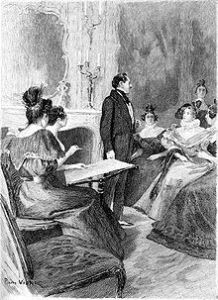
An illustration from Modeste Mignon
An intelligent but naive reader, Modeste writes philosophical, mystical, and hyperbolically emotional tetters to a Parisian poet she has never met, Canalis. He is not a good poet, but she loves his verse. Balzac too had fans who wanted to be his penpals, and he had read the correspondence between Goethe and his fan Bettina Brentano, who was thirty-seven years younger. Canalis doesn’t want a Bettina: he bangs our the verse for money and owes his love and loyalty to a middle-aged duchess who is his patron. It is Canalis’s secretary, the aptly named Ernest de La Briere, who replies to Modeste’s letters, under the name of Canalis, and soon the missives are flying back and forth. And so the comedy of their correspondence begins.
When Charles comes home a rich man, he is not exactly thrilled about the letters.
“I have read your letters,” said Charles Mignon, with the flicker of a malicious smile on his lips that made Modeste very uneasy, “and I ought to remark that your last epistle was scarcely permissible in any woman, even a Julie d’Etanges. Good God! what harm novels do!”
Modeste is now an heiress. Suddenly Canalis and a glamorous Duc are “in love” with her. Does poor Ernest have a chance?
There are some infelicities with tone in this translation. I suspect the letters between Modeste and Ernest would be much sillier in a modern translation, because Modeste and Ernest are so naive and earnest.. But this speculation is based partly on a scene in War and Peace, in which Prince Nicholas Andreevich is ironic about his daughter Mary’ s correspondence with her friend Julie.
At the sight of the letter red patches showed themselves on the princess’ face. She took it quickly and bent her head over it. “From Heloise?” asked the prince with a cold smile that showed his still sound, yellowish teeth.
“Yes, it’s from Julie,” replied the princess with a timid glance and a timid smile.
And here’s a footnote on this passage in War and Peace from Aylmer Maude. “The prince is ironical. He knows the letter is from Julie, but alludes to Rousseau’s novel , Julie, ou la nouvelle Heloise, which he, an admirer of Voltaire and of cold reason, heartily despised. A.M.
So you see, both fathers recognize “Julie” in their daughters’ epistolary style.

 mirabile dictu