The Joy of Rereading

Rereading is a joy.  It is perhaps the greatest joy as one gets older.

And yet readers express guilt about rereading. Not I, mind you.  But  in several “Best of the Year” and “Round-up of of the Year” posts,  bloggers and Booktube vloggers admitted sheepishly that one or two of their books were rereads.

This is very sad, because it is so Calvinist. One needn’t forge ahead; one needn’t worry about the number.  The world is not a giant TBR checklist. And yet more and more at Book Riot, Bustle, and other online publications, writers are desperately trying to find ways to meet challenges and Goodreads goals.

I started rereading very young, in the children’s section of the Iowa City public library. How many times did I read Frances Hodgson Burnett’s The Secret Garden, Cordelia Jones’s Nobody’s Garden, Philippa Pearce’s Tom’s Midnight Garden, and E. Nesbit’s The Wonderful Garden?  And those are just the garden-themed novels.

In middle age, rereading becomes more delightful.  You are not lost in a book, but you are more observant.  You reimagine  literary landscapes, parse periodic sentences,  thrill to the details of the narrative.   Nineteenth-century writings are especially powerful rereads:   those great writers simply were better-educated than most of our contemporaries.  We imagine George Eliot studying German theology, Trollope writing the Life of Cicero, Harriet Beecher Stowe weaving politics into her  novels, and Thoreau living at Walden as he meditates on transcendentalism.

But I also read and reread less well-known books by Dodie Smith, Pamela Hansford Johnson, Alice Thomas Ellis, Jean Rhys, L. P. Hartley, Molly Keane, and many others. I love mysteries and science fiction. I am a fan of humor writers Cornelia Otis Skinner and Emily Kimbrough.  I draw the line at romance, but you have to draw the line somewhere.

It is such a hectic world: we need to direct our own reading to an extent, instead of worrying about online book groups   or meeting a Goodreads challenge.  Kerry Jarema  at Bustle, in her recent article “9 Unconventional Tips That Will Actually Help You Finish More Books in 2018,”  recommends taking a social media break if you feel “reading pressure.”

Have you read Rereadings:  Seventeen Writers Revisit Books They Love, edited by Anne Fadiman?  It is the perfect book for us rereaders.

And let me know your favorite rereads.

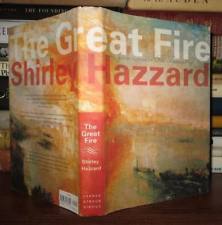
The Great Fire by Shirley Hazzard

Death haunts Aldred Leith, the central character of Shirley Hazzard’s The Great Fire, which won the National Book Award in 2003 and the Miles Franklin Award in 2004. In the aftermath of World War II, Aldred, a war hero, travels through China and Japan to document the ruins of Hiroshima and other towns. Explaining to two friends how he got this assignment, Aldred recounts a meeting with a young general in France.

“My paper on Caen had reached his desk. He had informed himself, and knew about my youth in the East, the languages, the war. He’d grown up in China and Indochina, and knew that these places were evaporating, transforming. The last days of all their centuries should be witnessed and recounted by someone who was not a spy, not a sociologist, beholden to no one.”

Hazzard, an Australian-American writer, was uniquely qualified to describe the vicissitudes of this lost world, and she does so unsentimentally.  At age 16, she worked for British Intelligence in Hong Kong from 1947 to 1948, monitoring the civil war in China.

Her tough, elliptical prose is most powerful in  its evocation of place. But place means less to Aldred than books, which urgently symbolize the pinnacle of civilization. During his childhood he traveled through Asia with his father, a popular novelist. We first meet  Aldred on a train, studying a book jacket photo of his father. The soldier who meets his train is reading his father’s book. Such literary coincidences are frequent in Hazzard’s novel. Aldred tells two young Australians–Ben and Helen, scholarly siblings who read Carlyle aloud–of his first meeting with his close friend, Peter Exley. “And then, when we first met in Cairo, each of us was carrying the same book.” Helen asks, “What was the book?” (Hazzard never tells us.)

Meanwhile, people are dying. Japan is a shambles.  Within hours of Aldred’s arrival at Kure, an old professor dies in his company. Two days later he stumbles upon the body of a Japanese suicide, a youth he saw verbally abused by Driscoll, the medical officer who is his host and the father of Ben and Helen.  After Aldred retires to his bleak room to write a report of his discovery of the body,17-year-old Helen Driscoll comes to his room with a brandy. And a romance blooms between them, which is Aldred’s salvation from the war.

Hazzard’s shift from her description of the Great Fire (her metaphor for the horrors of war) to romance is disappointing. Much more intriguing are Aldred’s meetings with his friend Peter, a lawyer who is investigating war crimes in China. Speaking about his interviews with former prisoners, Peter says, “No one went to pieces.” But Aldred has a more subversive view. “Well, they did and do, and one has seen it. But it’s like the phenomenon of suicide in all our lives–the wonder is that more don’t commit it.”

Yet romance can happen anywhere, even when one is recovering from war.  Hazzard writes,

Aldred Leith had developed stoicism that might have been a temporary condition of his war, of his task and travels. He knew, however, that the capacity for affection must be kept current if it is not to diminish into postcards. And that responsiveness in youth is no guarantee against later dispassion.

Although Helen is young, she, too, knows death. She spends long hours reading (yes, books again) to her older brother, who is dying of a degenerative disease. The complications of the affair detract from, rather than complement, the ambitious scope of the book. There is a softness at odds with Hazzard’s crystalline prose. But in the end The Great Fire is fiercely effective as a record of post-World War II Asia.

New Year’s Resolutions, a Literary Calendar, & a Virgil Readalong

WE RARELY KEEP OUR NEW YEAR’S RESOLUTIONS.   According to The New York Times, unclear resolutions are easily broken, especially when imposed from an external base. For example, dieting is a societal expectation, especially for women, despite our assertion that it is for our health.  My own resolution? To watch my sugar intake.  What I’ve learned:  they put sugar in milk, even soy milk.  One must read all the labels.

RESOLUTIONS I’VE BROKEN.  Last year I declared it was the Year of Balzac.  What a nice idea!  But after I finished reading the Penguin editions, I turned to tatty copies of 19th-century translations by Ellen Marriage and Clara Bell.  The flaking of old paper actually hurt my hands,  so I abandoned the project.

LITERARY CALENDARThe New York Times has posted a literary calendar for 2018. The most exciting event?  Muriel Spark’s 100th birthday on Feb. 1.  I love her books, and have posted about The Ballad of Peckham Rye (here), Robinson (here), and The Finishing School (here).

THE  READALONG OF VIRGIL’S AENEID, JAN. 8- Feb. 26, at Mirabile Dictu.

Do join us.  It’s a great read.

The famous line below is one of the reasons to read the Aeneid.

…forsan et haec olim meminisse iuvabat.

Translation:  “Perhaps someday we will be happy even to remember these things.”

In desperate times it is a comforting saying.

Does Aeneas believe this?  No, he does not.  He asserts it to hearten a band of Trojan refugees. Trauma lies behind them, trauma ahead.  Aeneas tells us privately that he wished he had died at Troy: his personal life ended with the fall of Troy. He is a reluctant leader, destined to found Rome.  The survivors of the Trojan war wander for years, welcome nowhere for long, not even in Italy, where the gods send them.

Is this an epic about empire, or an anti-war poem?  All interpretations are right, supported by critics, historians, or common readers. Feel free to argue about it!

Here is the schedule for January:

Jan. 8-14:  Book I

Jan. 15-21:  Books II and III (the “short version” is Book II)

Jan. 22-28:  Book IV

Jan. 29-Feb. 4:  Books V and VI (the “short version” is Book VI)

The schedule for February, including the “short version,”  will be announced later.

All the translations are very good, but if you want background, I recommend the excellent introduction, notes and glossary in the Penguin edition (Robert Fagles’s translation).

If you have questions, email me at mirabiledictu.org@gmail.com