“How to Give a Pill to Your Cat” & R.E.M.’s “ÜBerlin”

I’m having trouble giving my cat her pills.  (I wrote about it here.)

So I am posting a very funny video, “How to Give Your Cat a Pill.”( It does go a bit too far…)

And to balance it, below is an energetic video of R.E.M.’s ÜBerlin, chosen because the first line is “Hey now, take your pills.”

Two Great Movies with the Actress June Squibb

June Squibb, Golden Globe Awards 2014

June Squibb, Golden Globe Awards 2014

Do you want to know what it’s like to live in the Midwest?  See the movies Nebraska and About Schmidt.  Parts are hyperbolically funny, parts are moving, and both have a Midwestern atmosphere.

Coincidentally, both feature June Squibb.  She was nominated for Best Supporting Actress for her role in “Nebraska” as Bruce Dern’s aged wife, and also appeared as Jack Nicholson’s  wife in About Schmidt, which begins in Omaha, Nebraska.

Here is the trailer for Nebraska:

Here is the trailer for About Schmidt.

Stroszek Weekend

Werner Herzog's Stroszek

Werner Herzog’s Stroszek

There’s the opera, there’s the literary event, and now, just to make sure my weekend is perfect, a relative called to say he’s coming to town and can he get together with us?

At first I despairingly thought, Yes.  He’s family.

And then, No.  I can’t cope.  I’m not f—ing Aeneas.

My husband says, No.

And my cousin told me I would be crazy to let him come.  “Kat, he is so mean.”

He’s kind of a wild guy.  Undiagnosed bipolar II.  (Bipolar II is the lucky bipolar.  It’s out of control, but not actually hallucinating.)

It’s always tough to deal with him.

He’ll be utterly bored in five minutes, and want to go to a restaurant or a bar to talk to strangers.

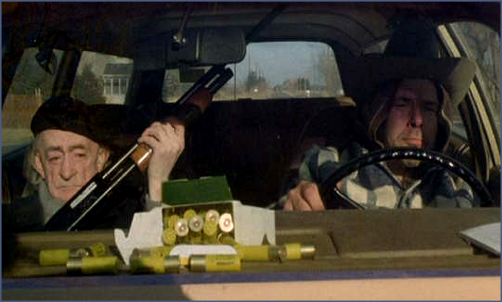
Once he arrived in an RV, opened a manhole in the street, and dumped his sewage in it.   Is that manic, or what?  It reminded me of Herzog’s film, Stroszek, about a German road trip through barbaric small-town America.

What can you do?  This is family.  This is why I left the Midwest.  This is why I came back.

Families don’t change.  Original reactions are often right.

The last time we had lunch together, he told my cousin and me how unattractive we were.   This did not actually hurt us.  He has said worse.

My cousin said,  “Wow!  Do you think we WANT to be attractive?”

I said, “One of the great things about being over 50 is that I’ll never have to take off my clothes in front of anybody new.”

“Are we supposed to be Playboy or The Jane Austen Book Club?”

“Do you see any attractive men here?”

“Hmmm.  How about that one?”

“Couldn’t he be more built?”

That one looks like he works out.”

My cousin doesn’t take any shit.  As she says, the minute you try to have a conversation with him he’s looking over his shoulder to see if there’s anybody more interesting.  He didn’t even seem to take it in that we’d insulted him.

This all is wearisome.

He can’t help being who he is, and sometimes what he does is better than what he says.  He’s my blood!  I’ve tried to get to know him.  I’ve tried to like him.

What can I do?  Be insulted?  I’ve done that.

So here’s the plan.

Let’s go to Minnesota!  Or Missouri!  Or anywhere!

No, I’ll just have to call him back.

What Bloggers Do & Catching up on Books

Ms. Mirabile:

“I have fallen behind in writing about books.”

What do bloggers do best?

I’ve been thinking about this since my favorite English blogger, Tom Cunliffe at A Common Reader, decided to discontinue his book blog.

He is an excellent writer, his book reviews are thoughtful and reliable, and he did not allow publicists to define what he read.

Still, I understand how difficult these reviews are.

Even writing a book journal can be work. Alas,  I have fallen behind in writing about books.

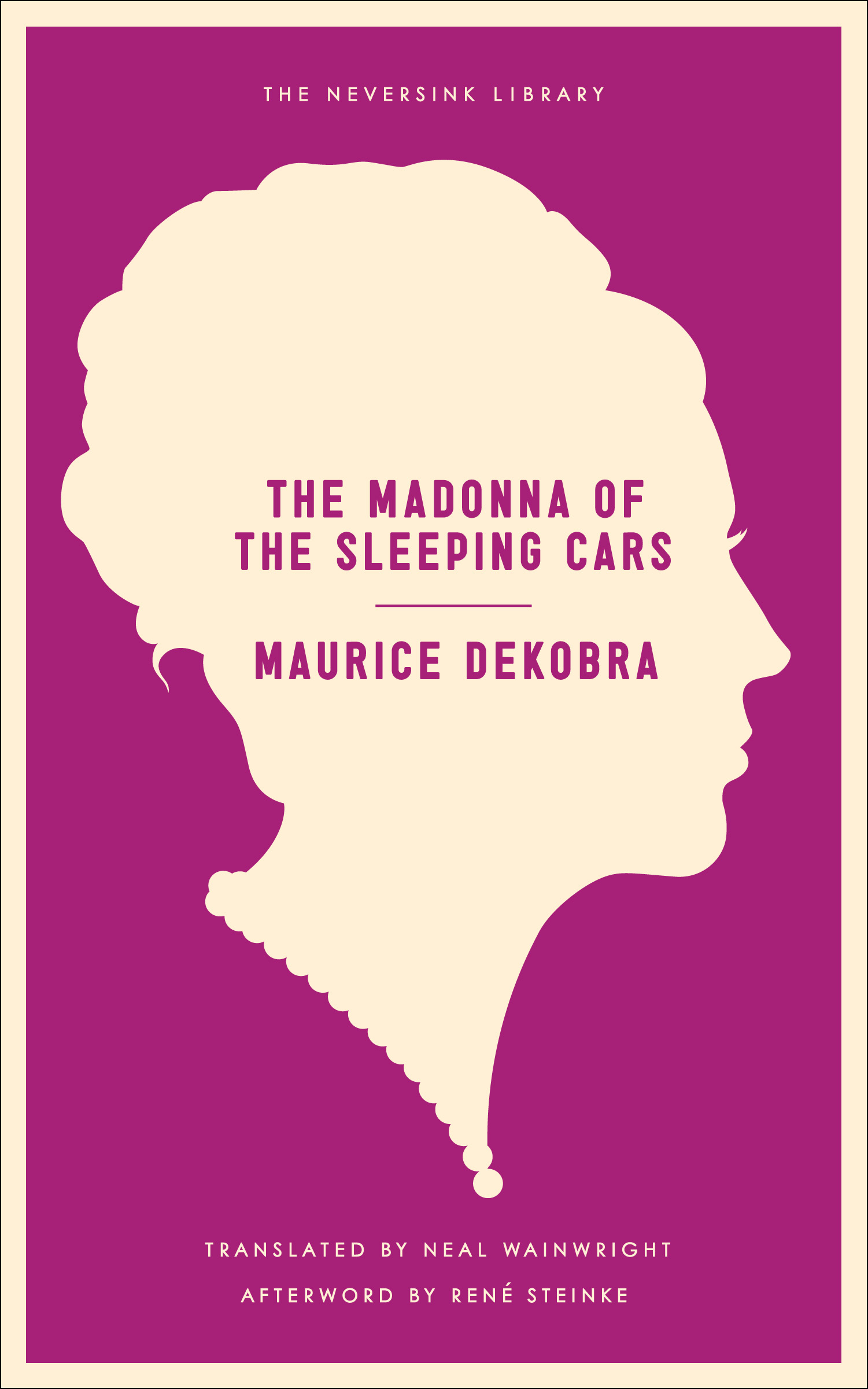
So this is a catch-up blog on a few books I’ve been meaning to write about: a remarkable literary novel, Carlene Bauer’s Frances and Bernard, and a middlebrow classic reissued by Melville Press, Maurice Dekobra’s The Madonna of the Sleeping Cars.

Frances and Bernard Carlene Bauer1.  Carlene Bauer’s  Frances and Bernard. This short, pitch-perfect  epistolary novel is based on the relationship between Flannery O’Connor and Robert Lowell.   It is a lovely, intense book, and though  I have not read biographies of O’Connor or Lowell,  it would be fascinating to be able to compare the writers with the characters.

Bernard/Robert and Frances/Flannery meet at a writer’s colony.  Bernard writes to a friend,

I met a girl I quite liked–but not in that way…Was a little Mother Superiorish.  She’s just escaped from the workshop at Iowa.  She was the only other real writer there.  Her novel is about a hard-hearted nun who finds herself receiving stigmata.  It sounds juvenile, but it’s very funny.

Frances, who is from Philadelphia (why Philadelphia rather than O’Connor’s Georgia I don’t know), gradually falls in love with Bernard; but she does not want to marry; she wants to write.

Writing can be a burden, though.  She says,

I get the existential shakes–I’m like one of those small metal wind-up toys that chatter in circles until they peter out, exhausted and finally keel over.

Bernard is also an intense writer.  He suffers from bipolar disorder, which Bauer does not romanticize, though it is often associated with creativity.  She does show that it does not adversely affect his brilliant poetry,

The disease makes his life very hard, and his relationship with Frances is rocky.  In one scene, Frances calls the police when she finds him camped  out on her doorstep after a fight.  He punches a cop, and babbles that Frances is his “bride”and that he is “a dragon with his foot on the saint.” They realize he is an altered state and  take him to a mental hospital. Frances is a loyal friend and visits him during his hospitalizations.  But eventually she says she cannot be involved with him anymore.

Bauer fascinatingly describes their intellectual discussions of Catholicism, teaching, reading, madness, and friendship.

A fascinating, sad novel about a romance/friendship between two writers.

The Madonna of the Sleeping Cars 300dpi2.  Maurice Dekobra’s The Madonna of the Sleeping Cars, reissued in the Neversink series by Melville House, reminded me a bit of Michael Arlen’s The Green Hat.  Dekobra, a popular French writer, published this best-selling novel in 1925.  Not only is it an entertaining portrait of rebellious New Woman who loses her fortune, but it also features Russian spies.  Through the eyes of the narrator, Prince Gerard Séliman,  we study the impulsive behavior of Lady Diana.

When she hires him as her secretary, she says,

If I add that my banker cheats me, that each year I have seven hundred and thirty invitations to dinner, all of which I couldn’t accept unless I cut myself in half at eight o’clock every evening; if I go on to say that I have, on the average, six admirers a year, without counting casual acquaintances and some exploded gasoline which sticks to the carburetor; that I keep an exact account of my poker debts, that I always help every charitable undertaking, that I am the honorary captain of a squad of police women and I was a candidate in the elections for North Croyden; if I finally admit that I have a very poor memory, that I love champagne and that I have never known how to add, then, perhaps, you will understand why I need a private secretary.

The writing goes on and on like this–isn’t it charming?

After losing all her money, she and Gerard travel on the Orient Express to  find a powerful Communist official, Varichkine, and inquire about the oil fields her late husband owned in Georgia.  Diana stops at nothing; she even gets engaged to Varichkine, and sends Gerard on to Russia to investigate the wealth of the oil wells.  He meets Varichkine’s sadistic mistress, who wants to stop Varichkine’s marraige to Lady Diana, and he has many adventures.  This is an entertaining, often comical little book, perfect for a summer’s beach read.

Alain de Botton on Twitter & Opera vs. Literary Event

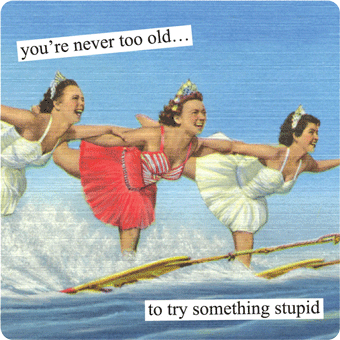
you-are-never-too-old to try something stupid anne taintorLast summer I had a disastrous experience with Twitter.

My cousin set up an account for me because it was “time for me to get into the 21st century.”  Why?  Don’t I spend enough time on the internet?  Twitter did not seem attractive, but I subscribed to the feeds of Lydia Davis, Jo-Ann Mapson, Sherman Alexie, Natalie Merchant, Ron Charles, Jay McInerney, and Salman Rushdie.

My husband said, “I don’t get it. You’ve read War and Peace six times and now you’re on Twitter?”

I didn’t get it either.

It was extremely boring.

About 100 links were coming by tweets a day.  Tin House was the worst.  All day long, links to unknown writers’ websites.  Newspapers tweeted every time they published an article.  And then all the lit pages tried to be hip and sponsored Twitter lit contests.

Finally I closed my account.  I hated it.

Alain de Botton, a philosopher, recently advised his Twitter followers to delete Twitter from “at least” their phones for their mental health. He also spoke to a writer at the Washington Post,

Twitter is of course a wonderful thing, but it is also the most appalling distraction ever invented. It sounds so harmless. But it wants you never to be in touch with yourself again and never to have time to catch up on ‘updates’ from the person you really need to keep close to you: yourself. It denies us that precious non-specific time in which you can daydream, unpack your anxieties and have a conversation with your deeper self.

I do agree with him.

The minute you’re without it, life goes back to normal.  You’re not constantly checking to see if someone will finally make the Twitter experience worthwhile.  You know what?  Nobody is ever going to make the Twitter experience worthwhile.  It is a waste of time.

So I say, good for Alain de Botton.  He thinks it’s a good thing to take time off from Twitter.

This weekend we have so much going on.

1.  A literary event.

2.  An opera.

The minute I realized both were scheduled for the same weekend I felt doomed.

Weekends are for idling.

I haven’t gone to a literary event in a long time, but we have been looking forward all summer to seeing Jonathan Lethem at Prairie Lights in Iowa City.  My husband introduced me to his novel, The Fortress of Solitude, and I have since read most of his books.

One hundred miles IS a long way to drive, though.  And there have been some disappointments.  Where was Will Self the time we went?  Canceled.  Where was Jeffrey Eugenides?  Canceled.  The last great reading I went to in Iowa City was by Sherman Alexie.

The thing is, we cannot do both opera and literary event.  I don’t know how we scheduled this.

I like rock and live jazz, but I do not really care for opera.  I love the Met HD series, because even an almost tone-deaf person appreciates the Met.  But operas last hours and hours and hours.  “I ha-a-a-ate Carmen,” I told my husband when I realized we would have to choose between the opera and the lit event.  Does every regional opera company put on Carmen every year?  Can there BE any more hip-wiggling and shoulder-shrugging?  They put on Carmen when they’re not putting on La Boheme.   (All right, I like John Adams’ Nixon in China, but it’s safe to say we’re not going to that.  It’s probably Madame Butterfly.)

Anyway, back to the literary events, I recently found an autographed copy of a book by Carol Shields and remembered that event with fondness.  Autographs used to mean something to me, and now I don’t even have real books.

“Your book would probably be worth more money if it was autographed,” my husband says.

“Buy me the paperback.”

But I don’t think we’ll actually make it to I.C.  We’re still repairing the damage done by the storm last week.

My Tortoiseshell

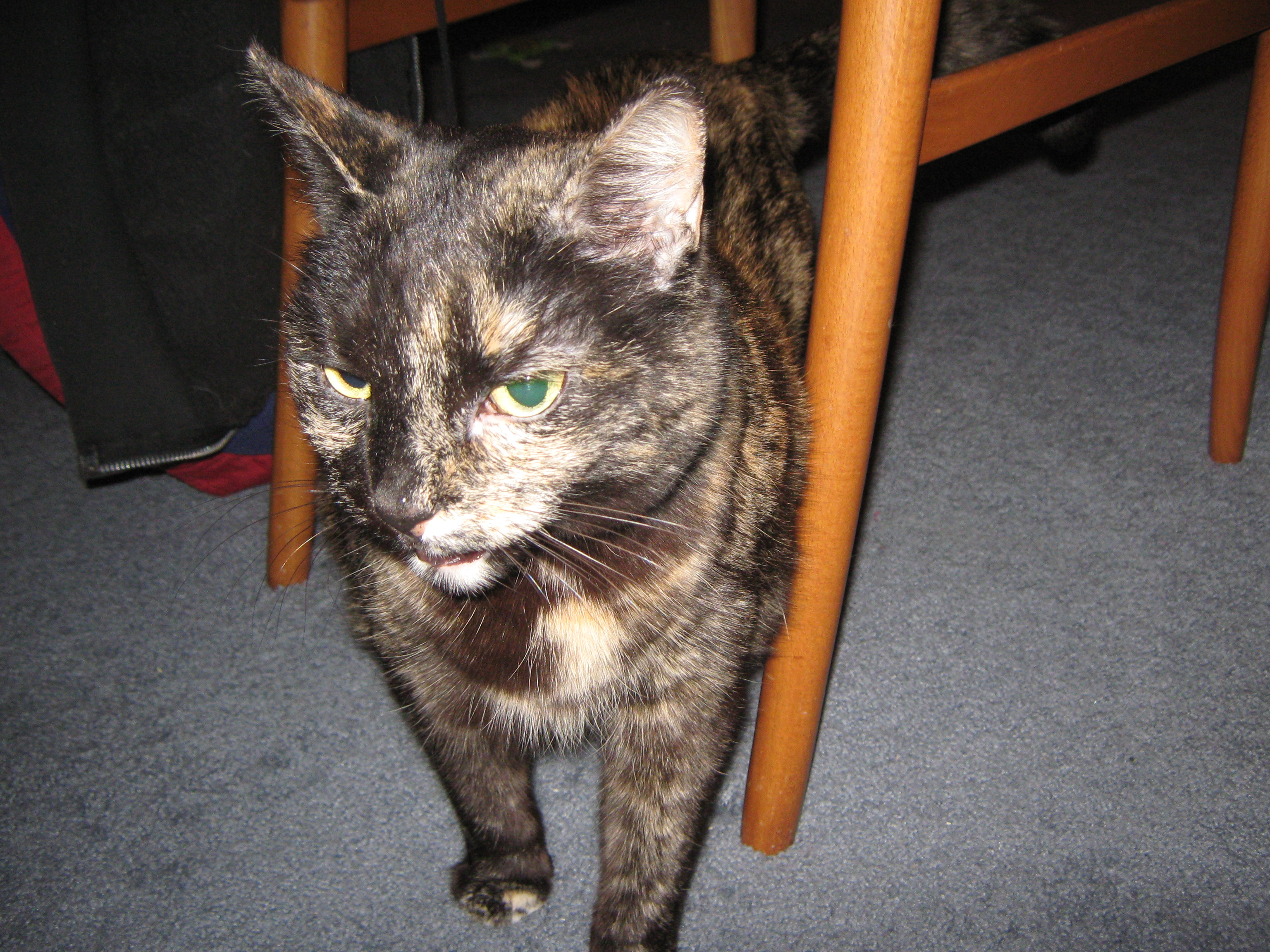
My cat, Helen

My cat, Helen

My cat Helen is very sweet, but like most tortoiseshells, she has a strong personality.

She would like to be the only cat.

She doesn’t like her “sisters.”

We live in a multi-cat household.

She purrs sitting next to me, but hisses at the cats.

Yet they are fascinated by her and she is their role model.

She is a survivalist who drinks water from the tap.  She leads the other cats into the bathtub.  It is necessary to wipe out the tub before we take a bath.

It is her bathtub, her couch, her books, her TV…

She also decides when it’s time to dine.

She stares and taps me with her paw.  She rushes meowing into the kitchen. Then she decides who can dine with her.

One  of our cats must dine in the living room, because she is not in Helen’s clique.

If Helen went to an addiction meeting (she loves humans too much), she would have to say she loves me too much.

Her favorite activity?  Staring at me while I watch TV.

She is essentially a Kat-aholic.

If we take her to the vet, she doesn’t bond with anyone.

“She doesn’t show much interest in us,” they say when she has to be there overnight.

And now poor Helen has a thyroid problem.  She has to take pills.

For a week I hid the pills in huge amounts of wet food.

Then she got smart.  She knows the pills are there.  Today I fed her three servings  and she pushed the pill aside repeatedly.

She is very contented because she now eats several times a day alone.  This is her dream.  Today she tried three flavors of pâté.  (And she still wouldn’t take the f—g pill.)

Both my husband and I tried tonight to give her the pill.

If she could write, her letter would say,

Dear Kat-Mom,

I won’t take my thyroid pills!  You are completely crazy to think that you can hide a pill inside a cat snack and I won’t find it.  I can see through tricks like that.

Luv ya, XXXXX, OOOO,

Helen

Anybody have any tips?

I take my pills, but she simply won’t take hers.

D. J. Taylor’s From the Heart

There comes a point when your life begins to resemble your job.”–D. J. Taylor’s From the Heart

From the Heart by D. J. TaylorD. J. Taylor’s novella, From the Heart, has recently been published as a Kindle Single.

Taylor, whose novel, Derby Day, was nominated for the Man Booker Prize in 2011 and whose biography of George Orwell won the Whitbread Biography Award in 2003, is one of my favorite contemporary writers.

This fascinating, complex novella is a fictional consideration of work, love, and loss.  It is told from three points-of-view:  Anthony’s, Alison’s, and Lucy’s.  The main character, Anthony, is an Oxford alumnus, age 38, dissatisfied, as so many are in their late thirties, with the direction his life has taken.  Although he is not nostalgic about Oxford, he is morose about his work and marriage.   Anthony is an insolvency practitioner who works on the liquidation of bankrupt companies. He married Alison, a PR director, because she “liked” him.  They have two children.

But he has long been in love with Lucy, his fantasy woman, an Oxford friend who has, unbeknownst to him, become a researcher-writer-interviewer for a BBC history show.  He hasn’t seen her in 17 years, but often illicitly examines what he calls the “Lucy file” (photos and papers) when Alison is busy.

Anthony’s soulless occupation is balanced by his bookishness and  his obsession with the heart.  He still has Lucy’s copy of Silas Marner from college; he admires her marginal notes (she has written an essay on goodness).  And he muses fascinatingly on the image of the heart in literature and art and its differences from the actual muscle.  As a student he saw a photo of a heart from the dissection lab.   The heart was

…simply a slump of muscle and sprouting, hacked-off tubers….Had any of the poets who wrote so blithely of the stirrings of the human heart, compared it to singing doves, arrows, anvils, india rubber, stone, said that it was clogged, aching, timorous or sullen, ever seen one?

His very nice, ordinary wife Alison (who did not, by the way, go to Oxford) knows Anthony is discontented.  She thinks:

Even now, at an age when most of us can barely remember what we did at university, he still wishes he was sitting in a set of panelled rooms, telling a sofa full of nineteen-year-olds about George Eliot and Anthony bloody Trollope.

Elsewhere in London, Lucy is also discontented with her life. Her bookish boyfriend, Mark, who in situation and interests in similar to Anthony, also has a complicated life in the City.  Their relationship is unraveling.  He charms her parents in the same way that Anthony charms Alison’s parents.  (Both women are annoyed by this charm.) She wittily, cynically observes,

In her decade-and-a-half in London, Lucy had never known a man who hadn’t left for work by 7:30.

Insolvency practice in the city is changing, becoming more sophisticated and global. Things are falling apart for the upper classes: Ian Kennedy, a beefy Oxford graduate who has gone bankrupt, cannot believe his company will be liquidated. At the same time,  Kwanko, an African educated in Paris, is on his way up, part of an international exchange at Anthony’s firm.  When Kwanko moves in to Anthony’s basement to avoid the ambassador’s wife, who has a crush on him, we learn that, like Anthony, he reads Victorian novels.  The life of the well-educated African aristocrat is not that different from Anthony’s, as long as the political life is stable.

Adultery is a complicated issue for all these numb readers of Victorian novels. They do not just jump into bed, like the characters in a film.

Morality matters.  Changing lovers is complicated.  Is it worth it?   There are a couple of endearing married sex scenes that show Anthony still finds his wife attractive, even though he’s restless.  “Outward primness and secret lack of shame is a failsafe combination.”

From the Heart is compelling, astute, and witty.  Real life can be dull, and even those of us who didn’t go to Oxford sometimes burn out and wonder why why why…  We’ve all had our Anthony /Lucy moments.  I enjoyed this very much, and consider it a great book to read indoors.  Definitely not a beach read.

Power Outage 2

A tree down a few blocks away.

A tree down a few blocks away.

What they don’t tell you is how exhausting power outages are.

The storms are extreme now.  On Monday night there were 70 mile-per-hour winds.

We woke up Tuesday morning to find a tree down in our back yard and  wires down and snaking.

The result of global warming, as my husband says.

We live in a smallish city.  You can call a tree removal company at 2 a.m. and somebody actually answers the phone.  The tree company crew removed the tree, and the electrician showed up promptly to fix the wires.  And then the power company guys, who were taking care of more live wires across the street, casually sauntered over and turned our power on.

Power company trucks, city trucks, and tree removal trucks were all over the neighborhood.  It was like seeing a military force on the move. (Not that I’ve ever seen one.)

Thank God I don’t have to do that.

And then I slept 10 hours.

I made jokes to the neighbors, but I found it all exhausting. Aren’t whining and  tears a good outlet for exhaustion, and aren’t we women allowed to complain?   But now I always tell myself, I’ve been through so much worse.  So I just whine online.

Mom, why did you raise us to be such Stoics?

Tonight, another power outage.  Fortunately this one didn’t last long.

Power Outage

george-clooney-gravity-image

Half of North America just lost their Facebook.”–George Clooney as Matt Kowalski, Gravity

I slept through a thunderstorm.  I woke up to a power outage.

Three trees down on our street.  Around the block, I saw a tree tangled in telephone wires.

As I foraged for coffee and batteries, I felt like a character in a postapocalyptic science fiction novel.  In one of my favorite books, Doris Lessing’s Memoirs of a Survivor, the narrator describes the disintegration of society caused by power outages and food shortages.  This stunning novel is a “memoir” of a future of regression and barbarism, but also a reminder of techniques of off-the-grid survival. (Gangs, barter, and flea markets are important.)  The future may be most difficult for those of us who remember civilization, Lessing hints.

How will we cope?

No internet, no interrupted thoughts, no ads appearing in the corners of webpages.

What is off-the-grid survival anyway?

Being off-the-grid can be a good thing.

We are so used to looking up information online.

The phone book works just as well.

While I waited for power, I got a lot of reading done.  I am absolutely loving Karl Ove Knausgaard’s nonfiction novel, My Struggle, which I read with the same voracity I do Doris Lessing’s autobiographical Martha Quest novels.  Knausgaard doesn’t change his character’s name.  The narrator is Karl Ove.  The events in the book mirror the author’s life.

Later, when the power came back, I read an interview with him at Amazon.  He says definitions are the enemy of the novel.

I just tried to write a novel. This was the only way I could do it at the time. So no, no active down-tearing of anything. But for me, these books definitely are novels. I didn´t try to represent my life, but wanted to use my life as a kind of raw material for a novelistic search for meaning or for meaningful patterns. I use all the novels tools, I can describe one day over three hundred pages, or a year in a sentence. It isn´t fiction, though, it´s non-fiction, but it isn’t a documentary or a memoir either: it’s a non fiction novel.

I really recommend getting off the net to read this fascinating modern classic.

Less screen time is more reading time.

But thank God the power is back on.  How lucky we are to have electricity!

Mirabile Does Middlebrow: Elizabeth von Arnim’s The Pastor’s Wife and Elizabeth Gaskell’s Cranford

Ms. Mirabile:  "Often middlebrow novels are better than the minor classics. "

Ms. Mirabile: “Often middlebrow novels are better than the minor classics. “

Perhaps it’s not a coincidence that I read two books by “Elizabeths” last week.

Odd how these things happen, isn’t it?  I’m a fan of Elizabeth von Arnim, whose The Caravaners and The Enchanted April I am happy to read over and over, and I am also a devotee of Elizabeth Gaskell’s Wives and Daughters.

During my vacation I took Elizabeth von Arnim’s The Pastor’s Wife and Elizabeth Gaskell’s Cranford off the shelves and immersed myself in reading.

Often the best middlebrow novels are  greater than the greats’ second-rate. I recently finished Trollope’s The Eustace Diamonds, which is well-written and comical, but not a work of comic genius, and the best chapters–shades of Wilkie Collins’ The Moonstone–are plotted like a mystery.  The novel rambles, though, all too obviously a three-volume book, and some of the characters are scarcely developed, like the “good girl” Lucy Morris, and the nondescript Mrs. Carbuncle, who wants to marry off her niece to a rich man.  And so I spent a lot of time almost liking Lizzie Eustace, the bad girl who refuses to return the diamonds to her late husband’s estates (the first theft of the diamonds?) and then tells lies. She is unlikable, but at least interesting.

All right, I enjoyed it, but it wasn’t Trollope’s best.

The Pastor’s Wife, however, is one of von Arnim’s best books, and, in fact, Deborah Singmaster, the author of the introduction to the Everyman paperback edition, says,

The Pastor’s Wife is Elizabeth’s most ambitious novel.  It is also her richest because it incorporates not just one, but all her characteristic modes:  satirist, nature lover, feminist.”

This is the Virago.  I have the Everyman (can't find a big enough image online!).

The Virago edition

The heroine of this comic, partly- autobiographical novel, Ingeborg, the bishop’s daughter, is in London because of dental problems.  After the tooth is pulled, she is miraculously well for the first time in months–no more ineffective “stoppings.”  When she sees an ad for a tour of Lucerne, she decides to go, as she is not expected home for a week.  This is her first independent act in many years:  she is her father’s secretary:  she is expected to organize his life.

On the trip, she meets Robert, an unconventional German pastor who scandalizes the other women  by talking about manure for his experimental rye crops. (Experimental farming is his vocation.) He and Ingeborg talk nonstop, and are unaware that they have committed social gaffes and are being ostracized by the others.

When Robert decides he will marry Ingeborg, he won’t take no for an answer.  He puts little notes under he doors of all the ladies’ rooms, because he doesn’t know Ingeborg’s room number.  In the note, he requests that she meet him in a lounge at 9 a.m.   All the curious spinster ladies show up, and when Ingeborg arrives and sees the proposal cake, she simply is too delicate to turn him down.

And when she goes home ,her family ostracizes her for her engagement, and she has all the more incentive to leave the bishop’s house.

We do not expect Ingeborg’s marriage to be happy after what we’ve seen of Robert.  And yet it is.  Von Arnim’s writing is lyrical as she describes Ingeborg’s first joyous months.  In Germany, she can be independent.  She is in charge of the house.  She makes one-pot meals.  She walks in the woods.   And we feel she is as responsive to nature as von Arnim herself.

It is true Robert, when he scanned the naked heavens the last thing at night  and peered at the thermometer outside the first thing in the morning, said it was the Devil’s own weather, and if there was not soon some rain all his fertilizers, all his activities, all his expenditure would be wasted; but though this would throw a shadow for a moment across her joy in each new wonderful morning she found it impossible not to rejoice in the light.  Out in the garden, for instance, down there beyond the lime tress at the end, where you could stand in the gap in the lilac hedge and look straight out across the rye-fields, dipping and rising, delicate grey, delicate green, singing in sunlight, dark beneath a cloud, restlessly waving, on and on, till over away at the end of things they got to the sky and were only stopped by brushing up against it…

This is also very much a feminist book, and addresses issues of birth control.  Ingeborg is pregnant six times, and only two of her children live.  Motherhood almost kills her.  She almost dies after the first birth, when an abscess develops and is not treated; after later pregnancies she becomes anemic and a little crazy (post-partum depression?), taking refuge in Christianity.  And finally she cannot get off the sofa.

At last the doctor insists she go away with a nurse.  When she comes back, she tells Robert she will no longer have sex.

And there is another man in her life, an artist, who, once you get to know him, is not much different from Robert.

Von Arnim knows all too well that a new man is not necessarily the answer to family problems.  In some ways, The Pastor’s Wife is a predecessor of Sue Kaufman’s Diary of a Mad Housewife.

Very worth reading, one of my favorite von Arnims.

cranford penguinElizabeth Gaskell’s second novel, Cranford (published in 1853) is charming, humorous, and entertaining, narrated by Miss Smith, known as Mary.  The town is “in possession of the Amazons; all the holders of the houses, above a certain rent, are women.”

I am going to write very briefly about this, because I have very little to say.   It is an episodic novel, almost a collection of short stories, and Cranford is based on Gaskell’s hometown, Cheshire.

The narrator often visits Cranford, and is especially close to the rector’s elderly daughters, Miss Deborah Jenkyns, an imperious, rigid woman, who is kind to the poor, but bosses around her younger, sweeter and gentler sister, Miss Matty.  Eccentric women and men populate Cranford:  they include Miss Barbara Barker, who sews pajamas for her cow; Captain Brown, who loves Dickens and openly talks about his poverty, a lapse of manners that horrifies Miss Deborah; and Mr. Holbrook, who courted Miss Matty in her youth, and who now reminds Miss Smith of Don Quixote with his non sequiturs about poetry.

The women of the town play cards, fight crime (yes, there are robbers),  and muse endlessly on fashion, though their clothes are long out of date.

The most moving part of the book occurs after Deborah’s death, when Miss Mattie’s bank goes bust. She loses all her money, and…  Yes, I did cry!

Gaskell beautifully describes the characters, we know that nothing too terrible will happen, and though this is not as sophisticated as her later novels, it is fun.