Feminine Wiles

A male acquaintance suggested I try “feminine wiles” to persuade my husband to take a trip with me to London.

“I think I’m a little beyond feminine wiles.”

“How old are you?”

I laughed.

Yes, I’ve belonged to the “girls’ club of life” for a long time, but I’ve never been one for wiles.  Life is wonderful if you’re not a wily woman.  And wiles don’t matter one way or another when someone doesn’t want to get on a plane.

In a strange way, I feel that I belong not only to the “wileless” girls’ club but to the “wily” boys’ club, too.

It has something to do with defying gender expectations.  Women are expected to have children.   If you don’t become a mother, all your friends who are mothers, even/especially those who are bad at it, try to persuade you to become one (presumably equally bad).  They’re dropping with boredom and letting their kids watch Sesame Street twice a day, but they feel you, too, should drop with boredom and let your kids watch Sesame Street twice a day.  They send you greeting cards with a picture of a woman with a briefcase and the slogan “Oh my God, I forgot to have children.”

“I didn’t forget, I planned,” I say.

Then, in my late thirties, I finally got pregnant, bled, got pregnant, and bled, and after I charted my cycle, the doctor said I needed to take fertility drugs.

If I couldn’t have a baby naturally, I wasn’t interested.  I certainly wasn’t going to take hormones.

And then the lecture.  Apparently if I did not take fertility drugs, I was somehow betraying middle-class women everywhere.  My education would be wasted if I didn’t have a baby!

I don’t think a classics degree is necessarily the best qualification for motherhood.

The doctor was a woman, and women can be really hard on women who don’t conform.  In the ’70s sisterhood was powerful, but standards for sisterhood have narrowed over the years.  She saw no reason why a healthy woman shouldn’t spend months taking hormones that no doubt cause cancer in women and babies.

She was like a Stepford doctor.  She had to be in control.

Here’s the thing about men.  They may be hard on their girlfriends or wives and expect conformity, but they honestly don’t care much what a non-related woman does.  At work they seldom bore you with pictures of their children, and they simply run in the other direction if you show them a picture of your latest bicycle trip.  Many workplace women’s conversations revolve around motherhood.   At book group some poor harassed mother will always show up wild-haired with a crying baby in a carrier, and if she does manage to leave the baby with her husband, she will assume you all want to see the latest pictures on her phone anyway.

Women bosses behave more like men in these situations:  when they’re trying to manipulate you, they use strange sports metaphors like,  “If you want to play with the Big Boys, you’ve gotta play ball!”

That doesn’t quite make sense, so I’m sure I’ve misremembered the phrase, but she simply believed I would want to work overtime after she said this about the Big Boys.

Heavens, if I wanted to play with the big boys, I doubt I would have been working for her.

The great advantage to working for men?  They leave you alone.  They don’t talk to you about the Big Boys, they don’t make you do overtime, they’re just so glad that anything at all gets done without their help.  They’re always in a meeting, so you only see them once a week.   And they’re so reasonable it only takes you about one week out of a month to get all your work done.  The rest of the time you do whatever you want.

So does that mean I prefer to be in the boys’ club?  Huh.

On my last day in London, when I was supposed to go to the Tate Modern, but just did laundry and went to bookstores instead, I finally went to the Ultimate Women’s Club.  This would prove to be the test of my  sympathies.

Having been given  perfect directions, I could not mistake the Persephone bookstore, tiny though it was.  In a minuscule room of gray-covered books and giggling young women, I felt I had wandered into the wrong club.  Some places you’re at home (Skoob), some places not.   I saw the Dorothy Whipples and the Mollie Panter-Downes, but didn’t see anything I really wanted.   I wasn’t in the mood to do a pity buy, so I fled back to Skoob and bought Penguin crime classics.

So I either passed some glorious test (like I may be too old for most Persephones!) or flunked one (my glorious American dollars might have saved the store!)

No, I passed the most important one.  DO WHAT YOU WANT!

London Box # 2, What We’re Doing on the Internet, & R.E.M.’s Shiny Happy People

There’s a gap between the author and the reader, and a gap between the author and the book….The author is still there, the reader is still there, but the thing in the middle is starting to break”–Approximately what John Lanchester said on the LRB panel, “The Author in the Age of the Internet,” April 2010

IMG_2897

The London Box # 2

The London Box # 2 arrived.

It is smaller than the first London box.

Yes, a box of books from Skoob.

Virago fans will be interested to learn that I purchased Nina Bawden’s The Birds on the Trees, Zoe Fairbairns’ Stand We at Last, Aileen La Tourette’s Cry Wolf, and Dora Russell’s The Tamarisk Tree Vol. 1 and 3 (I missed Vol. 2, or perhaps they didn’t have it).  Though I am not as mad as some of you about Viragos, I had  never seen any of these in the U.S.

And Skoob also sent me a free tote bag.

It wasn’t until I saw the bag that I realized Skoob is Books written backwards.

It was a lovely spring day, much warmer than it has been, and though it isn’t green yet, it is a relief to go outside without the wind nearly blowing you down. When I returned from a bike ride, I found the box. I was relieved that my husband didn’t lecture me about it.   Often there is a Lucy–Ricky Ricardo thing going on, where I throw my Amazon box in the dryer so he  won’t know I’ve bought books.  And usually I turn the dryer on so he won’t be suspicious–no, I made that part up.   Books mysteriously leave the house–when I’m done with them I often give them to the Planned Parenthood sale–and new books come in.  My theory is that since the books always occupy the same space, he doesn’t realize they’re new.

Lucy and Ricky Ricardo

Lucy and Ricky Ricardo

He understands that my trip to London was partly about going to bookstores. Just think:  20 years ago we didn’t have to go to London to buy books.  We were still able to go to 10 or 12 independent bookstores even in our small city.  Then it all began to change, and as  I have mentioned, the chain bookstores are the only ones left here, except for a tiny bookstore that I regard as a club for preppy women.  (I’m preppy myself, but I can never find anything I want there.)

I consider myself a friend of the book.  A very good friend of the book.  But mostly of older books.

I read widely in the canon in my teens and twenties, and then, after I started freelancing,  I read mostly contemporary fiction for 20 years.  And then I spent a decade reading scarcely any of it.  Now I’m trying to fit in at least one new book a month.

PANEL ON THE INTERNET.  I listened at the LRB site to two parts of a panel discussion held in 2010, The Author in the Age of the Internet.  The writers are very positive, very careful about what they say.  Nobody rants.  The critic James Wood likes the diary form of blogs,  Colm Toibin thinks blogs are like Jonathan Swift’s pamphlets, Mary Kay Wilmers, a former editor of the LRB, has nothing against them, and Lanchester, a critic and novelist, likes video games.

Are they being polite, or do they mean what they say?  I can’t read the British…

They talked about changes in format and text, and said chain bookstores were responsible for some of this.  Lanchester mentioned David Foster Wallace, and how his books became shorter and more accessible after the publication of Infinite Jest (1996).  Since I’ve never read anything by David Foster Wallace, I can’t chime in here.

And for me, I love the internet, I hate the internet.  Mostly I love it.  Remember when I was cyber-addicted last fall and hated Twitter so much?  Well, Twitter is by far the stupidest feature I have yet seen. (I deleted my account.)  My cyber-addiction just ended one day, and my life went back to normal, just like that.  No idea why it started or why it ended.

Anyway, let me end this with a video of R.E.M.’s rehearsal of “Shiny Happy People.”  They sing it with unsmiling faces, with a sense of irony, and, after all, isn’t that all we get of happiness?  A rehearsal?  This is much better than the official video, where they’re smiling, laughing, and not seeming like R.E.M. at all.

Liver, the Internet, & Where Are the Online Literary Festivals?

IMG_2778

They love backpacks!

If there is anything grosser than sautéing liver in butter, I don’t know what it is.

We live with cats.  Many cats.

It is a multi-cat household.

I am a cat lady.

We want our thin “senior citizen” cats to bulk up.

I fried the liver for the cats.

One of them is bulked up.  She’s just like me.  She sees me eat;  she eats.  There is a symbiosis between us.

But if we put her on a diet, then the thin cats also go on a diet.  They want crunchies in the bowls at all times so they can eat on their own schedules. Cat one:  11:30.  Cat two:  2:00.  And so on.  And if the food is there, my overweight cat also eats it.  There is no solution to this problem.

“Bulk up,” we say to the thin cats.

Sometimes they’ll eat tuna in oil.  Lately no.  They wanted albacore tuna in water.  Now they’re tired of that.  Salmon.  No.  Absolutely not.

They’re tired of canned cat food.

In despair I searched the supermarket.  Would they eat cheap fish?  You never know.  The chicken liver is fattier, though.  You fry it up, you chop it in the blender, and voila!  Fat cat meat.

I fried it in butter so they would bulk up.

So far it seems that my twin, the cat who is just like me, will eat it.  But, alas, she’s not supposed to eat it.

The other cats look at it with no interest.

How can they not want fried liver?

Honestly, this generation of cats is so picky.  The first generation (’80s) and second generation (’90s) loved chicken, chicken livers, turkey, etc.  These 21st-century cats don’t like human food at all.  That tells us something about the hormones shot into the food.

What are you feeding your cats?  There are some raw meat recipes online for cats, but I don’t want them getting salmonella.

There must be something they’ll eat.

Okay, a couple of them are back on canned cat food.  Thank God!

THE INTERNET.  I have a love-hate relationship with the internet.  When I was in London, it was a relief to come home at the end of the day and write my blog.  The same people read it everyday; we keep under the radar, and no truly nasty cyberstalkers bother to leave comments anymore;  I’m trying not to offend prima donna bloggers (yes, occasionally I’m mocking, but I was brought up among the witty and sarcastic); and I enjoy keeping up with the blogs on my blogroll.   Blogging is not like writing for publication.  It is a performance for myself.

But I must admit that when I came home I went into internet shock.  There is good writing on the internet, and there is bad writing on the internet.  I was trying to find some well-written new blogs to read.  And if you read enough bad stuff, you really wonder what you’re doing.

My family doesn’t read my blog.  That, I think, is a good thing.   Partly it is because most of them write, and writers don’t always like other writers, especially when they’re in the same family.  I could tell this with my aunts, who wrote family histories and memoirs and self-published them at Kinko’s.  Neither ever mentioned the other’s work.

And so I’m not really surprised that they all think I’d be better off writing something else.

What, I wonder?  I’m not a fiction writer.  I’m not a poet.  I simply refuse to write any more articles about State Fair food.

Well, maybe I will.  Do you want to hear about turkey on a stick or bacon cupcakes?  Ugh.

I did recently find some wonderful blogs mentoned at AbeBooks Reading Copy, “20 Booksellers Who Blog.”  So  thank God!  I’ve found some good new blogs to read, and I’m justified in continuing Mirabile Dictu.

WHERE ARE THE ONLINE BOOK FESTIVALS?  As you know, I am an unregenerate literary fan.  No matter how bad the event, and that short story panel at Daunt Books was a huge disappointment, I will find another event to attend.  (N.B.   the writers on the short story panel, when I could hear what they said, were phoning it in from their  Creative Writing 101 classes.  Since I grew up in Iowa City, I thought, What?  And I’m sure some of the  other gray-haired fans in the audience were amazed, too.  Most of us were too old for the discussion taking place.

Since I missed the Oxford Literary Festival, I thought I’d check it out online, because I wanted something on a higher level.

But there are no videos, as far as I can see.

What a disappointment!

I did, however, find a video of a very interesting panel discussion sponsored by the London Review of Books in 2010, “The Author in the Age of the Internet,” with  John Lanchester, Nicholas Spice, Colm Tóibín, Mary-Kay Wilmers and James Wood.

I watched 30 minutes of it, and here’s a surprise:  Toibin is very funny.  I laughed aloud at much of waht he said, and some things that the others said.  They were all fairly positive about the internet in the first 30 minutes of the discussion.  Now I’m sure the gloom and doom part comes later–the discussion is divided into three parts–and so of course I want to see what develops.

I have been reading some fascinating books lately, if you want to know, and will shortly be telling you about them.  This is the week I catch up with award-winning literature.  Not The Luminaries, though.  That’s much too long.

Valete!

Ms. Mirabile on The London Box & Do We Like Writers?

IMG_2895

The London box:  Dickens’ Mrs. Lirriper, Jane Bowles’ Everything Is Nice, a D. J. Taylor omnibus, Compton Mackenzie’s The Adventures of Sylvia Scarlett, and Mavis Cheek’s The Lovers of Pound Hill.

The London box arrived.

Yes, I FedExed a box of books to myself from London.

Another stack from the London box:  Platanov's The Foundation Pit, Mishima's The Temple of Dawn, Penelope Fitzgerald's The Means of Escape, Olaf Stapledon's Last and First Men, Dicken's The Pickwick Papers, Robert Graves' The Golden Fleece & L. P. Hartley's My Fellow Devils

More from the London box: Platonov’s The Foundation Pit, Mishima’s The Temple of Dawn, Penelope Fitzgerald’s The Means of Escape, Olaf Stapledon’s Last and First Men, Dicken’s The Pickwick Papers, Robert Graves’ The Golden Fleece & L. P. Hartley’s My Fellow Devils

I wasn’t home to sign for it, so I begged my husband to take me to the FedEx store to pick it up.

“Couldn’t we get it on our bikes?”

“It’s huge.”

And in my mind it really WAS huge.

When he saw it, he couldn’t stop laughing.  It was the size of a slightly oversized Amazon box.

“We could have biked.”

“But it weighs 9 pounds.”

All I know is it was a struggle to lug a laptop bag and a tote bag of books into the taxi.

It’s satisfying to receive a box of books.  My husband wants Platonov’s The Foundation Pit.  We both are fans of Russian literature.

It is ridiculous that I bought a copy of The Pickwick Papers at the Dickens Museum, when I could have found it at home.

It was something about being in the Dickens Museum.  I wanted books I had bought at the Dickens Museum.

I also bought a copy of Dickens’ Mrs. Lirriper, which I have never seen anywhere except at the Dickens Museum.

And below is a scene from Hereafter, one of my favorite movies, in which Matt Damon visits the Dickens Museum.  Unfortunately there’s no sound, but you can see the museum.

.

Although I’m patting myself on the back for traveling cheaply, I am also relieved that my husband understands why I bought my Dickens at the Dickens Museum.

He is disappointed I didn’t go to the Sherlock Holmes Museum.

It didn’t occur to me because I was burning out, but next time.

I will return to London after I’ve read all my London books.

And I have a couple of more boxes coming, because at the end I was madly paying money for the bookstores to ship books to me.

I spent almost nothing!  Everything I did except the Dickens Museum was free.

My husband looked askance at my food bills from Tesco Express and Waitrose.  Five pounds?  All I can say is, it was a great deal cheaper than eating out.  And everything cost at least five pounds, except coffee!

Free things to do in London?  There are so many.

DO WE LIKE WRITERS?

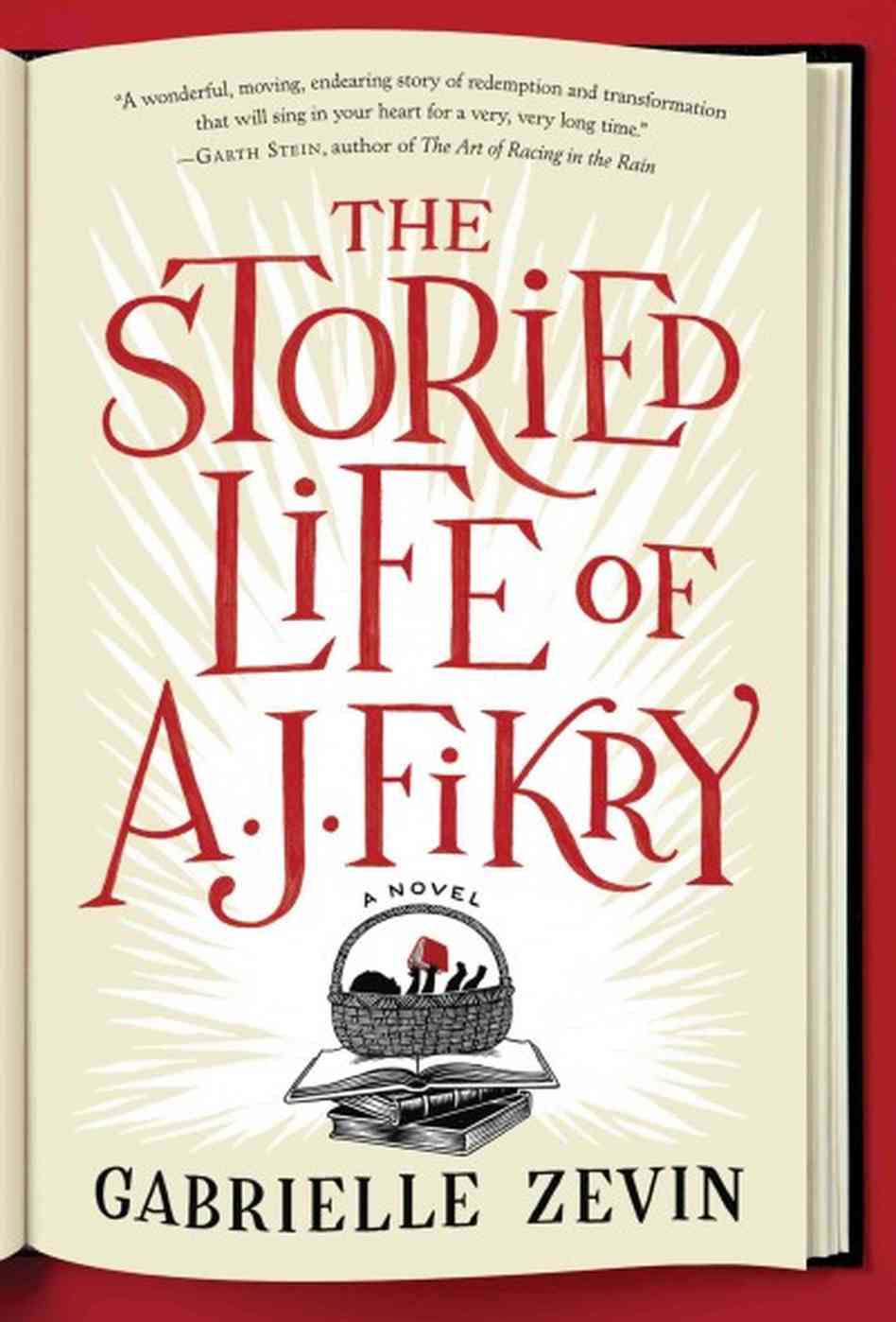
Storied Life of A. J. FikryI have just finished one of the most charming novels I’ve ever read, Gabrielle Zevins’ The Storied Life of A. J. Fikry. I couldn’t resist a novel about a bookseller, and it is very, very funny and smoothly written.

The main character, A. J., is a rather cranky bookstore owner.  He is lonely.  He is a widower.  He misses his wife.  He has poor social skills, so he doesn’t have a particularly strong customer base. It was his wife who did the PR and who sponsored the Vampire Ball.

Every chapter begins with a brief journal entry by A. J. about a short story, and he  loves short stories more than novels.

There are many things he doesn’t like, among them Y.A. vampire books.

He doesn’t like writers.

And the only writer event he hosts in the book is something of a bust from his point of view, but the customers love it.

A. J. says about writers:

Despite the fact that he loves books and owns a bookstore, A.J. does not particularly care for writers.  He finds them to be unkempt, narcissistic, silly, and generally unpleasant people.  He tries to avoid meeting the ones who’ve written books he loves for fear that they will ruin the books for him.

This made me burst out laughing, because I organized a series of readings for various bookstores and schools years ago.  (I was a fanatic about books, and did this pro bono.)  Most of the writers were very kind and charming, and some wanted to hang out with me.  (I was MUCH younger then, and I read their books.)  Very few people at these events have read the books.

There were a few difficult writers.  I won’t pretend there weren’t.  You want to stay away from prima donnas, if you know they’re prima donnas.  They are not better writers than the non-prima donnas, but they are picky about everything:  their flights, their food, their escorts, professors putting their arms around them (these particular professors put their arms around everyone, male or female), they want juice instead of water, they can’t eat anything at the restaurant, because they’re on a special diet of beef, and they make fun of the people at the reading.  Sometimes it really puts you off a writer.  In general, though, I found them to be very easy-going people.  Book touring is part of the job.  And they were getting paid an honorarium.

So overall, though I love books, I don’t need to meet writers, even if I would like to. I do wish I’d attended something at the Oxford Literary Festival, because their standards must be high (it’s Oxford!).

There are, however, a lot of readings in Iowa City, if I want to attend.  For instance, on Saturday Rachel Kushner, author of The Flamethrowers, will be in Iowa City for two events.  And she has been longlisted for the Bailey Women’s Prize.  I’m still jet-lagged, so I won’t be there.  But someone will be thrilled.

Usually attending readings makes me want to read more of the writers’ books.  It is very unusual for it to put me off.  If you don’t have to deal personally with the writers, it’s always a breeze.

But how do you feel about writers?  Do you like writers?  Do you want to meet them?  I’m sure some of you go to readings, and some do not.    Let us know your impressions!  What’s the best event you ever attended?

Wouldn’t you like to meet Dickens?

Traveling Alone & Helene Hanff’s The Duchess of Bloomsbury Street

Year after year I’d planned a pilgrimage to London, only to have it canceled at the last minute by some crisis, usually financial. This time it was different.  From the beginning, heaven seemed to favor the trip.”–Helene Hanff’s The Duchess of Bloomsbury Street

DuchessofBloomsburyCOVERI  am reading Helene Hanff’s The Duchess of Bloomsbury, a sequel to 84 Charing Cross Road, the story of her 20-year correspondence with the buyer of an antiquarian bookstore.  Hanff, an autodidact, was unable to find the books she needed in New York, so she ordered dozens from London.

After the publication of 84 Charing Cross Road, she finally traveled to London, though, alas, her friend the buyer had died and the bookstore closed.  The publishing company set up a mini-book tour for her (signings and interviews).  Though Helene was terrified by the flight, her many friends and fans made her comfortable in London:  a fan who worked for the airline whisked her through customs (“She’s a friend”), and then Nora from the store and her daughter Sheila drove her to the Kenilworth Hotel in Bloomsbury (at Russell Square near the British Museum.)

Her adventures at the hotel are very amusing.  Why is it so hard to be an American traveling in London?  It’s because we don’t know how to work the gadgets.

She is baffled by the shower.

The shower stall is a four-foot cubicle and it has only one spigot, nonadjustable, trained on the back corner.  You turn the spigot on and the water’s cold.  You keep turning, and by the time the water’s hot enough for the shower you’ve got the spigot turned to full blast. Then you climb in, crouch in the back corner and drown.  Dropped the soap at once and there went fifteen dollars worth of hairdresser down the drain, my shower cap was lifted clear off my head by the torrent.  Turned the spigot off and stepped thankfully out–into four feet of water.

I was similarly bemused by the shower. When I reported that only cold water came out of the spigot, the clerk explained one handle was for the temperature, the other for the pressure. Then I managed to get hot water (only hot water), which was preferable to cold.  Regulate the temperature?  Couldn’t be done.

Helene was constantly getting lost.  She couldn’t read a map.

Sallied forth with my map after breakfast and saw the sights of Bloomsbury.  Got lost several times; it seems a street can be on the left on your map without necessarily being Left of where you’re standing.  Various gents came out from under umbrellas to point me where I wanted to go.

I got lost, too.  It was easier after I figured out that if you’re not on the side of the street where the signs are you’ll never find your way.   And you never know whether the sign will be on the left or the right!.

Helene didn’t take the tube.  She walked, took cabs, and her fans sometimes picked her up in cars. The tube is much easier than cabs, I think.  The one time I called a cab (the black cab company recommended by the guidebook), I was waiting on the steps when a clerk came out to say I had a phone call.  The dispatcher told me there wasn’t a cab in the area. So even if all the others were rogue cabs, as my guidebook suggested, I could not lug my books to the shipping store on my own. The third company sent a cab.

IMG_2840By the way, after a bracing first night sleeping in jeans and sweaters, I  experimented with the white thing on the wall.  Fortunately it was a radiator.

And then there was blessed heat!

I’m an inexperienced traveler, as you can tell. I’m used to bicycling in the country.   But I loved London and hope I’ll go back someday.  My husband says he’ll go if I can find a boat.

Hanff’s book is a wonderful travel book, and I wish I’d read it before I left.  Nothing much has changed since the ’70s…  And I laugh at her adventures, because we are/were both inexperienced travelers.

Fat Women Don’t Look at Art

IMG_2836

Ms Mirabile: “Fat women do look at art.”

“She’s massive,” a man says behind me at the British Museum.

Thank you, Britain.

He is talking to his kid. Talking about me. Setting a good example to his kid.

I am not particularly pissed off. I have high self-esteem.  He doesn’t know who I am. He doesn’t know anything about me.

My husband thinks I should go on The Biggest Loser.

Shut up!

But I would lose more weight than anyone on a reality show–I’d be the Katniss (love the name!) of the literal Hunger Games–because I’m very competitive.  (You’re looking at the winner of the Lowden Prize for Latin.)  And then the weight would come right back on.  Yes, that’s how it works.  Talk to anyone on a diet.  You lose, you gain.

I’ve got the dieter’s wardrobe: the size 8 schoolmarm/wedding dress (it doubled for both things) up to…you don’t want to know!

There are so many fat Americans in the Midwest that you don’t hear a lot of chat about fat.  Walk through the mall and you’ll see a lot of fat people.  Walk through a museum and the fat people vanish.  Do they feel good enough to eat a pretzel but not good enough to look at Rubens?

According to the CDC, more than one-third of Americans are obese, and 28.4% of people are obese in my state. Certainly no one in the U.S. is rude to me because of my weight.  People are very polite in the Midwest. It’s beautiful, it’s rugged, it’s windy, it’s cold, and we all give one another a lot of space.  There are eating disorder groups, but, alas, my doctor thinks it would be a bad idea to attend one, because most of the members have borderline personality: “They’re very self-centered and annoying.”  I guess it’s a compliment that I don’t have borderline personality.  I do remember when I taught composition the thin, sad students who suffered from anorexia and even struggled to eat yogurt for lunch.  They wrote their term papers on anorexia. As for obesity, the fat girls ignored it.  Not one of them ever wrote about it.  Is anorexia more acceptable than obesity?

And, as my doctor tells me, I am in better shape than most thin people. I used to be a runner. Well, I stopped 10 years ago, but I still bicycle.  My blood pressure is so low I’m almost not there. My pulse is low. My cholesterol is low.  I do have hypothyroidism, but in a general sense, I’m very healthy.  Being fat does not mean you’re unhealthy.  Much depends on diet (yes, I do eat healthy food) and exercise.

Fat can ruin your life, but only if you let it.

It doesn’t necessarily preclude your flirting, having relationships, or being married.

I did sense in London that a few people judged me because of my fat (most were very polite), but then I didn’t see any fat people anywhere.  Either there are no fat people, or they’re all too neurotic to go out of the house.

I loved London. A beautiful city, gorgeous museums, and it is possible to take a very cheap trip there.  Even with my book-buying and shipping of books, I spent very little.  I am stunned at how little I spent (aside from the hotel and flight).

But it was time to come home, because after being up for more than 24 hours on Saturday, I have been sleeping on every piece of furniture in the house.   But I will go back!  I will see the Tate Modern!  And do so much more…

The End of London and What to Read on the Plane

“No, Sir, when a man is tired of London, he is tired of life; for there is in London all that life can afford.”–Boswell, Life of Johnson

London is beautiful, fascinating, rich, poor, inspiring, tiring…and I wish I had walked around the neighborhoods of London for days like Martha Quest in Doris Lessing.

If, like me, you can go to museums almost indefinitely, you try to go to every museum twice.  I managed the British Museum and the National Gallery twice, and the National Portrait Gallery, the Dickens Museum, and the British Library once.

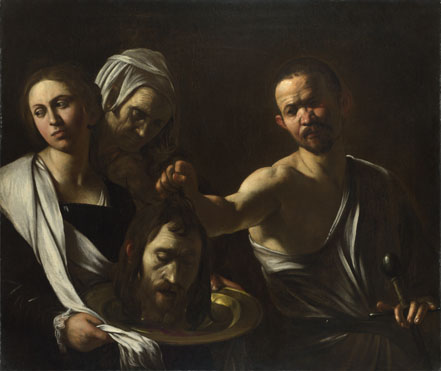
I will never forget Caravaggio’s superb painting at the National Gallery, “Salome receives the head of John the Baptist.”

"Salome receives the head of John the Baptist," Caravaggio

“Salome receives the head of John the Baptist,” Caravaggio

Look at the parallel figures of Salome and the executioner, both looking to the left, with their heads at the same angle, while Heroides looks down at John the Baptist’s head, whose eyes also appear to look downward.  The executioner (is it Herod?) looks regretful and separated from the women’s vengefulness.

The National Gallery website says:

“The subject is from the New Testament (Mark 6). Salome had danced so well for King Herod that he swore he would grant her any request. Her mother, Herodias, who sought revenge on John the Baptist, persuaded Salome to ask for his head. The old woman behind Salome may be Herodias.

This is a late work by the artist, painted in the last three years of his life, perhaps in Naples where he resided from 1609 to 1610. No longer concerned with the incidentals of the narrative, Caravaggio focuses on the essential human tragedy of the story.”

If I lived in London, I would go back every day and look at one painting thoroughly.

Looking at art was my richest experience in London.  And it is only in very big cities that one has a chance to see so many masterpieces.

By the time I made it to the British Library (accidentally; suddenly I found myself there), I was too burned-out to do more than gape at a few manuscripts.  With my bifocals, I couldn’t see Charlotte Bronte’s or Dickens’ tiny writing in the dark space of the museum, so I quickly left and walked home.

My great regrets? I didn’t make it to the Tate Modern or to Peter Stothard’s interview with a writer at the Oxford Literary Festival (I was flying home). I would doubtless have enjoyed seeing Stothard, the editor of the TLS, whose Alexandria:  The Last Nights of Cleopatra was my favorite book last year.

Next time I’ll do more in London.  Ha!  I’m not sure I can spend 17 hours waiting around in airports and flying again.

Flight is an amazing invention.

The plane is a chance to sleep, or to catch up on your reading.

I was so tired that I did sleep on the plane.  I also got a little reading done.  And so I will write very briefly about the reading.

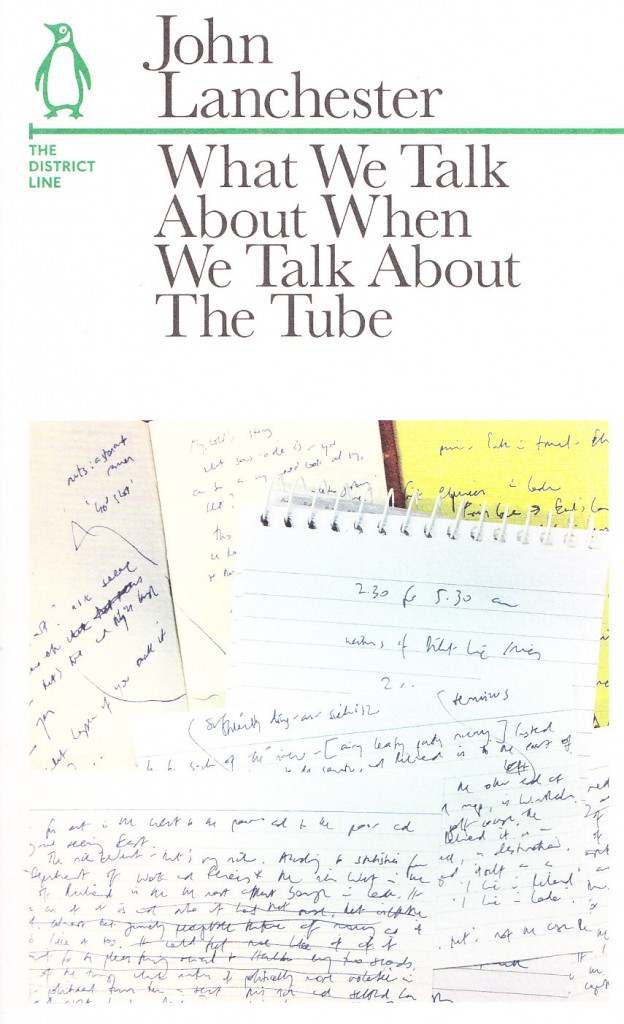
What We Talk About When We Talk About the TubeI picked up a wonderful short Penguin, John Lanchester’s What We Talk About When We Talk About the Tube.  I loved the tube–only a couple of minutes from Russell Square to Leicester Square, and the same from Euston to Baker Street–so I was fascinated by this short essay about the history of the Underground.  He begins by writing about taking the first train on the Underground to leave the station before 5 a.m. (the District Line).  He writes from the perspectives of a passenger, and also interviews the drivers, who get there by minicabs, and sketches the history. He distinguishes between the Victorian Underground and the Tube of the 20th century (a deeper underground, in the form of tunnels).

Before he did his research, he pictured the first train as

populated by inhabitants of the secret Baudelairean London. The truth is more prosaic, and it becomes clear, not so much at Upminster, since, after all, Upminster is a relatively posh suburb, out past the East End where things are starting to feel vaguely, suburbanly rural.  No, it’s a few stops before you realize who these people getting on the train are, bone-tired but indefatigable:  they are cleaners.  By Dagenham East, a few minutes after 5 a.m., the first train on the network is already packed, and the people with whom it is packed are cleaners on their way to work.  That’s the unromantic truth about this version of the secret city.

This brilliant, entertaining book was the perfect length for reading on the plane.  Well, alas, I had hours left after that, but I do find nonfiction somehow easier on the plane.

I also read a classic mystery, Gerald Heard’s A Taste for Honey, one of the old crime Penguins with a green cover.  Did I really pay 7 pounds for this?  My husband was looking at the prices, and discovered this.   I was spending my British money madly at the end.  And I love this book.

Heard was a brilliant philosopher who also wrote mysteries, and this first-person narrative by Sydney Silchester, a timid man who has retired to the country, is both humorous and compelling.  He dislikes people, and becomes reluctantly involved with both a Sherlock Holmes-like detective and a gloomy mad scientist beekeeper who turns out to be a murderer.  There is a terrifying scene where a swarm of murderous bees are sent to Sydney’s house (it reminds me of The Birds) and he has to outrace the bees and shut himself in the bathroom to avoid a lethal sting.  (Hhe is stung, though, and cannot convince the doctor or the hired girl that the bees were set on him. )   Heard’s writing is superb, and it is the perfect book to read when you are miserable because you’re breathing plane air and your butt hurts.

This trip to London will have to last me for years.  I’m back to my quiet life in the Midwest, but do you know?  I really prefer it.:)

London with Coffee # 7: A Day off from Tourism

I took a day off from my tour of London.

Take a bus or tube … I wasn’t up for it.

I did my laundry.

It takes all day if you don’t know how to set the electronic switches:  wash, extra-wash, spin, extra spin…

Then I mailed some packages.

I shipped my books home.

It had reached the point where I could barely carry them.

But buying books in London is a good thing, is it not?  I supported the London Review of Books shop, Foyles, and Skoob Books.  I wandered into some other shops, but didn’t find anything of interest.  We have some first-rate used bookstores at home, and only Skoob measured up.

The selection at Daunt was very much like Prairie Lights in Iowa City.

If I can get it in the U.S., I don’t buy it.

The shipping costs were ridiculous, but even if I’d bought another bag, I doubt I could have lugged it into the airport.  And where ARE the porters these days?  I’ve seen them at O’Hare, but nowhere else.  And seldom at O’Hare.  I always drag my own luggage.

It was worth it to go to all the bookstores.  Thank you online for recommending them!

CULTURAL OBSERVATIONS.  Londoners don’t smile.  Can that possibly be true?  People are expressionless or frowning.  The area where I’m staying is over-crowded on the weekend, and tourists don’t know where they are or where they’re going.  (Finally I know where I’m going.  Huh!)

On the tube we’re all too cross to smile.

We don’t smile while we’re looking at art.

I’m annoyed with myself that I didn’t take notes on the art.

People who work in bookstores don’t smile much, but they are friendly and competent.

People who work in service do often smile, and the smiling helps the communication.  My impression is that many with service jobs are immigrants, or else English is not their first language.

Londoners who give directions often smile.

And then there are some other helpful Londoners who don’t smile.

So I decided to practice my London scowl.

The problem is that when I squint, my mouth curves up into a smile.  I’m not smiling, but you can’t possibly know that.

I am reminded of the characters in Trollope who don’t smile because they have bad teeth.

Or is that in Trollope?

I wonder if we smile more in the U.S.?

SUITCASES.  This is a tourist area, or rather an area of suitcases.  If you lose your way to the tube, just follow the suitcases.  The hotel lobby is always full of suitcases.  And at museums sometimes tourists come in and try to check their suitcases.

“We’re out of room.”

Much gesturing, until the tourists understand that they have to park their suitcases on the free shelves.  They’re not happy about it.

FOOD.  There is some excellent food.  I had some gnocchi that was so wonderful I ignored the fact that there was bacon in it.  (In the U.S. we can’t eat pork right now because a terrible virus has hit the pigs.)

I had a sandwich at Pret-a-Manger, which was recommended by someone online, and it was delicious.

Shopping at the supermarket proved the best and cheapest, though.

I love Rachel’s Yogurt!   And the canned soup is better than that in the U.S.

You can find some good sandwiches.

At home it’s always easier to eat healthy, but there are always salads.

ACCENTS.  “Great,” I said.  I kept saying it.  I never say “Great” at home.

Everything is “gray-y-y-te” here.

I’ve never heard an American accent like mine.

I stepped off the plane and started talking like this.

Let’s talk a little quicker and narrow the vowels.

But it’s easy to say “good” or “great” when you have no idea what someone’s saying.

I almost talked with a Texas accent today.

It’s a good thing I didn’t go to the Oxford Literary Festival, because that might have been too Brideshead Revisited for me, and I can’t imagine what it would have done to my accent.

Too bad I didn’t get to see Sebastian Barry or Magaret Drabble (but she was not talking about her own books).  There really isn’t any reason to see writers though.  It’s their books I love.

COULD I LIVE IN LONDON?  A beautiful city, I absolutely love it, but it makes me appreciate our quietness.  I’m longing for the country!

London with Coffee # 6 & a Literary Event

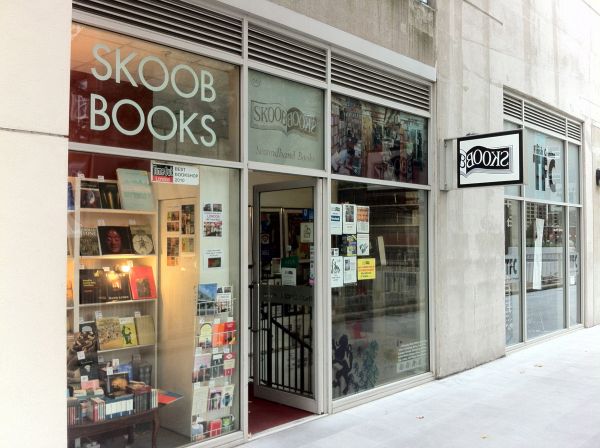
Skoob Books

Skoob Books

Another lovely sunny day in London.

I had only one thing booked today:  a reading at the Daunt Books Festival by three short story writers, A. L. Kennedy, Helen Simpson, and David Constantine, from their new books, and then a very short panel discussion on the short story with K. J. Orr.

I left the hotel in plenty of time.

But let’s have some coffee first.  God, I’d been drinking tea all morning and it did nothing for me.

Today:  coffee at Costa.  I spilled it on my sweater.  Goddamit!

But the coffee did energize me enough that I went to Skoob Books, the most wonderful used bookstore I’ve been to in England.  A fascinating collection, old Penguins, old crime Penguins, Oxford classics editions, Loeb editions, and some newish Viragos I’ve never seen by contemporary writers.

Then I went out and thought briefly of buying a hairbrush, because I have been in London without a hairbrush.

Then I realized I was only going to a literary event, so it hardly mattered whether my hair was brushed or not.

I do have a way of getting lost, and the English have all been very good about getting me oriented.  I wanted to get in a good walk today, so I walked to a station that was a little farther away from my hotel.  I got turned around, and when I finally got off the tube, though I was headed in the right direction, I was on the wrong side of Marleybone to see Marleybone High Street.  So I went too far, and when I saw Regent’s Park, a beautiful green space, I realized what had happened and crossly crossed the street.

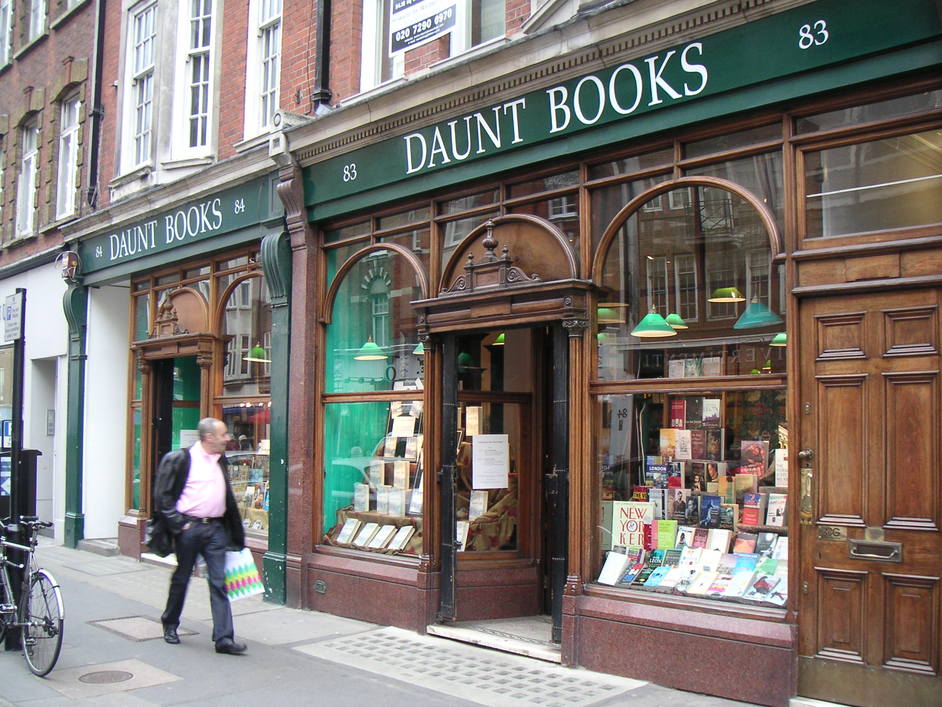
Daunt BooksI showed up at Daunt Books a little late.

I was there for the last 10 or 15 minutes of the event.

A. L. Kennedy was finishing her reading, and she was either too far from the microphone (did they have one?), or has a low voice, because I couldn’t hear.

She was reading a description of  a penis:  “Penis something something penis something.”

Everyone laughed, and I’m sure it was very funny, but I couldn’t hear.  I idly remembered something:  I just missed a book group discussion at home of Lady Chatterley’s Lover.  (The penis in Chatterley is called John Thomas.)

After Kennedy finished the reading, K. J. Orr conducted a short panel discussion about the short story.  Very short.

I liked Helen Simpson the most, because I could hear her.  She said she started the day reading a short story, and that it got her out of bed.

Kennedy, whom again I couldn’t hear, said something about not liking anecdotes in short stories.  A man goes into the bar with a dog means nothing to her.  And then I heard no more.

I didn’t hear a word David Constantine said.

Next time I’ll get there early and sit in the front.

I do wish the discussion had been longer.  No questions from the audience were allowed.  Now that’s ridiculous for 5 pounds, and the writers could have spent more time if they wanted me to buy books.  I have never been to an event before with four writers in 45 minutes, and since the next event wasn’t till five, surely they could have accepted a couple of questions.  Note:   In the U.S. book festivals are free, readings always last at least an hour, and the writers give and give of their time, with the exception of Nobel winners.   Toni Morrison, who has obviously had too much of a good thing, was charming in the ’80s and actually met with students after an event.  But the  last time I heard her, after she won the Nobel Prize, she finished on the dot and did not have a signing or meet with us patrons after the event.

And am I going to the Oxford Literary Festival? No, I’d love to hear Margaret Drabble,  but she’s talking about Jules Verne, not her own books.

The writers’ event at Daunt Books (which admittedly I hardly even made it to) was the only disappointment in my trip, but my critique cannot be a real critique, except for that of the discussion and the Q&A.

I’ve been very touristy–this has been my first tourist vacation in my life–because in American cities, it has always been more about entertainment for me.  But I am unlikely to have a chance to see this city again, so am trying to make the most of tourism!

London with Coffee # 5 & Art

In Manhattan,  Diane Keaton says Van Gogh is overrated.

She pronounces it Van Gog.

Keaton is hilarious as an intellectual journalist.

At the National Gallery, I found myself skipping over the Van Gogh, though of course as a child I loved him and had a print of Van Gogh’s Chair.  I was more interested in other 19th-century painters like Monet, Manet, and Pissarro.

Such a good collection of Impressionists at the National Gallery.

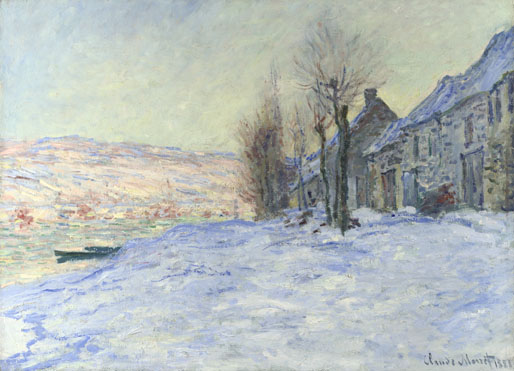
I especially love Monet’s paintings of snow, because I am at home with snow.  It snows and snows and snows where I live.  Here is “Lavacourt under Snow.”

Monet's Lavacourt under Snow

Monet’s Lavacourt under Snow

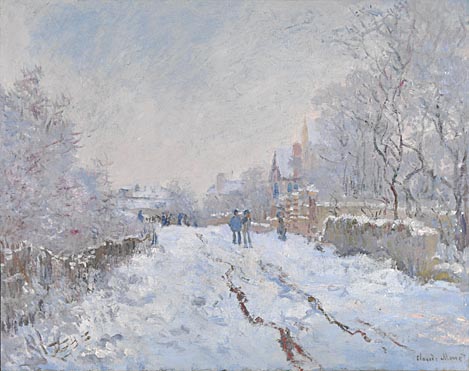
And here is “Snow Scene at Argenteuil”:

Monet's Snow Scene at Argenteuill

Monet’s Snow Scene at Argenteuil

The colors are lovely and light after the dark paintings of the 16th , 17th, and 18th centuries.

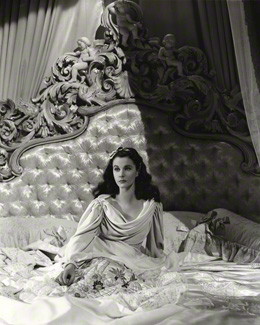
STARRING VIVIEN LEIGH:  A CENTENARY CELEBRATION AT THE NATIONAL PORTRAIT GALLERY.  The trip to London is my mother’s legacy, and Vivien Leigh was her favorite actress.

And so it is appropriate for me to see these photos of Leigh.  Gone with the Wind was my mother’s favorite book and movie.

Vivien Leigh in "That Hamilton Woman"

Vivien Leigh in “That Hamilton Woman”

Of course I know Leigh as Scarlett, but the photos of Leigh in other movies were even more intriguing:  as Cleopatra in Shaw’s Caesar and Cleopatra, as Lady Hamilton in That Hamilton Woman, and as Blanche Dubois in A Streetcar Named Desire.  Oh, Blanche!  What a brilliant movie that was!

So sad to be beautiful and mad.  Poor Vivien!  I remember reading long ago about her madness.  And did Laurence Olivier take care of her, or not?  There are always sad stories about mad women and their husbands.

My mother never went to a museum in her life.  Well, that’s probably an exaggeration, but close.  She had a bachelor’s degree, but she loved pop culture.  She could have been a pop culture critic.    Ladies’ Home Journal, movies (I saw every movie in the ’60s except Darling, which, inexplicably, I was not allowed to see), movie magazines, TV (we loved the fall edition of TV Guide), and musicals (we’d go to community productions).

The apple does fall far from the tree.  No human beings were ever more different than my mother and I.

I love museums, but even I admit you can have too much of a good thing.

There was so much to see at the National Portrait Gallery.  But this is all I have room to write about today.

COFFEE.  I had a cup at a bookstore:  excellent.

I went to Oxfam, a lovely bookstore, but the Virago Online Group who met in London last weekend seems to have wiped them out temporarily.  I had almost everything in the fiction and poetry sections, and I know that’s just not possible…:)  So maybe I’ll go again before I leave.  Oxfam is a favorite with everybody.

Foyles, however, is the best bookstore in the world.  (Well, I haven’t seen all of them.)

And I was out in the London rain today.  Very light, very easy.  I know you have floods here, but this was a spring rain.  And now I understand why English people go for walks in the rain.  At home it’s always a deluge.  So lovely and mild here (so far).