London with Coffee # 4 and Who Looks at Art?

Hahn/Cock, or, as I call it, the Blue Chicken

Hahn/Cock, by Katharina Fritsch

I love art.  I love museums.  And I very much enjoyed visiting the National Gallery.

I saw the blue chicken outside at Trafalgar Square.

The blue chicken is actually called Hahn/Cock, and is a sculpture of a cockerel by the German artist Katharina Fritsch.  It was installed in 2013.

I immediately felt at home with Hahn/Cock.  I’ve seen countless bright modern sculptures at various sculpture gardens, and I enjoy their humor and incongruousness.

What could be more traditional than Trafalgar Square? I love the lions.  I sat on a fountain for a while in a daze.  I shouldn’t have been tired, but I’m still on American time.

Inside the National Gallery, I didn’t take notes on the art for once.  It was so crowded that I didn’t feel up to whipping my notebook out.

My only note?  At first I thought the Drunken Silenus Supported by Satyrs was wearing glasses.

The painting is attributed to Anthony van Dyck, and was probably executed in Rubens’ studio.
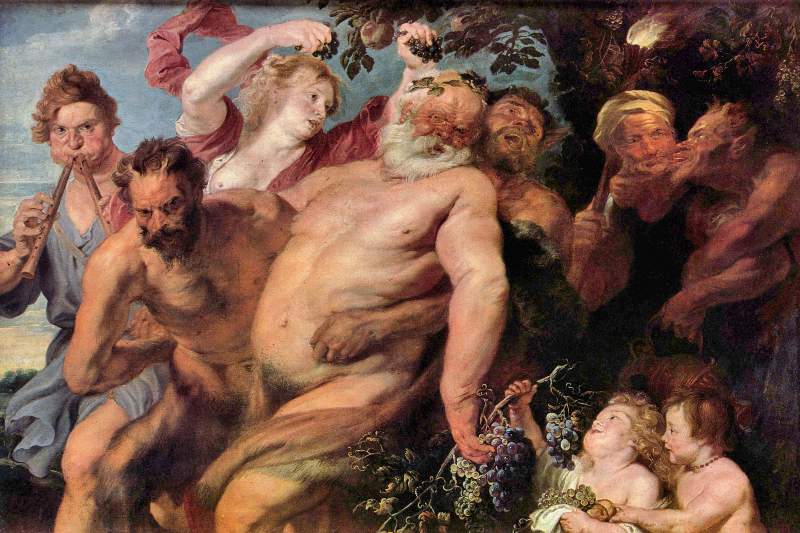
Drunken Silenus Supported by Satyrs, Anthony Van Dyck, c. 1620

Drunken Silenus Supported by Satyrs, Anthony Van Dyck, c. 1620

Silenus is just so fat and drunk, and the light was such that my weak eyes saw little wire-rimmed glasses.  I do have new bifocals, and they help, but I need brighter light than this. My friend Ellen Moody, the blogger with whom I went to the National Art Gallery in Washington, D.C., can vouch that I have to look close up.

And this was when it struck me.  Fat women don’t look at art.   Only thin women look at art (with, ahem, one exception).  And yet there are many fat women painted in art.  Even Juno, Venus, and Minerva are overweight in Rubens’ Judgment of Paris, 1632-65. Are fat women self-conscious in museums?
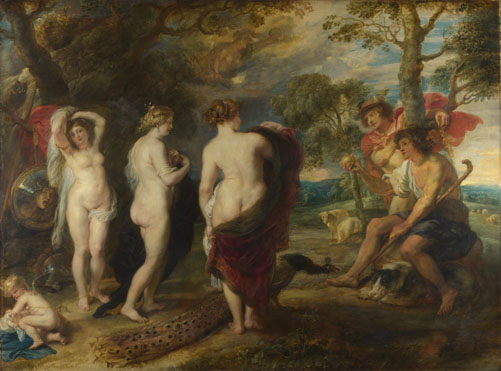
Judgment of Paris, Rubens

Judgment of Paris, Rubens

So who looks at art?  So many different languages!

I got the impression that most of us were tourists from elsewhere.  Thin Europeans looked at art.  Many thin Asians seemed very knowledgable about art as they looked at art.

Do some of us feel more comfortable looking at art than others?

Fat or thin, I’ve looked at art.

I wish I’d picked up a brochure (didn’t see any!) or bought an art book, so I could talk knowledgably about what I saw, but you’ll have to take it from me that a pop culture writer like me adores The National Gallery.

You are probably wondering what I did about coffee today.

I had a cup at a patisserie.  It was good.  I was in a hurry, so I gulped it down.  I still haven’t made it to an indie coffeehouse.

And then I got lost on the way to Foyles.

I love Foyles.  What a wonderful bookstore!  It’s very big, and as good as the LRB Bookshop in a different way.  Yes, I am afraid I bought some books.  I was even tempted to buy some nice editions of books I already have.  Isn’t that crazy?

I almost bought Sebastian Barry’s The Last Gentleman, but I have a rule that I can’t buy hardbacks.  It will be out shortly in the U.S.

Am I going to the Oxford Literary Festival, where, by the way, Barry is reading tomorrow?  Oh, you guys, I’d love to go, but I’m just so tired.  I very much admire the transit system, however, and know I could get there if I tried.

It was snowing at home, last I heard, and it’s just so wonderful to spend my “spring break” here.  A very beautiful city.
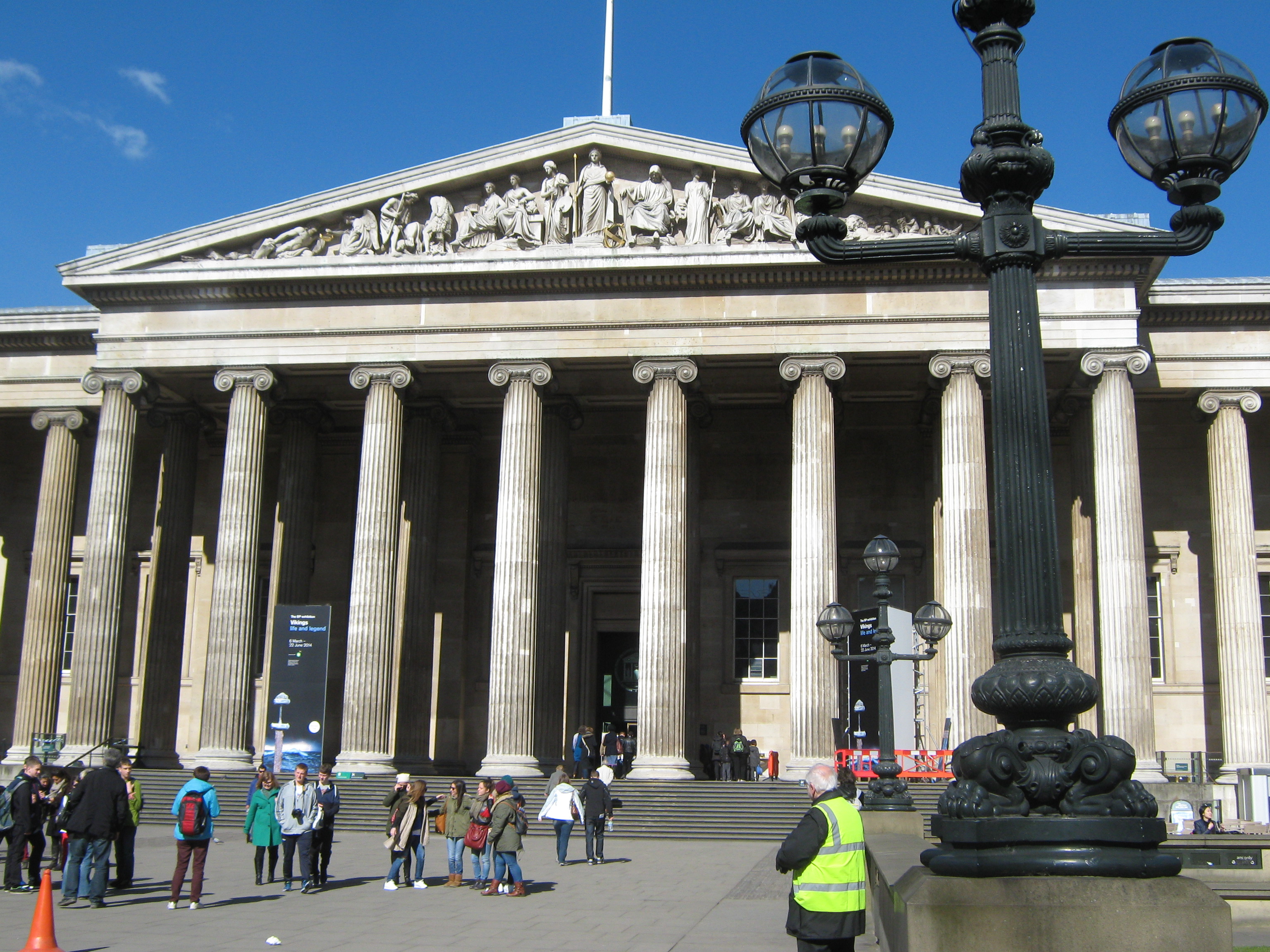
London with Coffee # 3

The British Museum--again?

The British Museum–again?

I am getting better at being a tourist.

That means I wake up, I leave the hotel, I get lost.  And today I was so lost that I didn’t have coffee till noon.

Why would I get lost?  There is no reason to get lost.  I have guidebooks, maps, an A/Z, a computer.

There I was in the hotel room, planning my trip to the Dickens Museum.  There are Dickens walks, but I was far too tired to go on a Dickens walk.  I was in the Dickens mood, though, because I fell asleep last night reading Bleak House.

I started out at 10 a.m.  I had written everything down, but I hit a dead end.  Buildings.  On the other side I suppose the street continued.

I don’t know where I was, but suddenly I recognized a street and knew the British Museum was there.

Later I’ll go to the Dickens Museum, I promised myself.

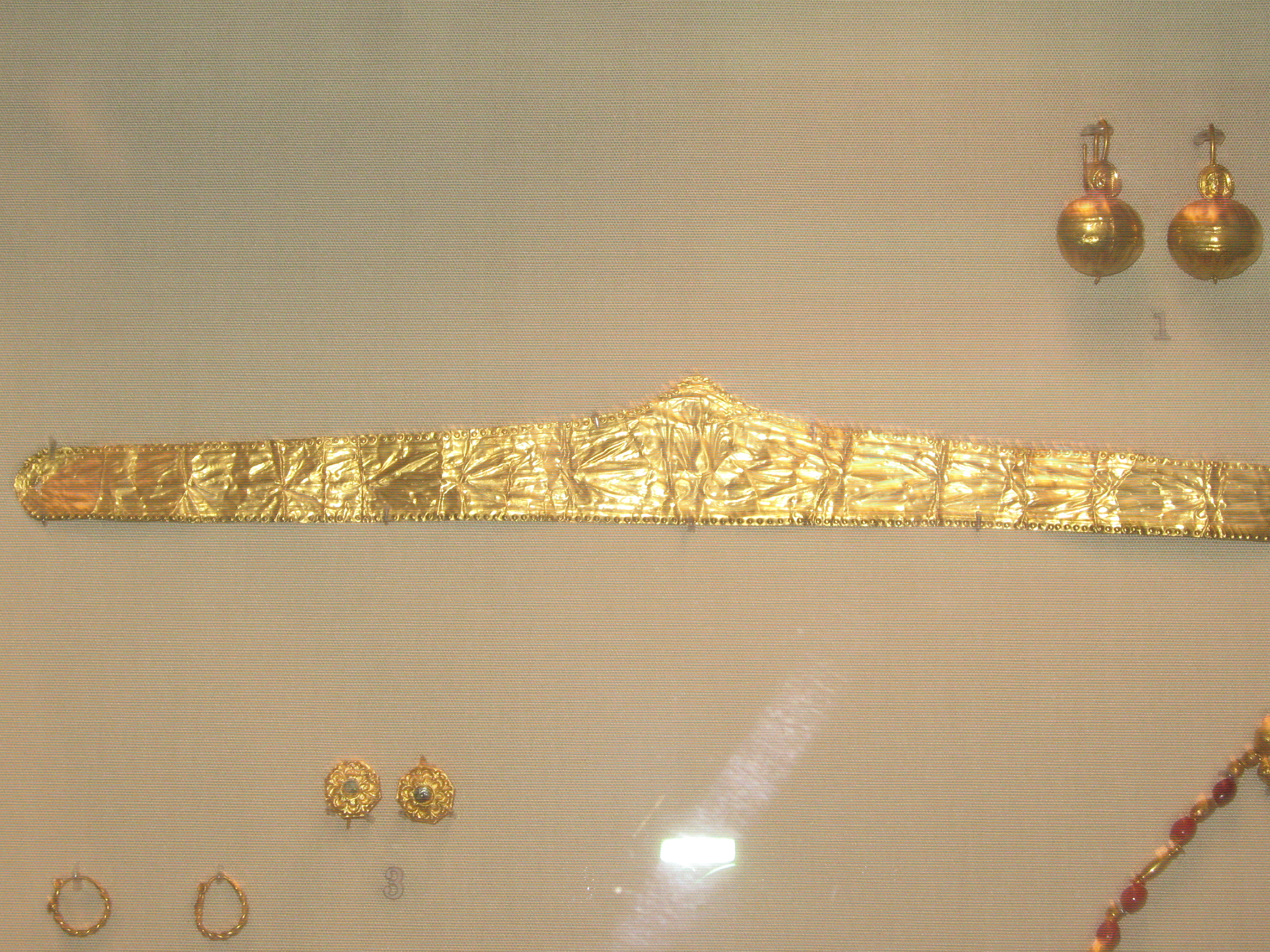
I wandered briefly among the Greek and Roman exhibits.  I want this diadem and the ball-shaped earrings:

Diadem, decorated in relief with palmette flanked by leaves.

Diadem

Yes, it is a terrible picture, but I like the idea of wearing a diadem decorated in relief with palmette flanked by leaves.

And I saw two lovely bronze statuettes of Venus loosening her sandals.  My pictures didn’t come out unfortunately.

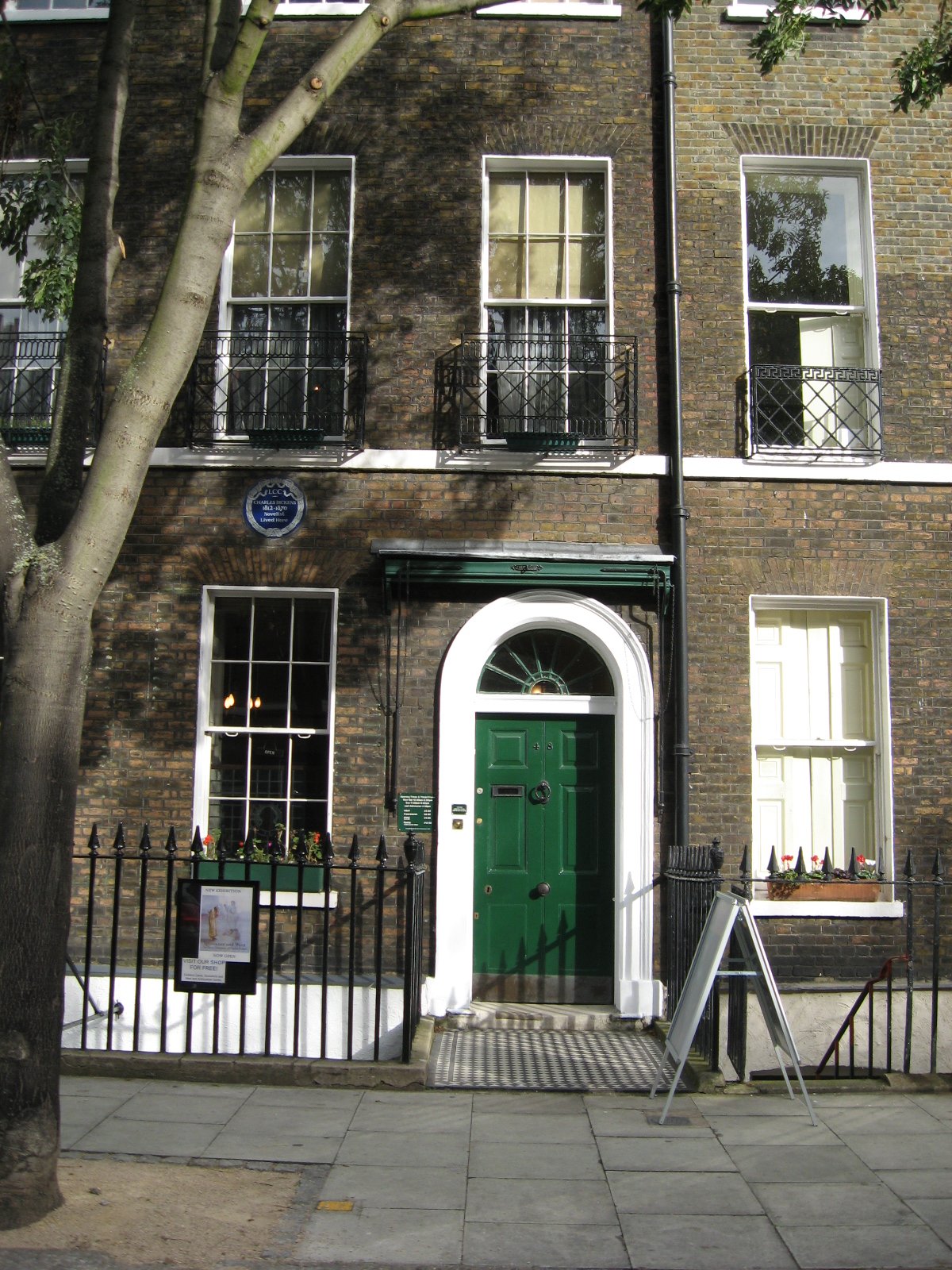
Okay, then I made it to the Dickens Museum.

Dickens Museum

Dickens Museum, Bloomsbury

At first I walked right past it because the sign was so discreet and I was on the wrong side of the street.  Then Doughty St. turned into John St. (Why is this always happening in London?)  I retraced my footsteps on the OTHER side of the street and found the museum.

All right, I paid what I paid and then I was in the museum.  First, the dining room.  I thought it was a bit corny.  I didn’t need the settings at the table with the names Dickens, Walter Ainsworth, Forster, etc., on the plates.  I liked the mahogany sideboard, though, which I think Dickens bought himself, though I don’t quite remember that part. And what the f- was that soundtrack in the background?  Street sounds?

I thought, Oh God, this doesn’t compare with Willa Cather’s house in Red Cloud, Nebraska.

Well, in a way it doesn’t.  But so many people love Dickens that they want to make it more commercial, I suppose.

I got hooked upstairs in the drawing room and study.  Then I felt the writer “near me.”  In the drawing room I admired the rosewood leather-topped table, and the rare reading desk he had designed and built for his readings and performances.  A podium?  Very exciting, isn’t it?  I would have loved to hear Dickens read.  And there was a tape (a CD? whatever you call it?) of someone reading Dickens aloud.  I’m afraid I don’t know what was being read.

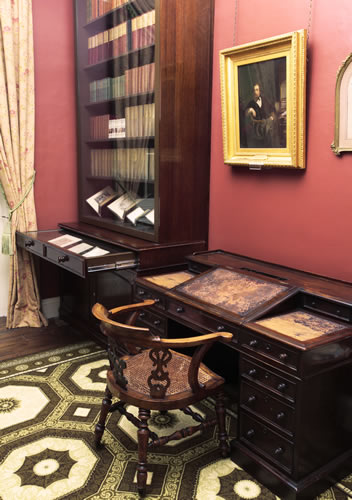
And then in his study there was his desk from Gad’s Hill.  What is it about writers’ desks?

Dickens' desk.

Dickens’ desk.

And there were Dickens’ books in the glass bookshelf:  Shakespeare, Robinson Crusoe, and Specimens of English Sonnets.  Also a page or two of his original manuscript of Oliver Twist.  And then in another bookcase were sets of Dickens’ own books.

The rest of the house was quite nice, too.  Kitchen, bedrooms, etc.  And then I did buy a few books.  Not a Dickens mug, but it was necessary to buy a copy of A Walk Around Dickens’ London.  It’s really a sweet little pamphlet.  I’m unlikely to take the walk, but I like reading it.

I loved the Dickens Museum.  I love Dickens!

COFFEE NOTES.  Today I had to go to Starbucks.  I passed two of them, and honestly I needed my grande. One Starbucks coffee and that’s all you need.   The coffee is so good:  Costa was a little strong for me yesterday.  Will I be able to find an indie coffeehouse tomorrow?  Everybody advertises cappucchinos–but can they make coffee?

London with Coffee # 2

Book shopping, that is.

Book shopping, that is.

I realized while browsing in the Greek and Roman life room at the British Museum that my late mother would have enjoyed the tiny terracotta and bronze figures.  She collected ceramic figures and dolls, so how could she not like these “figurines?”  There were tiny figures of sacrificial animals–a ram (from Syria), a pig (near Rome), and a bull (I think it was Etruscan)–and figures of gods and even comic actors.  I loved a diminutive bronze figure of Mercury, a terracotta woman in a bath, and a bronze figure of a satyr playing double-pipes.

Perhaps they have some adorable Greek and Roman figurines at the museum store.  But these stores are always expensive, and you never like the stuff that much when you get home.  I have many souvenirs of the Chicago Art Institute, all tucked away out of sight.

On the way to the British Museum, the quest for coffee continued.  How could it not?  Starbucks, Costa, Nerro’s…  I’m on my Size Epic two.

It is beautiful here in London.  Though the spring is not far advanced, it is very green and there are some flowers. It is mild, in the 50s here, though at home it is still cold and windy–the wind never stops blowing on the prairie.

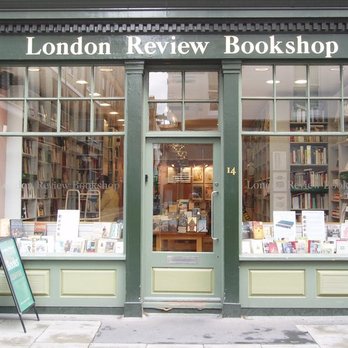
I sat outside the British Museum and soaked up the sun. I didn’t have a book in my bag, except a guidebook, so I decided to go to the LRB (er, London Review of Books) Bookshop. It is just south (or possibly east or west; God knows where I was) of the British Museum.

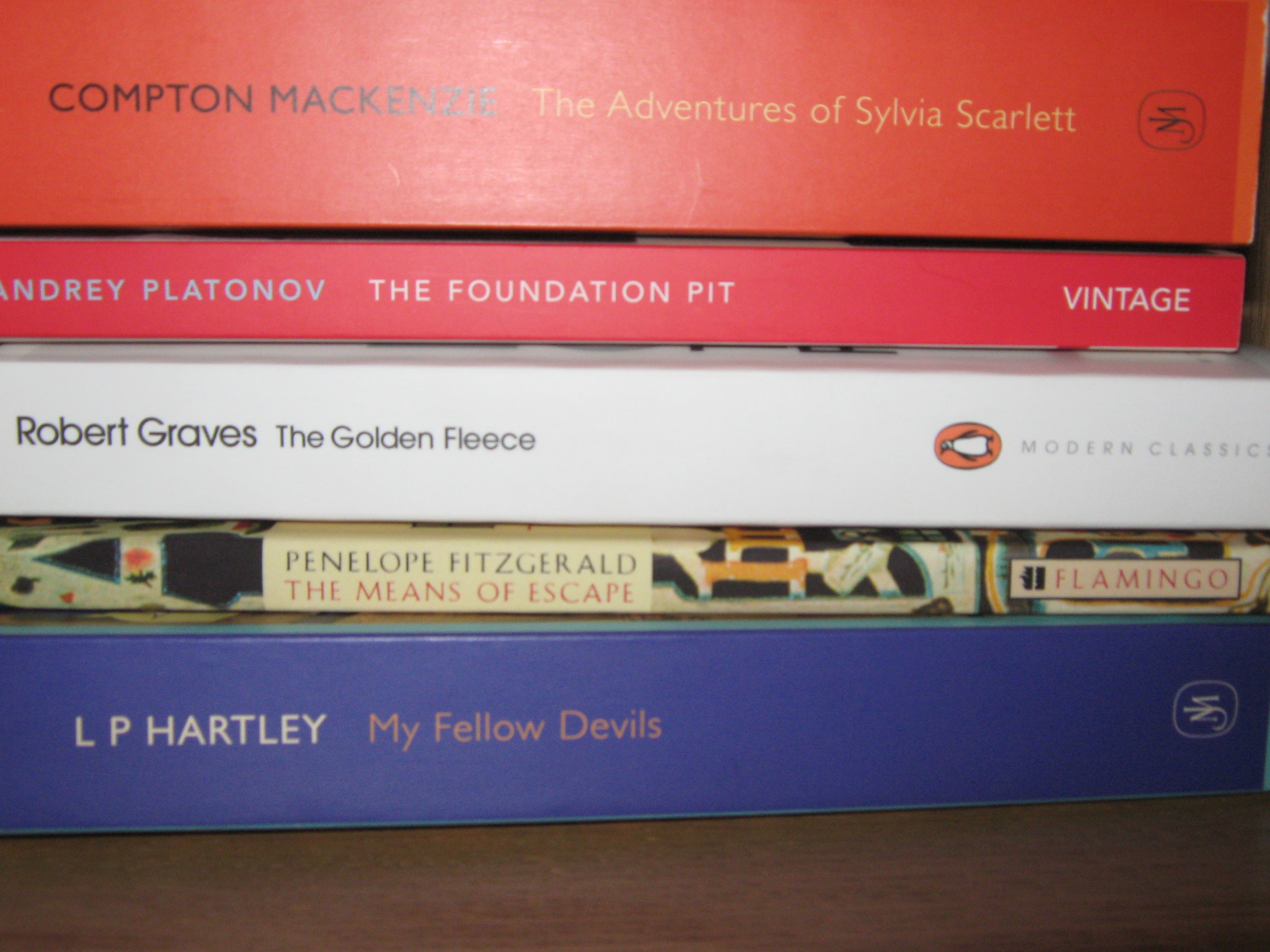
LRB bookshopNow I don’t read the LRB, because I already read the NYTBR, the NYRB, the TLS, and the WSJ (I made that last up:  I don’t read the WSJ), so I can’t really add anything else with initials at this time. But what a good bookstore this is! I considered a book of literary history, not usually my kind of thing, and several novels I’ve never heard of.  The whole Bailey’s Women’s Prize list seemed to be there, but I already have The Goldfinch, and must read that before adding more to my “queue.”   I was looking more for the obscure, for something I couldn’t get in the U.S.

Nothing hardback, I decided.

No problem.  Look at this haul:

IMG_2843I know, I know.  This is my whole budget for books.

Now I must get much more touristy tomorrow.  Seriously, you know how it is when you arrive:  it’s midnight, it’s only 7  at home, so you wait till 2 or 3 to go to bed, then you wake up early and turn off your alarm because you’ve only had a few hours’ sleep.

The secret:  coffee.  I’ve drunk so much coffee today.  Caffeine, caffeine!

Tomorrow:  must find really GOOD non-chain coffee in London. (I already drank all the Pickwick tea in my room.)

Airport with Coffee # 1

Cathy, my favorite cartoon.  You can read these like a graphic novel.

Cathy, my favorite cartoon. (You can read these like a graphic novel.)

At five-thirty a.m., I was having a miraculous good-hair day at the airport.  I was absolutely convinced that everyone was admiring my drip-dry hair.  And then suddenly I had my personal security line.  There was only one of me, and there were at least eight security people to look at my stuff.  While my husband made faces at me on the other side of the glass (he thought it very funny that I couldn’t be rushed), I put the ziplocked bottle of mouthwash they are so fond of x-raying in one bin, shoes and coat in another bin, and almost had to part with my sweatshirt.

“What about that jacket?”

I gave them that inimitable schoolmarm look.

I got to keep the sweatshirt.

Let’s realize something. I’m a matron.  I’ve waited all my life to be a matron.

I didn’t hustle either.  It took me a while to regather my stuff.  “Do you need help, ma’am?”

“No, I’m just slow.”

I needed coffee very badly, and I have no memory at all of how those coffee-less hours passed. Later, at another airport, I passed a Starbucks.  But I was wandering around looking for my gate, and my so-called carry-on luggage was so heavy that my back ached, and how could I carry a coffee while dragging a barely-regulation-size suitcase and balancing an unbalanced laptop bag?

The only option was coffee at the McDonald’s by the gate. There was no sleeve!  It was too hot!  I couldn’t even sip it.   And if you, like me, thought an Egg McMuffin was an English muffin with an egg on it, you are wrong.  It also has a piece of ham and two yellow rectangles of cheese.  I threw it away.  It was utterly disgusting.

Now I’m sure you all know the answers to this airport dilemma.  BRING YOUR OWN GOOD FOOD.  There was no reason I couldn’t have made myself a little sandwich, if I’d thought of it.  Well, they would have x-rayed it, and that would have been no good.  But I certainly shouldn’t have been eating McDonald’s.

They did feed me later on the plane, unexciting but all vegetarian, and I did have coffee, but it’s not real coffee, if you know what I mean.

TOMORROW:  one good cup of coffee must be found.

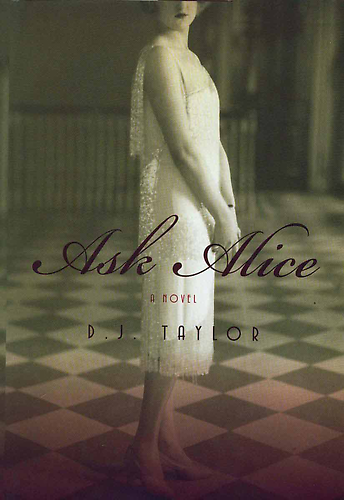
D. J. Taylor’s Ask Alice

AskAliceThe Midwestern landscape can be eerie.  Thousands of empty miles of flat or gently rolling fields of corn, soybeans, wheat, and prairie grass.  There are more hogs than people in the Midwest.  I mean that literally.

Not much Midwestern literature is published.  Though Willa Cather’s sagas of loneliness and resilience on the Nebraskan prairie are widely known, few Midwestern writers have made it into the canon.

So you may be surprised when I categorize the English writer D. J. Taylor’s novel, Ask Alice, as an honorary Midwestern novel.  Though most of this novel is set in England, it begins in the Midwest in the early twentieth century, and we first meet the heroine, Alice, traveling on a train through Kansas with her Aunt Em.  And, yes, if you’re thinking of Oz, so you should. This is the beginning of Alice’s journey from sweet Midwestern girl to successful English actress to London society hostess in the Jazz Age.

After Aunt Em and Alice part, a charming salesman, Mr. Drouett, picks up Alice.  Thrilled by his tales of travel, she half dreams of escape from the emptiness of Kansas.  He persuades her to go to dinner with him at a hotel, then seduces her.  They live together near De Smet in South Dakota, until Drouett deserts Alice during a terrifying blizzard.  After a few years of marriage to a strict young Scandinavian minister, she steals a church relief fund and absconds to England with her child, Asa.  Eventually she ends up on the stage.  She has to farm out Asa to caretakers.

Taylor pays homage to several writers in this complex, beautifully written novel, among them Dreiser, Laura Ingalls Wilder, H. G. Wells, and J. B. Priestley.  He deftly depicts Alice’s naiveté and theatrical dreams: her friendliness and unselfconscious beauty ensure her success first on the stage and then as a society hostess.  There are multiple story lines in this intricate novel:  much of the book is  narrated by the gently witty Ralph, an English orphan who does not know who his parents were, and who vividly describes his life with his eccentric “uncle,” a brilliant inventor of a new red dye, called hogpen.  And it is not spoiling anything to say that Ralph is actually Alice’s son Asa–you will realize this immediately–though this is not officially revealed till the end.

Taylor fashions Alice’s sexual and theatrical adventures along the lines of those in Dreiser’s Sister Carrie, a naturalistic novel in which Carrie, a country girl, meets a traveling salesman on a train to Chicago, where she will eventually become an actress. Taylor’s Alice is likable and kind, except when it comes to men, and then she is cold and calculating:  can they be of use?   When her husband, Guy Keach, won’t allow her to perform in a charity theatrical, she is annoyed but has an epiphany.

He coughed his cough and it occurred to her again that there would come a time when he would not be there to read her letters and refuse her invitations, that she might look forward to a future in which she could do what she liked, write as many letters as she chose and have whoever she pleased to live with her.  Shortly after this he went away, the sound of the axes rose up again from the distant wood and the letter Alice had thrown towards the fireplace burned itself to extinction against the glowing coals in the grate.

Ralph, on the other hand, is very much enjoying his life with his uncle, who, now that he can hobnob with the rich, is even happier than he was as a mad inventor.  Ralph is now a gentleman, with friends who are Jazz Age socialites.  His  observations are astute and witty but also very kind.

My uncle was very great in those days.  I have said that the mark of his genius was a willingness to adapt himself to whatever environment in which he happened to fetch up.  He was as at home on the prow of Atry’s yacht as it tacked desultory across the Solent as he was slaughtering grouse on Lord Parementer’s Aberdeenshire estate, as happy dispensing seedcake to the Dowager Duchess of Southerland in Pont Street as parading in the Ascot Enclosure.  I have a memory of him from this time at some reception on the House of Commons terrace, with a charged glass in his hand and Mrs. Stanley Baldwin on his arm.  It was the look of an athlete who, having breasted the tape of some long and arduous race, glances over his shoulder at the flotsam of the finishing line straight behind him.  He was, or so it seemed, always seeking out new territory even as it colonised the ripped-up earth beneath his tread.

All goes well with Alice and Ralph in their separate spheres until Drouett, the salesman, shows up in England in search of Alice.  Then the lives of all three dramatically change.

The journal of the novelist, reporter, and ghostwriter Beverley Nichols lightens up the last chapters of this novel, though I won’t reveal the context.

This is a dazzling novel, with a huge cast of fascinating characters, most in search of some quality that eludes them, even when they acquire money (though money helps). Taylor is a brilliant writer, and this book fascinates me so much that I want to reread it in tandem with some of the books Taylor mentions or alludes to.

In the past few months, I have read three other stunning novels by Taylor, The Windsor Faction, Derby Day, and Kept.  They’re all remarkable, but this is my favorite.

Mirabile on Cold Pills, The Literary Life, & Five Literary Events in the UK

pop021Give me a white coat, put me in an exam room, and I can diagnose the common cold with the best of them.

A few years ago, there was much whining by newspaper columnists when over-the-counter cold medicines containing pseudoephedrine, a decongestant, were yanked from the shelves in pharmacies.  (Pseudoephedrine is used in meth labs, and the meth cooks were buying up the cold pills.)

Personally, I never found that pseudoephedrine helped my colds anyway.

And I ask myself:  can over-the-counter medication possibly get any stronger even without pseudoephedrine? I recently took two cold/sinus pills, and was knocked out for 15 hours.

Fifteen hours is a lot of sleep.

I was cured.

Was it the sleep or the pills?

Anyway, just in time for my trip to London… which is coming up.

Being an extremely boring bibliophile, I have wondered anxiously which books I should take with me on the plane.  Will my library book set off the security alarms?   Perhaps I should take a paperback.

I will doubtless acquire new books in London.

I cannot pretend my bookish idea of a good time would suit everyone.

“Are you getting a job in a second-hand bookstore?”  my husband asked.

That was my first plan.

My second plan was to attend a lot of literary events. Literary events are to me what jumble sales are to Barbara Pym’s characters. (I grew up in Iowa City, home of the Iowa Writers’ Workshop, and have a high tolerance for readings, lectures, etc.)   And if I do go to any literary events, I will be sure to wear a Pymish jumper/sweater, my thickest glasses, and my walking shoes.

So, literary London?  Why not?  It will get me oriented, right?  I  probably won’t have time to attend these events, since I plan to be thoroughly touristy in an unliterary way,  but, nonetheless, I have compiled a literary calendar.  See you there.  Well, maybe.

1.  Royal Shakespeare Company:  “Two special events with the award-winning writer Hilary Mantel over the weekend of 22nd and 23rd March at the Swan Theatre”.  I can’t get the information about this to come up now–does that mean it’s sold out?–but Mantel will talk about Cromwell: her novels Wolf Hall and Bring up the Bodies have been dramatized.
http://www.rsc.org.uk/about-us/updates/hilary-mantel-events-at-rsc.aspx

2.  Oxford Literary Festival, March 22-March 30.  A week of writers, lectures, interviews, and other events. You can see Sebastian Barry, Jan Morris, Ian McEwan, Margaret Atwood, Alexander McCall Smith, Orhan Pamuk, Peter Stothard, Margaret Drabble, Eleanor Catton, and many others.  Yes, I should probably have simply spent the week at the Festival.

3.  Daunt Books Spring Festival, Thursday 27th and Friday 28th March, 2014, at Daunt Books, 83 Marylebone High St, London W1U 4QW.  Although 10 a.m. is too early in the morning for me–what are they thinking?–some of you Virago fans might want to attend a talk on “Celebrating Virago Modern Classics” with writers
Deborah Levy, Maggie O’Farrell and Susie Boyt.

4.  Mad Man, Chris Goode’s new adaptation of Gogol’s Diary of a Madman.  A Theatre Royal Plymouth Production,
Thursday 20 March–Saturday 5 April

5.  WordFactory’s  Salon with 
Joe Dunthorne, A.S. Byatt, Will Cohu
WATERSTONE’S PICCADILLY
Saturday, 29 March 2014, 6:00PM – 8:00PM

“An unforgettable evening of story-telling from internationally renowned AS Byatt, (Possession/ The Children’s Book) and rising stars Will Cohu and Joe Dunthorne (Submarine). Enjoy a warm welcome and free glass of wine at the UK’s leading short fiction salon.”

Is that enough to keep me busy?  I hope so!

Cheeseburgers, Smarter Than My Landline, & What I’m Reading: The Flight of the Silvers

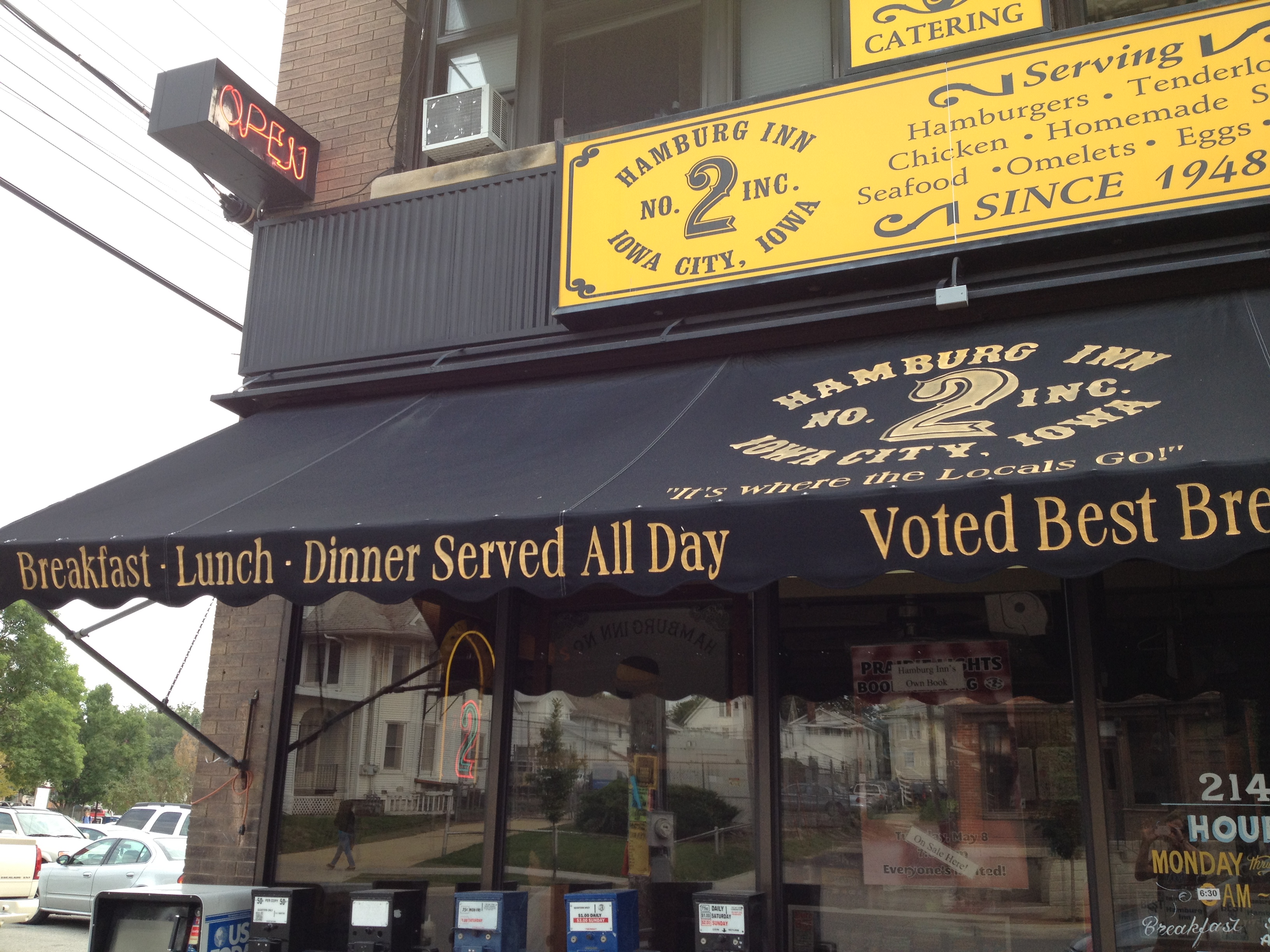
I plan to break my "vegetarian fast" one day this spring at the famous Hamburg Inn in Iowa City.

I will eat one cheeseburger during National Hamburger Month.

This place is like Wal-Mart on acid,” Hannah said.  “It’s freaking me out.” –Daniel Price’s The Flight of the Silvers

When I became a vegetarian last fall, I was disgusted with meat.  You know that manmade chicken in David Lynch’s surreal movie, Eraserhead?  The  one with creepy parts that won’t stop moving?  I ate some chicken that tasted like that.

Many months later, I can tell you that I am definitely healthier on a vegetarian diet. One day, however, I became so so vegetable-mad that I almost made pasta out of thin strips of vegetables. (See Mollie Katzen’s The Heart of the Plate: Vegetarian Recipes for a New Generation.)

“That’s really sick,” my husband said.

So I made lasagna out of real noodles.

“Where’s the hamburger?”

All right, there was no hamburger.

And suddenly, very suddenly, I wanted a cheeseburger.  One of those at the local diner that are as big as the plates.  And I want everything on it.  Mushrooms, onions, special sauce…

I wasn’t tempted by a bacon festival on the State Fairgrounds.

No, it is the cheeseburger. The cheeseburger got me the last time I was a vegetarian. One night we were at a restaurant, and I thought, F— it, I’m having a cheeseburger.

My husband, seeing my desperation, recently bought some soy hot dogs. If you leave them in the boiling water for six minutes instead of two, they taste almost like meat.

So six soy hot dogs and 300 calories later…I should have had a cheeseburger (500 or more calories) and gotten it out of my system.

In May, National Hamburger Month, I will break my veggie “fast” for a day with a cheeseburger at the Hamburg Inn.  And then I’ll be all about the omelet again.

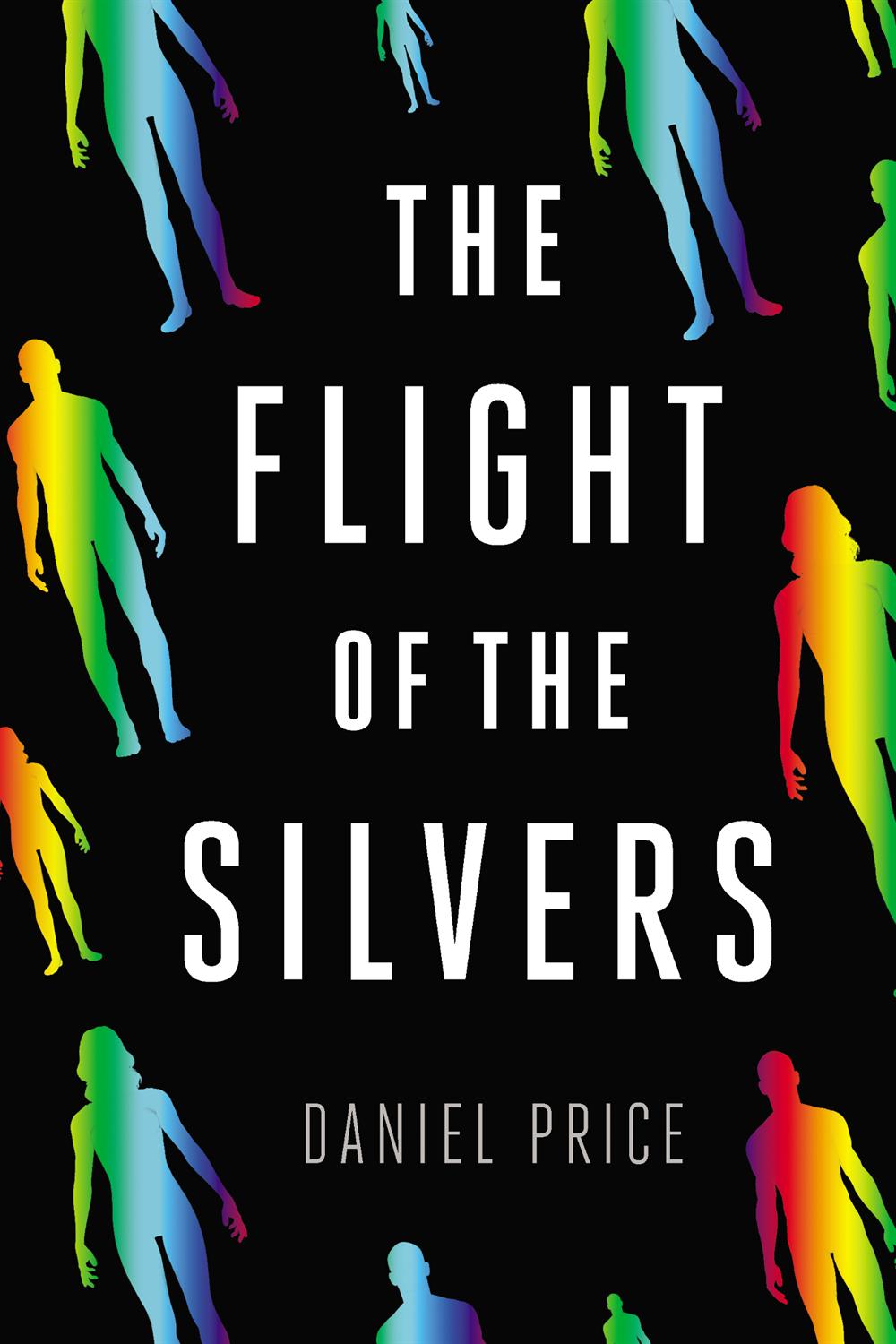
THE FLIGHT OF THE SILVERS BY DANIEL PRICE.

I haven’t flown away on my trip yet.

But in the meantime, I have discovered the perfect airplane book:  Daniel Price’s The Flight of the Silvers.

You might not think you like science fiction, but you do.  There are many SF classics, like John Brunner’s 1968 novel,  Stand on Zanzibar.  One of the characters is named Obami, and he is a president in an African country:  no kidding.  I’m also very fond of the work of Samuel Delaney, Kurt Vonnegut, Alfred Bester, and Karen Joy Fowler.

SF is perhaps the “brainiest” genre.  Although the quality of the writing varies, the writers often have brilliant ideas, and some academics of my acquaintance have written scholarly articles and books about science fiction.

And after a trying afternoon shopping for various items for my trip, I needed science fiction.  When a clerk suggested I  buy an app for my smart phone (my what?  I don’t even have a cell phone) instead of a travel clock, I realized I was living in a futuristic dystopian novel.  I am, thank God, still smarter than my land line.

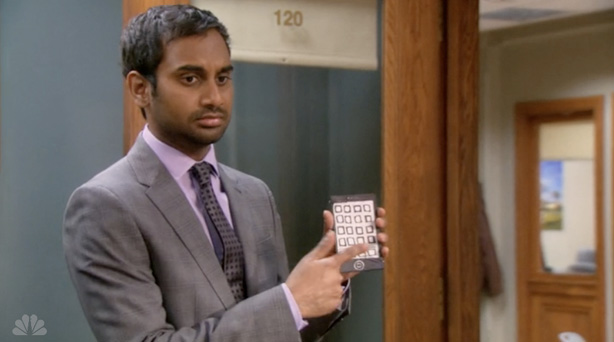
Tom on "Parks and Recreation" makes a paper iPhone after barred by a judge from using electronics for a week.

Cyberaddicted Tom on “Parks and Recreation” makes a paper iPhone after being barred from using electronics for a week.

I am reading a new SF novel, Daniel Price’s The Flight of the Silvers.  This very long pageturner is the adult equivalent of the popular Y.A. novel The Hunger Games, only with a more complicated plot.  Price’s writing is sometimes quite good, and all of it is good enough, and it is absolutely fascinating.

Flight of the Silvers by Daniel PriceAs children, Amanda Given and her younger sister Hannah are saved by apparently supernatural beings from a car wreck.  Years later, when the sky literally falls and destroys earth, they are saved for the second time, silver bracelets clasped to their wrists that form bubbles around their bodies.  Along with other members of a group called the Silvers, they are transported to a parallel Earth where they are of interest because of abilities concerning bending time.

Here is a sample of the terrifying description of the Earth’s end.

Everyone froze as a thunderous noise seized the area–a great icy crackle, like a glacier breaking in half.  Bystanders threw their frantic gazes left and right in search of the clamour until, one by one, they looked up.  The eerie sound was coming from above.  It was getting louder….

Suddenly the tallest buildings in the skyline began to splinter at the highest levels, as if they were being crushed from above.  Metal curled.  Stone cracked.  Windows exploded….The sky wasn’t just getting brighter and louder.  It was getting closer.  The sky was coming down.

Price’s characters are vivid and believable, though I will not dwell on their confusing talents:  Amanda is a nurse who dropped out of med school, and finds she has a special power to extend her hands as if in long cement gloves and (sometimes) stop evildoers; Hannah is an actress who can accelerate her person to 90 miles an hour while time seems to stand still; Zack is a comic book writer and illustrator with the ability to turn back time (so far he uses it mainly to refresh old bananas); Mia is a teenager who receives notes from her future self through a portal; David is a teenage prodigy who works with ghosts; and Theo is an alcoholic whose talents so far aren’t clear to anybody but would love a drink… as we all would if were in their position.

The Silvers flee from the giant laboratory where they’re being studied, and so far it has been an exciting road trip.

This book is pure fun.  Where do these SF writers get their imagination?  It’s the best escape book I’ve read in a while.

It’s the first of a trilogy, and I just hope he doesn’t write it too fast.  That was the problem with Suzanne Collins’ Hunger Games books.

The “Lunch in London” Trip, Fun, & How Nancy Drew Changed My Life

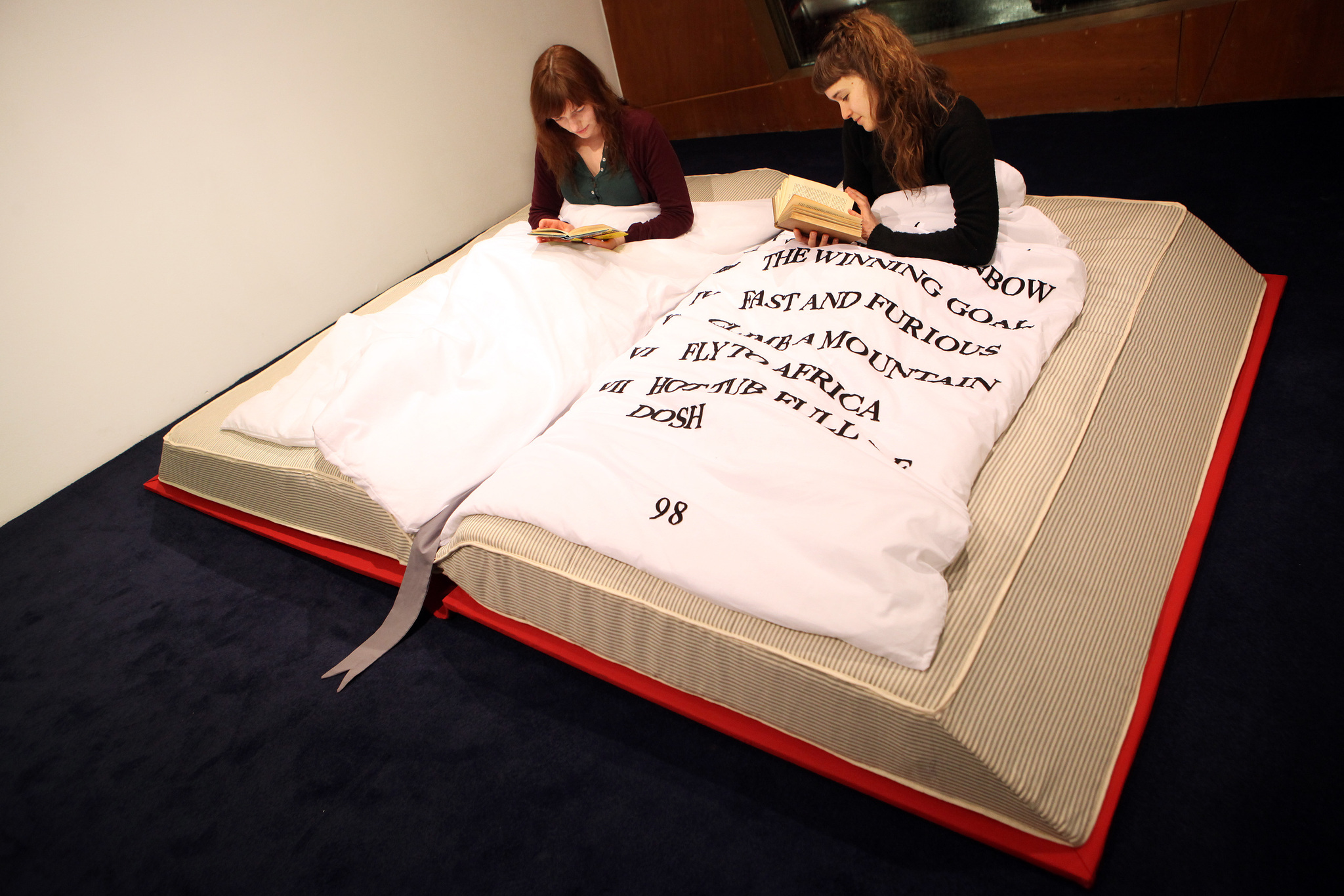
Bookbed by Ruth Beale

Bookbed by Ruth Beale

I am getting ready for my “Lunch in London” trip.

I call it “Lunch in London” because I see no reason to get up before lunchtime.

My plans are:

1.  Sleep till noon, lounge in pajamas, and then eat cereal out of a box, or possibly a sandwich.

2.  Rush out and embark on one of my many sight-seeing ventures. (I am the queen of tourism culture!)

And then do something vaguely fun.

Fun?  What is fun?  Do I ever have fun?  Have I ever had fun?  Google “London Fun” and you come up with the Vikings exhibition at the British Museum (I can come up with that kind of fun on my own), something called Bookbed (a solo exhibition by  artist Ruth Beale featuring a book-shaped bed), and the musical of From Here to Eternity.

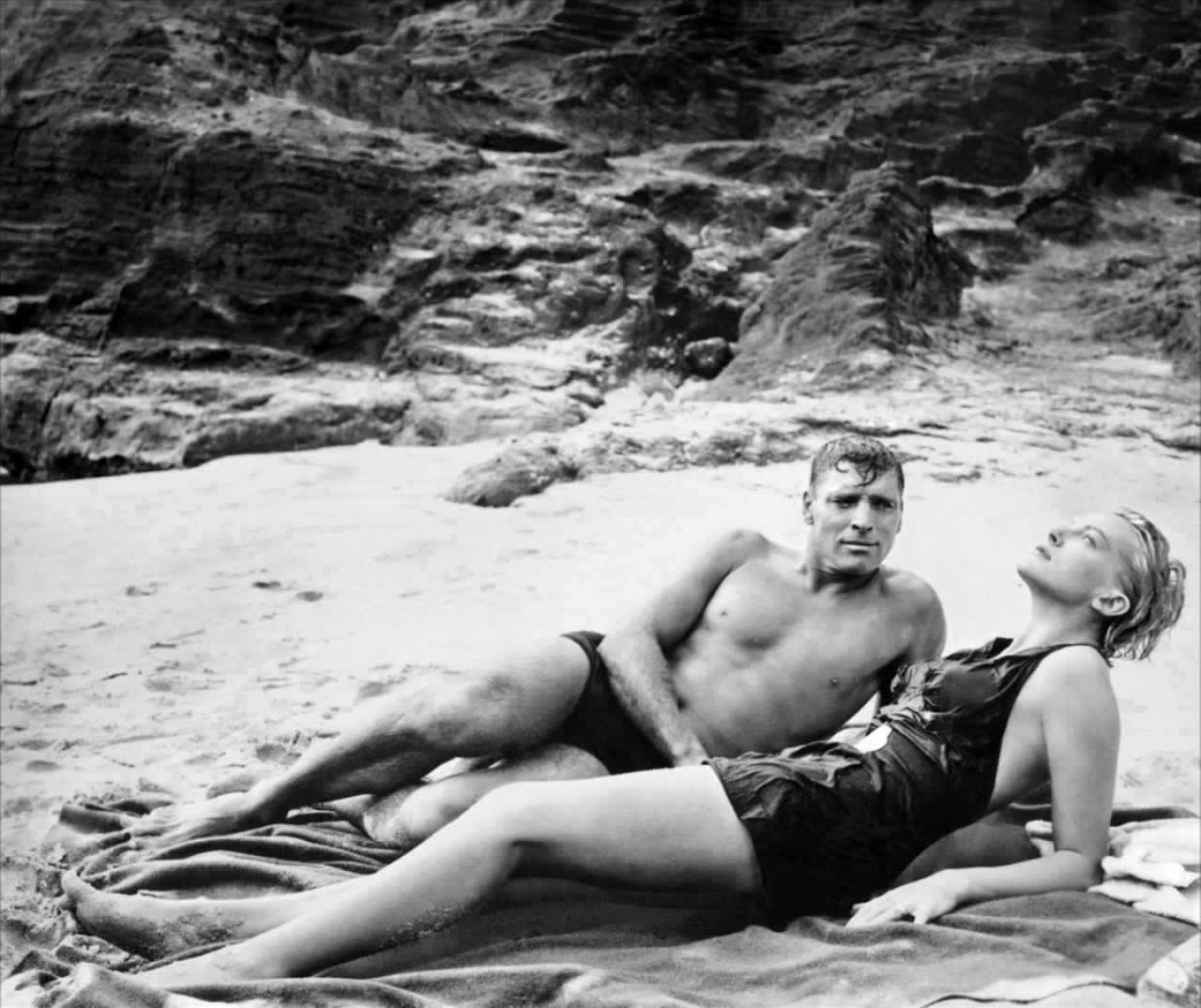
The wrong "From Here to Eternity" (the movie)

The wrong “From Here to Eternity” (the movie)

Actually, I quite like the sound of From Here to Eternity.  Deborah Kerr!  Burt Lancaster!  Oops, that’s the movie.

Doesn’t  Bookbed look like something I should see?

Then there are various literary events and festivals I can attend if I feel inspired.  I am such a fun person…

My husband wonders if I understand that the cats can’t do without me. Well, I’ll Skype them.  A typical conversation with a cat goes like this:  “Who’s the prettiest cat in the whole wide world?” and “Who wants crunchies?”   Maybe they’ll like Skype.  Probably they’ll be indifferent.

And now on to Nancy Drew.

I went to B&N and stocked up on paperbacks, including George Saunders’ Tenth of December, winner of the Folio Prize.

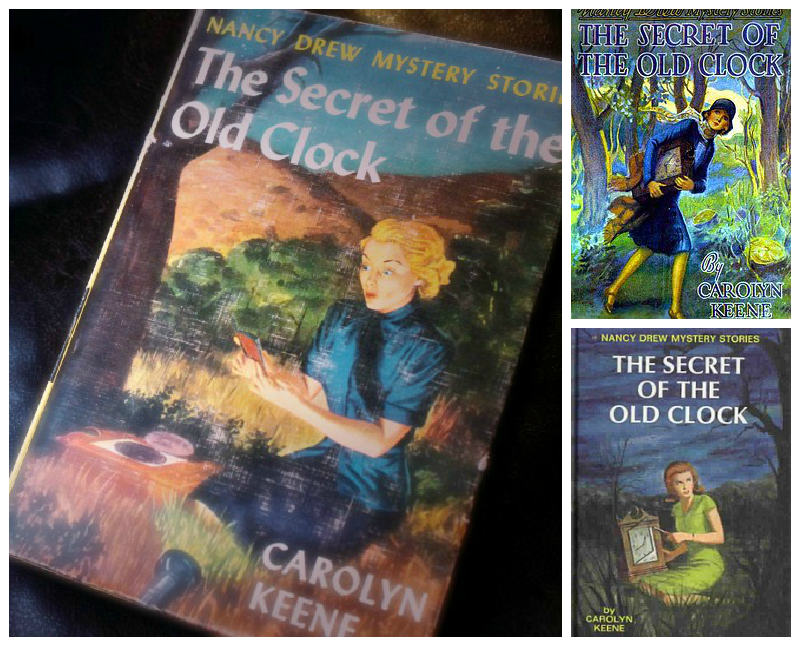
And then I also bought Nancy Drew, The Secret of the Old Clock.

Like countless other American women, I was raised on Nancy Drew.

My late mother, who really spoiled me, bought me possibly 20 Nancy Drew books.  Looking in the back of the book at the Complete List of Nancy Drew Mystery Stories, I remember the first 10 titles and then must have  bought some out of order, because I recognize later titles like The Clue in the Old Album (# 24) and The Secret of the Golden Pavilion (# 36).

Nancy Drew The Secret of the Old Clcok

Three different covers.

You don’t really have to read The Secret of the Old Clock as an adult:  skimming tells you all you need to know.

In the opening chapter, Nancy saves a little girl who runs out into the road and is almost hit by a van.  Nancy returns the child to her great-aunts, seamstresses who are struggling to raise her. The great-aunts had counted on their cousin Josiah Crawley to leave money for their niece. Inexplicably he  left all his money to a rich family.

Nancy is sure something is wrong and intends to find a later will Josiah made.

Now when I was nine or ten I believed every minute of these mysteries.

Here’s an example of the exciting writing.

The elderly woman’s lips had begun to move.
“The clock!” she whispered.  “That was it!  The clock!”
Nancy gripped the arms of her chair in excitement.  “Josiah Crowley hit the will in a clock?”  she prompted.

Wow, the power of the verbs of saying!  Characters were always “whispering,” “exclaiming,” “prompting,”  and “screaming.  Their “eyes danced” a lot.  Throughout my childhood I happily wrote fiction using such verbs, and possibly it wasn’t till I was an adult that I noticed characters in novels mostly “say.”

I love it that Nancy rides around in a blue convertible “roadster,” and that her mind is on mysteries even when she picks out a dress for a country club dance.

Unfortunately, this book is one of the revised versions: the 1930s versions were censored so that words like “roadster” were deleted, and so that the books were shorter and cheaper to publish.

Alas, my mother, gave my Nancy Drew set to my nieces.

The nieces found my 1960s editions old-fashioned.  They wanted an SUV; Nancy drove a roadster.  As my mother pointed out, they didn’t read much: they were always being rushed around to classes and  sports.  “They can’t entertain themselves,” she said.

I grew up in a quieter time.  The only sport I liked was jumping rope.  Thank God no one ever made me play sports.

I do wish I had my old set of Nancy Drew, which they sold on Ebay. (I wonder if I could buy it back!)  The fiction writer Bobbie Ann Mason wrote a book about these mysteries,  The Girl Sleuth: On the Trail of Nancy Drew, Judy Bolton and Cherry Ames.   I very much enjoyed Cherry Ames, though I didn’t know Judy Bolton.

My favorite sleuth of my childhood?  Trixie Belden.  Trixie’s ghostwriters, under the names of Julie Campbell and Kathryn Kenny, had a better sense of humor than the ghosts of Nancy Drew, who wrote under the name Carolyn Keene.

Ten Faves Self-Interview

Occasionally we take a day off at Mirabile Dictu.

Or perhaps a week off.

Or perhaps two weeks off.

Or perhaps a month off.

We’ve never done this before, but I plan to take at least the weekend off.

First, here is a Friday night post:  the Ten Faves Self-Interview.   If you have time to answer one or two or all, please leave a comment.

Are you ready?  Here is my Q&A.

Ten Faves Self-Interview

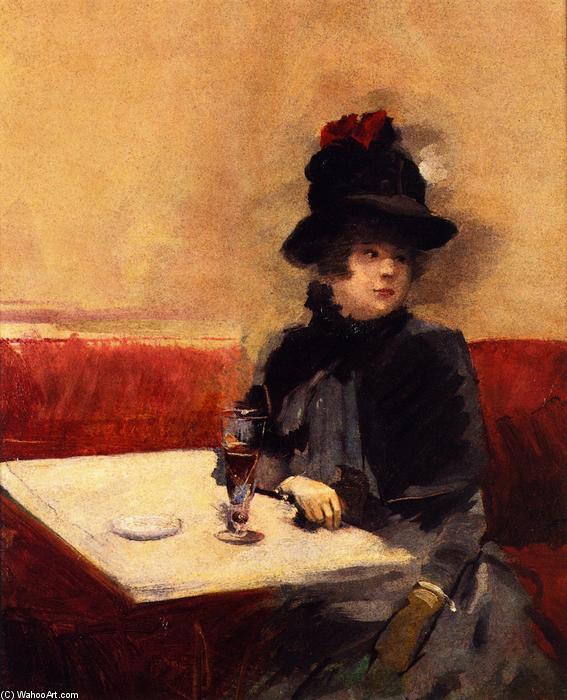
Q 1.  What is your favorite work of art?

Jean-Louis Forain, "Woman in a Cafe" (1885)

Jean-Louis Forain, “Woman in a Cafe” (1885)

Jean-Louis Forain’s “Woman in a Cafe” (1885). Forain liked to paint “the world of the café, brothel, racetrack, ballet and other aspects of modern Parisian life in the late nineteenth century,” according to the self-guided tour in the exhibition, “Renoir to Chagall:  Paris and the Allure of Color” at the Joslyn Art Museum.

Q 2.  What is your favorite band?

R.E.M.

Q3.  What is your favorite classic of all time?

Tolstoy’s Anna Karenina

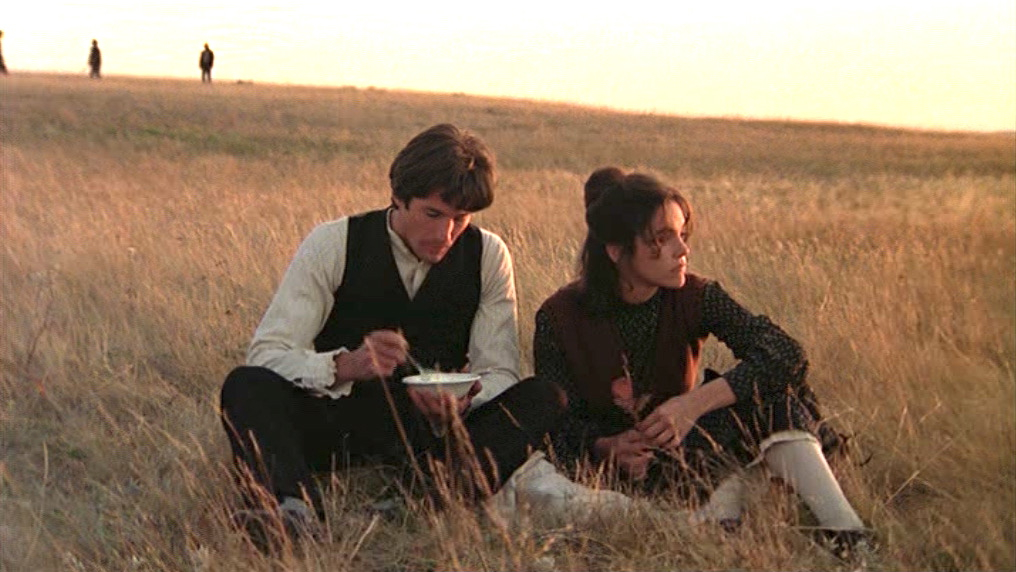
Q4.  What is your favorite film?

Days of Heaven, directed by Terence Malick, starring three of the most beautiful actors of the 1970s, Brooke Adams, Richard Gere, and Sam Shepard.

days-of-heaven-92

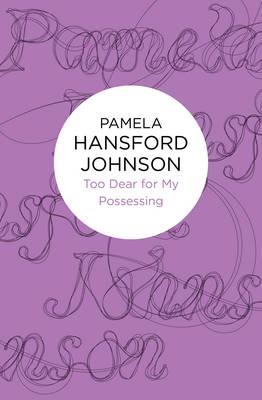
Q5. What is your favorite novel?

Pamela Hansford Johnson’s Helena trilogy, Too Dear for My Possessing, An Avenue of Stone, and A Summer to Decide.

too-dear-for-my-possessing pamela hansford johnson

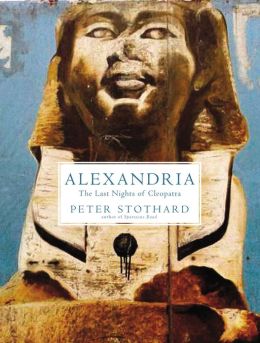
Q 6. What is your favorite nonfiction book?

Peter Stothard’s Alexandria:  The Last Nights of Cleopatra

Alexandria peter stothardQ7.  What is your favorite poem?

Horace’s Ars Poetica

Horace epistles ars poeticaQ8. What is your favorite book review publication?

TLS

Q9.  What is your favorite TV show?

Parks and Recreation.

Q10.  What is your favorite Virago?

Molly Keane’s Good Behavior

And optional Q11?  What is your favorite rock song? Driver 8

On Bicycling for Transportation & The Tragic Death of a Bicyclist

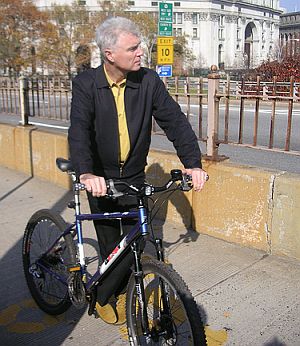
David Byrne on bike

David Byrne

I saw David Byrne on a bicycle the other day.

Actually I saw a white-haired man with a slightly bird-shaped haircut.

“He looked like David Byrne.”

“It probably was him,” my husband said.

After he performed here in concert last summer, he blogged about riding his bicycle on the trails.

Those of you who know how strongly I feel about bicycling–it is not only fun, it is a life-style–will understand why I like David Byrne.  I loved Byrne in the Talking Heads, and he is even better as a solo artist, but it is Byrne, author of The Bicycling Diaries, who has won my musical loyalty.

In an op/ed piece for The New York Times, “This Is How We Ride” (May 26, 2012), he wrote:

I’ve used a bike to get around New York for decades. There’s an exhilaration you get from self-propelled transportation — skateboarding, in-line skating and walking as well as biking; New York has good public transportation, but you just don’t get the kind of rush I’m talking about on a bus or subway train. I got hooked on biking because it’s a pleasure, not because biking lowers my carbon footprint, improves my health or brings me into contact with different parts of the city and new adventures. But it does all these things, too — and sometimes makes us a little self-satisfied for it; still, the reward is emotional gratification, which trumps reason, as it often does.

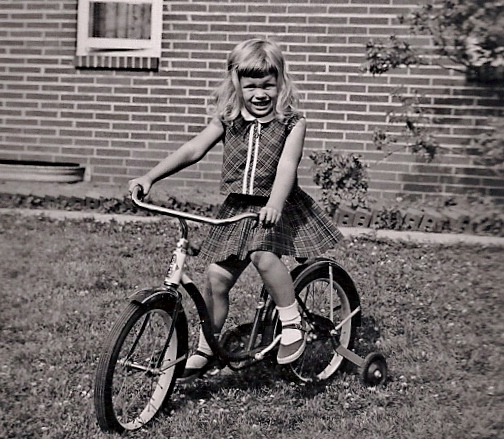
On my first bicycle, age four.  Watch out for Super-Environmentalist!

On my bicycle at age four. Watch out for Super-Environmentalist!

It is spring and we’re biking again.  I love the breeze in my hair, seeing the trees and gardens close-up, hearing the birds, and feeling part of the scene.  I like the  effect on my blood pressure (very, very low, to my doctor’s astonishment) and general health.  (Even if you’re overweight, bicycling, an easy sport, will improve your health.)   Three seasons of the year, I bicycle for transportation.  If there’s not snow, I ride in winter.

I got my first bicycle at the age of four and have cycled ever since.

Bicycling is more energy-efficient (really, you can’t get more energy-efficient) than driving and it is cheap.  I paid $500 for a bicycle in 2003.  I have had to replace the seat and pedals, but otherwise it’s still going strong.

I ride about 1,500 miles a year. Our city has bike lanes, bike trails, and a bike-share program (a rental bike program by which you can ride very cheaply from station to station downtown).

Many cars, alas, do not like to share the road with bicyclists.  One year a mad driver, possibly drunk, stopped his car downtown and yelled at my husband and me to get off the road:  it was Sunday and we three were the only people on a four-lane street.  Once I was pelted with a Coke can and another time with apples by passengers in a car.  I could have written down the car license, but let’s just say I preferred to live.

Horrifyingly, in accidents where a driver kills a bicyclist, the sympathy is often with the driver.

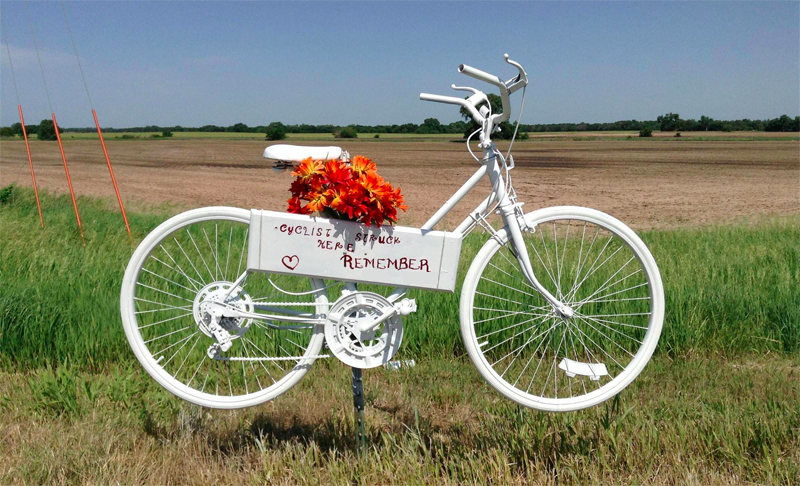
cyclist memorial rememberNot always, though.  Last year, when a 58-year-old bicyclist, Gerald Williams, was killed in a tragic hit-and-run accident in Lenox, Iowa, people were outraged when the killer, 33-year-old Jessica May Brown, was not charged with manslaughter.  She claimed later, after she was caught, that she thought she’d hit a deer.

Williams’ wife, who was out of town, had reported him missing when she couldn’t contact him. Twenty-four hours later, searchers found Williams dead in a ditch.

Brown had to pay a $500 fine for failure to stop at an assured clear distance, with a statutory surcharge of $175 and court costs of $60.

It sounds like manslaughter to us.

So ride (right) on, bicyclists!  But watch out for cars.  Some drivers hate bicyclists, runners, and pedestrians.

And here are the Red Hot Chili Peppers singing “The Bicycle Song.”  As they say, “How could I forget to mention the bicycle is a good invention?”