Ten Children’s Writers Who Also Wrote for Adults

Cat hanging out with books and Christmas cactus.

This cat prefers to read Heinrich Boll

The cat pictured is very fond of Heinrich Böll.

The others were raised on George MacDonald’s The Princess and Curdie. (I read them a couple of pages once.)

Lilith george McDonaldThe great thing about MacDonald is that he also wrote for adults.  I discovered Lilith when I was 12 in one of those Ballantine ’60s fantasy editions with the pretty covers.  Amazon says:  “First published in 1895 …, this is the story of the aptly named Mr. Vane, his magical house, and the journeys into another world into which it leads him.”

So I started thinking:  what other children’s writers also wrote for adults? After MacDonald I came up with:

2.  Madeleine L’Engle.  L’Engle’s A Wrinkle in Time is a classic, but she also wrote adult books.  I very much enjoyed her novel,  A Live Coal from the Sea, a sequel to her children’s book, Camilla.

a-live-coal-in-sea-madeleine-lengle-paperback-cover-artCamilla, now an old woman,  is an astronomer who has had a rich life as a college professor at her alma mater. She adored and was adored by her late husband, Mac, a minister.  Her children, Taxi and Frankie, and granddaughter, Raffi, are more complicated.  After Camilla wins an award for astronomy, Taxi, a neurotic actor, stirs things up.  He hints to Raffi that Camilla is not really her grandmother.  The narrative goes back and forth in time so we know what happened.

L’Engle fans may like this:  I’m not sure about anybody else.

kingfishers-catch-fire3.  Rumer Godden wrote many children’s books, among them A Doll’s House and An Episode of Sparrows.  But her adult novels are especially good:  my favorite is Kingfishers Catch Fire, an autobiographical “pre-hippie” novel in which Sophie, an impoverished young woman, moves with her two children to Kashmir to “live simply.” The misunderstandings between her and the villagers cause an unexpected crisis.

4.  Louisa May Alcott, author of Little Women, wrote some good adult books. Are you familiar with Hospital Sketches, her chronicle of her nursing in the Civil War?

5.  I enjoyed Penelope Farmer’s Charlotte Sometimes and The Summer Birds (now available from NYBR), and I hanker for her out-of-print but wildly overpriced adult novel, Glasshousees.  According to Amazon, it is “An intense novel of three characters, Grace, her husband Jas, and her young apprentice, set in the suggestive, obsessive milieu of a glassblowing workshop.”

6. I grew up on Eloise Mcgraw’s Mara Daughter of the Nile and The Golden Goblet.  She also wrote an adult novel, Pharaoh.  It’s going for $30-some at Amazon, so I’ll have to pass.

7.  Did you read Mary Norton’s The Borrowers books?  How about her adult fiction, The Bread and Butter Stories?  According to Amazon, these are period pieces about being an upper-middle-class woman in the 1940s and early 1950s.

8.  E. Nesbit was my favorite writer when I was a child.  Though I’ve found her adult books disappointing, The Red House, the story of a married couple who inherit a large house, is very funny–and the characters also meet the Bastables (characters in three of her children’s books).

9.  L. M. Montgomery, best known for Anne of Green Gables, wrote at least one adult book, The Blue Castle, about a 27-year-old spinster who rebels against her family.  I haven’t read it.

10.  John Wyndham’s The Day of the Triffids, a stunning science fiction novel, made me want to read more of his books.  I haven’t read The Chrysalids, available from NYBR, which is apparently a children’s novel .  The book description says;  “Like everyone else in the nuclear-wasted world he lives in, David is loyal to his kind and on the watch for anyone who deviates from the ideological or genetic norm. But what would happen if it were revealed that David himself was a mutant?”

It sounds interesting, doesn’t it?

What children’s writers do you know who wrote for adults?

Are any of them any good at it?
Glasses & Dover Books

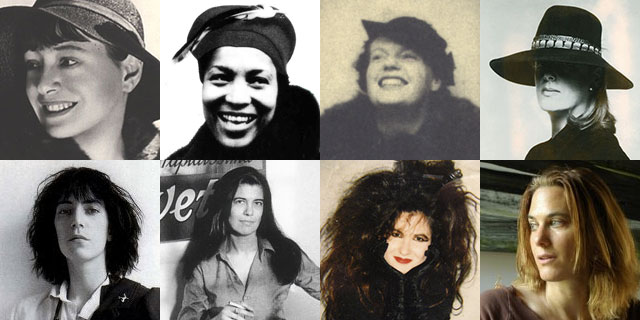
op row: Dorothy Parker, Zora Neale Hurston, Shirley Jackson, Gael Greene. Bottom row: Patti Smith, Susan Sontag, Tama Janowitz, Kate Christensen.

Dorothy Parker, Zora Neale Hurston, Shirley Jackson, Gael Greene, Patti Smith, Susan Sontag, Tama Janowitz, & Kate Christensen.

Where are these writers’ glasses?

Do you know any writers without glasses?

I have new glasses.

It’s liberating.

I was going for a professorial look.

My husband tells me I didn’t get it.

They’re bigger and rounder.

When I walk the wind doesn’t blow in my eyes as it did with my much smaller glasses.

In summer the bugs won’t fly in my eyes.  (This is a problem with bicycling.)

It was hard to find any glasses I liked.

I’ve worn wire-rimmed glasses since high school.  Well, most of the time.

It was time for a new look, I was told.

I tried on any number of Malcolm X glasses.  I didn’t realize they were Malcolm X glasses until I squinted at myself in the mirror.

Malcolm X

Malcolm X

Meg Ryan’s big glasses are adorable in When Harry Met Sally.  Perhaps they’re bigger than is fashionable today.

Meg Ryan in "When Harry Met Sally"

Meg Ryan in “When Harry Met Sally”

Diane Keaton’s glasses in Annie Hall are the best of all.

Diane Keaton in "Annie Hall"

Diane Keaton in “Annie Hall”

Too bad none of us looks like Meg Ryan or Diane Keaton.

I’ve been trying to find pictures of women writers with glasses. There aren’t many.  Here’s the Southern writer, Elizabeth Spencer.  She is usually photographed without glasses.

Elizabeth Spencer

Elizabeth Spencer

Here’s  Karen Thompson Walker, author of The Age of Miracles, a very good literary science fiction book.

Karen Thompson Walker with glasses

Karen Thompson Walker, author of The Age of Miracles

Here’s award-winning Barbara Kingsolver.  She is sometimes photographed with glasses:

Barbara Kingsolver

Barbara Kingsolver

Here’s Madeline Miller, author of The Song of Achilles and winner of the Orange Prize.

Madeline Miller

Madeline Miller

Dorothy Parker didn’t wear glasses in public.  “Men seldom make passes/At girls who wear glasses,” she wrote.

Dorothy Parker 01Who are your favorite women writers with glasses?

DOVER BOOKS.  I love book catalogues, and today we received the Dover Publications catalogue in the mail.

$5 off when you order $35 or more!

 The first six pages are devoted to Shakespeare.  (So cute!)  And since I’ve been thinking about reading Shakespeare this winter, I got out my Pelican edition.  I also have some little paperbacks that are easier to read.

Trollope’s Ralph the Heir is back in print.

What about The Riddle of the Sands?  (I have this, but my cat threw up on it.)

Cranford is $3.50.

But honestly I have my share of classics.

Still, I urge you to go to Dover.  Where would we be without them?

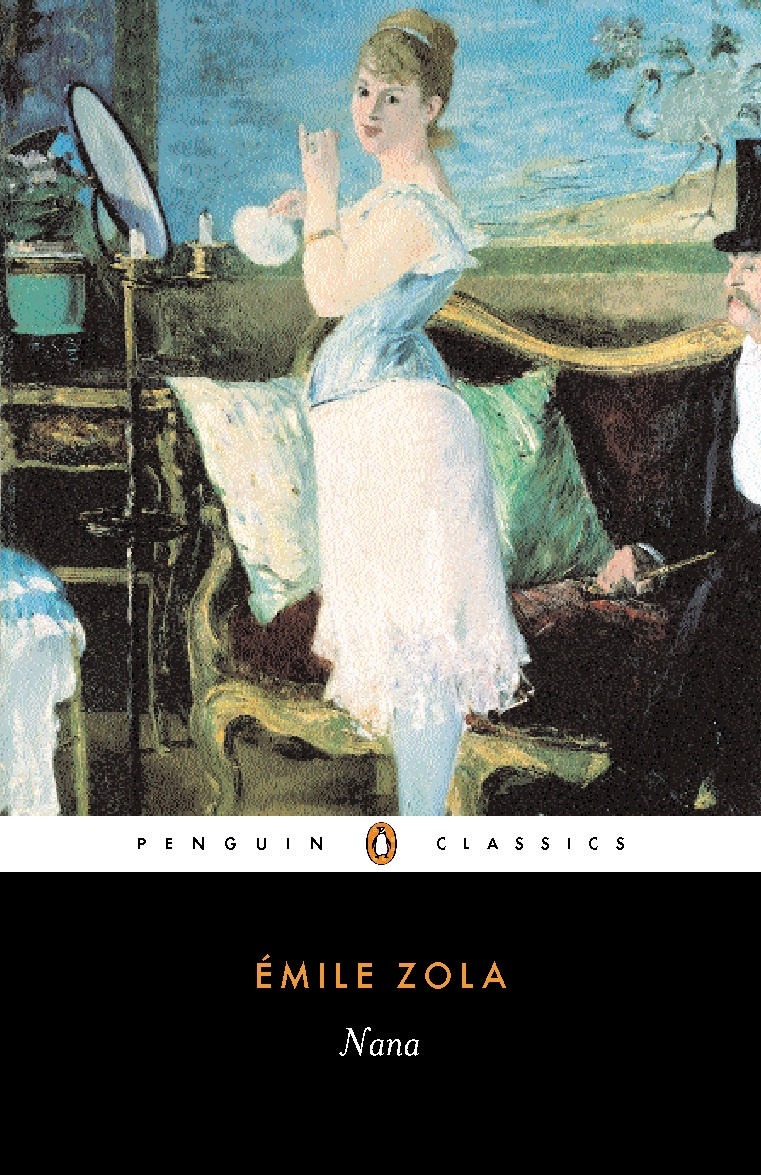
Ultimate Bitches & How Zola’s Nana Slept Her Way to the Top

Nana by ZolaNice girls finish last.

Women who sleep their way to the top are the Ultimate Bitches.

In my field, originally Latin schoolmarmism, we never Slept Our Way to the Top.  There were very few women classics profs in my day, and they were our role models, respected for their Non-Whoreishness.  Perhaps Mary Beard, the ultimate celeb classicist, can vouch for the integrity of Latinists.  (Beard reminds me of a character in my favorite Margaret Drabble novel,  The Realms of Gold:  Frances is an archaeologist who sails effortlessly from success to success.)

So why are I so fascinated by the meretricious?

It is the depths to which one can sink, if, like Zola’s Nana, one is the daughter of alcoholic deadbeats in the slum.

In Zola’s Nana, one of my favorite books, a novel you must read to understand prostitution, the heroine Nana sleeps her way to the top.  After a career on the streets of Paris as a prostitute, she stars in an operetta, “The Blonde Venus.” She laughs at herself onstage and men find that irresistible.  They fall in love with her semi-nude body, draped only in veils, though she has zero talent.

At the theater before the show, the journalist, Fauchery, doesn’t know who Nana is and has low expectations.

Ever since this morning, everybody has been asking me about Nana.  I’ve met over a score of people, and it has been Nana here and Nana there.  What do they expect me to tell them?  Do I know all the girls in Paris?…  Nana is something invented by Bordenave.  I don’t need to say any more than that.”

And Bordenave, the producer and director, indeed refers to his theater as a brothel and invents Nana.

Nana rises quickly in the world:  bankers, counts, and handsome young men give her money.  She runs through it like water, and it is fascinating to see what she buys.  She has sex joyously with everybody, but doesn’t love anybody.  She spends several fortunes as a mistress/courtesan, and the men will do anything to keep her.  The theater is truly the setting for Nana, even after she retires from it:   thus the big beautiful house the Count gives her is decorated in bad, glittering, gaudy taste that reminds the reader of the theater.

Nana is a reader, and her opinion of a novel about prostitutes is surprising.

After that, Nana chatted with the four men like a charming hostess.  During the day she had read a novel which was causing a sensation at the time.  It was the story of a prostitute, and Nana inveighed against it, declaring that it was all untrue, and expressing an indignant revulsion against the sort of filthy literature which claimed to show life as it was–as if a writer could possibly describe everything, and as if novels weren’t supposed to be written  just to while away the time.  On the subject of books and plays Nana had very decided opinions:  she liked tender, high-minded works which would set her dreaming and uplift her soul.

Of course Zola was mocking himself, and what Nana might think of him.  He was writing for a serious purpose:  he intended in his twenty-novel series, The Rougan-Macquarts:  the Natural and Social History of a Family under the Second Empire, to explore the effect of heredity and environment on one family.

Nana is not a nice girl.  She is a bitch, but is very likable and enjoys life. Money means everything to her.  Sleeping with men doesn’t matter in the least; she can’t imagine why the prim middle-aged count who falls in love with her cares that she has sex with a woman friend from the slums, Satin, another prostitute.  She is able to convince him that none of it matters, even when he walks in on her with another man.

I adore Zola.  I devoured everything I could find in translation after  watching a BBC miniseries of Nana sometime in the ’70s.  I’ve even read some of them in a turn-of-the-last century translation, and they’re still powerful, though I prefer to go with something more modern.

I also love Balzac, Zola’s role model.

More on the French later!

Darling Blogger & The Wrong Reader

Anne taintor Stop Me Before I Volunteer vintageI love publicists.

They helped me set up interviews with writers last year, and perhaps will help me set up more later this year.

But, alas, I am usually the wrong reader for the free books they offer bloggers.

The email press releases go something like this:

Gibbon, Terrier, & Fowl has published a sensitive, pitch-perfect, passionate novel, An Alliance of Half-Wits, which is a romance and may win the Pulitzer Prize.   Ainsley Ames, a bigamist and ad man, flees from Morgantown, West Virginia, to Cannes and moves in with Lark, a screenwriter who wears a negligee and smokes marijuana in her Gothic castle. It is Anna Karenina crossed with Valley of the Dolls crossed with Gentlemen Prefer Blondes

Some bloggers love to write about free books from publishers.

At first it seems wildly exciting to receive a free book in the mail.

But, as my husband says, we have no room for books we’ll never read.  Last year I received a sports book. I think it was about basketball.  I would never read such a book.

And I still have five or six “free” first novels which I haven’t even looked at.  I do feel obligated to read at least one of them, though it’s probably too late to help the publicist.

In the last year I have read and written about books by Nancy Mitford, Ursula K. Le Guin, Jonathan Lethem, C. S. Lewis, Dickens, and Mrs. Humphrey Ward.

Does anything about this scream that I want to read An Alliance of Half-Wits?

Okay, I made that book up.

I am simply the wrong reader for many of these books.

AND NOW LET ME WRITE ABOUT A PRETTY GOOD BOOK FOR WHICH I AM THE WRONG READER.

Why Are You So Sad? by Jason PorterI recently read Jason Porter’s novel, Why Are You So Sad?, a gift from a publicist.  At first I thought I was being offered a self-help book, but then I read on, and, according to the blurb by Colum McCann, “Jason Porter could find a place on the shelf beside Richard Brautigan, George Saunders, and David Sedaris. This is a quick, odd, wonderful book, one that pinned me back on my heels and made me laugh.”

Despite the fact that I do not read books by Richard Brautigan, George Saunders, or David Sedaris, I thought it sounded pretty good.  I told the publicist to send it.

And, you know, it is pretty good.

This comical novel is about an obsessive depressive ilustrator of furniture-assembly manuals.  He writes and distributes a very funny survey he makes up to measure his co-workers’ sadness.  I know I would have laughed madly at this when I was 20 or 30.  It is well-written, and has many wittily surreal moments, but is not as funny, say, as Robert Irwin’s The Limits of Vision, a favorite novel about an obsessive housewife fighting dust and dirt.

The narrator of Porter’s book, Raymond Champ, is suicidally depressed, only in a droll way, and decorates his cubicle with dismal photos of a dying bull and a child soldier pointing an automatic weapon.  He is in traffic one morning when he decides he needs “an emotional Geiger counter that could objectively measure other people for sadness.”

I looked at the woman in the car next to me.  She was applying makeup during the stops, opening and closing her mouth like a feeding fish, staring at her red lips in the rearview mirror.  I imagined holding a Geiger counter to her forehead.  I would ask her a question about her children.  Were they an accident?  What dreams did they make impossible?  She would say, ‘They are the best thing I ever did,” and the readout would expose her lie with a pixelated frown.

And so he makes up his survey in the car.

Each chapter starts with an answer to one of the questions on his survey.  For instance,

If you were a day of the week, would you be Monday or Wednesday?

I would be a Wednesday, but in a week that went Wednesday, Wednesday, Wednesday, Wednesday, Wednesday, Wednesday, Wednesday, and repeat.

It is a bit like a literary version of the cartoon Dilbert.

He does have encounters with his co-workers, but most of it is in his head.

There is not much text on the page.

I  might like it if it were twice as long.

I am just the wrong reader.

There are some remarkable new books out there, but in general at my age you read War and Peace twice in a year and are also hooked on Zola’s Nana.

If anybody would like Why Am I So Sad?, I would be happy to send it on, because there is a “right” reader for it. Leave a comment if you want it, and if more than wants it, I’ll have a “drawing.”

Please take it!  I have too many books.

Notebooks vs. Leatherette Diaries & E-books vs. Real Books

One of these notebooks will go to London.

One of these notebooks will go to London.

I am planning my trip to London.

Two carry-on bags.

And a notebook.

I have a laid-back approach to vacations. I pretend I’m in a cottage, whether I’m in the country or a city.  I get up late, go to the breakfast buffet or a cafe, drink a dozen cups of coffee, hold the map upside down for a while, scrawl notes on when to turn left and right, and then go out.  I do not have a strict schedule.  I might feel like a tour; I might feel like shopping.  Then I go to a coffeeshop and that’s it for the day.

I do have one event planned.  I bought a ticket to see Sebastian Barry at the Oxford Literary Festival. If I feel up to going (if the sun is shining…if I feel like taking the train), it will be exactly like “The Amazing Race”: I must take a train, then find my way around Oxford (by walking, bus, or a taxi; I’ll have to Google it), then take notes if I’m not too frazzled, and afterwards take a “tour-ette” (possibly guided) of Oxford. Do the students and dons still wear robes? No?  I’d love them to look like Dorothy Sayers or Evelyn Waugh, but  possibly they look more like Hugh Laurie or Rebecca Mead, author of the book I’m reading, My Life in Middlemarch.

Fortunately the train service is excellent between London and Oxford.

There are other writers I’d like to hear at the festival, but they’re all there on different days, so I regret I’ll have to pass:  Still, if you want to, you can hear Ian McEwan, author of Atonement and Man Booker Prize winner; Peter Stothard, author of Alexandria:  The Last Nights of Cleopatra, interviewing a writer I’ve never heard of; Orhan Pamuk, the Nobel winner, whose novel Snow I really loved;, and Eleanor Catton, author of The Luminaries and winner of the Man Booker Prize.

I have a long list of things to do in London.

Too many things.

But what notebook should I take?

I love to write about my vacations.

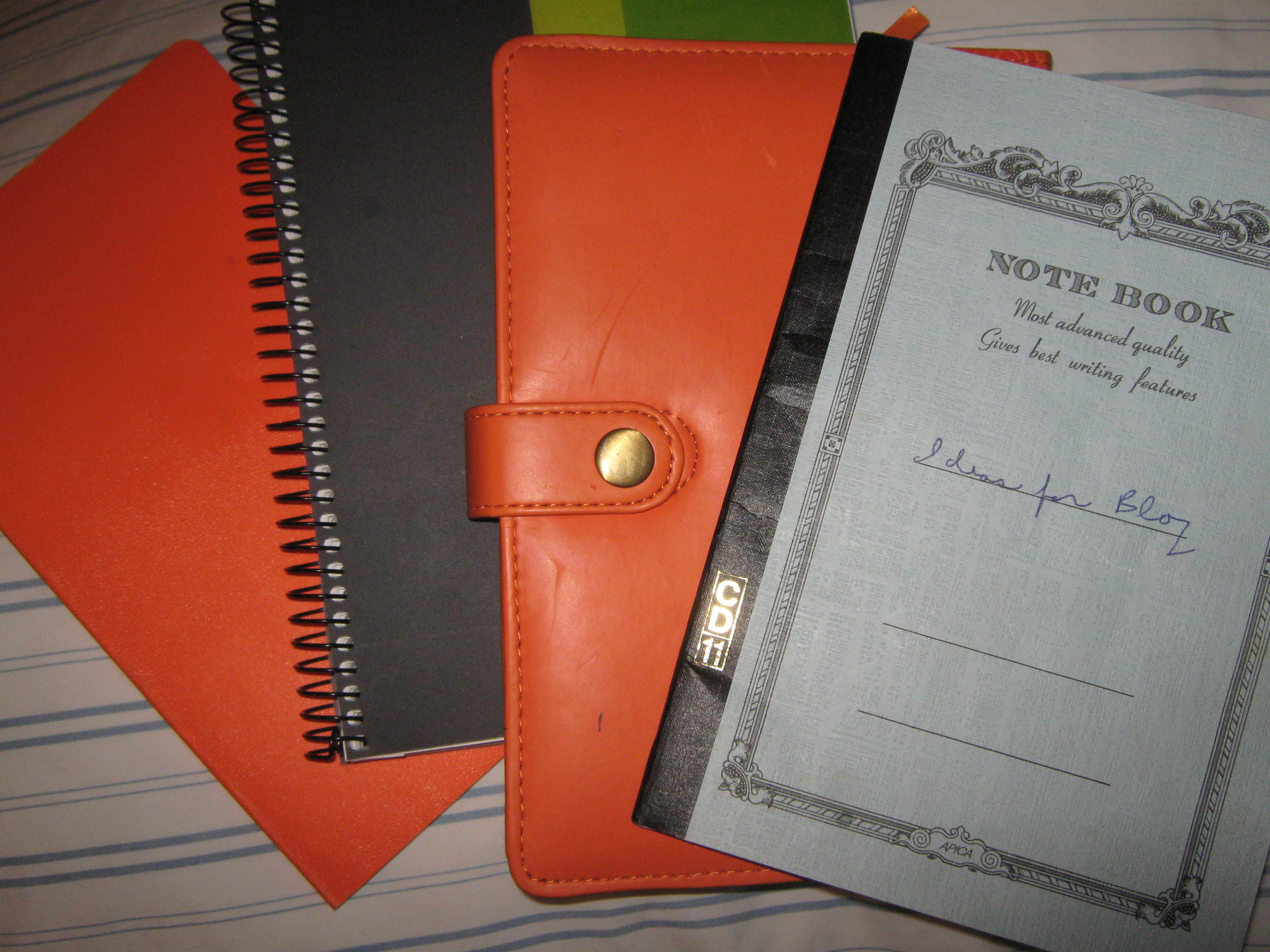
See the blue Apica paperback notebook labeled “Ideas for Blog”?  Apparently I had no ideas for blog. I took a few notes when I went to Bess Streeter Aldrich’s house in Elmwood, Nebraska.  (Her piano came on a steamboat and she embroidered her own luncheon cloths.)  But what on earth did I mean by Fish Tank, The Third Man, Mother, Fallen Angels, Old Boy, & Mary & Max?

See the orange leatherette notebook?  I bought it at Target while my husband was browsing in the sports equipment department.  I love the magnetic snap:  Close the notebook and you hear that wonderful noise. But it’s more a diary than a note-taking notebook.

Next up:  A natty Miquelerius spiral, but perhaps too big for my purse.

Last one:  an orange paperback Moleskine.  Smallish, and except for a few notes on Swann’s Way, it’s empty.

Actually it’s between the Moleskine and the Apica.

And now:  e-books vs. real books.

Harlot High and Low BalzacHere we are in 2014.

And I miss books.

I used to order print-on-demand books if my Mrs. Oliphant or George Meredith weren’t available used.

Now I buy e-books, or get them from manybooks.net.

I miss real books.

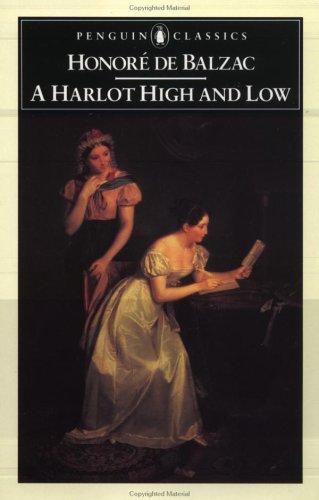
I was looking at my Balzac collection.

“Do we have A Harlot High and Low?”  If I remember correctly, this is better than Zola’s Nana, which I’ve just finished.

“I took notes in it,” my husband said.

He was a notorious note-taker in college–my advisor once told me he was the best student they’d had in 10 years:  they were shocked he didn’t go on for a Ph.D.–and the pages are covered with notes.

I simply can’t read a book with highlightings and scrawlings.

On the occasions when I took notes in class, I wrote in a notebook.

I have to buy another copy, right?  And I want a paperback.   I read everything  for months on my e-reader and then suddenly need a real book.

E-books or books?  Which do you prefer?

Bookish Posts vs. Diaries

Mom, Dad, and me.

Mom, Dad, and me (last century!)

I have written 328 posts in a year and two months.

Why put everything on the internet?

It is the fashion.  We write at Facebook or blogs.

Maybe in 10 years there will be silence.  Fashions change.

I wonder why I don’t write in a journal, but I do not.

I used to be strictly bookish, but I sometimes write diary entries. Some prefer the bookish posts, others prefer the diary.

“Best female writers?” Everybody’s there.  “Horse Races in Literature”?  Fantastic.

The most popular posts recently?    “Viragos Are Sometimes Inconsequential…” and “Library Books.”

I don’t even consider writing “real” articles or reviews.  Whatever I write is easier in a blog.

When critics find fault with blogs, they are thinking about a world of rough drafts.   It can take days, weeks, months to write a good article. Blogs are often more a collection of notes.  Often very good notes.  (I have read some excellent blogs lately.)  Journalists don’t understand bloggers’ socializing in comments and “challenges.”  Comments?  Well, why bother?  The Guardian now posts comments as articles, without, I presume, paying the commenters.

Before I move on to bookish things, I am going to write a post about my mother again.

She died last August.  I loved knowing that she was in the world, playing bridge, watching the soaps, not cooperating at the nursing home. I didn’t visited every day.  When I couldn’t bicycle, I took the bus and then called my husband for a ride home. (The neighborhood wasn’t safe after 5, or more like 3.)  I would plan to visit for one hour, and then stay till 7 p.m.  Since she wouldn’t eat the prepared food at the nursing home, I rushed out and bought hamburgers from McDonald’s; another time she resisted taking a shower for a week, and I had to convince her to go with the aide; and another time she had fallen and been left in the bathroom all night.

And this was one of the better nursing homes.

There is a lot of grief in families as one gets older.  My father wanted to visit her.  She was fascinated by him, but would have been mortified to receive him in old age.  She thought a great deal about how she looked,. She wore a wig.  She worried about the spots on her face.  You know the creams advertised on TV?  They don’t work.   If she and my father had stayed together, she would not have been in a nursing home.  That was the most exasperating thing.

My mother never remarried; my father had his pick.  I tried to straighten things out from time to time.  Utterly ridiculous.

And so another day of wondering about the past.  I really miss her.

Horse Races in Fiction

Kentucky Derby 2013

Kentucky Derby 2013

I love the races.

I always bet on horses with names like “Loopy Dazzle” and “Champagne Cake.”

I couldn’t read the Racing Form if my life depended on it.

But the horses are beautiful and the races are exciting.

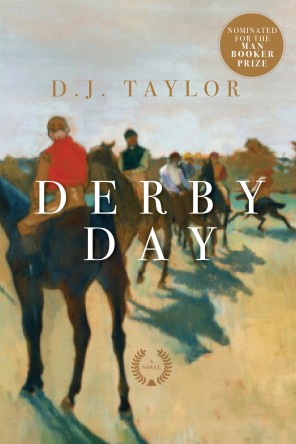
Recently I’ve read two novels with horse-race scenes, Zola’s Nana and D. J. Taylor’s Derby Day.

And so I decided to make a list of fiction with horse races.

First, three classics I have reread recently:

Nana by Zola1.  In Nana, Zola’s novel about a courtesan, Nana rises from prostitution to a starring role in an operetta to spoiled mistress of a banker, a count, and others.  No one can resist Nana. She fascinates with her perfect figure–men become obsessed by her when she plays an almost-nude scene in the operetta–and out of the theater she is a genial girl who enjoys socializing with old friends from the slums and her many lovers.  The problem:  avarice.  She squanders several  fortunes.

There is a glorious horse race scene.  The odds are against the horse, Nana, who is named after her.  Here is an excerpt from the George Holden translation:

Then the crowd witnessed a splendid sight.  Price, rising in the stirrups  and brandishing his whip, flogged Nana with an arm of iron.  the dried-up old child, with his long, hard, dead face, seemed to be breathing fire.  And in a furious burst of audacity and triumphant will-power, he poured his heart into the filly, picked her up and carried her forward, drenched in foam, her eyes all bloodshot. The whole field went by with a roar of thunder, taking people’s breath away and sweeping the air with it, while the judge sat waiting coldly, his eye fixed on his sighting mark.

anna-karenina-leo-tolstoy2.  In  Anna Karenina, Tolstoy’s masterpiece, there is perhaps the most dramatic horse race ever.  Vronsky, Anna’s lover, rides in a steeplechase race, but his tension beforehand, caused by his family’s objections to Anna, and his visit to Anna immediately before the race, does not bode well.  During the race, his merciless treatment of the horse, Frou-Frou,  is a harbinger of what will happen to Anna.

Here is an excerpt:

Vronsky did not even look at [the last water jump], but hoping to win by a distance, began working the reins with a circular movement, raising and dropping the mare’s head in time with her stride.  He felt she was losing her last reserve of strength, not only her neck and shoulders were wet, but on her withers, her head, and her pointed ears the sweat stood in drops, and she was breathing short and sharp.  But he knew that her reserve of strength was more than enough for the remaining five hundred yard.

3.  In D. H. Lawrence‘s short story, “The Rocking-Horse Winner,”  a boy has an uncanny gift for predicting winners of horse races. He rides his rocking horse for hours to predict the winner of the Derby…  and then…

Next, two contemporary books:

Derby Day Taylor American4.  In Derby Day, which was nominated for the Man Booker Prize in 2011, D. J. Taylor  describes the double-dealings of horse owners, thieves, a power-hungry woman, and bookmakers before the Epsom Derby. Taylor seems to write effortlessly, and in this elegant novel, set in Victorian England, he deftly weaves history into a breakneck, thrilling narrative. ( I recently wrote about this  here.)

Here is an excerpt:

A riot of colour.  Colour everywhere.  The horses are of every imaginable hue:  black, baby, chestnut, grey, a multitude of shades in between.  The jockeys’ silks–scarlet, magenta, carmine, green-and-white, quartered blues and yellows–rustle in the breeze.  In the distance a sea of faces, sharp and distinct where the people press up against the rail, fading–as the crowd diffuses up the hill–into a remote generality.  Nothing Mr. Frith could ever do can convey the enormity of the scene or its infinite particularity, the sway and eddy of fifty thousand shoulders, the women fainting in the heat and being taken out, the flashes of light as the sun catches on the raised opera glasses in the grandstand, the cacophony of individual shouts–‘Baldino!, ‘Septuagint!’, ‘Pendragon!’.  The band is still playing ‘The British Grenadiers’ on the near side of the paddock, but nobody hears it.

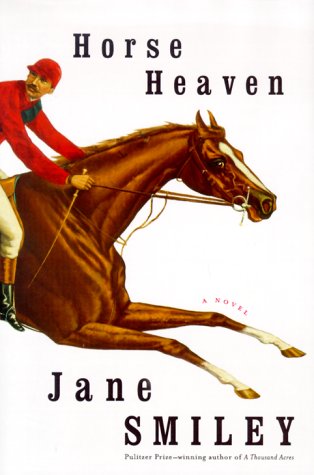
Horse Heaven jane smiley5.  In Pulitzer Prize-winner Jane Smiley’s Horse Heaven, tycoons, trainers, breeders, jockeys, and others behind the scenes in southern California race their horses and have a chance at the Kentucky Derby or the Breeders Cup.  The characters are eccentric and amusing, the details about racing are absorbing, the plot is addictive, and I especially loved the passages from the horses’ points-of-view.

I would have to reread this book to write about it intelligently, but I did love it when it was published.

Here is an excerpt I found online (unfortunately I couldn’t find one from the horses’ point of view).

The first thing Mr. Maybrick did after he poured his coffee was to call his horse-trainer. When the trainer answered with his usual “Hey, there!,” Mr. Maybrick said, “Dick!,” and then Dick said, “Oh. Al.” He always said it just like that, as if he were expecting something good to happen, and Mr. Maybrick had happened instead. Mr. Maybrick ignored this and sipped his coffee while Dick punched up his response. “Can I do something for you, Al?”

“Yeah. You can put that Laurita filly in the allowance race on Thursday.”

Now for pop novels.

The Dark Horse Rumer Godden6.  Rumer Godden’s Dark Horse.  Not a very good book, but entertaining.  (I picked it up for $1 at a sale.)   In the 1930s, a millionaire buys the Dark Invader, a beautiful horse that has failed as a racehorse in England; the horse and his groom are shipped to India to be given a second chance.  The groom, Ted, a jockey whose career was wrecked by alcoholism, reveals how the horse was ruined by a sadistic jockey.  Ted is hired to stay in Calcutta with the horse; the Mother Superior of a nearby convent proves to be very horse-smart; and everybody finds redemption.

7.  My husband suggests  Dick Francis‘s mysteries and Faulkner.  I don’t know which Faulkner, but he says there are a lot of horsey scenes.

Let me know your favorite horse race books!

Walking in the Cold and Walking in a Hail Storm

I needed my horse and sleigh.

I needed my horse and sleigh.

It has been a cold winter, with record lows.

The  temperature was in the double digits, so I got up from under my flannel sheets, three comforters, a blanket, and quilt and took a walk.  The wind was 20 or 30 miles per hour, and no one was walking except me, but I struggled on to the library.  I decided to thaw out before checking out my books, so I went to the comfortable chairs next to the fireplace…and no fire.

It is a fake fireplace, with an electric fire, and I have sweated next to it in summer.  Now it seemed to be broken.

So I sat in the freezing cold next to a window (all the other seats were taken) and read something.  Then a homeless person sat down next to me.  Although the library is a haven for the homeless, and I want them to stay warm, I like to have a chair or two between us.   (N.B. I can diagnose all my friends’ mental problems from years of watching daytime TV with my mother so that they don’t become homeless.  The medicine is Blue Bunny malt cups or cookies from the Hy-Vee.)

Then I lost a mitten.  I trailed all over the library, looking for my mitten.  “Have you seen a mitten?”  I asked the check-out person.  He had not seen a mitten.  Back to the chair, and the homeless person was gone, but no mitten.  Back to the shelves, and there was my mitten.

I couldn’t have ventured into the cold without two mittens. I would have called a taxi, I don’t have a phone (I don’t believe in cell phones except for the elderly and the disabled), there are no more pay phones, I would have had to use a librarian’s phone, and I needed the exercise.

Walking was easier.

Really cold, though.

AND I WALKED IN A HAIL STORM.  Today I was absorbed in my book, D. J. Taylor’s Kept, and not thinking about walking.  Then I took a break to check my email, and discovered the temperature was 47.  I donned my spring coat and went for a walk.

It didn’t feel like 47.  I figured the temperature was gradually dropping.  Then it became windy, and it was cold, but I decided I was fine.  Then suddenly small pellets of hail were landing on me and all around me.  I WAS WALKING IN A HAIL STORM.

What should I do?  Shelter on someone’s porch?

I walked, and it was damned cold.

My face was frozen.

I was very annoyed, because the weather report had said 0% chance of precipitation.

Suddenly there was my husband in a car.  He had come out looking for me.  I was never so glad to get in a car.   (Thank you!)  He dropped me off before he went to the store to get healthy foods beginning with “c”:  cauliflower, kale (whoops, that’s a k!), carrots, Diet Coca-cola… oops, that last isn’t healthy.

Winter:  Who needs it?

Viragos Are Sometimes Inconsequential, Europas Aren’t Always Good, & What Was Dickens Thinking When He Wrote The Old Curiosity Shop?

washing my mouth out with soap won't do any good

…after I read a bad book.

Although I have read some excellent books this month, I have also read my share of second-rate books.  One is so contrived and mawkish I almost refrained from writing about it, the second is the most violent book I have ever read, and Dickens’ early novels were not all classics.

Oh, Viragos, I thought.  Oh, Europas.  Oh, Dickens.  I can read these very good books without screening them for quality.

Not so.

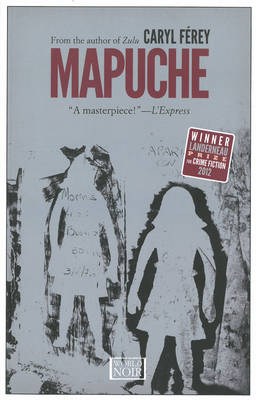
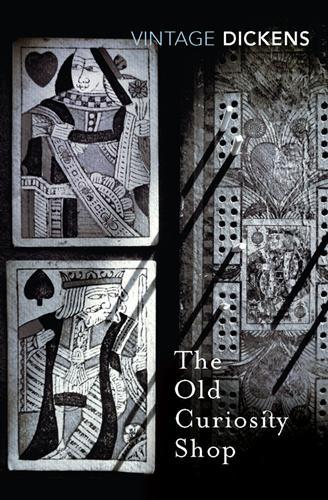
I hoped to enjoy Mary Renault’s The Friendly Young Ladies, a library book I picked up because it’s a Virago; I recently read and loved her novel Fire from Heaven.   Caryl Ferey’s Mapuche (Europa) says on the cover, Winner Larderneau Prize for Crime Fiction 2012.  And I decided to reread The Old Curiosity Shop to prepare for the Dickens tour I may or may not take on my trip to London.

I must have been brainwashed by the Virago/Europa reputation.  And if I didn’t like The Old Curiosity Shop years ago, is it likely that I’d like it now?

Many of my blogger friends love books published by a single publisher, whether it be Virago, Europa, NYBR, or Dalkey Archive. (I do like many of these publishers’ books, but not all.)   At my old blog, I accidentally alienated several English bloggers by gently mocking Virago Week (or was it Persephone Week?), and you don’t want to get the English riled up.  Fortunately the Europa fans didn’t mind when I gently mocked the Europa Challenge, probably because they’re Americans.  (And I read two outstanding Europa books last year, Elena Ferrante’s My Brilliant Friend and Jane Gardam’s Crusoe’s Daughter.)

Well, anyway, let’s take one of these books at a time.

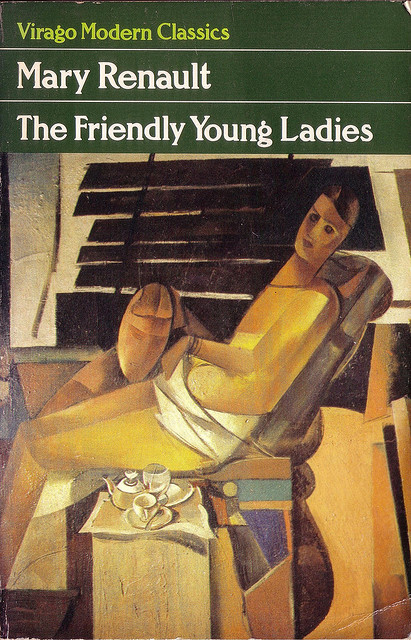
The Friendly Young Ladies RenaultMary Renault’s The Friendly Young Ladies. Though I was dazzled by Fire from Heaven, a novel about Alexander the Great, this is one of the worst books I’ve ever read.

I can only think Virago published this because it’s an early example of gay lit, or queer lit.

Some of the scenes are fascinating, but the writing is maudlin.

Renault does a masterly job of portraying Elsie, a silly teenager who runs away to find her sister Leo, who left under a cloud years ago.  Peter, a doctor she has a crush on, suggests it will help Elsie get over her inhibitions. Peter is a Freudian who likes to flirt with his patients and then dump them.

Elsie thinks Leo may be a prostitute.  Hardly.   Leo, a writer of Westerns who often dresses in mannish clothes, lives on a houseboat with Helen, a beautiful nurse, and yes, she and Helen are lesbians, or are they?  Or aren’t they?  Or are they?  Or aren’t they?

Leo and Helen sleep in the same bed.  But they embrace men at parties.

What the f___, as I like to say.

And then they go home and sleep in the same bed again.

And they both gently make out with Peter (separately) and don’t respond much.

And Leo tries to seduce Peter’s girlfriend, not sexually, but by charming her off the houseboat.  She is furious that Peter has brought a woman to their home when he knows Elsie is in love with him.

And Joe, a writer of literary fiction, is in love with Leo, who practically drowns so she won’t have to have sex with him. Joe invites Leo to go to Arizona with him, and explains he has had other relationships, and she says, “On my side there’s Helen.  I don’t suppose you want to know anything about that, either.”

The houseboat scenes are good and really interesting.  Leo is constantly pumping water, and she and Helen do a lot of boat housework.  Helen really doesn’t like having Elsie around, because she doesn’t help at all and doesn’t have a job; their finances are squeezed.

And Helen is terrified of losing Leo.  She had heterosexual relationships before meeting Leo, so got that out of the way, but Leo apparently has not.

Some of Pamela Frankau’s books, as I recall, also deal with gay life, but are more realistic and better-written. Some of  them have been published by Virago.

Mary Renault in the Afterword seems surprised that Virago wanted to reissue this 1944 book.  She laughs at parts of the book.  She dislikes the word “gay,” makes fun of The Well of Loneliness (I haven’t read that one, but I do have a copy), and said that she wouldn’t be more explicit if she wrote it in the ’80s.

Congregated homosexuals waving banners are really not conducive to a good-natured ‘Vive la difference!’  Certainly they will not bring back the tolerant individualism of Macedon or Athens, where they would have attracted as much amazement as demonstrations of persons willing to drink wine.

Mapuche fereyCaryl Ferey’s Mapuche.   After the coup d’etat in Argentina in 1976, many people disappeared (the Desaparecidos).   Ruben, one of the main characters, was tortured in a prison, and his father and sister died.  He is now an investigator who helps a group called the Mothers of the Plaza de Mayo search for the Desaparecidos.  He becomes involved with Jana, a Mapauche (an Indian of the pampas), after her friend, a transvestite named Paula/Miguel, is tortured and killed.  A well-known photographer disappears at the same time, and her connection to Paula is sad and unexpected.

Ruben’s months in the prison as an adolescent are told in violent detail,  but there are historical reasons for that. In the last 50 pages or so, when Jana takes revenge, hunting and tracking and using multiple weapons, even Ruben throws up at the violence.  And I was close to it.

It is a political thriller, but not my kind of thing.  It is badly-written, at least in translation.  If you want it, it’s yours.

Dickens’ The Old Curiosity Shop.  I love Dickens, but I tried to reread this one a few years ago, and couldn’t get past the wax works.

I’m having the same problem this year.

the-old-curiosity-shop dickensThe writing is vivid, but there’s not much of a plot.  Little Nell takes care of her grandfather, a gambler who loses the Old Curiosity Shop to Quilp, a dwarf who causes havoc wherever he goes.  The grandfather and Nell take off, meet some puppeteers on the road, and then meet Mrs. Jarley, a kind of Madame Tussaud, and Nell becomes a docent for the wax works.  But her grandfather gambles away their money and..

I really love most of Dickens’ books, but this one is not very compelling.  It’s not actually a bad book, but it’s not very good.

Disappointing to read three bad books in one month.

Our Informal List of “Greatest” Living Female Writers

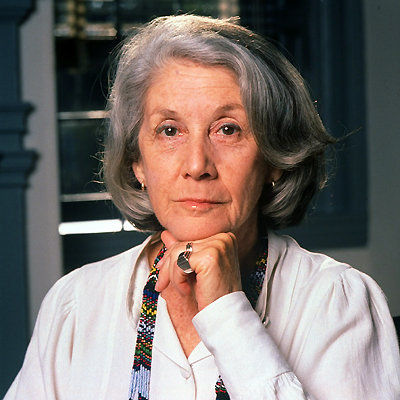
Nadine Gordimer:  on my list of best living writers.

Nadine Gordimer, one of the greatest living writers.

Abebooks’ Reading Copy blog recently posted an odd list of “75 Greatest Living  Female Writers,” who were selected and voted on by its customers and readers.  J. K. Rowling comes in at the top, followed by some remarkable literary writers, some good pop writers, and many much less wonderful writers of all genres.

Perhaps we can come up with our own informal list.  Clare, Karen, and I have already expressed our annoyance with the Abebooks list.

So in no particular order here are my suggestions for Greatest Living Female Writers.  Please leave your suggestions in comments.

Nadine Gordimer

Louise Erdrich

Jayne Anne Phillips

Margaret Drabble

Joyce Carol Oates

Maxine Hong Kingston

Jane Gardam

Marilynne Robinson

Linda Hogan