The Persuasion Book Club

She had been forced into prudence in her youth, she learned romance as she grew older–the natural sequel of an unnatural beginning.”—-Jane Austen, Persuasion
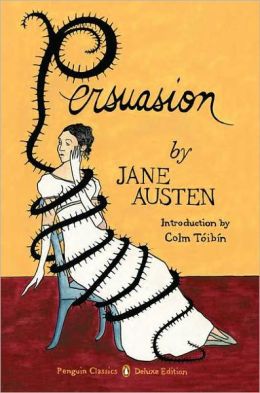
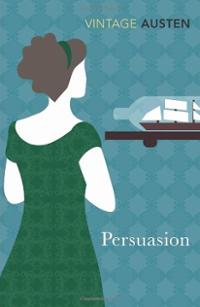
Persuasion by Jane Austen Penguin Deluxe Edition

Heavens, what’s with this cover? Do you like it?

My cousin and I have formed a Persuasion book club.

We are doing this for you.

Yes, we’re grateful for your consternation over the fact that (1)  she was called an idiot by a private online Austen book group; and (2) you don’t entirely dismiss her view that Anne Elliott, the heroine of Persuasion, was a wimp.

And so I suggested that I reread the book, and that she and I discuss it next week.  Possibly Wednesday, possibly Thursday:  it depends on when I finish.  There will not be a video:  I will write from notes in my reporter notebook.  I am a good note taker.

I have read Persuasion many times, and of course am on the side of Anne Elliott, the smart, quiet, charming heroine who behaves so beautifully with her ex-boyfriend.

My cousin thinks Anne is a wimp, and I think that point can be argued.  As I put it, some of us are Annes, some of us are not.

I fear that in my youth I was like Louisa Musgrave, the gregarious, bright 20-year-old rival who jumps off walls on walks to get attention.  Far worse, I wore leotards without a bra and made out with Captain Wentworth, oops, I mean So and So, on the stairway at work.

But a modern Anne might well have done the same.  She probably made out with Captain Wentworth, don’t you imagine?  Or did she have to wait till the official engagement?  We are not scholarly here, and we want to know.

May I say that Captain Wentworth is Austen’s sexiest hero?  Don’t you love it when he wordlessly picks up Anne and puts her in the carriage?

Now, guys and gals, I am PRETENDING to be a hip, silly reader. (Perhaps like the heroine of a Tama Janowitz story.)  I am hip, but not dumb, and I am not a blonde, though that might be a good idea.  Perhaps I WILL dye my hair before the book group.  But last time I dyed it I had an allergic reaction.

My cousin is occasionally blonde, and she is not dumb: she just doesn’t read many novels.  She wants me to add that her favorite book is Lytton Strachey’s Eminent Victorians.  Now she wants me to tell you that she made that up because she knew we would enjoy that comment.  Her favorite book is Barbara Tuchman’s The Guns of August.  She also likes Diana Gabaldon’s romances.

We will find at least one sequel to Persuasion.  (We will comb Jane Austen websites for suggestions.)

We will post a playlist.  (The video of Richard Thompson’s song, “Persuasion,” appears at the bottom of the post.)  Please contribute songs to our playlist.

I look forward to the discussion and your comments.

The Loneliness of Online Life

Photo illustration by Justin Metz (The Daily Beast)

Photo illustration by Justin Metz (The Daily Beast)

We don’t often talk about the loneliness of online life.

For months we don’t notice it.

If my mother hadn’t died, perhaps I wouldn’t have noticed it at all.

We blog, we email, we post, we comment.

My cousin and I were sitting in the back yard, drinking tea.  Electronic devices littered the table:  laptops, phones, e-readers.  She opened her laptop and checked her email.  She started crying.   An online friend at a Jane Austen fan group had posted a 1,000-word tirade calling her an idiot.  My cousin, a scatty reader who prefers history to fiction, had written that Anne Elliott, the heroine of Persuasion, was “a wimp” for not having married the love of her life, Captain Wentworth.  She said Anne shouldn’t have obeyed her silly father and the conventional Lady Russell, her late mother’s best friend.

“This is an ignorant misreading of Austen’s morals and manners,” her online friend wrote.

persuasion-jane-austen-paperback-cover-artAll right, not the end of the world, you say.  Any of you who belong to  Janeite groups know quite well that they quarrel all the time.  They know tiny things about Austen’s books that my cousin would never dream of.  They argue for days about minuscule details.

She knows this friend from online poker. Yes, that’s the internet for you.

I know how she feels.  Many years ago I shut down the computer during a discussion of The Aeneid in a chatroom on AOL .  “Are you crying?”  my husband asked incredulously.  Yes, I was.  I can’t remember what was said to me, but it was vicious.

There is an emptiness and deep sadness in this kind of online fighting.  You don’t choose to participate in it, and then there it is.  Didn’t you go online to get away from this?  Aren’t you seeking “purer” relationships?  Since my mother’s death, I have spent less time online, more time outdoors.  I don’t want to miss  “real life.”

I’m also reading better books now. The time that’s left should be well-spent.

I do intend to join at least one new online reading group this fall.  Winter is coming.

I love my online life, and I do appreciate my cyberfriends.  Online life can complement real life.

It’s time to reread Jane Austen.  Maybe not Persuasion.  Anne is a bit wimpish, whatever the Janeites say.

Don’t say I said, so, though.

C. S. Lewis’s Till We Have Faces: A Novel of Cupid and Psyche

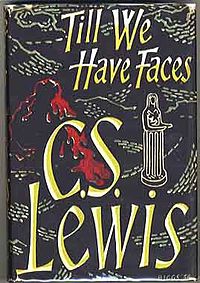
Till We Have Faces C. S. LewisAlthough I loved the fantasy novels of E. Nesbit and J. R. R. Tolkien as a child, I was bored by C. S. Lewis’s Christian Narnia allegories.

And so I have come to C. S. Lewis late. I admire his gracefully-written, sometimes humorous, fable about the afterlife, The Great Divorce.

Even more gorgeous is his novel Till We Have Faces, a retelling of the Cupid and Psyche myth.

In Till We Have Faces, Lewis turns the myth inside out.  He focuses not on the beautiful Psyche but on her ugly older sister, Orual. Faces have been their destinies:  Psyche’s beauty has won her the hatred of Ungit (Aphrodite);  Orual’s ugly brilliance has also won Ungit’s hate.

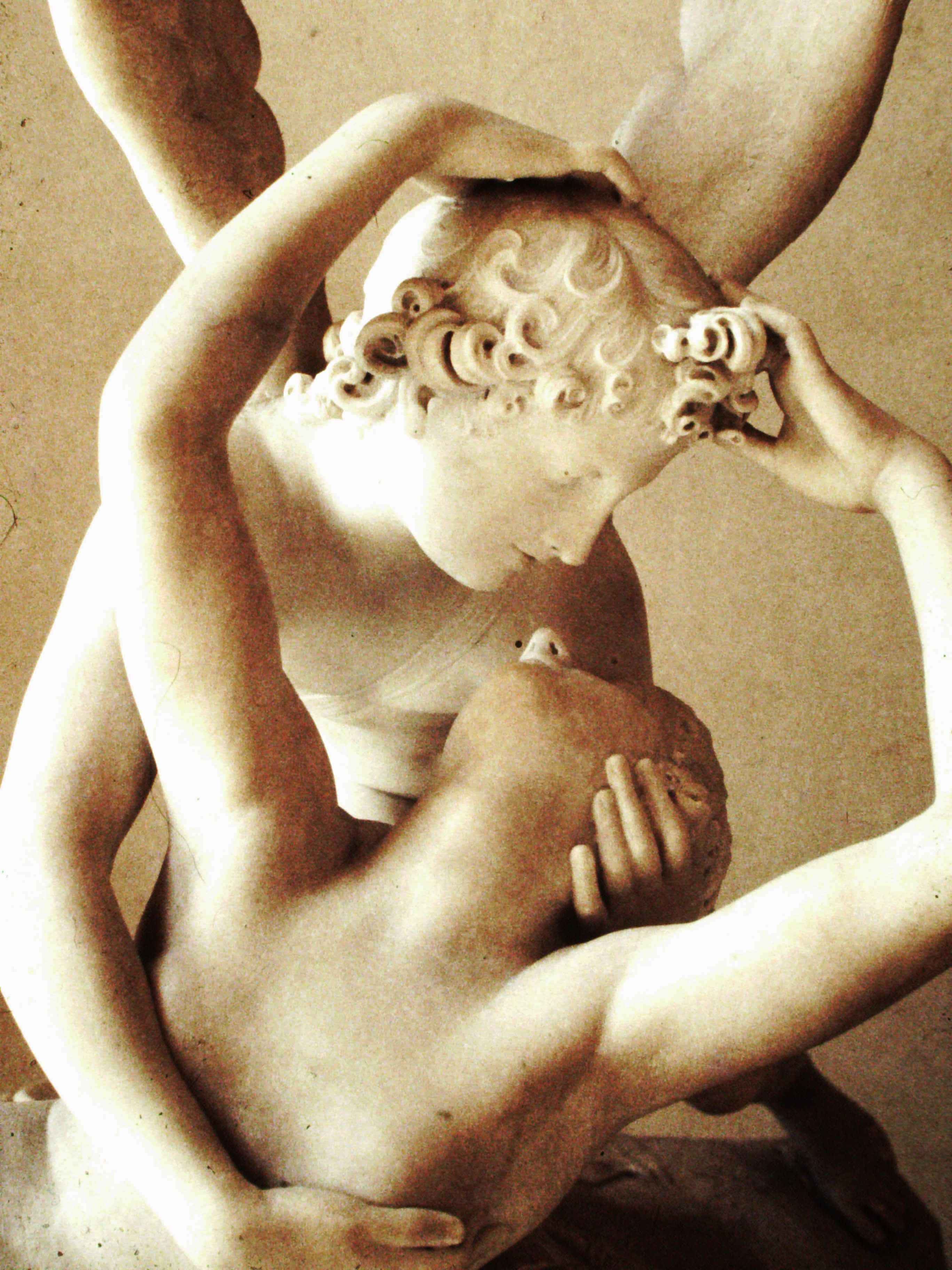
The Cupid and Psyche myth, a love story that goes awry, was a godsend when I was a Latin teacher. M. G. Balme’s Latin adaptation of Apuleius’s Cupid and Psyche inspired many to hang on through Caesar’s Gallic Wars (“Just a few more chapters and we’ll read Cupid and Psyche!” I’d say. ).  We’d read a few pages of C&P weekly as a treat; once we’d gone on to Ovid, they were in love with Latin again and the C&P could be put away.  The myth is one of the many tales inserted in Apuleius’ picaresque novel, Metamorphoses, or The Golden Ass (the only Latin novel that survives whole).  In the tale, Psyche (meaning “soul”), the youngest daughter of a king, is exposed on a mountain because of an oracle of Apollo:  though her two older sisters have husbands, it is Psyche’s fate to be married to a non-human.  Venus, jealous of Psyche’s beauty, sends Cupid to poison her with the love of a monstrous man. (Yes, all gods are psychotic.)  But Cupid falls in love with her and rescues her from Venus’ fury.  He visits her for  passionate nights of love in a hidden palace, but forbids to look on him.

"Cupid and Psyche" by Antonio Canova

“Cupid and Psyche” by Antonio Canova

As is so often the case in fairy tales, the jealous sisters destroy the beautiful sister.   On a visit to Cupid’s palace, they tell her to look at her lover by lamplight while he sleeps, because he might be a monster.  Poor, Psyche!  Struck by his beauty, she stares so long that a drop of oil falls on him.  He leaves her because she has disobeyed, and Venus assigns her impossible tasks (such as gathering the wool of human-killing monstrous sheep) before she is reunited with Cupid.

Lewis’s rendition of the myth is written more like a historical novel than a reinterpretation of myth.  As a girl, brilliant Orual, the narrator, adores her half-sister, Psyche, whose mother died in childbirth.  Orual has no envy of the child’s beauty.  She brings her up with the help of the Fox, the Greek tutor/slave who teaches them both.  During an epidemic, the common people believe goddess-like Psyche’s touch can heal them:  this brings trouble from the gods, as you can imagine.  Eventually the middle sister, pretty, envious Redival, brings Psyche to the attention of the priests of Ungit (Aphrodite), who  insist that she must be left on the mountain as a sacrifice to end an epidemic and famine.

Orual, with the soldier Bardia, rides to the mountain to bury Psyche.  When she discovers Psyche has survived, Orual’s disbelief in the gods ruins Psyche’s life.  She cannot see Cupid’s palace and Psyche appears to be dressed in rags:  she thinks Psyche is psychotic.  She suggests Psyche look at Cupid with the lamp.  There is a huge storm:  Cupid appears as a beautiful passionless face in the sky, telling Orual that he can no longer hide Psyche from Venus, and that she, too, will be Psyche now.  Orual knows, at least at the time, that he is a god.  Later, she is not so sure.

200px-Till_We_Have_Faces(C.S_Lewis_book)_1st_edition_coverOrual goes on with her life:  she studies fencing with Bardia, and falls in love with him, but he is married, and though he is her counsellor when  she becomes a warrior queen, she is aware that he does not think of her as a woman.

One of her great strengths is wearing a veil.  She never takes it off in public once she understands the power it gives her.

I could never have believed, till I had proof of it, what it would do for me.  From the very first (it began that night in the garden with Trunis) as soon as my face was invisible, people began to discover all manner of beauties in my voice.  At firs tit was “deep as a man’s, but nothing in the world less mannish,” later, and until it grew cracked with age, it was the voice of a spirit, a Siren, Orpheus, what you will.  And as years passed and there were fewer int he city (and none beyond it) who remembered my face, the wildest stories got about as tot what that veil hid.  No one believed it was anything so common as the face of an ugly woman.  Some said (nearly all younger women said) that it was frightful beyond endurance….  The best story was that I had not face at all….

There is a long scene in the Underworld, where Orual learns about faces and not having faces.  I could write an entire essay on just that.  This is a great book.

Bookish 2: Comments & Stats

It is fair to say that Virginia Woolf was bookish.

It is fair to say that Virginia Woolf was bookish.

Who’s bookish?

On Sept. 6, when my post, “Bookish & Unbookish: Rock Stars & Writers,” appeared here, a few readers chimed in to say they were bookish, too.

Like me, Ellen Moody can’t leave home without a book.  She wrote, “I feel lost if I go somewhere and realize I will have waiting time (there is always waiting time) and find I forgot to take my book.”   Clare Shepherd wrote:  “I don’t believe one can be too bookish, so back to my book lol.”  Sherry Jones, author of the lively historical novel,  Four Sisters Four Queens, commented on the “unbookish” part of the post, my new rock groupiedom:  “Make sure to see only bands you really love. Otherwise, you’ll wish you’d brought a book.”

We bookish people are a minority.   According to the Statistical Abstract of the United States published annually by the U.S. Census Bureau (2010), “37.9% of the American population, or approximately 87 million adults, read books for leisure in the previous 12 months.”

Actually, I’m surprised the numbers are that high.

It’s not just reading.  It’s also book-buying.  According to the Book Industry Study Group, book sales are down.

“Sales from adult hardcover, paperback and mass market; children’s hardcover and paperback; downloadable audiobooks and e-books–were $2.19 billion for the first half of 2011, compared to $2.39 billion for the first half of 2010.”

I spend most of my money on books.  “Have you ever heard of the library?”  one friend asked when I bought three hardcovers at B&N.

Most of my housekeeping money goes towards books.  I can make do with vinegar and water as a cleanser if it means saving a few dollars. As for dinner, why not cook the dregs of the garden and bits and pieces of other things in the refrigerator?  I call it soup!

And then I can buy a book…

I read the books I buy.   I check out way, way, way too many library books that I don’t read.  Right now I have:

J. P. Donleavy’s The Ginger Man

Laura LIppman’s The Most Dangerous Thing

Andrea Barrett’s Archangel

Tan Twan Eng’s Garden of the Evening Mists

Will I read any of them?

COMMENTS.  Recently a friend emailed me to say that she had not been able to comment on my blog.  I have no idea how, but sometimes this happens.

If your comment isn’t coming through, email me at mirabiledictu.org@gmail.com

Unfortunately the spam does come through!

Retold Myths & NANOWRIMO

………………………….Run a little slower
And I will run, I promise, a little slower.”– Apollo to Daphne, Ovid’s Metamorphoses

I love retold myths.

John William Waterhouse: Apollo and Daphne - 1908

John William Waterhouse’s Apollo & Daphne

If I find a novel that retells, say, the Daphne and Apollo myth, I’ll read it.

Oh, wait.  That’s the one I’m writing.

Yes, I’m writing a novel for National Novel Writing Month (NANOWRIMO), an annual project that brings people together to write their own 50,000-word novels between November 1 and November 30.

You can read about this enjoyable project here. A group started it in San Francisco in 1999 for the same reason people start bands, they say at their website:

Because we wanted to make noise. Because we didn’t have anything better to do. And because we thought that, as novelists, we would have an easier time getting dates than we did as non-novelists.

One reason it’s fun and sweet is that members in your area meet twice or thrice a week at coffeehouses or Panera. (You don’t have to go, of course.)   It’s kind of like AA or Weight Watchers, only you are trying to do something, rather than not do it.  A bunch of people get together with their laptops…and write.

I am not a novelist, but I once won a scholarship to a writers’ conference on the basis of the first chapter of a novel I was writing.  Did I go home and write Chapter Two?  No, I did not.   When it came to writing Chapter 2, I discovered that I’d rather be reading a book.  Any book.

NANOWRIMO means all kinds of things.  It can mean participating in online forums.  It can mean shopping.  I intend to buy a new black sweater and black jeans (I wonder if it’s tax-deductible to buy writing clothes?) which I will don one minute before I leave the house, because otherwise they will be covered in cat hair.

NANOWRIMO is such a charming idea, and Erin Morgenstern did start her best-selling book, The Night Circus, there.  Now I have signed up twice, and never finished.  I enjoy the first couple of days, but then I fall behind on my word count.  Everything I write needs revision, and NANOWRIMO is not about revision.  It’s about getting something down on paper.

I hardly think my retelling of Apollo and Daphne will take up the space of a whole novel, but that’s my idea of the moment.

In Ovid’s comical version in his brilliant poem, Metamorphoses, Cupid wickedly fires an arrow at Apollo to make him fall in love with Daphne, and fires one at Daphne that drives all love away.  When Apollo chases the nymph, he begs her not to run so fast; she prays to her father, the river god, “to change and destroy the body/which has given too much delight” (Rolfe Humphries’ translation).  Her father turns her into a laurel tree, and Apollo  will not let her go.  He claims the laurel for himself.  It is an aetiological myth:   it’s why he wears a laurel wreath, and why Roman victors wear laurel wreaths.

The description of Daphne’s changing into a tree is simultaneously dazzling and nightmarish.

…her limbs grew numb and heavy, her soft breasts
Were closed with delicate bark, her hair was leaves,
Her arms were branches, and her speedy feet
Rooted and held, and her head became a tree top,
Everything gone except her grace, her shining.
Apollo loved her still.  He placed his hand
Where he had hoped and felt the heart still beating
Under the bark; and he embraced the branches
As if they still were limbs, and kissed the wood,
And the wood shrank from his kisses…

Metamorphoses, Rolfe Humphries translation

Read on!  It’s a very great poem.

Cute Cats! & Colette’s Cats and Cats of Paris

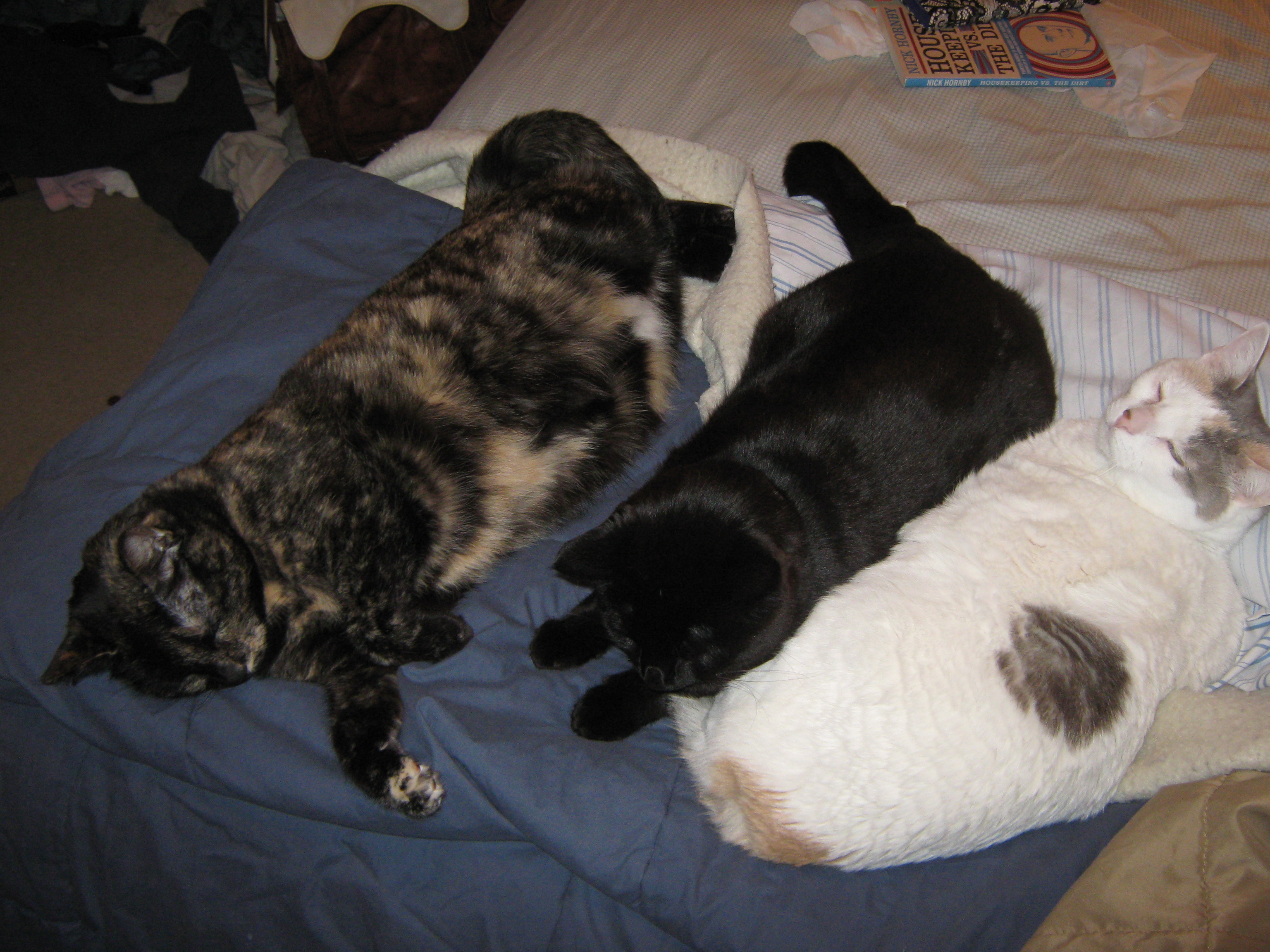
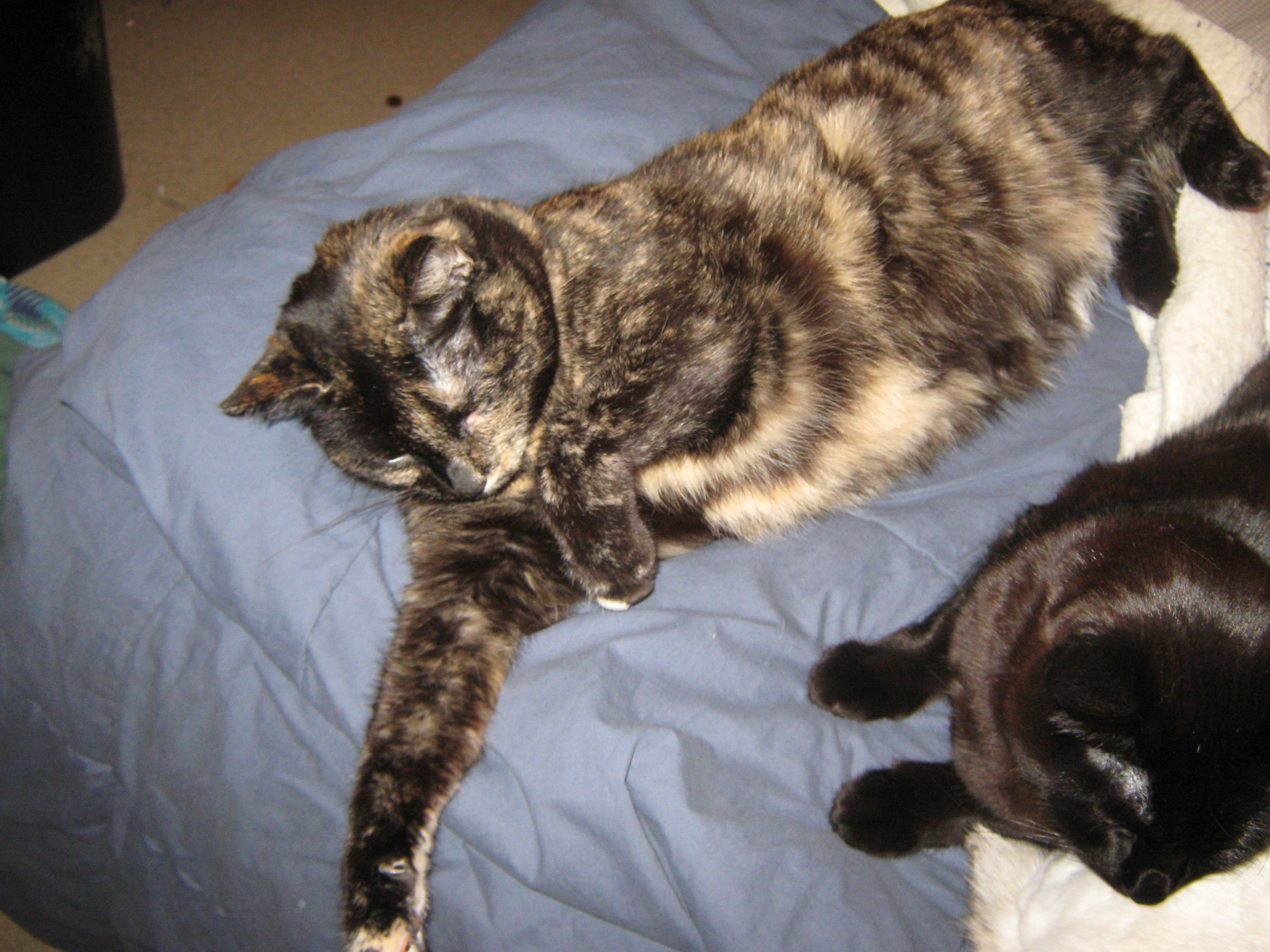
Cats Take Over Bedroom!

The house was quiet.

Husband:  business trip.  Friends:  banned (temporarily).

A few days of solitude.

You’re not alone if you have cats.

Thirty years ago I adopted my first cat, a free Siamese kitten.  Since then we’ve had tabbies, black cats, calicos, tortoiseshells, white cats…

All are from the “pound” or the APL.

Very laid-back!

Very laid-back!

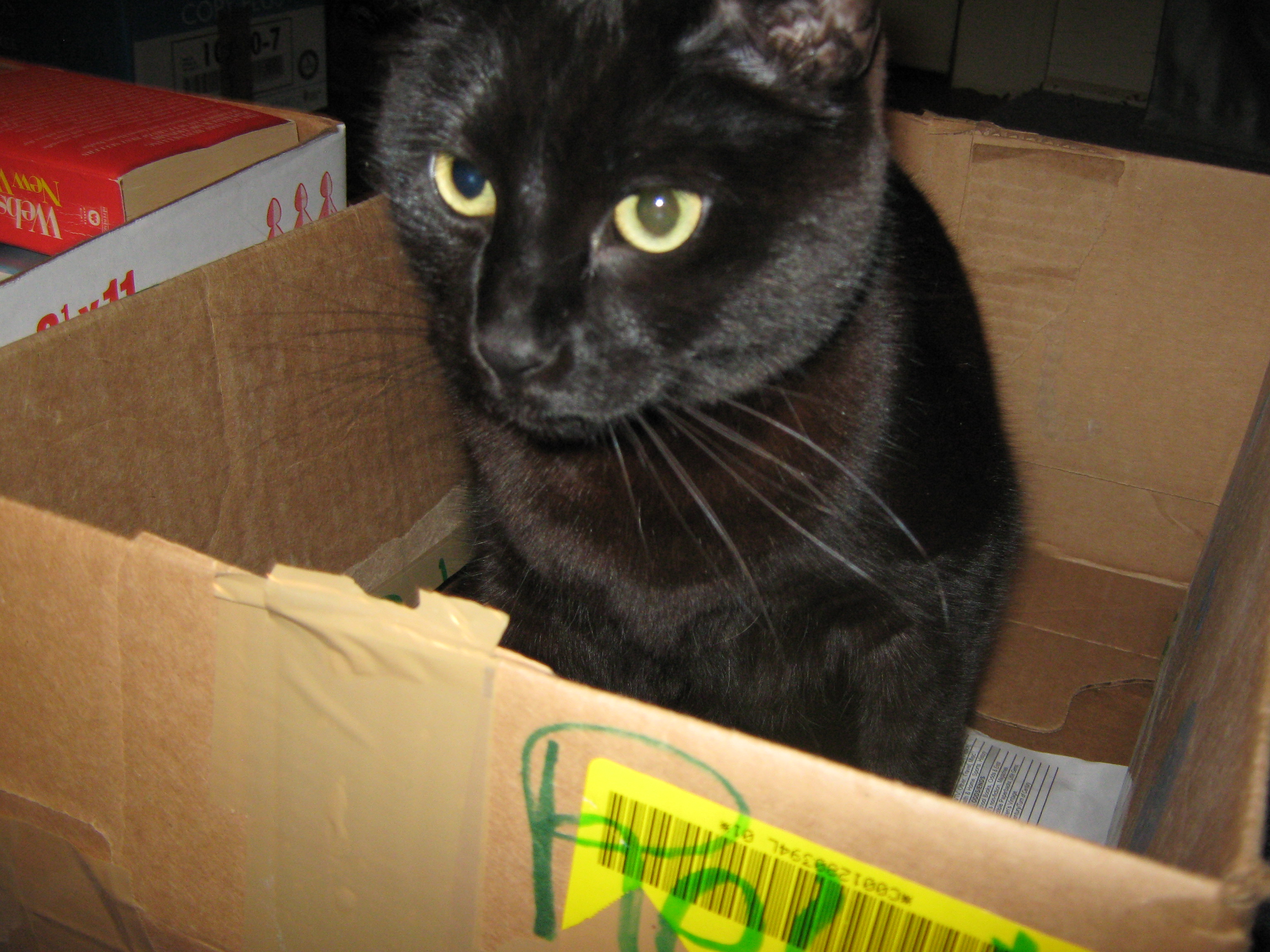
This adorable cat came from the APL:  endless paper work and very expensive, but a sweetheart. Black cats are  always laid-back. She has a lovely temperament and likes everybody, though she was so wild as a kitten that she destroyed the living-room curtains and two computer cords. (Really.)  She likes UPS packages, birds, and The New Yorker (delicious!  she chews bits occasionally).  Her favorite person: me.  Her second favorite person:  the white cat below.

A hippie cat.

A hippie cat.

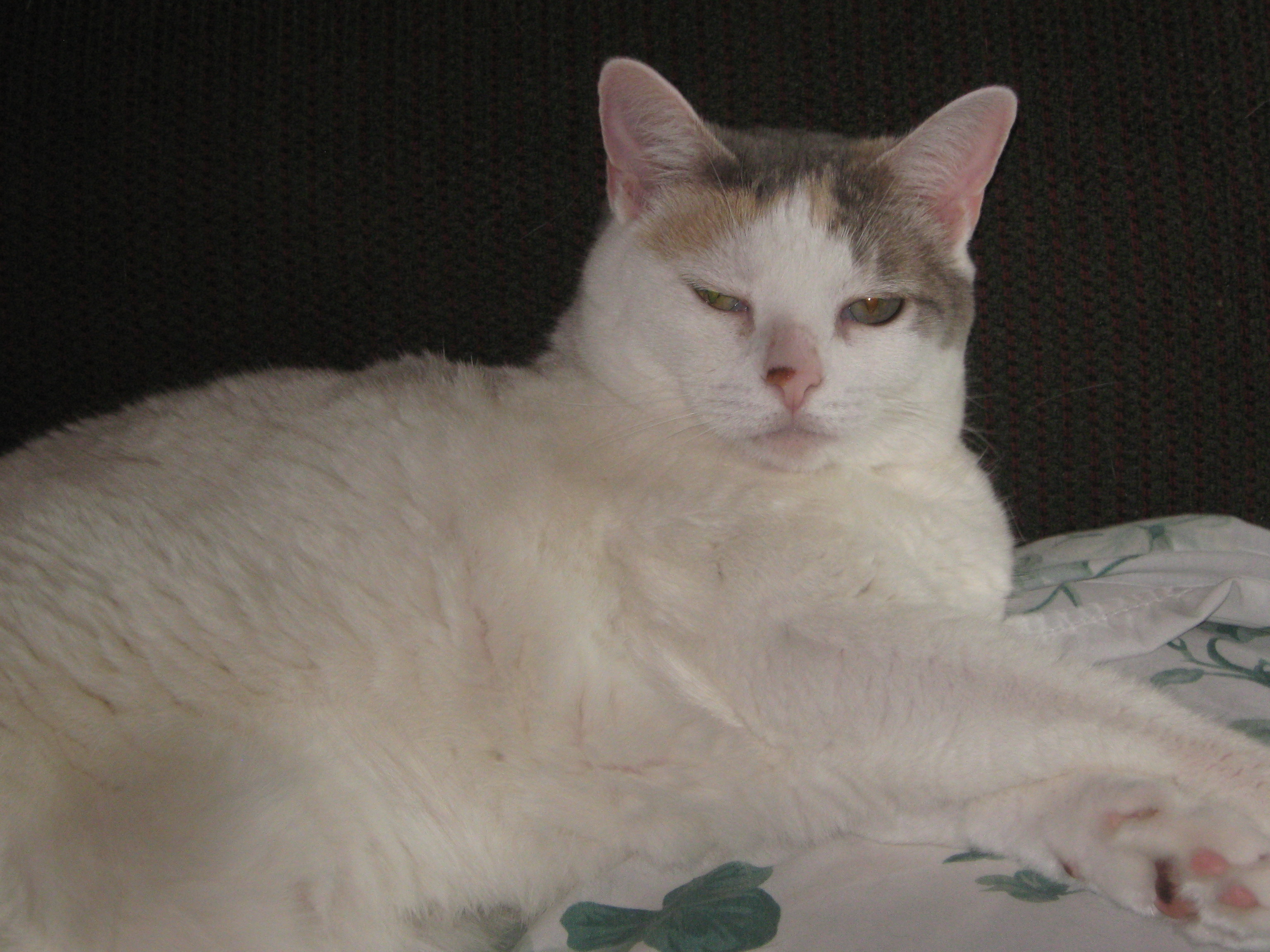
Like the black cat, the white cat is a hippie.  She looks as though she ought to wear a beret, doesn’t she?  When we brought her home she didn’t know how  to jump.  We worried that perhaps she had been in a cage too long.  Anyway, she learned from the others.  They learn EVERYTHING from each other.

Smart:  likes computers!

Smart: likes computers!

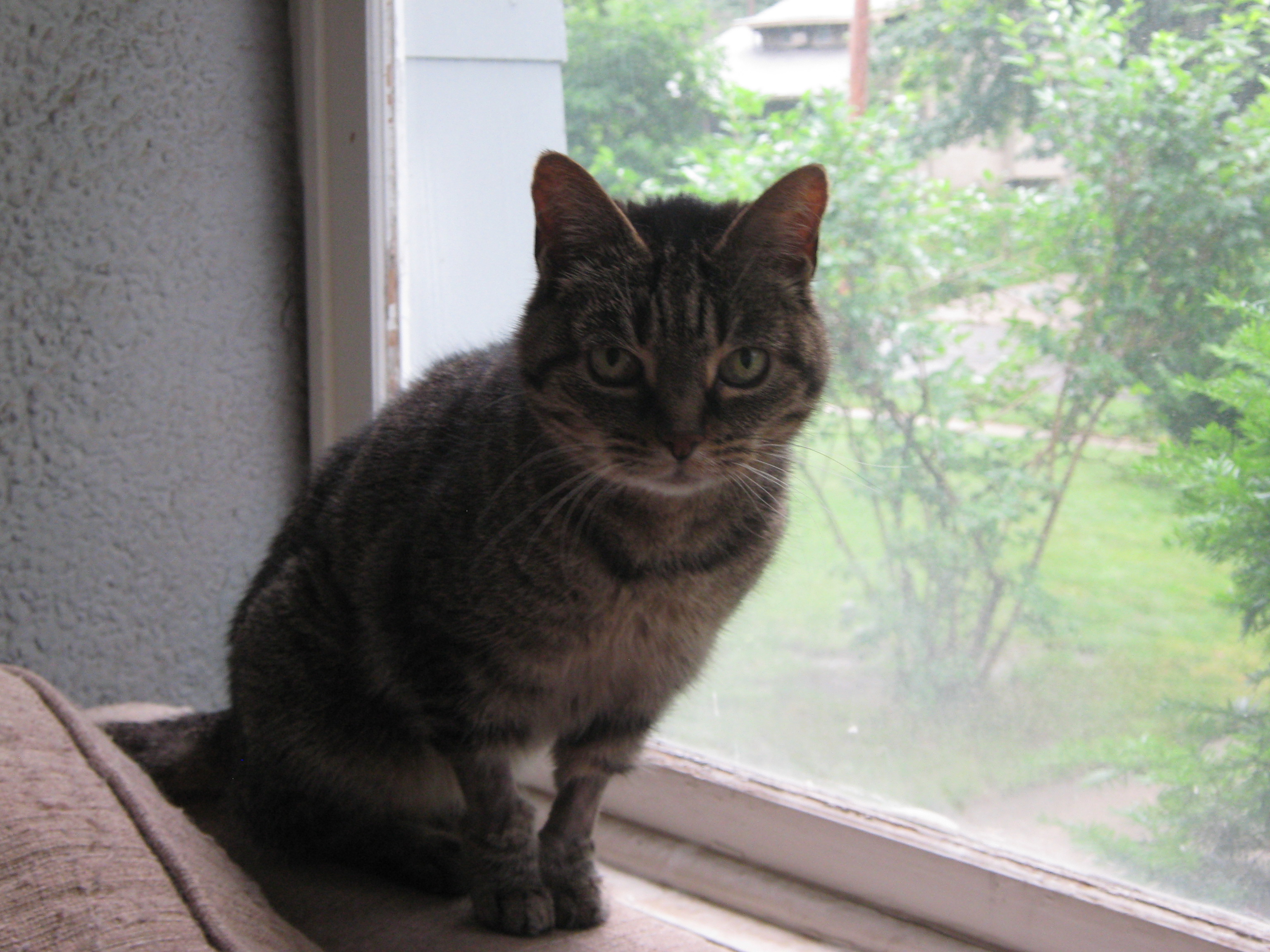
See this darling tabby?  She is the matriarch.  In our fax days, we would wake up in the night and hear her faxing in the study.  God only knows whom she was calling.  She is VERY smart.  Her hobby is  computers.

The beautiful tortoiseshell (below) was, according to the “pound,” picked up walking down the street with a Siamese and a calico. She has survival skills.  She drinks out of the tub.  The tap isn’t on:  she just licks it.  Now all the cats prefer to drink out of the tub or out of one of my cups.  Their cat bowl doesn’t interest them!

Our beautiful tortoiseshell!

Our beautiful tortoiseshell!

If your cats tell you it’s time to watch TV (they’re very fond of Master Chef), line up by the CD player to hear their favorite record (James Taylor’s “Fire and Ice”), bring their feather-toy-on-a-stick to you, and insist on their meal an hour early, you are probably a Cat Person.

Now how do the cats fit into a book blog?  Well, today I read Colette’s Creatures Great and Small, a collection of dialogues, vignettes, and essays about animals.   I have very much enjoyed the sections, “Cats” and “Cats in Paris.”

Here is a very short vignette,”The She-Cat in the Mirror”:

Is she prettier than I am?  I don’t think so.  Come to that, what cat is?  I should like to have a good look at this interloper when she has her back turned to me.  But eery time that happens, just at that very moment, at the exact same time as I…she turns round again and looks at me.”

What are your favorite cat books?

John Brunner’s Stand on Zanzibar & What Do We Want?

I’ve been reading science fiction.

After the Today Book Club fiasco (If you recall, I couldn’t read The Bone Season), I wanted to read something good.

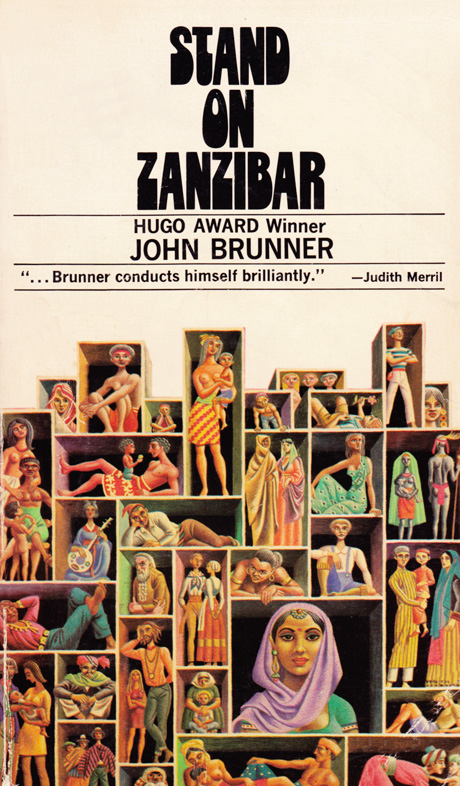
Stand_on_Zanzibar_workingI just finished John Brunner’s Stand on Zanzibar (1968), a post-modern science fiction classic.  Set in 2010, it is a brilliant book, the story of a future dominated by a giant too-smart computer, geneticists’ control of reproduction, and miserable citizens who hate their work.   Women don’t always have permanent homes: “shiggies” stay with men who pick them up, sometimes for a night, sometimes longer.  “Dicties” (addicts) wander the streets, and “muckers” kill people at random.

The  narrative is broken up by quotations from radical sociologist Chad Mulligan (who is rather like Marshall McLuhan) and TV blurbs from news and rumors on Scanalyzer.

Here is one of the definitions from Chad Mulligan’s book, The Hipcrime Vocab:

Hipcrime:  you committed one when you opened this book.  Keep it up.  It’s our only hope.

Here is an excerpt from Brunner’s futuristic New York Times editorial:

Like living creatures, automobiles expired when their environment became saturated with their own excreta.  We ourselves are living creatures.  We don’t want the same to happen to us.  That’s why we have genetic legislation.

The novel follows two main threads: Norman, an African-American executive in New York, is wretched and lonely.  But eventually he is chosen to rule Benini, an African country whose president, Obami (I am not kidding!), is dying and wants to hand this small, peaceful country over to someone who can unite it with the West.

Donald’s fate is much worse.  He is a spy paid to read obscure journals and books to spot trends.  Finally he is activated to be a killing machine and assassinate an Asian  geneticist who has threatened the Western world by scientific discoveries.

I’m not going to write about this at length:  it is a very complicated book.  But if you like science fiction, you will be impressed by Brunner’s writing.  Some of it is very like our present.

IN WHICH WE DECIDE WHAT WE WANT AND WHEN WE WANT IT.

What do we want? Peace!
When do we want it? Now!

I was listening to Woodstock when my friend Janet dropped in. Pure nostalgia: Arlo Guthrie, Jefferson Airplane.  I was too young for Woodstock, but did you see Ang Lee’s movie, Taking Woodstock, about the making of the rock festival?

I was still in my pajamas.  Do you have days like that?  I had showered, but then jumped into a pair of FRESH pajamas.

It’s the weekend.

Husband outside, doing husband things.  Woman inside, reading.

There might have been cat hair on my pajamas.

DID my hair stick up as I suspected?

HAD I shaved my legs this month?

“Come in,” I said sleepily.  “Have breakfast.”

She helped herself to tea while I changed into something less comfortable (jeans).  I made faces in the mirror.

“Well–l-l,” I said.

I had been doing the dishes in shifts:  glasses last night, dishes this morning.  Janet was laughing at me.  “No bowls?  How can I eat cereal?”

“I’ll wash you a bowl.”

anne taintor-i-believe-we-have-an-opportunity-to-make-somShe doesn’t clean much either.  She works, goes to the opera, and has a poetry group.  She is going to the Poetry Sucks! event at The Southern Festival of Books next month.

She begged me to attend Poetry Sucks! with her.  Her boyfriend, whom she broke up with after the cross-state bike ride in July, was supposed to go.

“Please.  You’ll love it,” she said.

I can’t go to Poetry Sucks!  I went to the Southern Festival of Books one year and I loved it, but you don’t want to go to an event like that with Janet.  Within two hours she will have taken up with a man. This has happened many, many times.  There you are, in a bar alone.  And you go back to the hotel and God knows where she is.

“Janet, no.”

“I  might read at Open Mic.”

“No.”

“No, really, I’m chaste now,” she said abruptly. “I’m even menopausal.  And I’ve stopped dyeing my hair.”

Hm.  A few gray hairs.  That WAS new for Janet.  She has been dyeing her hair since I’ve known her.  But frankly what does that mean?  Gray hair, menopause.  It’s all the same.  You do not lose your sex.

“Well, how about your poetry group?” I said vaguely.

“No, they’re worried about the same thing you’re worried about.”

I got the blueberries out for the cereal and sat down.  “Granola, anyone?”

I want a peaceful weekend.

Bookish & Unbookish: Rock Stars & Writers

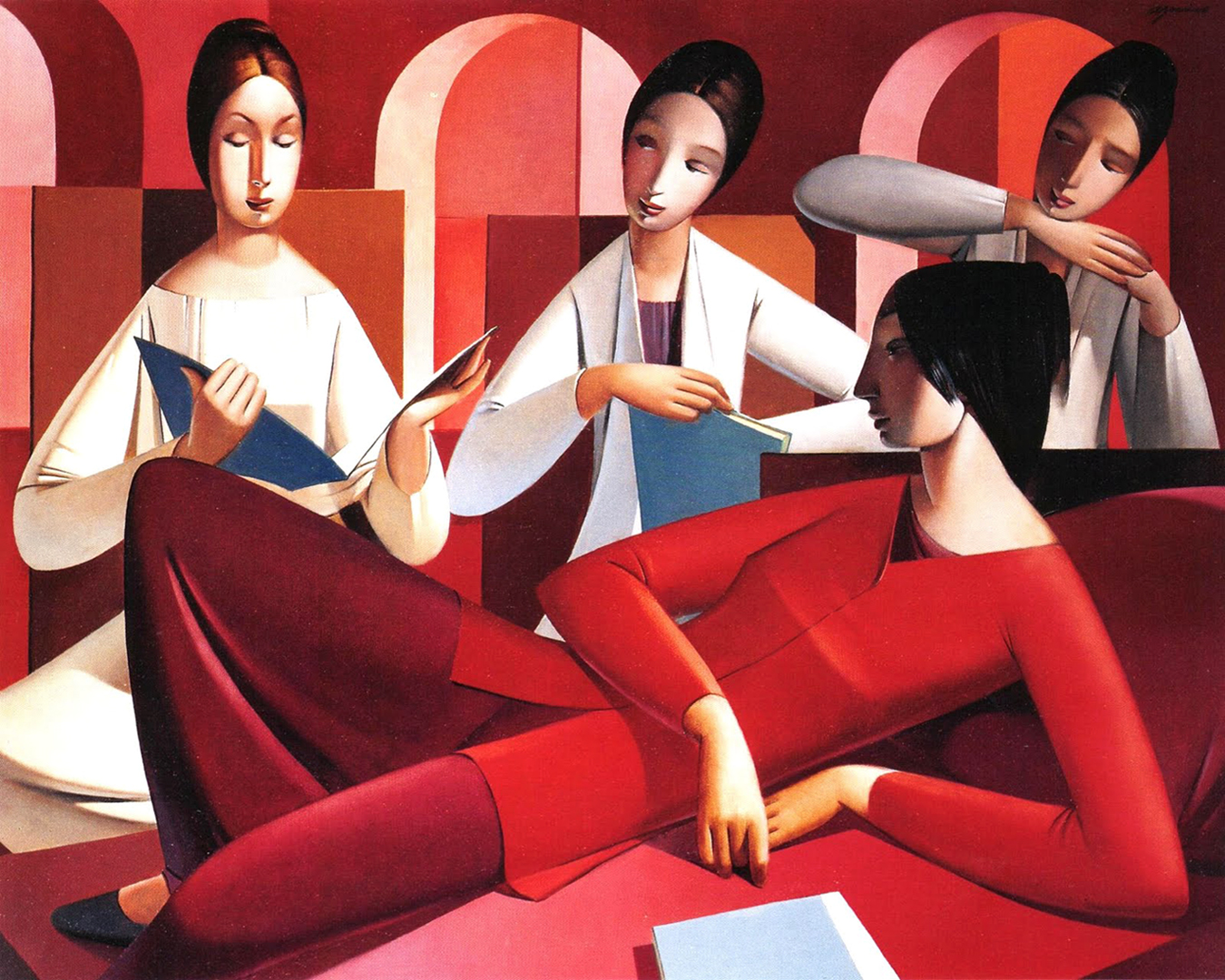
Women by Armando Barrios (1920-1999)

Painting by Armando Barrios (1920-1999)

Bookish people read books. Bookish people attend readings and book festivals.  Bookish people are disappointed when Will Self, Jeffrey Eugenides, and Mary Robison cancel.   (Yes, that really happened.)

But one can be too bookish.

I am too bookish.

It means that I carry a book everywhere, even shopping.  Today I panicked because I was waiting for a beverage without a book. I was running errands.  One doesn’t usually read while running errands.   I’d have read the labels on the coffee beans if I hadn’t found a newspaper.

I said to myself, “You are too bookish.”

I have been told this many times.

The most recent “too-bookish” episode was when I listened to the Grateful Dead for 48 hours. It was a good remedy for grief, but after the first day I HAD to read:  my cousin said I couldn’t because I had to be mindless. She said I wouldn’t have wanted to read if had had more than one shot of vodka. Having Ambien in the cupboard didn’t count, since it is a sleeping pill.

“Now if you combine it with…”

“Don’t be ridiculous!”

I have decided to prove that I am unbookish.  I will go to rock concerts and book festivals.

Now this isn’t as silly as you might think.

You can’t read at either.

We are all rapt when we listen to rock music except when we have to do it for the entire Labor Day Weekend.

At rock concerts we wear black and sway.  If our hair is long enough, we flip it around.  We can do the same kind of thing at a book festival.  Only less swaying and flipping.

The  Zombies are on tour and will play within the 400-mile radius designated for my new rock thing.  I would love to hear them sing “The Time of the Season.”

It’s the time of the season
When love runs high
In this time, give it to me easy
And let me try with pleasured hands

We’re never too old for that!

Bonnie Raitt is touring in a city near me. “Put your hands together for the one and only Bonnie Raitt!”  She sings better than anyone about love and work.  During an unhappy work experience I listened to her version of “Angel from Montgomery” again…again…again…and again…

How the hell can a person
Go to work in the morning
And come home in the evening
And have nothing to say

rolling stones beast of burden 1978

Rolling Stones, “Beast of Burden,” 1978

How could I possibly have missed the Rolling Stones in Chicago in June?  I could have taken the train to Chicago. Perhaps they sang “Beast of Burden”!

Am I hard enough
Am I rough enough
Am I rich enough

Yes, I think you probably are.

Couldn’t R.E.M. get back together just long enough to sing my favorite song, “Driver 8”?  I respect their breakup, because why perform if you don’t want to, but I miss them.

And the train conductor says
“Take a break Driver 8, Driver 8 take a break
We can reach our destination, but we’re still a ways away”
But we’re still a ways away

Can one be a groupie at book festivals?

On my sidebar I have listed the four best new books of 2013.  I sincerely do doubt that any of these writers will come here on tour.

One gathers that Sir Peter Stothard, author of Alexandria:  The Last Nights of Cleopatra, might be too busy editing the TLS or judging awards or something to go on tour in the U.S.   I googled “Peter Stothard book tour” but nothing came up.   Too bad!  Wouldn’t it be great to have an autographed copy of his book? Just his name would be fine.  “To Kat” isn’t necessary.

Karen E. Bender, author of A Town of Empty Rooms, wrote me a lovely email when I wrote about her book.  She is a graduate of the Iowa Writers Workshop, so she might come to the Midwest sometime.  But in the  2013-2014 academic year, she is teaching creative writing at Tunghai University in Taiwan.

Steve Yarbrough, the author of the brilliant novel, The Realm of Last Chances, has been one of my great “discoveries” of the year. But he teaches at Emerson College, and it looks from his tour schedule as though he’s not coming anywhere near here.  What a pity!

Susan Choi, author of My Education, is giving readings in Brooklyn and Portland this fall.  A long way away…

It’s much easier to see a rock band than a writer!  See you in black at the concert.

Starfruit and the Humanities

Starfruit

Starfruit

I ate my first starfruit today. It tasted like an apple.  Not knowing how to eat it, I munched on the wings.  There’s a core inside!  Well, it’s actually seeds.

I had long intended to try starfruit.

I wanted some other exotic fruit, too, like dragonfruit.

I decided to go to the Hy-Vee to buy fruit.  It has been very hot, and fruit seemed the thing.   I ride my bike every day unless it’s ridiculously hot, like 100 degrees (it was only 90), and the Hy-Vee was a destination. I carried a huge knapsack, because I know from experience that fruit, like Chinese food and deli coleslaw, explodes in my bike pannier.

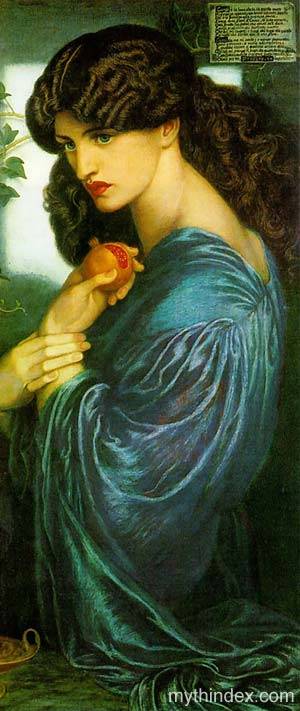
"Proserpine" by Dante Gabriel Rpssetti

“Proserpine” by Dante Gabriel Rossetti

The “new” Hy-Vee is acres and acres of food.  It was built to compete with Whole Foods, which moved in a year ago. I meant to buy dragonfruit, but picked up plums and a pomegranate instead.  The pomegranates remind me of Persephone, the goddess who spends six months a year in the Underworld because she ate pomegranate seeds there after Hades abducted her.  She’s out now, by the way:  it’s summer.

Do not eat pomegranate seeds!

The Hy-Vee can be overwhelming.  I passed the Asian food station, Starbucks, the bakery, and the beautiful fresh fish.  No, No!   The idea was to get out of there without spending a fortune.   But then I bought expensive shampoo, and I almost bought Vitabath.  A bubble bath!  How wonderful in this weather.

It was hot, my knapsack stuck to my back as I rode, I stopped to admire Bounnak Thammavong’s fish sculpture in a park, I rode through construction on Washington, I made it up the big hill, the branch library was closed, and finally I was home.

THE HUMANITIES. This summer, many essays have been published in newspapers and magazines on the demise of the Humanities major.

Happens every year, doesn’t it?  Something to work us up.

I am, however, calm from bicycling.

A new report from The American Academy of Arts and Sciences says that college students are choosing vocational majors rather than majoring in the liberal arts.  Verlyn Klinkenborg in The New York Times says,

In other words, there is a new and narrowing vocational emphasis in the way students and their parents think about what to study in college. As the American Academy report notes, this is the consequence of a number of things, including an overall decline in the experience of literacy, the kind of thing you absorbed, for instance, if your parents read aloud to you as a child. The result is that the number of students graduating in the humanities has fallen sharply.

Only 16 English majors graduated this year at Klinkenborg’s alma mater, Pomona College, where the most popular majors were economics and mathematics. Among Yale graduates in 2013, the most popular majors were economics and political science.

Some of us have seen this coming. People are too plugged-in:  even Gary Shteyngart says he’s not reading as much as he used to.  On the rare occasions when I take the bus rather than bicycle,  almost everybody is plugged into a phone.  A teacher friend tells me no one is majoring in English. “Business majors, engineering… It’s a f—–g trade school,.”

It is fashionable to pretend that literature won’t make you a better person. I say it can at least make you look at life form a different angle.  Take Aeneas, the exhausted middle-aged hero of Virgil’s Aeneid.  Why was he so querulous?  It is his fate (the gods tell him this again and again) to lead Trojan refugees to Italy to  found Rome when all he he wants is a domestic life.  All he is given is pietas (duty to the gods, country, and family).

Sounds like American life, doesn’t it?

I am  schoolmarmish when it comes to the study of Humanities. I majored in School of Letters (a major that no longer exists), a combination of English classes, literature in translation, and the study of two languages.  Could I have read English lit on my own?  Yes. But could I have studied classical languages?  NO.  The study of classics, which I continued in graduate school, was life-changing.

Lee Siegel in The Wall Street Journal saysit is absurd to think humanities majors “recognize truth, beauty and goodness.” He doesn’t think the demise of humanities majors is the end of the world.  He adds, “These solemn anxieties are grand, lofty, civic-minded, admirably virtuous and virtuously admirable. They are also a sentimental fantasy.”

Naturally, I disagree.  “Sentimental fantasy?” I’m too weary to take that on.

Adam Gopnik wrote a fascinating response to the Academy Report, “Why Teach English?”,  in The New Yorker’s blog.  

I loved my education.

No regrets!

Willa Cather’s My Mortal Enemy

Willa Cather's home

Willa Cather’s home

In 2009 we drove to Willa Cather’s hometown, Red Cloud, Nebraska, population 1,020.  I am a Cather enthusiast, and if you’re living in the Midwest, why not visit Red Cloud? We decided to drive all day and spend a few hours there.

As we drove down the highway through wheat fields and prairie, we saw some very rough towns.  But Red Cloud is different, tiny but groomed. Many of the buildings have been restored, among them the Opera House, now the headquarters of the Willa Cather Foundation, and the Farmers’ and Merchants’ Bank, which was founded and built in 1889 by Silas Garber, the fourth governor of Nebraska and the model for Captain Forrester in A Lost Lady.  We visited her childhood home, a small house with 14-ft. ceilings that made it seem spacious, which has some of the original furnishings, described in Song of the Lark and “Old Mrs. Harris.”  We saw Cather’s desk in her tiny room in the attic.

When I read Cather’s books, I always see Red Cloud now.  But somehow I never read her short stories or novellas.

Kevin Neilson at his brilliant blog, Interpolations, inspired me to read Cather’s novella, My Mortal Enemy.  Kevin writes, “Published in 1926, Willa Cather’s slim 85-page novella, My Mortal Enemy, packs some serious heat. We’re talking Rim Fire at Yosemite heat. The title alone hints at passionate depths.”

my-mortal-enemy-willa-cather-paperback-cover-artKevin beautifully captures the tone of Cather’s writing and explores the meaning of the phrase “my mortal enemy.”

I love this novella.  It is one of Cather’s masterpieces. The narrator, Nellie Birdseye, tells the story of Myra Henshawe, a cultured, charming woman who many years ago eloped from Illinois to New York with Oswald Henshawe, a Harvard graduate.  Myra’s uncle, her guardian, forbade the marriage and threatened to disinherit her.  He left his money to the Catholic church.

When Myra returns to visit her friends in Illinois, she is not what 15-year-old Nellie expected:  she is middle-aged and plump, charming but rather intimidating.

Nellie assumes Myra and Oswald are very happy.  Her Aunt Lydia tells her,

Happy?  Oh, yes!  As happy as most people.”

The answer was disheartening; the very point of their story was that they should be much happier than other people.

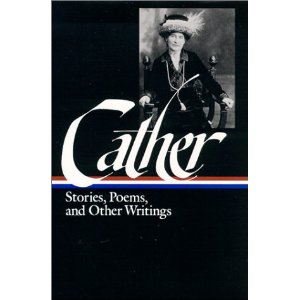
My Mortal Enemy is in this Library of America volume.

My Mortal Enemy is in this Library of America volume.

Marriage is difficult.  Marriage is unhappy.  Cather has described marriages before, and I cannot think of one happy one. When Nellie and Aunt Lydia visit New York, Myra and Oswald are charming at first: they introduce them to people in the arts and go to the theater.

But the Henshawes also have friendships with younger people.  Myra has a young man friend whom she advises not to give opals to the woman he wants to marry: opals are unlucky.  Oswald has a young woman friend who gives him beautiful topaz cuff buttons.  Different jewels.

One assumes that Myra advises the young man because he is attractive; one assumes Oswald is acting on his attraction.  Oddly, it is Oswald who wins Aunt Lydia’s sympathy when he asks her to pretend to give the cuff buttons to him on Christmas so Myra is not upset by the young woman’s gift.  Aunt Lydia is very sympathetic to Oswald, and one assumes she envies Myra.

But when Myra makes a scene, Nellie is also dismayed:  Myra has found out about the young woman’s gift of topaz buttons, and discovered a key that Oswald will not account for.

Ten years later, when Nellie meets the Henshawes again in a western town, they have lost their money and Myra is dying.  Myra is still charming and fascinating, but the rooming house is badly-built; the noisy neighbors upset her.

And she refers to Oswald as her mortal enemy.

“Oh, if youth only knew!” She closed her eyes and pressed her hands over them.  “It’s been the ruin of us both.  We’ve destroyed each other.  I should have stayed with my uncle.  It was money I needed.  We’ve thrown our lives away.”

Again, Oswald has a young woman friend, and Nellie approves:  Oswald charms women.

Cather often uses the  viewpoint of a young narrator to tell a story: think My Antonia and A Lost Lady. Nellie’s quiet account of difficult, fascinating Myra is affectionate but ambivalent.  Myra is so passionate that we (in a way) understand why Oswald is her mortal enemy.  Myra is deeply flawed, but also brave.

What a great book.