Sweat, Hipsters, & Banned Relatives

peace sign 1We got there on the dot of ten, but the priest was already praying over the body.  The deacon asked if I wanted a minute with the open casket.

I shook my head. On the day she died, I had already said,  “Goodbye, Mom, I love you.”

And I dislike open caskets.

The last funeral I went to was in a Mennonite church.  It was very simple.

Here there was a procession.  My husband and I walked awkwardly behind my sibling and his family who do not speak to me who walked behind the coffin.

“Kat,” hissed my  “banned relative” from a front pew.   I have never been so overjoyed to see him.

“They can’t kick me out,” he had said on the phone.

The priest walked around the coffin shaking incense.  Suddenly the censer broke.  The two vessels (or vessel and lid?) fell off the broken rope.  They were so hot that the deacon had trouble picking them up.

I didn’t know the responses in the Mass.

My dad said, “Why is your brother kneeling?  Isn’t he an atheist?”

We stood and sat.

“The Lord be with you.”

“And also with you.”

I could have sworn it was, “And with your spirit.”  I remember the Latin:  et cum spiritu tuo.

“No, it’s ‘And also with you,'” my husband assured me.

I took communion.

“Body of Christ.”

A pause while I figured out what to say.  “Amen.”

The holy wafer stuck to the roof of my mouth.  In the old days we weren’t allowed to touch it.  It didn’t dissolve.  It was there for the rest of the mass.

I sang the last hymn, “Jesus, Joy of Our Desiring.”

But, on the second verse, we, the family, were expected to troop out of the church.

“Bye, do you need a ride to the burial?”  I whispered to the “banned relative.”  I was a little late leaving the church, but, really, who cared?

I talked to my mother’s friends at the burial service.

Afterwards we had coffee downtown, Chinese food, and went to one bookstore before driving home.

It was a very long day.

Dorothy Baker’s Cassandra at the Wedding & Preparing for a Funeral

This weekend I read the selection from  Emily Books, a women’s bookstore that chooses one e-book a month.  You can subscribe as a member and get the monthly selections, or buy the books one at a time.

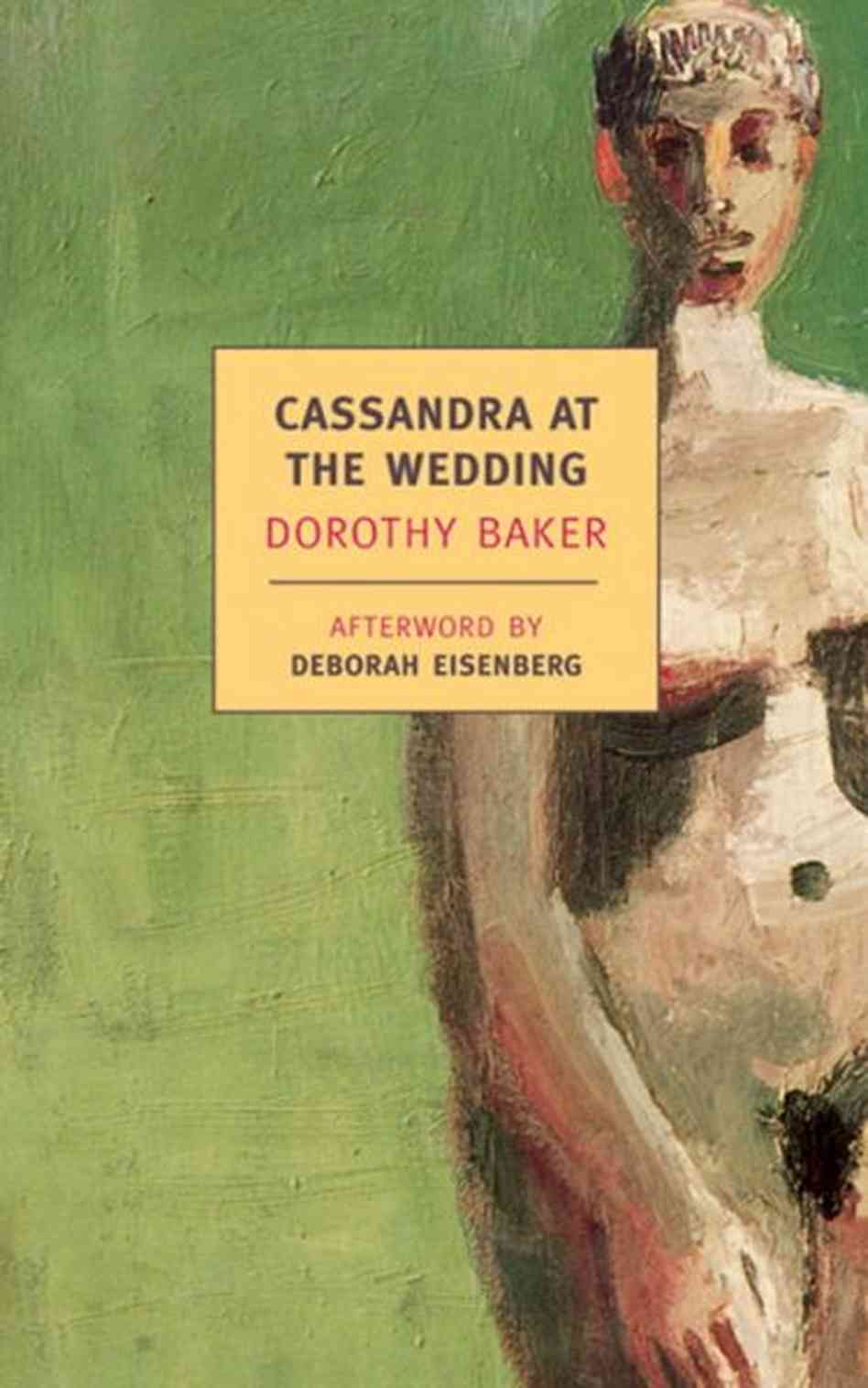
This month the selection is Dorothy Baker’s Cassandra at the Wedding, which is also available from NYRB.  (I have an old Virago).
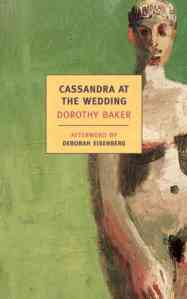
Cassandra at the wedding dorohty bakerIn this remarkable novel about twins, sexuality, and depression, the narrator, Cassandra, prepares to drive from Berkeley to the family ranch for her twin sister Judith’s wedding.  Judith, a musician, will marry Jack, a medical student, in a private ceremony.   Cassandra, their father, and grandmother, and perhaps a few of their grandmother’s friends will attend.  Their mother died of cancer a few years ago.  She was a writer, often absent.

Cassandra, a graduate student who has written 56 pages of her thesis, has felt suicidal.  She stares out the window of her apartment at

…the bay with the prison islands and the unbelievable bridge across it. Unbelievable, but I’d got to believing in it from looking at it so often,and it had been looking quite attractive to me off and on through most of the winter.  All but irresistible at times, but so was my analyst, and they canceled each other out more or less.

She decides to go home a day early, and on the five-hour drive stops at a bar for vodka and lemon squash.  Cassandra drinks a lot.  She never stops drinking.  And when she looks in the mirror at the bar, she sees her sister’s face.

But I looked again in a moment or two, unable not to, and this time I let myself know who it was.  It was the face of my sister Judith, not precisely staring, just looking at me very thoughtfully the way she always used to when she was getting ready to ask me to do something–hold the stop watch while she swam four hundred meters, taste the dressing and tell her what she left out, explain the anecdotes about the shepherd and the mermaid.

When she arrives, drunk and drinking, she tries to persuade Judith not to get married.  She and Judith are both disturbed by the fact that they have bought the same dress (separately) for the wedding.  Their grandmother thinks it is very funny, because their parents were adamant about their not dressing alike as children.  But Cassandra is devastated.
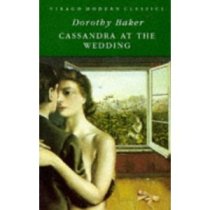
Cassandra at the wedding viragoThey belong together, she tells Judith.  They are special.  They need to live together in their apartment in Berkeley with their Boesendorfer piano.  Cassandra has had lesbian encounters with a few women, but they have meant little to her.

The next day, Cassandra wakes up and believes Judith has agreed to call off the wedding.  She is mistaken.

Part of the novel is narrated by Judith.  Her voice is likable, balanced, and sensible, and we are relieved that she can separate from Cassandra, and that we can have a break from Cassandra.

Baker’s style is witty, brilliant, and bold, and though this book is not quite a classic–it is a tiny bit overwritten–Baker’s portrait of Cassandra is both richly-colored and convincing.  Cassandra’s voice is wry and often funny, but she is exasperating, sometimes even frightening, when it comes to her relationship with Judith.  Cassandra’s detailed account of the events of her arrival and the following day is harrowing.  She attempts suicide when Judith goes to the airport to meet Jack.

It is a fascinating novel, one you can easily read in a day.  Baker’s husband, Harold Baker, a poet and critic, said that Cassandra and Judith were based on their own daughters, who were not twins, but were astonishingly alike as children.

Is this perhaps the best book about twins?  I did enjoy Audrey Niffenegger’s Her Fearful Symmetry, but it is not in this class.

GETTING READY FOR THE FUNERAL.

Photo on 2013-06-09 at 21.11

I can’t wear this to the funeral.

I will go to my mother’s funeral after all.

I am going in her honor.  She went to a lot of funerals.

I will wear matching clothes. Usually my outfits are far from put-together.  A t-shirt and jeans are my normal ensemble.

Today I shopped for funeral clothes.  No, just clothes.  Clothes a woman can wear out of the house.  It took me five minutes to try on ten tops and buy the five most acceptable.

In the morning I will put on whatever seems most appropriate.  Maybe “the matron shirt,” as I call it.  With khakis.  Except my ancient khakis no longer fit. I rummaged through the closet and fortunately found a pair of suitable slacks on the floor.

I will wear sunglasses if I can find a pair. I will literally not be able to see my family if the glasses are dark enough.

I will sit in the back of the church.  No, I’ve been told this is unacceptable.

I will not know when to stand, sit, or genuflect.

I will not know the new (Protestant) end to the Lord’s Prayer that the Catholics added some years back.  “Power and glory something something something?”

I will take some drugs.  No, I don’t take drugs.  Anyway, I have searched the cabinet.  We have:

1.  Vitamin B (always an exciting drug).

2.  Advil (my favorite.  I may chug a couple of those).

3.  Alka-Seltzer Plus.  (It’s a cold medicine.)

4.  Ambien.  (A sleeping pill.)

All right.  Here’s what I’m saying to myself.

‘ten-shun!

To My Mother and to Myself

"A Burial at Ormans" by Gustave Courbet

“A Burial at Ormans” by Gustave Courbet

My mother died this week.  I miss her very much.

Shall I go to her funeral or not? I am not callous.

A divorce split my family forty years ago.  Some people in the family still do not speak to one another.  Forty years is such a long time that I can’t imagine how they keep it up.

“They can’t kick me out,” said one relative who intends to go to the funeral.

But that is exactly the kind of confrontation I hope to avoid.

I do not go to funerals.  My mother went to funerals.  Once she told me not to visit because she was going to a funeral.  “It’s going to be huge,” she said.

I could not comprehend what these funerals meant to her until I ended up with her box of obituaries.

My mother believed in God and went to Mass every week.  I believe in the afterlife for her because she believed.

The death scenes have been a bit like the scenes in War and Peace, when Count Bezukhov is dying , and the three Princesses (his daughters), Prince Vasily Kuragin, and Anna Mikhaylovna (on behalf of the illegitimate Pierre) are intriguing for money.  The Prince tells the Princess that they must find a letter the Count wrote to the Emperor.  If it is sent, the Count’s illegitimate son Pierre will inherit everything.

Although there are no letters in my family, the word “money” is said so often that I have taken care to accumulate very little in my lifetime.  (Does this call for a poem by Horace?  Probably.)

In Chapter 18 of War and Peace, many clichés are uttered.  Tolstoy had a fine sense of irony.

The human span,” said a little old man, some sort of cleric, to a lady who had come to sit by him and was now listening naively to everything he said, “that span is determined and may not be exceeded.”

I had to listen to a lot of cliches like that this week.

My mother was in agony the day before she died.  “Help me,” “I might die,” and “Sorry.”

Sitting next to her while she slept the next afternoon, I flashed on her life.  I worried about the “Sorry.”   I felt that I understood her.  When she was in her mid-forties, her husband left her, I, her daughter, left her, and her mother died. Too much at once.  It cracked her.  In my life it has been more or less one thing at a time, which is a blessing.  Though, frankly?  The two of us both suffered immensely, and there is no point to our sufferings, either.  (What doesn’t kill you makes you stronger.  What shit!)

My mother was a devout Catholic who became more liberal as the years went by because of watching “The View” and other talk shows.  She positively approved of gays at the end of her life.

We had little in common.  She liked TV, I don’t much.  We both liked movies.  She liked shopping, I don’t.  But we became very good friends.

I miss her very much.

I dedicate the following song to the one I love:  her.    John Mellencamp was a Midwesterner, and that kind of identity meant a lot to her.  For instance, she loved Ashton Kutcher because he was a Midwesterner!

Love you, Mom!

Here goes.

“Human Wheels,” written by John Mellencamp and George Green.

This land today, shall draw its last breath
And take into its ancient depths
This frail reminder of it’s giant, dreaming self.
While I, with human-hindered eyes
Unequal to the sweeping curve of life,
Stand on this single print of time.

Human wheels spin round and round
While the clock keeps the pace.
Human wheels spin round and round
Help the light to my face.

That time, today, no triumph gains
At this short success of age.
This pale reflection of its brave and
Blundering deed.
For I, descend from this vault,
Now dreams beyond my earthly fault
Knowledge, sure, from the seed.

Human wheels spin round and round
While the clock keeps the pace.
Human wheels spin round and round
Help the light to my face.

This land, today, my tears shall taste
And take into its dark embrace.
This love, who in my beating heart endures,
Assured, by every sun that burns,
The dust to which this flesh shall return.
It is the ancient, dreaming dust of God.

Human wheels spin round and round
While the clock keeps the pace.
Human wheels spin round and round
Help the light to my face.
Human wheels spin round and round
While the clock keeps the pace.
Human wheels spin round and round
Help the light to my face.

Steve Yarbrough’s The Realm of Last Chances

All over the country people were being dislocated, heading off to places they didn’t belong, hoping to somehow find themselves another home.”–Steve Yarbrough’s The Realm of Last Chances

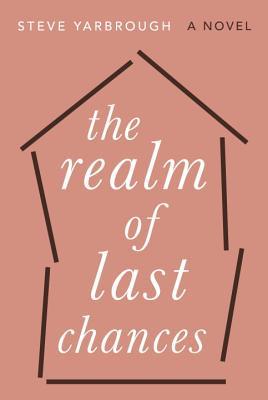
realm of last chancesSteve Yarbrough’s The Realm of Last Chances, a spare, brilliant novel about being set adrift in midlife, unflinchingly examines the lives of Kristin Stevens and her husband Cal, both fifty when Kristin is laid off from her job as vice president of academic personnel at a university in California.   Moving to Massachusetts, where Kristin finds a job at a third-rate college, is traumatic:  even the change of seasons is disturbing.  Neither Kristin (named after Kristin Lavransdatter, her parents’ favorite book) nor Cal (a lifelong Californian)  are sure they will survive the move.

Yarbrough writes of Cal, who works construction and is a musician:

He was the man you engaged if you needed to have something small and delicate done and could pay for fine work.  You had to accept certain things about him, though.  He’d come and go on his own terms, and he would bring a small Bose along and listen throughout the day….The fact that he was working for you didn’t necessarily mean he’d return every phone call.

Cal has a violent past.  He has secrets.  In fact, Kristin didn’t know when they got married that he’d legally changed his name from Stegall to Stevens.  His father, a developer of cheap housing estates, did time in prison for bribery, mail fraud, and witness tampering.   On the other hand, Cal, more or less in the same line of work, is utterly ethical and  chooses only the best materials for his carpentry and construction.

Every character is believable, lonely, and depressed.

Their neighbor, Matt, is displaced.  He used to be the fiction buyer at the Harvard Emporium.  He dreamed of buying a bookstore in Andover, a gorgeous, wealthy town where he and Kristin (and her coworkers) shop at Whole Foods before returning to their duller suburb.  Matt now works at a friend’s deli.

He lost his job at Harvard Emporium after he volunteered to work the cash registers for an hour a day. He explains to Kristin,

The staff loved it.  You’ve got a very leftist workforce there, and for me to do something as lowly as ringing up sales…well, that created a kind of egalitarian atmosphere.”

But he used that time to embezzle $35,000.  He bought cocaine.

He and Kristin begin to have an affair, but at one point Matt thinks,

He’d let his own nose ruin his own life, and now it looked like his prick would ruin somebody else’s.

Kirstin, who is very snobbish about her new job at first,  is unhappy that she has ended up at North Shore State.  After earning her Ph.D., she was an English professor, though not a very good teacher, she says, and then went into a job in administration.  In California, she  had enjoyed her work.  But North Shore State College, originally a teachers’ college which expanded the curriculum after World War II, has much lower standards, Kristin thinks.

In a purely academic sense–and almost every other sense as well–NSSC was undistinguished, its deficiencies rendered all the more glaring by its close proximity to Harvard, MIT, Tufts, Brandeis, even UMass Lowell.  It was just a third-rate state school, where the students often worked full-time and took seven or eight years to graduate, but this was where she’d ended up.

Then a plagiarism case turns up.  The head of the history department has discovered that two  assistant professors have published articles they’d plagiarized, and that one had  plagiarized a book.  Kristin must document the evidence before she informs the president and the provost.  The two are well-liked and under review for tenure, and Kristin is afraid she might lose her job.  But Kristin, like Kristin Lavransdatter, does the right thing.  She takes risks.

Throughout the entire novel, the characters are under extreme stress and must contemplate morality and justice.  Kristin has never had an affair before, and  the plagiarism case is convoluted. Cal, who is lonely and violent, finds out about the affair, as he must.  And Matt realizes that he must get his life under control.  Does he want to break up a marriage?

The writing in this book is breathtaking.  There is no showing off, no overwriting.  Every sentence is deftly balanced and pitch-perfect.  I have seldom read such a perfect novel.

I highly recommend it.   Perhaps a classic?  Time will tell.

My Beautiful Mother

My Beautiful Mother and I

My Beautiful Mother and I

My beautiful mother is very, very ill.

I held her for a while this evening.  The drugs are not working.  She is shaking and terrified.  A staff member told me to hold her hand and tell her it’s all right for her to go if she has to.

I cannot do that.  That is the job for her primary caregiver. I just cannot.

She is being given “End of Life” treatment.

The first words out of her mouth when she saw me,  “You look so good.”  (Mom, thank you! )

She mumbles and mumbles.   Then:  “I might die,” she said clearly.  Mostly she mutters,  “Help me.”

I couldn’t understand what she was saying at first.

It seems to calm her if I put my hand on her shoulder or my arm around her.  She dropped off to sleep for a while.

Undoubtedly she is the best mother ever, the strongest, and smartest (when she is not drugged).  I love her dearly.  What other mother could  have given the gift of indestructible confidence to such an ordinary daughter?  Not only was I as good as anybody else, but much better!  (Well, yes, I am much better.)

See, that’s what she did for us.  I have been called a bitch (a compliment, no?) and a sweetie (an even greater compliment).  It’s all compliments–see?  That’s my mom!

But she isn’t sleeping. She wakes up after 10 minutes.   “Couldn’t you give her Ambien?”  I asked.  I am an expert on Ambien.  It is the only drug you will ever need if you can get it.  Throw out your Prozac and whatever else.  Just go to sleep.

Here is what I know about my beautiful mother.  (Surprisingly little.)  She is a good mother.  When I was in the hospital for a tonsillectomy and almost bled to death, she did not leave my side.  She set up Barbie patio furniture on my bed.

She is  good at everything.  Bridge?  The best.  Want to see the prizes?

Badminton?  Pretty good.  I remember a day of playing badminton after t my father didn’t come home one day. It was an occasion.  She rarely played with us.  She was fun, but somehow frail.

She never stooped to playing Bingo.

She has many, many, so many  friends.  I can count mine on one finger, to quote John Mellencamp.

Sometimes life is too ridiculous to live
You count your friends all on one finger
I know it sounds crazy just the way that we live”–John Mellencamp, “Between a Laugh and a Tear”

She saw EVERY movie, and I do mean EVERY movie.  She fell asleep when we went to Pollock.  We laughed over the last movie we saw in a theater together,  Bridesmaids.

She knows politics. She is sharp.  She was a political science major. She waited for hours on the Old Capitol lawn to see Hillary and Bill Clinton.  “I hoped to see a woman president in my lifetime.”

She saved Holy Cards (a really nice one of St. Patrick), the St. Patrick’s Catholic Church Dedication Liturgy (a new church was dedicated in 2009 after the destruction of the original church by a tornado), and a surprisingly good Special 25th  Anniversary issue of People magazine. (I have been reading about Madonna, John Travolta, and Karen Silkwood’s children tonight.)

I would like a pack of Holy Cards.

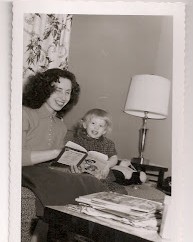
Note how beautifully dressed she is in the picture above.  That is a cashmere sweater she later gave to me.

She introduced me to reading.

Baby Animals:  that is the name of the book we’re reading in the picture.  I am one year old.  I already have a huge pile of Golden Books.  Little Red Riding Hood, Three Little Kittens, The Poky Little Puppy, The Little Red Hen.  Every time we go to the grocery store I get another Golden Book.  (My panda has been abandoned for a good book.)

I meant to post a much more glamorous picture of her, but I couldn’t scan it.   It simply wouldn’t work.

I think the whole family should have met before an End of Life decision was made.  Families often fight about this, my doctor told me.  He knows of a case where a brother and sister came to blows.

If they’d tell me her weight and the dosage I could figure out the dosage of Ambien on my calculator.  Just call me Doctor World Wide Web.

I want her to be comfortable.  I do not want her to suffer.

I do not want to say goodbye to her.  I want her to survive.

I’m red-eyed from crying, but will not be red-eyed tomorrow.  I will be strong.  It is what I can do for her.

I called my dad, but he was cold.  “Let me know if anything changes.”  They have been divorced 40 years.

That is when I knew that it was hopeless.  Nobody is going to step up to the plate.  If anyone steps up, it has to be me.  I saved her life twice. But I have been ill, and this time it has gone on too long without intervention.

And I will leave you with a Bob Marley song that isn’t very practical here.

Get up, stand up: stand up for your rights!
Get up, stand up: don’t give up the fight!

It should be:  Get up, stand up:  stand up for your Mom!

Diary of a Mad Baker: Blue-Chip Brownies

Yes, this is I:  how did you guess?!

Yes, this is indeed the perfect baker.

I spend a lot of time chopping vegetables. There I am at the end of the day, listening to public radio, chopping zucchini into toothpicks.  (What should I do with the zucchini in the garden? I’ve thrown a lot of it into a wok.)

I love vegetarian dishes, and that’s mostly what we eat.   Recently I posted a recipe for the most delicious dish I have ever eaten, Mollie Katzen’s Green Beans and Tofu with Crunchy Peanut Sauce.  At the end of the post, I added an “improv” shortcut.  It worked once; the second time it did not.

And that’s what makes me an indifferent cook.  The shortcuts.

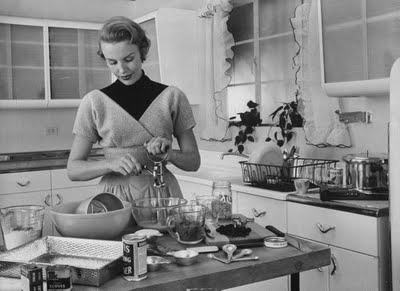
I sympathize with Claudette Colbert in "The Egg and I"

I sympathize with Claudette Colbert in “The Egg and I”

If I am an indifferent cook, I am a mad baker.

No one cooked or baked when I was growing up.  My mother didn’t see the point.  Her mother had done all the cooking.  Her mother made delicious roast chicken, homemade noodles, delicately-cooked fresh vegetables, and Boston creme pie.  My mother proudly lived at home while she went to college and worked at her first job.  She never cooked or baked.

When she became a housewife, she liked one-step meals, possibly two-.  Tuna casserole, fish sticks, roast beef in an electric cooker.  I never saw a vegetable till I grew up and did my own shopping.  Well, that’s not quite true.  We had sweet corn.

She really hated baking.  “Cake mixes are better,” she told me.

When I bake them, they certainly are.

Once I made madeleines.  I could not understand the point of adding one ingredient at a time.  Why not add all the eggs  at once?  I ended up throwing everything in, butter, sugar, eggs, etc., and mashing it together.  The madeleines were probably not what the author of The Joy of Cooking had in mind.

Today I decided to bake brownies.  We had cocoa and the essential ingredients.  So I looked up cocoa brownies online, and found a delicious recipe at Bon Appetit.

I took no shortcuts today.  These are blue-chip brownies.   Forget baking chocolate or Hersey’s syrup! These are the best brownies I’ve ever had.

I would have liked vanilla ice cream with them, but you can’t have everything.

Here is the recipe:

nonstick vegetable oil spray
1/2 cup (1 stick) unsalted butter, cut into 1 inch pieces
1 1/4 cups sugar
3/4 cup Scharffen Berger natural unsweetened cocoa powder (I used regular cocoa powder)
1/2 teaspoon kosher salt
1 teaspoon vanilla extract
2 large eggs
1/3 cup all-purpose flour

Preparation

Preheat oven to 325°. Line an 8x8x2 inches glass baking dish with foil, pressing firmly into pan and leaving a 2 inches overhang. Coat foil with nonstick spray; set baking dish aside.

Melt butter in a small sauce-pan over medium heat. Let cool slightly. Whisk sugar, cocoa, and salt in a medium bowl to combine. Pour butter in a steady stream into dry ingredients, whisking constantly to blend. Whisk in vanilla. Add eggs one at a time, beating vigorously to blend after each addition. Add flour and stir until just combined (do not overmix). Scrape batter into prepared pan; smooth top.

Bake until top begins to crack and a toothpick inserted into the center comes out with a few moist crumbs attached, 25-30 minutes.

Transfer pan to a wire rack; let cool completely in pan. Using foil overhang, lift brownie out of pan; transfer to a cutting board. Cut into 16 squares.

P.S.  I had no aluminum foil, so I simply greased the pan.  That’s not really a shortcut, is it?

Mary Hocking’s Good Daughters & A Particular Place

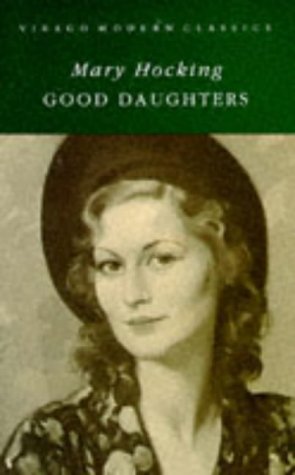
Good Daughters by Mary HockingMary Hocking’s irresistible novels have been compared to Barbara Pym’s.

Is she like Barbara Pym?  Well, no. I find her sharp, gracefully-written fiction more like the tart novels of Penelope Lively crossed with the family sagas of Elizabeth Jane Howard.

Last week I jotted notes about Hocking’s An Irrelevant Woman, a poignant novel about a middle-aged woman’s mental breakdown.  I have since read two other novels by Hocking: Good Daughters (1984), a family saga about three sisters growing up in London in the 1930s; and A Particular Place (1989), a novel about a new Anglican vicar’s effect on the inhabitants of a small market town.

In the plot-driven family saga, Good Daughters, which is the first novel of a trilogy, much of the narrative is related through the consciousness of Alice, age 12.  Alice’s ingenuous voice reflects the impossibility of her understanding  the world beyond the domestic realm.

It begins:

In later years, Alice heard people talk as if those who grew up during the period between the two wars had lived their youth beneath the shadow of the swastika.  But it had not seemed like that at the time.

Although in her childhood older people talked of the war that was just finished, and then, some ten years later, began to talk of the war which was to come, no shadow seemed to touch her until she was sixteen.

Absorbed by school and friendships, the three Fairley sisters, Louise, Alice, and Claire, ignore their father Stanley’s preoccupation with world events.  Stanley, a dramatically devout Methodist who has moved his family from Sussex to be a headmaster at a boys’ school in Acton (he wants to work with the disadvantaged), is obsessed with newspapers:  finding the Daily Herald on his doorstep instead of the News Chronicle can ruin his day. His level-headed wife, Judith, frequently expresses annoyance at his pomposity and theatricality.  It is her practicality that holds the family together:  the girls go to her for support, not to pious Stanley.

Alice, the middle child, is a mediocre student but an excellent writer; she is torn between devotion to her parents and loyalty to her rebellious friends.  She is proud of her “burgeoning” maturity  (she likes the word “burgeoning”) and has learned to keep secrets, unlike her eight-year-old sister, Claire, who blurts out everything.  Still, it makes Alice’s “tummy hurt” when she must censor reports of her activities.  She feels guilty about her misadventures with her careless, confident best friend, Daphne: when Alice sneaks out in the middle of the night to search for secret passages at Daphne’s house, the two giggling girls open a trap door in the kitchen that turns out not to hide a secret chamber: soot pours out all over the floor.  In the morning, Daphne’s parents call the police, thinking someone broke in.

Alice is also utterly loyal to her 17-year-old sister, Louise, who feels no compulsion to tell her parents everything:  when Louise tries out for a play at the coed St. Bartholomew’s Dramatic Society, she tells her parents she auditioned for the school play (they attend a girls’ school).  She orders her sisters not to tell.

There’s no need to say anything to Mummy and Daddy about it until I know if I’ve got the part.”  It was all too much, and Alice had one of her tummy upsets that night.

Of course, Claire tells.

In her year of acting in the theater and capturing the attention of three boys, Louise pursues the most handsome of them, Guy, an aspiring actor with blatant sexuality.  She finally compels her parents to realize she does not want to go to the university.

Gradually the coming of the second world war affects the Fairleys:  a tragedy occurs in the Russian Jewish family next door.

This is a perspicuous, moving, immensely entertaining  book, not great, but good.  I cannot wait to read the second book, which spans 1939 to the late forties.

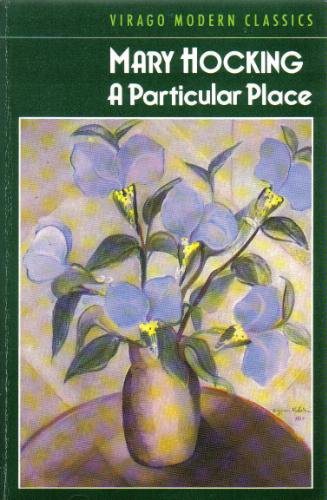
aparticular-place Mary HockingHocking’s A Particular Place is a sharp, almost perfect novel, with an ecclesiastical core.  It centers on a new Anglican vicar’s effect on the inhabitants of a small market town.  His impact is partly religious, but also, quite surprisingly, romantic. When  most of the characters meet at a candlelit Holy Saturday Vigil at St. HIlary’s, they are certainly not looking for love.

Charles, an agnostic, brittle, lonely teacher, is curious about the new vicar; sharp-tongued Hester, a children’s book writer who is  sympathetic to her imperfect neighbors though she prefers to be alone, attends because Michael is her nephew; Valentine, Michael’s wife, an ironic, whimsical beauty whose avocation is amateur theatricals, can think of places she’d rather be than St. Hilary’s; and Norah Kendall, an outspoken feminist nurse, is sincerely interested in the church, but perhaps attends also because her husband visits only on weekends and their marriage isn’t working out.

As the parishioners move from the graveyard up the stairs of the church, Norah falls.  The fall foreshadows a love affair and a tragedy.

Close by, with no warning, someone fell.  Charles Venables, stepping from his shelter, found himself a member of a concerned group.  The vicar hurried up.  ‘Oh dear, what have we, a casualty already?’  Irritation only just concealed at this disaster striking before the performance had got under way.

What happens when one falls in love?  Married love, new love, deliriously happy love, lost love, grief over being too old to love. Hocking explores all love.   As many of the characters come to terms with love, choosing to act or not to act on their feelings, their lives are characterized by happiness or grief.    At the center, Hocking’s novel is deeply moral.  None of these characters is truly malevolent; none sets out casually to destroy relationships.  It is a witty, sensitive, never mawkish, novel, the best I’ve read by Hocking.

Practical Glamour

It didn't quite work out for me like this!

It didn’t quite work out for me like this!

First, it was one of those days when nobody rode a bicycle.

Practical glamour on my birthday.  That is the rule.

My cousin and I hung out and beautified ourselves.

Although I have high self-esteem, I lost my looks years ago and don’t care much.  Shattered by a divorce in my late thirties, I faded. I had to go back into the workforce after years of freelancing.   I didn’t tell anyone at my new job that I was getting a divorce, because I was one of three women who worked there.  I was hired because I ran into somebody at a fiction reading.

I did good work, but was very, very tired.

Sadness, ruined skin from the sun:  so what?  The looks of the women in my family do not last.  I have a picture of my vain mother after her divorce.  She tried to keep everything going:  the hair, the smile, the confidence.  It is the saddest picture I have ever seen in my life.

I was grateful for Doris Lessing’s novel, The Summer Before the Dark, during my divorce. The heroine, Kate, has a breakdown after she is left by her family for a summer.  Her husband has an affair.  After working at a high-powered summer job, she gets sick and moves into an apartment with a young “hippie” woman, Maureen.  Kate has let her beautifully-dyed hair go and stopped eating.

Kate’s relationship with Maureen is not unlike mine with my cousin.

Maureen was looking frankly and critically at Kate.  She examined the mass of crinkling hair, with its wide grey band down the middle.  She looked at Kate’s dress, walking, or stepping, carefully around Kate to do so.  Then she said, ‘Wait’ and went off for a minute.  She came back with some dresses, and held them up one by one, frowning, in front of Kate.  The two women began to laugh:  the laugh built up so that the guitar player glanced up to see what was so funny.  As a skinny frilled dress stretched against Kate’s bones, she smiled briefly, and retired back into her music.

Kate doesn’t get a divorce:  she goes back home.  I remarried.

My cousin the librarian is very different from me.  She has never married, and she is not a feminist.  She cannot understand why I don’t wear makeup.  Her mother likes it; mine used to say it was “stupid.”  A dermatologist told me years ago not to wear makeup.

But my cousin was determined to smarten me up.  “We’ll make our own,” she said.

I was leery, but I said Okay. A mask of yogurt and oatmeal:  mix a cup of yogurt and a half cup of oatmeal and smear it on your face.   Keep it on for 15 minutes.  My skin DID feel refreshed.

We hung around with cucumber cream under our eyes and drank peppermint tea.

I told her about the novel I was reading,  Zola’s The Ladies’ Paradise, about a new Parisian department store in the 19th century that drives the small neighboring shops out of business. I could see myself going mad at the lace counter, rushing home to sew “blonde lace” onto dresses. Nobody buys lace anymore. When was the last sale on lace?

“Let’s go to a department store,” my cousin said.

“Where’s the lace?”  I asked her.

She bought me a nightgown.

I can’t wait to wear it while I stay up late and watch TV.

Then the makeup counter.  She loves the practical glamour of cosmetics and decided to check out moisturizers and eye creams. Most of them cost more than her clothing.

I tried on some cream that did amazingly smooth out my skin. But they didn’t want to rip us off, so they sold us another cheaper cream and some other makeup.

“If only I had a job at the department store…” my cousin fumed.

“You couldn’t live,” I said sensibly.

But of course she would love it.

I went home and put the makeup away and made dinner.  I’m sure I’ll forget about it, but it was nice of her to give me what every woman wants.

My birthday only comes once a year.

Gorp and Iced Tea Breakdown

Sorry, I had to save myself!

I had to save myself, needless to say.

My plan:  four miles. I walk four miles often.  It is nothing. Sometimes I take 30-mile bike rides.  I took a 40-mile ride last weekend.  Sometimes I crash in the middle of a ride and lie down on a picnic table.

But I don’t crash on walks.

After a couple of miles I felt dizzy, thirsty.  I did not have a bottle of water with me.

I walked.  I kept walking.  What on earth…?  It wasn’t that hot.   This had never happened to me.

Put your back into it, lass.

I really had to sit down.

I walked very, very slowly toward the church on the corner.  I sat on the steps.  I thought I might faint.  I put my head down.  I pep-talked myself.  If you just wait a few more minutes…then you’ll get up….  Then you’ll take a shortcut home.

Woman in a  gorp breakdown.

Woman in a gorp breakdown.

The shortest route home was a busy street. Go!  Do it!  It would take me past the health food store, where I would eat and drink and feel well again.

I walked very, very, very slowly. I passed a bar.  BEST NACHOS IN THE CITY, the sign said.  I considered buying a bag of chips, but that was not quite what I needed.

Okay, one block, two blocks, a long block…  At the health food store I bought gorp and a bottle of iced tea.  It was very expensive.   This is why I don’t buy health food.

Outside I sat down on the sidewalk. My hair was plastered down with sweat. My shirt was damp with sweat.  I pulled the iced tea bottle out of the bag and realized I LOOK LIKE A HOMELESS PERSON. I drank the tea.  I ate gorp like a starving person.  I began to feel myself renewing.

After 10 minutes I felt fine and walked home.  My glucose was back!  Or something.

I should have water and gorp with me at all times.